Is a developer hiring platform worth the investment? The short answer: it can be - if it saves time, improves hiring quality, and reduces costs. By calculating ROI, you can determine whether these tools align with your business goals. Here's what you need to know:
- Costs: Subscription fees, setup, training, and ongoing maintenance.
- Time Savings: Platforms can cut hiring timelines by 11+ days and save hours of recruiter and engineering time.
- Efficiency Gains: Automating tasks like screening and scheduling reduces recruiter workload, saving up to $121,000 annually per recruiter.
- Revenue Impact: Filling roles faster can recover $450–$900 in daily productivity per unfilled position.
- Better Hires: Improved matching leads to higher retention and fewer costly replacements.
For example, a 10-person recruiting team investing $65,000 in a platform could see a 686% ROI, earning $7 for every $1 spent. By tracking metrics like time-to-hire, cost-per-hire, and retention rates (using a developer hiring timeline planner can help track these benchmarks), you can build a solid business case for your CFO.
Bottom line: A developer hiring platform can transform your recruitment process into a measurable business advantage.
::: @figure 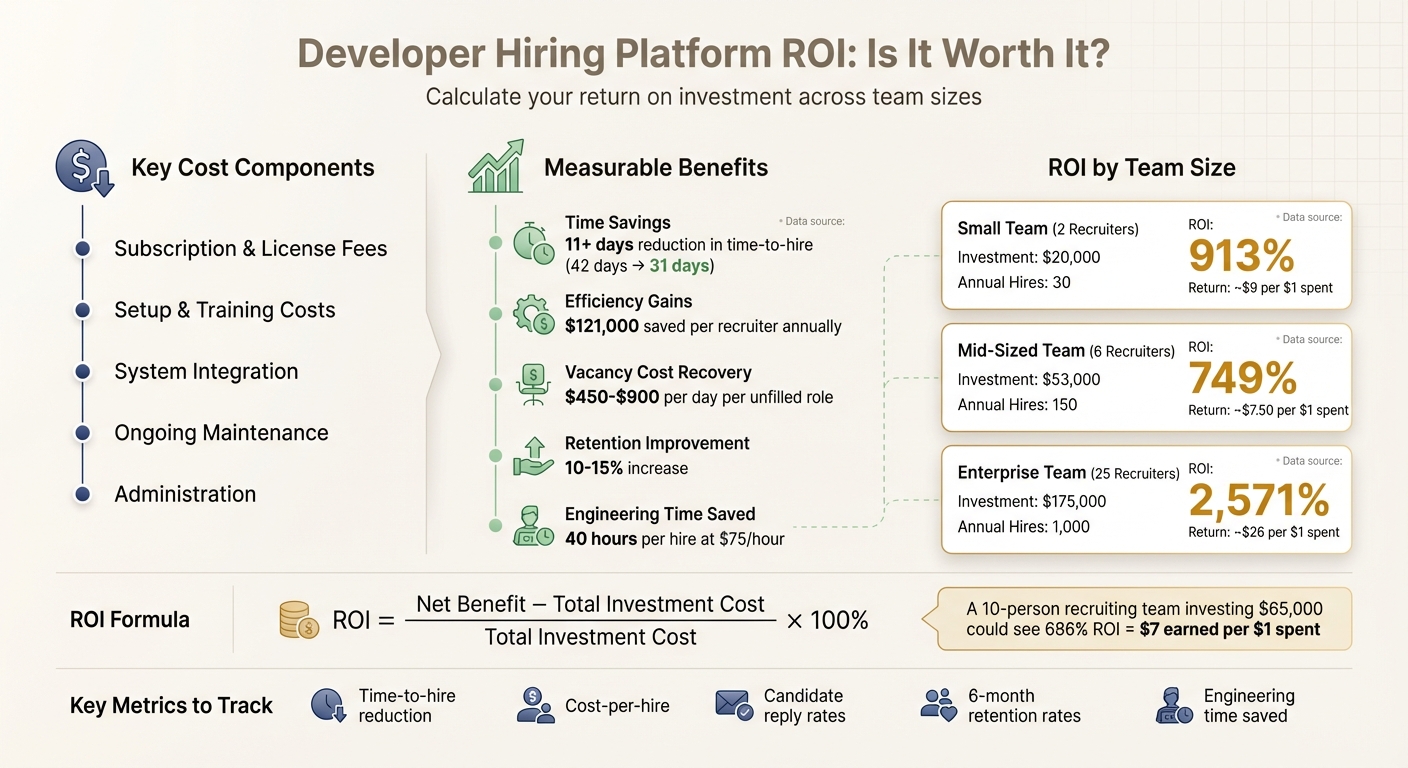 {Developer Hiring Platform ROI Calculator: Costs vs Benefits by Team Size}
Breaking Down Developer Hiring Platform Costs
Direct Costs: Subscription and License Fees
The main expense you’ll encounter is the subscription fee. Most developer hiring platforms follow pricing models that include per-seat fees, tiered enterprise packages, or annual licenses that secure pricing for a set period . Additionally, some platforms charge a per-hire fee, adding a cost for each successful placement. When estimating your budget, start with the base subscription and factor in the number of active users . Don’t forget to consider extra expenses like platform setup and training, which can add to the overall cost.
Indirect Costs: Setup, Training, and System Integration
Subscription fees are just one piece of the puzzle. You’ll also need to account for implementation costs, which include platform setup, workflow customization, and technical integration with tools like your Applicant Tracking System (ATS), communication platforms (e.g., Microsoft Teams), or background check services . Training your team is another key expense, involving workshops, documentation reviews, and hands-on practice sessions . Investing time and effort into these phases ensures a smoother rollout and helps your team make the most of the platform from day one.
Hidden Costs: Administration and Ongoing Maintenance
Once the platform is up and running, ongoing costs come into play. These include managing licenses, troubleshooting issues, applying updates, and handling daily maintenance tasks . Keeping an eye on active users versus licensed seats is crucial to avoid paying for unused access. Another way to manage costs is by consolidating multiple tools into a single, comprehensive platform by auditing your tech hiring stack. This approach can reduce integration challenges and simplify vendor management . To get a full picture of the platform’s value, weigh these ongoing costs against the time savings and efficiency gains your team achieves.
Calculating Time Savings and Efficiency Gains
Time Saved Across Recruiting Activities
Recruiting takes up a lot of time, especially in sourcing, screening, and communicating with candidates. On average, recruiters spend about 40 hours to make a single hire . Specialized developer hiring platforms can ease this workload by automating repetitive tasks like interview scheduling, sending follow-up reminders, and conducting initial screenings. Tools like conversational AI and one-way video interviews allow for asynchronous candidate evaluations, cutting down on the back-and-forth .
This efficiency shows up in your hiring timeline. For instance, AI-driven candidate discovery can reduce the median time-to-hire from 42 days to 31 days - a savings of 11 days . Take JYSK, a global retailer, as an example: they reduced their time-to-hire from 56 days to just 20 days with a specialized platform. Similarly, Catholic Healthcare improved six-month retention rates by 30% while trimming their hiring timeline by 9 days .
These time savings not only speed up hiring but also lighten the workload for recruiters.
Faster Hiring and Lower Recruiter Workload
Faster hiring has a direct financial impact. Unfilled technical roles can cost businesses between $450 and $900 per day in lost productivity . For example, the NFL cut its time-to-fill by 24% using AI-powered tools . Asbury Communities saw similar success, reducing their time-to-fill by 33%, from 46 days to 31 days . These improvements lead to immediate cost savings and allow recruiting teams to handle more job openings without becoming overwhelmed.
Specialized hiring platforms often deliver a 40–60% decrease in time-to-hire and improve interview efficiency by 50% . This means recruiters can focus more on high-value tasks, like building relationships with candidates, rather than getting bogged down in administrative work. Companies using advanced platforms report an average savings of $121,000 per recruiter annually .
These efficiency gains not only save time but also directly reduce costs, as the next section explains.
Converting Time Savings to Dollar Value
The time saved can be translated into clear monetary benefits. Here’s how: multiply the hours saved per day by the recruiter's hourly wage, then by the number of working days in a year, and finally by the number of recruiters on your team . For example, if a platform saves each recruiter 2 hours per day at a rate of $35 per hour, that’s $70 per day or roughly $18,200 per year per recruiter (based on 260 working days).
For revenue-generating roles, the calculation shifts slightly. Multiply the average daily revenue per employee (annual revenue divided by 365) by the days saved in the hiring process and the number of annual hires . A company with $150,000 annual revenue per employee (about $411 per day) that saves 11 days on 1,000 hires could gain approximately $4,251,000 in productivity . Additionally, monitoring advertising costs per applicant and conversion rates can help pinpoint which sourcing strategies yield the best returns .
Measuring Quality Improvements in Hiring
Beyond saving time, improving the quality of candidate engagement and retention is essential for getting the most out of your hiring platform.
Higher Candidate Reply Rates and Engagement
Modern platforms elevate outreach by turning it into meaningful conversations. Candidates confirm their interest before recruiters reach out, ensuring that every interaction starts with genuine intent. This approach addresses developers' dislike of generic spam by providing clarity on key details like the tech stack, salary, and work model upfront.
AI-powered semantic matching takes things further by understanding the context of skills, rather than just matching keywords. For instance, it can recognize how React experience aligns with Full-Stack roles, ensuring outreach is tailored to the candidate's actual expertise. Additionally, these platforms connect with passive talent where they are already active - on spaces like GitHub or daily.dev - rather than relying on outdated LinkedIn profiles. This is crucial because top tech talent is often available for just 10 days, and higher engagement minimizes wasted resources on unresponsive candidates.
This stronger engagement lays the foundation for better retention rates.
Better Retention and Lower Replacement Costs
Improved candidate matching directly leads to better retention. For example, Unilever achieved a 16% increase in new-hire retention after adopting AI-driven matching algorithms . Similar implementations have shown comparable results, which is significant when you consider that a bad hire can cost up to 30% of the first-year salary . For a senior engineer earning $120,000, that could mean a $36,000 loss.
AI-driven recruitment systems often deliver a 10–15% boost in employee retention by ensuring a better fit between candidates’ skills, company culture, and role requirements . These systems help prevent early attrition - hires who leave within their first 6–12 months. Tracking this metric can reveal whether your platform is delivering more than just faster hiring; it’s about quality too.
Improved Candidate Experience and Employer Brand
Beyond the numbers, the candidate experience plays a huge role in shaping your employer brand and cutting long-term hiring costs. For example, Sana Commerce raised its candidate Net Promoter Score (NPS) to over 90 within six months of using a specialized talent platform . Similarly, an e-commerce company increased its offer acceptance rate from 60% to 85% by enhancing candidate engagement and simplifying scheduling .
Interactive, conversational interviews also outperform traditional methods. They achieve an 80% candidate completion rate compared to less than 50% for standard coding tests. This leads to higher offer acceptance rates, more referrals, and a stronger employer brand . Regularly monitoring your candidate NPS can provide insights into how your hiring process impacts your brand, ultimately helping reduce sourcing and advertising costs over time.
These improvements in engagement, retention, and experience not only strengthen candidate matches but also directly contribute to ROI by lowering turnover and its associated expenses.
The ROI Calculation Formula
Understanding the ROI Formula
Building on the earlier analysis of costs and time savings, let’s dive into how to calculate ROI using a simple formula:
ROI = (Net Benefit − Total Investment Cost) / Total Investment Cost × 100%
Here’s how it works: Net Benefit includes all the positive outcomes - time savings, quality improvements, and revenue gains. Total Investment Cost covers everything you spend, such as subscription fees, setup, training, and maintenance. The result shows how much you earn for every dollar invested.
For instance, if your platform costs $50,000 annually and generates $150,000 in benefits, the ROI is 200%. In other words, you’re making $2 for every dollar spent. This clear metric is invaluable for CFOs and budget discussions.
Variables to Include in Your Calculation
To make your ROI calculation accurate, include all costs and benefits:
- Costs: This includes subscription fees, implementation, training, and administration. Be sure to use fully loaded rates (not just base salaries) to account for benefits and overhead .
- Efficiency Gains: Multiply the time saved per hire by your team’s fully loaded hourly rate.
- Revenue Gains: Calculate how much faster positions are filled and multiply that by your company’s daily revenue per employee. For example, if your company generates $150,000 annually per employee, that’s about $411 per day for every position filled faster .
- Quality Improvements: Factor in cost reductions from fewer replacements or better hires.
Also, adjust for actual usage - use the percentage of active users (e.g., 60%) in your calculations .
With these variables in mind, let’s look at a practical example.
Example: ROI Calculation for a 10-Person Recruiting Team
Imagine a 10-person recruiting team, each with a fully loaded cost of $80,000 annually ($40 per hour). They’re evaluating a platform that costs $60,000 per year, with an additional $5,000 for setup and training. That’s a total first-year investment of $65,000.
Now for the benefits: The platform reduces the median time-to-hire from 42 days to 31 days - a savings of 11 days . With 100 hires annually and a daily revenue per employee of $411, this generates $451,100 in revenue gains (11 days × $411 × 100 hires). Additionally, the platform saves 15 hours per hire through better candidate matching and automation. At $40 per hour, that’s $600 saved per hire, or $60,000 annually across 100 hires.
Adding it all up, the Net Benefit is $511,100 ($451,100 in revenue gains + $60,000 in efficiency gains). Using the ROI formula:
($511,100 − $65,000) / $65,000 × 100% ≈ 686% ROI
This translates to nearly $7 earned for every dollar spent, making it a strong argument for budget approval.
ROI Examples by Team Size
The following examples break down how ROI can differ based on team size, using a structured framework to highlight the potential financial benefits.
Small Team ROI Example
Imagine a startup with two recruiters tasked with hiring 30 developers each year. Each recruiter has a fully loaded annual cost of about $75,000 (roughly $37.50 per hour). The developer hiring platform costs $18,000 per year, plus a $2,000 setup fee, making the total first-year investment $20,000. This includes subscription fees, implementation costs, and efficiency improvements from quicker hiring and better candidate quality.
One major advantage is reducing vacancy costs. Leaving a senior software engineer role unfilled can cost between $450 and $900 per day in lost productivity. If the platform reduces the time-to-hire from 45 days to 30 days - a 15-day reduction - the savings per hire range from $6,750 to $13,500 in vacancy costs. Multiply that by 30 hires, and the total recovered productivity is between $202,500 and $405,000. Using the lower end of this range, the ROI calculation looks like this:
(($202,500 − $20,000) / $20,000) × 100% ≈ 913% ROI.
As team sizes increase, the benefits of the platform scale even further, as seen in the mid-sized team example below.
Mid-Sized Team ROI Example
Now, consider a tech company with six recruiters hiring 150 developers annually. Each recruiter costs $80,000 fully loaded (about $40 per hour). The platform costs $45,000 annually, with an additional $8,000 for setup, making the total first-year cost $53,000. This includes subscription fees, implementation costs, and the efficiency gains from faster hiring and better candidate quality.
By optimizing technical screening, the platform can save about 40 hours of engineering time per hire. At an average engineering rate of $75 per hour, this equates to savings of $3,000 per hire - or $450,000 across 150 hires.
This efficiency gain alone results in an ROI of approximately 749%.
Beyond time savings, the platform enhances recruiter capacity and candidate quality, driving even greater value. For large organizations, these benefits grow exponentially, as shown in the enterprise example.
Enterprise Team ROI Example
For larger enterprises, consider a company with 25 recruiters managing 1,000 developer hires annually. The platform costs $150,000 per year, with $25,000 allocated for training and integration, bringing the total first-year investment to $175,000. This includes subscription fees, implementation costs, and efficiency improvements from quicker hiring and better retention.
Case studies show the platform can reduce time-to-hire by up to 36 days and improve six-month retention rates by 30%.
For an enterprise hiring 1,000 employees annually, with an average revenue per employee of $150,000, reducing time-to-hire by just 11 days could generate $4,251,000 in additional revenue gains. Furthermore, a 30% boost in retention could lower replacement costs by $423,000 (based on 30% of a $4,700 average hiring cost for roughly 300 additional retained hires).
When combined, these benefits total approximately $4,674,000. The ROI is calculated as:
(($4,674,000 − $175,000) / $175,000) × 100% ≈ 2,571% ROI.
"We believe these three pillars [Technology, Efficiency, Revenue] are stepping stones to better business outcomes" .
Conclusion: Making the Business Case for a Hiring Platform
This framework provides a clear, data-focused way to evaluate the return on investment (ROI) of a developer hiring platform. It breaks down the benefits into measurable outcomes, such as time savings, reduced vacancy costs, and better retention, making it applicable for teams of all sizes.
To build a compelling case, focus on results that matter to your stakeholders. For example, CFOs prioritize tangible ROI and payback periods, while engineering leaders value reclaimed interview time. Use actual numbers from your current hiring process to strengthen your argument.
Consider this: leaving a technical role unfilled can cost $450–$900 per day, and a bad hire might cost up to 30% of the hire's first-year salary. Inaction isn’t just a missed opportunity - it’s a direct hit to your bottom line. Framing the decision as a choice between action and inaction shifts the perspective, making the platform an investment in protecting revenue and staying competitive .
To ensure your investment continues to pay off, track key performance indicators (KPIs) that reflect these benefits.
Metrics to Track for Ongoing ROI Monitoring
After implementing a hiring platform, focus on metrics that illustrate its broader business impact - not just activity counts. Leadership wants to see how the platform contributes to the company’s goals, not just how many resumes it processes .
Some key metrics to monitor include:
- Time-to-hire reduction: Measure the average days from job posting to offer acceptance and compare it to your pre-platform baseline.
- Cost-per-hire: Calculate this by dividing total recruiting expenses by the number of hires.
- Candidate reply rates: Use this to gauge the quality of engagement.
- Six-month retention rates: Better candidate matching should lower early attrition, signaling improved hire quality.
- Engineering time saved: Track how many interview hours your technical team reclaims when the platform handles initial screenings.
These metrics align with your earlier ROI calculations, reinforcing the case for the platform and its value over time.
Next Steps to Start Your ROI Analysis
To kick off your analysis, begin by benchmarking your current hiring process. Document why developers ignore recruiters, recruiter hours, interview time, and agency spend to create a baseline. Use a spreadsheet to track data like role, hiring time, total interview hours, recruiter hours, and productivity loss due to vacancies. Reviewing your last 20 hires will give you a solid foundation for reliable averages .
When modeling potential benefits, use conservative estimates. For instance, if industry benchmarks suggest a 30% reduction in time-to-hire, present a 20% improvement to show you’ve accounted for risks. Always present savings as ranges instead of fixed numbers to reflect potential variability .
Lastly, quantify retention and candidate experience improvements. For example, if the platform increases retention by 10% across 50 hires, calculate the savings from avoiding five replacements, each costing roughly 30% of their annual salary. This approach turns abstract benefits into concrete financial terms that decision-makers can evaluate .
FAQs
What numbers do I need to calculate ROI for a developer hiring platform?
To figure out the ROI of a developer hiring platform, you'll need to gather a few key numbers: total hiring costs (both internal and external), time savings, improvements in hire quality, and the number of hires made. These data points allow you to calculate metrics like Cost-Per-Hire and overall ROI. With these insights, you can evaluate the platform’s worth and make a solid case for the investment.
How do I put a dollar value on faster time-to-hire?
To figure out the dollar value of speeding up your hiring process, start by calculating the savings from reduced hiring time and boosted productivity. Take the number of hours saved and multiply it by the average hourly rate of your engineers or other relevant team members. This approach converts time saved into direct financial gains, making it easier to justify investing in a developer hiring platform by demonstrating how it speeds up recruitment and cuts related costs.
How can I quantify better hire quality and retention in ROI?
To measure the impact of better hire quality and retention on ROI, focus on tracking key metrics such as new hire performance, integration success, and retention rates. When these areas improve, they help cut down turnover costs and enhance productivity, both of which directly influence ROI. Employees who are a better fit tend to stay longer and deliver stronger results, increasing the overall value they bring to the organization.
.png)