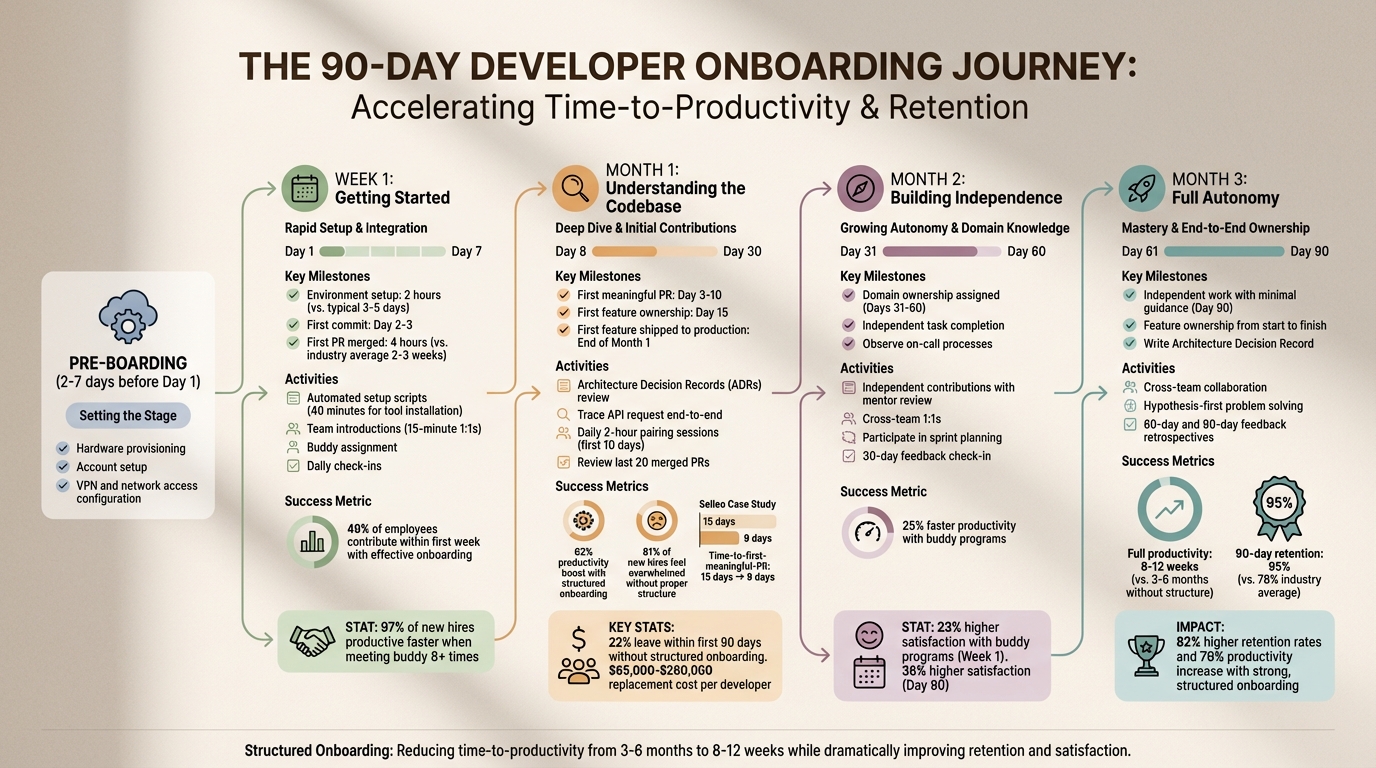
Onboarding developers effectively is critical for retention and productivity. Without a structured process, 22% of developers leave within their first 90 days, costing companies $65,000–$260,000 in replacement expenses. However, companies with strong onboarding practices see 82% higher retention rates and faster time-to-productivity, often within 8–12 weeks compared to the typical 3–6 months.
Key strategies include:
- Pre-boarding: Set up hardware, accounts, and development environments before Day 1. This transition is smoother when you've already optimized the candidate experience during the hiring phase.
- First Week Focus: Automate setup, assign a buddy, and prioritize team introductions over immediate output.
- Milestones: Aim for the first commit within 2–3 days, a small feature shipped by Month 1, and independent work by Month 3.
- Documentation: Provide clear, up-to-date technical guides, architecture diagrams, and troubleshooting resources.
- Feedback Loops: Conduct check-ins at 30, 60, and 90 days to refine the process and address gaps.
Tracking metrics like time-to-first-commit, new hire Net Promoter Score (NPS), and 90-day retention rates helps measure success and identify areas for improvement. Investing in onboarding not only reduces turnover but also accelerates developer contributions, ensuring long-term team success.
Week 1: Getting Started
The first week is all about setting the stage. Your new developer is evaluating their decision to join, and a well-structured onboarding process can make all the difference. In fact, 49% of employees contribute to their team within the first week when onboarding is handled effectively. Instead of pushing for instant productivity, focus on creating a sense of belonging and clearing the path for their first meaningful contribution.
Environment Setup
Nothing kills momentum faster than a broken development environment on Day 1. Onboarding done right can cut the setup time from the usual 3–5 days to just 2 hours. The trick? Automation and preparation.
Start pre-boarding 2–7 days before their first day. This includes provisioning hardware, setting up accounts, and configuring VPN and network access so the new hire can log in and get started immediately.
Use automation scripts to handle the majority of the environment setup. Tools like shell scripts or package managers (e.g., Homebrew, NVM) can install everything from language runtimes and IDEs to Docker and other essential tools. Walk them through cloning repositories, configuring their environment, seeding test data, and launching local servers.
Take inspiration from Ran Bar-Zik, Senior Software Architect at CyberArk, who successfully merged his first pull request on Day 1 in August 2022. His success was due to having hardware and credentials ready in just two hours, an automated bash script completing tool installation in 40 minutes, and a pre-selected "good first issue" focused on the installation script itself.
"There's little more disappointing and disempowering than to excitedly begin your job and then get stalled because you can't get your local development environment working."
– James Turnbull, VP of Engineering
Before moving forward, confirm that all existing tests pass locally. Equip the new hire with a troubleshooting guide to address common issues like port conflicts or missing dependencies. This minimizes disruptions and allows them to solve problems independently.
Once the technical setup is squared away, shift the focus to helping the new hire connect with their team.
Team Introductions
Technical skills aside, building relationships early on is just as important. In fact, new hires paired with buddies are 23% more satisfied with their onboarding experience after the first week. The initial days should prioritize connections over immediate output.
Plan short one-on-one meetings (about 15 minutes each) between the new hire and team members, as well as key stakeholders. These informal chats help clarify roles, workflows, and where to go for help. Since 33% of new hires prefer guidance from their direct manager over HR, make sure the manager leads this process.
Provide a team glossary to decode internal jargon, acronyms, and essential tech terms. This can help the new hire understand terms like "the monolith", "the data pipeline", or "the legacy system", reducing confusion.
Assign a peer buddy who can answer questions without judgment and check in daily during the first week. Managers should also schedule brief daily touchpoints to ensure everything stays on track.
"I think that expectations in the beginning need to be low because new hires are in the learning phase. This should also be communicated so new developers don't feel pressured."
– Ruben Grill, Lead Backend Developer, TeleClinic
First PR Merged
Once the technical groundwork is laid, early contributions help build confidence and foster collaboration. Even a small task can affirm the new hire’s place on the team and lay the groundwork for future projects.
Although the industry average for "Time to First Commit" is 2–3 weeks, a structured onboarding process can reduce this to just 4 hours.
Prepare a simple first task - like fixing a typo in documentation or resolving a minor bug - that can be completed in under an hour. This task should introduce the new hire to the team’s Git flow, pull request process, and code review practices without diving into complex logic or unfamiliar frameworks.
"The ideal first task is a medium sized method, with a unit test that needs a behavior change. I typically don't dive into HubSpot stuff until they're ready."
– Jeff Dwyer, Tech Lead, HubSpot
Test the task yourself to ensure there are no hidden blockers or missing dependencies. Pair programming for the first pull request can also be beneficial, as it introduces the new developer to your team’s branching strategy, code review norms, and CI/CD pipeline.
For example, in 2024, a client of Full Scale, a software firm, slashed their onboarding time from 6 weeks to 10 days by following a detailed 90-day plan. Their approach included a first code commit by Day 3 and a first feature merge to production by Day 15, leading to a 40% improvement in code quality.
Month 1: Understanding the Codebase
Month 1 is all about getting comfortable with the codebase. The main goal? Building a solid mental model of how the system works - where everything is located and why certain architectural decisions were made. A structured onboarding process can boost productivity by 62% .
Codebase Familiarity
A common mistake during onboarding is dumping too much information on new hires all at once. In fact, 81% of new hires report feeling overwhelmed during the onboarding process . Instead, focus on introducing information progressively, as it's needed.
Start with Architecture Decision Records (ADRs). These plain-text documents, stored in the repository, explain the reasoning behind major technical choices. They capture trade-offs and rationale that you won’t find in code comments . Combine this with tools like CodeTours for in-IDE walkthroughs, which guide developers through the codebase without requiring constant interruptions from senior engineers.
"If a new hire needs a human to find 'where things are,' the system is missing maps, owners, or golden paths."
– Selleo
To help new hires quickly understand the system, have them trace an API request from start to finish. This exercise builds a working model of the system. Encourage them to review the last 20 merged pull requests to get a sense of coding standards, review culture, and which areas of the codebase are actively changing .
In 2024, the software development company Selleo managed to reduce the time-to-first-meaningful-PR from 15 days to just 9 days. They achieved this by introducing tools like a "first-PR playbook" and a "quick wins library." They also cut the time-to-local-run from 180 minutes to 60 minutes by using one-command setup scripts .
To make learning more efficient, use high-level context diagrams and recorded architecture walkthroughs. This allows new hires to learn asynchronously, reducing the need for repetitive questions. Once they’ve absorbed these basics, collaborative pairing sessions can deepen their understanding and solidify their knowledge.
Pairing Sessions
Pairing sessions are invaluable for sharing knowledge that isn’t captured in documentation - things like architectural reasoning, naming conventions, and the team’s quality standards . Research shows that new hires with an onboarding buddy become productive 25% faster. In fact, a Microsoft study revealed that 97% of new hires who met with their buddy more than eight times in the first 90 days reported increased productivity .
For the first 10 days, schedule daily two-hour pairing sessions focused on real sprint tasks. Using the driver–navigator model and rotating pairs frequently helps prevent knowledge silos and exposes the new hire to different coding styles . Before they submit their own pull request, have them shadow a few code reviews to understand the team’s feedback process and quality expectations. For remote teams, tools like VS Code Live Share or Tuple can make pairing sessions seamless.
"The fastest ramp-up comes from deleting repeated questions, not from adding more meetings."
– Sebastian Kardyś, Head of Marketing, Selleo
Some remote teams also assign a dual-buddy system, pairing the new hire with both a technical mentor for code-related questions and a culture buddy to help navigate company norms and social dynamics .
First Feature Shipped
By the end of Month 1, the new hire should have shipped a small, well-defined feature to production. This milestone is crucial - it builds confidence and reinforces what they’ve learned. While the industry average for developers to reach full productivity is 3–6 months, a well-structured onboarding process can reduce this to just 3–4 weeks .
Choose a feature that isn’t high-risk but still touches multiple parts of the codebase, giving the new hire broad exposure . Before coding, they should write a technical approach document to ensure they’ve considered dependencies and edge cases .
The goal is to have their first feature pull request approved in fewer than three review cycles. If it takes longer, it might indicate the task was too complex or that the documentation could use improvement.
| Milestone | Target Day | Success Indicator |
|---|---|---|
| First Commit | Day 2–3 | Code passes CI/CD and is merged |
| First Meaningful PR | Day 3–10 | Changes behavior or reduces risk |
| First Feature Ownership | Day 15 | Small feature merged to production |
"Confusion is temporary. Competence is built."
– Daniil Kornilov, Indie Maker and Career Guide Author
As the new hire progresses, encourage them to document their learning journey. Whether it’s updating outdated READMEs or clarifying environment variables, their contributions will improve the onboarding process for future team members.
Months 2-3: Moving to Independent Work
By the second month, the focus shifts from guided tasks to independent work. By day 90, the goal is for the new hire to work independently - identifying, scoping, and completing tasks with little guidance .
Independent Contributions
Between days 31 and 60, assign the new hire a specific domain or vertical to own . This means they’ll start handling tasks independently and making thoughtful technical decisions . At this stage, the mentor’s role evolves from hands-on assistance to reviewing decisions and focusing on the reasoning behind them rather than the execution .
Provide examples of strong pull requests as models for their independent work . Begin integrating them into the operational side by letting them observe on-call processes. This step gives them insight into system interactions and incident resolution without the pressure of being directly responsible .
"By day 90, you shouldn't just be ramped up. You should have a point of view."
– Pradnya Shelar, Engineering Manager
This phase of independence also sets the stage for broader engagement within the organization.
Cross-Team Collaboration
As their technical confidence grows, it’s time to encourage relationship-building across teams. Schedule introductory 1:1s with key stakeholders, such as product managers and engineers from adjacent teams . Provide owner maps that clearly outline who is responsible for specific services or domains. This reduces the friction of figuring out who to approach for cross-team questions .
Assign tasks that require them to take ownership of a feature from start to finish, naturally encouraging collaboration with other teams for approvals and integrations . Encourage participation in sprint planning or demos from adjacent teams to familiarize them with other teams’ workflows and priorities . Additionally, introduce them to the key experts for critical systems outside their immediate team .
Feedback Loops
Conduct retrospectives at 30, 60, and 90 days to gather feedback, address any confusion, and assess how supported they feel . Ask targeted questions, such as:
- What was unclear or missing?
- What could have helped you ramp up faster?
- On a scale of 1–10, how supported do you feel? .
| Timeframe | Goal | Deliverable | Metric (Target) |
|---|---|---|---|
| Day 30 | Safe Contribution | First meaningful PR merged; review cadence set | Time-to-first-meaningful-PR |
| Day 60 | Domain & Ops Context | Owner map; request lifecycle walkthrough; observe on-call | Fewer repeated questions in check-ins |
| Day 90 | Full Autonomy | Independent delivery of a small scope area; feature ownership | Stable DORA lead time trend |
Encourage new hires to frame their questions in a "hypothesis-first" approach, such as: "I looked at A and B, and my hypothesis is C." This demonstrates an active problem-solving mindset as they transition into independent work . By the third month, assign them to write an Architecture Decision Record (ADR) or refine existing documentation. Their fresh perspective is invaluable for spotting gaps in shared knowledge .
"A new hire is productive when outcome metrics show they can ship a safe change, not when they look busy."
– Selleo
Onboarding Buddy Programs
An onboarding buddy is a peer - not a manager - assigned to help a new developer navigate their first 90 days. Unlike formal mentorship, this setup offers a comfortable space for asking basic questions. Buddies assist with technical tasks like setting up the development environment and understanding the codebase, while also sharing team norms and practices. This relationship is structured with clear roles and regular check-ins, which are outlined in the next section.
The impact of these programs is clear. Microsoft's internal research found that 97% of new hires who met with their buddy more than eight times in their first 90 days became productive more quickly. Those with buddies also reported 23% higher satisfaction after their first week and 36% greater satisfaction by the 90-day mark. Companies that use structured buddy programs have seen 82% higher retention rates among new hires, with engineers reaching full productivity 25% faster compared to those without a buddy .
Structure and Responsibilities
The best buddies are experienced team members who have been with the company for at least six months, communicate effectively, and are open to helping others. Some teams use a dual-buddy model, pairing a technical mentor for architecture-related questions with a culture buddy to help navigate social dynamics. Typically, the buddy relationship lasts six to eight weeks, giving the new hire enough time to build connections and work independently.
During Week 1, buddies should dedicate two to three hours per day to the new hire, scaling back to one to two hours in Week 2, and about 30 minutes a day by Month 2. To avoid overloading buddies, managers might reduce their sprint workload by 10–20% during the first month. A recommended meeting schedule includes daily 15-minute check-ins during Week 1, every other day in Week 2, and weekly meetings through the second month. This schedule supports the program’s goal of speeding up productivity and improving retention.
"The buddy is not a manager and not a formal mentor; they are a peer who makes the new hire feel welcome and ensures they are never stuck without knowing who to ask."
– Engineering Manager Tools
Benefits of Buddy Programs
Beyond helping new hires get up to speed, buddy programs address the challenge of "tribal knowledge" - those undocumented decisions and historical insights that can easily get lost. For instance, Zapier’s "Zap Pals" program led to a 70% drop in employee turnover within the first 90 days and a 65% boost in new hire productivity . Similarly, Netflix’s "Peers" program connects new hires with colleagues in similar roles, easing first-day nerves and building confidence during onboarding.
Buddy programs also encourage updates to onboarding materials. When outdated instructions are discovered, both the new hire and their buddy should revise resources like the onboarding README to fill in missing details. For remote teams, buddies are especially important in preventing isolation. Video coffee chats and screen-shared pairing sessions can help recreate the sense of connection found in face-to-face interactions.
Technical Onboarding Documentation
Good documentation can make all the difference when it comes to onboarding new developers. With clear, accessible guides, a developer could be shipping their first pull request (PR) in just a few days instead of weeks. Without it, new hires often waste hours troubleshooting setup errors, chasing down undocumented processes, or asking senior engineers the same questions repeatedly. Take Selleo, for example - they significantly reduced the time-to-first-meaningful-PR and time-to-local-run by introducing a first-PR playbook and a one-command setup process . These practices streamlined their onboarding process, making it easier for new engineers to contribute quickly and effectively.
One approach that stands out is the "docs-as-code" method. This involves storing documentation in the same repository as the code itself. The benefit? When engineers update features, they can also update the related documentation in the same PR. Another valuable tool is Architecture Decision Records (ADRs), which don’t just explain what decisions were made but also why they were made. This context is especially helpful for new hires trying to understand past technical choices.
Preparing Before Day 1
First impressions matter. A developer's perception of your engineering culture starts forming within hours of their first day. If they spend that time waiting for access credentials or trying to decipher outdated setup instructions, you risk losing momentum - and potentially their confidence in the team. Clear, reliable documentation on Day 1 sets the tone for a smooth onboarding experience.
To ensure new hires hit the ground running, provide a one-command setup script or a devcontainer. These tools minimize manual configuration errors and make the setup process nearly foolproof. For even less friction, cloud-based environments like GitHub Codespaces can handle the entire local setup. A verify-setup.sh script is also a great addition - it checks for required dependencies like Node, Docker, and API access, and gives immediate feedback when everything is ready to go .
Here’s what the essential Day 1 package should include:
- A one-command setup script or devcontainer
- System architecture diagrams and a codebase map
- Communication norms and technical processes (e.g., branching strategies, pull request reviews, CI/CD pipelines)
- Security and access guidelines (MFA, SSO, secrets management)
To avoid overwhelming new hires, organize documentation by timeline - what they need on Day 1, during Week 1, and by Month 1 . Additionally, offering a "Quick Wins" library or a set of well-scoped "Good First Issues" gives new developers a chance to tackle low-risk tasks while learning the ropes.
Keeping Documentation Current
Even the best documentation can quickly become outdated if it’s not regularly maintained. That’s why it’s crucial to keep materials fresh and relevant. One effective strategy is assigning new hires the task of updating documentation during their first two weeks. This not only helps them spot gaps or outdated content but also captures their fresh perspective before they fully integrate into the team.
Encourage new hires to submit pull requests whenever they encounter outdated instructions or missing troubleshooting steps. This approach - sometimes called the "new hire ownership" model - ensures that tribal knowledge is documented and that onboarding materials stay accurate. Some teams also set up feedback loops at 7, 30, 60, and 90 days to identify recurring pain points .
To avoid duplicating effort, link directly to official sources for tools and processes. For example, instead of copying installation steps that might change with every release, simply point to the official documentation. Similarly, use dynamic diagram tools to keep architecture visuals up-to-date .
A quarterly review of all onboarding materials can help ensure they align with current team practices. Adding an "Edit this Page" button that links to the documentation’s source file makes quick fixes even easier. As OneUptime Engineering puts it:
"Outdated docs are worse than no docs" .
Keeping documentation accurate and relevant not only helps new hires but also strengthens the overall onboarding process for your team.
Remote Onboarding: Challenges and Solutions
Remote onboarding comes with its own hurdles, both cultural and technical. For instance, 60% of remote hires report feeling adrift during their first few weeks, and 41% struggle with a sense of disconnection due to the absence of spontaneous "watercooler" chats . Additionally, remote environments often lack immediate hands-on support for troubleshooting, which can compound early frustrations. Alarmingly, 63% of remote workers feel inadequately trained during onboarding . Tackling these challenges early can lead to an 82% improvement in retention rates and a productivity boost of over 60% .
Building Connection Remotely
Creating connections in a remote setting requires intentionality. Start even before the official first day by sending a physical welcome kit that includes company swag and a handwritten note. This small gesture helps reduce the anxiety of starting a new role and signals that the company is genuinely invested in the new hire’s success .
Once onboarding begins, structured virtual interactions can help bridge the gap left by the lack of in-person encounters. Tools like Donut can automate casual coffee chats, while video meetings during the first month allow new hires to connect faces with names and pick up on social cues. Other strategies include creating Slack channels centered on hobbies or interests and hosting "show and tell" sessions where team members share personal projects.
Involving senior leadership in a "Mission Deep Dive" session can also be impactful. This helps new hires see how their role aligns with the company’s broader goals. As Isabelle Fahey, Head of Growth at CloudDevs, aptly puts it:
"Onboarding isn't about IT setup and HR forms. It's about cultural immersion and building real human connections."
Clear Communication Practices
With remote work, clarity in communication is non-negotiable. New hires need to know when to expect responses to avoid delays or interruptions. Set clear guidelines, such as aiming for a 30-minute response time for technical blockers, 24 hours for code reviews, and 48 hours for architecture proposals .
| Situation | Communication Mode | Expected Response Time |
|---|---|---|
| Production Outage | Synchronous (Phone/Video) | Immediate |
| Technical Blockers | Synchronous (Slack Huddle) | Within 30 minutes |
| Code Review | Asynchronous (GitHub/GitLab) | Within 24 hours |
| Architecture Proposal | Asynchronous (RFC Document) | Within 48 hours |
| General Questions | Asynchronous (Slack/Email) | Within 48 hours |
These response times should work hand-in-hand with both synchronous and asynchronous communication. For teams in different time zones, establish "core overlap hours" (e.g., 2:00–5:00 PM UTC) for live collaboration . Outside these hours, asynchronous tools like Loom can help explain workflows or bugs without requiring immediate interaction .
Virtual Shadowing
To replicate the learning that happens through observation in traditional office settings, remote teams need to be proactive. Virtual shadowing allows new hires to watch senior team members tackle real-world challenges. Pair programming during the first two weeks and shadowing an on-call shift within the first six weeks can provide invaluable insights into how incidents are managed and resolved .
Recording architecture walkthroughs and debugging sessions builds a video library that new hires can revisit as needed . Additionally, screen-sharing during code reviews offers context beyond what changed - it explains why those changes were made.
Gabriel Paunescu, CEO of Naologic, highlights the importance of this approach:
"We assign new devs difficult tasks because we want them to explore, get stuck, and ask questions to their colleagues until they get it right. This will make them more comfortable when asking questions at work."
Ensuring that new hires feel supported is key. Vindya Dassanayake, Software Development Team Lead at UCL, underscores this point:
"The important thing is to never leave someone on their own. There should always be a mentor who sends new hires the necessary documentation, tells them what to do, and checks in with them at the end of the day."
Measuring Onboarding Success
After implementing strategies for technical and remote onboarding, the next step is to evaluate their effectiveness. Measurement is essential for identifying what works and what doesn’t. Without tracking the right data, you risk wasting time and money. The top engineering teams focus on three key metrics: time-to-first-commit, new hire NPS, and 90-day retention rates. Each of these highlights a different dimension of onboarding, from technical readiness to how well new hires integrate into the team.
Time-to-First-Commit
This metric shows how quickly a new developer can adapt to your tools, workflows, and environment. Leading teams aim for a first commit within two days. It doesn’t have to be a major contribution - something as simple as fixing a typo or updating documentation works. The goal is to test the entire pull request-to-deployment cycle and uncover any roadblocks, like access issues or setup delays .
For a more meaningful milestone, aim for the first independent pull request within two weeks . Without structured onboarding, developers often take three to six months to reach full productivity. However, with well-designed onboarding, this timeframe shrinks to 8–12 weeks . The financial benefits are clear: reducing ramp-up time by two months for a developer earning $130,000 annually can save around $22,000 in salary costs .
"Time to productivity is the core metric. Without structured onboarding, new developers take 3 to 6 months to reach full productivity. With good onboarding, that drops to 8 to 12 weeks."
New Hire NPS
Net Promoter Score (NPS) surveys at 30, 60, and 90 days provide insights into how new hires feel about their onboarding experience . The primary question is: “Would you recommend [Company] as a great place to work?” To get deeper insights, add open-ended questions. For example, at day 30, ask if the role aligns with what was promised during recruitment. At day 60, check if they understand what they still need to learn. By day 90, confirm whether they see how their work ties into the company’s goals .
Ruben Grill, Lead Backend Developer at TeleClinic, highlights the value of this feedback:
"I really appreciate that kind of feedback because even small details can make a difference. Small details are typically not shared without surveys either because people only think about them when they're asked to reflect on the process, or because most people don't want to report minor problems when not asked for it."
Low NPS scores in the first 45 to 90 days can signal potential turnover, which can cost anywhere from 50% to 200% of a developer’s annual salary . On the flip side, exceptional onboarding makes employees 2.6 times more likely to feel extremely satisfied with their workplace . This feedback not only identifies immediate issues but also helps shape strategies for better retention.
90-Day Retention Rates
The first 90 days are crucial for new hires. During this time, they often decide if the role meets their expectations. With early turnover rates averaging 22%, tracking retention during this window is vital . High turnover often points to problems with social integration or unclear roles. Companies with strong onboarding processes see dramatic results - new hire retention improves by 82%, and productivity increases by 70% .
Compare your 90-day retention rates to your goals. A structured onboarding process can lead to a 95% retention rate, well above the industry average of 80% . If senior engineers are taking longer than 12 weeks to reach productivity, it’s a sign that your onboarding process may need adjustments . Formal retrospectives at 30, 60, and 90 days can provide valuable feedback to refine your approach .
These metrics provide a clear picture of whether your onboarding efforts - from technical setup to mentoring programs - are setting your team up for long-term success.
How daily.dev Recruiter Reduces Onboarding Friction
Onboarding challenges often begin even before the first day - stemming from hiring mismatches. When developers join teams that don't align with their technical values or work styles, it can lead to disengagement or early turnover . Beyond that, a poor fit can introduce risks, like security vulnerabilities, if new hires aren't familiar with key standards .
The key to smoother onboarding? Tackling mismatches early. daily.dev Recruiter ensures mutual compatibility right from the start. By facilitating warm, double opt-in introductions, candidates gain a clear understanding of your team's environment before they even begin. This trust-focused process reduces redundant screening and sets clear expectations upfront.
The platform also emphasizes developer-friendly job descriptions and precise role targeting. This reduces what’s often called the "roadmap tax" - those constant interruptions caused by unclear role definitions . With a clear understanding of their responsibilities, new hires can focus on meaningful contributions instead of spending time on basic clarifications.
Studies highlight the importance of hiring "humble and open-minded" developers for maintaining long-term software quality . daily.dev Recruiter’s network-driven approach naturally connects you with developers who are actively learning and engaging with others in the community. These traits - valuing growth and collaboration - are essential for smoother onboarding and long-term retention. This method not only supports better onboarding metrics but also strengthens overall team retention.
Conclusion
A well-structured onboarding process isn't just a nice-to-have - it’s a proven way to improve retention and productivity. Companies with strong onboarding practices report an 82% increase in new hire retention and a 70% boost in productivity . Considering that replacing a developer can cost anywhere from 50% to 200% of their annual salary, a carefully planned 90-day onboarding strategy quickly becomes a smart investment .
Key milestones can transform the onboarding experience. Aim to have developers commit code within their first two days, ship a feature by the end of the first month, and work independently by the third month . Support this with buddy programs, well-maintained documentation, and feedback checkpoints at 30, 60, and 90 days. These steps help remove friction and build momentum .
To measure success, focus on metrics like time-to-first-commit, new hire Net Promoter Score (NPS), and 90-day retention rates. Tracking these indicators helps identify and fix bottlenecks in the process . As Sahil Singh from DEV Community insightfully stated:
"If your senior engineers are taking 12+ weeks to become productive, the problem isn't them. It's the environment. Fix the environment, and every future hire benefits" .
daily.dev Recruiter takes this a step further by ensuring developers and teams are a mutual match from the start. Through warm, double opt-in introductions, developers join teams that align with their technical values and work styles, minimizing mismatches that often lead to early turnover .
FAQs
What should I include in a 90-day developer onboarding plan?
A solid 90-day developer onboarding plan typically unfolds in three phases: orientation, contribution, and independence.
Week 1: This is all about getting started. Developers set up their environment, meet the team, and complete their first pull request. It’s a chance to ease into the workflow and build confidence early on.
Month 1: The focus here shifts to deeper engagement with the codebase. New hires participate in pairing sessions and work on shipping their first feature. This phase helps them understand the team’s processes and how their work fits into the bigger picture.
Months 2-3: The final phase emphasizes independent contributions. Developers begin collaborating across teams and receive feedback to refine their skills and grow within their role.
To make the process even smoother, consider adding a buddy program for guidance, providing detailed technical documentation, and tracking metrics like time-to-first-commit and 90-day retention. These steps ensure the onboarding process is both structured and effective.
How do I get a new engineer to their first commit faster?
To help a new engineer make their first commit quickly, focus on a structured onboarding process that encourages early contributions. The goal? A first commit by Day 3 and a merged pull request (PR) by the end of Week 1.
Provide clear setup instructions, in-IDE walkthroughs, and resources that explain your systems to make the process smoother. Use repeatable onboarding checklists to ensure consistency, and track progress with metrics like time-to-first-commit. This approach not only speeds up onboarding but also helps new engineers start contributing in a meaningful way right from the start.
What metrics show onboarding is effective?
Key metrics to assess the success of onboarding include time-to-productivity, new hire satisfaction, and 90-day retention rates. These metrics provide insight into how quickly new employees start contributing, how they feel about the onboarding experience, and whether they remain with the company after the crucial first three months.
.png)