Hiring developers in 2026 can feel like a battle against tech giants with massive budgets. But startups can still find great talent without overspending. Here’s how:
- Free tools like GitHub Talent Search and Wellfound help you source skilled developers at no cost.
- Low-cost ATS options like Breezy HR (free for one role) and Recruitee ($224/month for 10 roles) streamline hiring.
- AI-powered tools speed up candidate screening, saving time and effort.
- DIY strategies using platforms like GitHub, Reddit, and Stack Overflow connect you with developers where they’re active.
- Pay-as-you-go models (e.g., HireTrace) offer flexibility for startups with tight budgets.
Key takeaway: Combine free tools, budget-friendly ATS platforms, and smart DIY sourcing to attract top talent without breaking the bank. Start small, and scale your recruiting toolkit as your hiring needs grow.
Why Startups Need Budget-Friendly Developer Recruiting Tools
Startups face an uphill battle when competing with tech giants for top-tier developer talent. The challenge is clear - big companies have expansive recruiting teams and deep budgets, while startups often have lean teams and limited funds. Every dollar spent must directly contribute to effective hiring.
With tight budgets, startups can't afford to waste resources. Many enterprise recruiting platforms demand expensive annual contracts, which can drain funds that would otherwise go toward team growth. For bootstrapped startups, investing heavily in a single tool is risky, especially if hiring goals aren’t met.
Adding to the challenge, startups need tools tailored specifically for hiring developers rather than generic HR platforms. Developers often gather in niche communities, contribute to open-source projects, and engage with technical content - places far removed from traditional job boards. To connect with these candidates efficiently, you need tools that tap into their preferred spaces without charging extra for unnecessary features.
Understanding pricing models is also key when budgets are tight. Some platforms charge per recruiter seat, which can quickly become expensive as your team grows. Others use a per-role or per-connection pricing model, which scales more flexibly with your hiring needs. For instance, Freshteam offers a free ATS plan for up to 50 employees, and Breezy HR provides a "Bootstrap" plan with no cost for one active position . These options let you experiment and refine your hiring process without a major upfront cost.
Startups need lean, effective recruiting platforms to keep pace with their hiring demands in 2026. Early-stage companies should steer clear of bloated tools that drain resources or fail to connect them with the right talent. Affordable solutions are out there - focus on the features that truly matter.
Hiring engineers?
Connect with developers where they actually hang out. No cold outreach, just real conversations.
Free Developer Sourcing Platforms
Finding talented developers without breaking the bank is a huge win for startups working with limited budgets. Below, we’ll look at three free platforms that connect you to skilled developers without any upfront costs.
GitHub Talent Search
With over 100 million developers, GitHub is the go-to platform for sourcing skill-verified talent . Its advanced search functionality lets you narrow down candidates by programming language, repository stars, forks, or recent activity. For example, queries like language:python "machine learning" stars:>50 or language:go pushed:>2026-01-01 can help you pinpoint active, talented developers. In fact, this approach has been credited with identifying 68% of elite engineers .
When evaluating candidates, look for indicators like 500+ stars on key repositories to gauge industry recognition or 50+ pull requests in the past year to confirm recent contributions . Including a reference to a specific commit or pull request in your outreach can boost response rates by up to 60% .
Wellfound (formerly AngelList Talent)
Wellfound is perfect for startups, offering unlimited free job postings to a network of over 10 million startup-focused candidates . The platform's free tier includes a basic applicant tracking system (ATS) called "Track", which organizes email communications, notes, and interview feedback - all at no cost . Since its inception, Wellfound has facilitated over 100,000 hires for more than 25,000 companies .
Setting up your company profile is quick - less than 10 minutes - and you can start receiving applications right away . Developers on Wellfound often filter roles by factors like funding stage, team size, and equity options, ensuring you're connecting with candidates who are genuinely interested in joining an early-stage startup.
Ray Putrus, Senior Recruiter, shares: "Wellfound is more helpful than other sourcing tools because it's easy to use and the candidates are warmer, active, and more responsive. The platform specializes in talent who want to work at startups and are motivated to make that jump" .
daily.dev Recruiter
daily.dev Recruiter skips the outdated resume game and connects you with active developers from the daily.dev community. With its double opt-in system, you only engage with developers who have explicitly expressed interest, ensuring 100% consent-based connections .
Unlike cold emails, which have trust rates below 1%, or LinkedIn InMails, which hover around 5%, daily.dev Recruiter guarantees 100% opt-in from developers . Instead of relying on static profiles, the platform uses real-time activity signals from its community to identify candidates who are open to new opportunities . For startups competing with larger, well-funded companies, this trust-driven approach can help level the playing field - no costly recruiting tools required.
Low-Cost Applicant Tracking System (ATS) Options
Once you've sourced candidates for free, an Applicant Tracking System (ATS) can help you manage applications, schedule interviews, and coordinate with your team - all without breaking the bank. These ATS options work seamlessly with the free sourcing tools mentioned earlier, offering a budget-friendly way to streamline your hiring process.
Breezy HR
Breezy HR provides essential ATS features tailored for startups on a budget. Its Bootstrap plan is free forever, covering one active job posting, unlimited users, and automatic distribution to over 50 job boards [15,18]. If you're hiring for a single role at a time, this plan offers a cost-effective way to manage candidates.
For expanded capabilities, the Startup plan costs $157/month (billed annually) and includes unlimited job postings, automated scheduling, and video assessments . The platform uses a visual Kanban-style pipeline to track candidates through each hiring stage. It also integrates with tools like Slack, Google Workspace, and 31 other apps, while offering SMS messaging for U.S.-based candidates as an optional add-on (starting at $41/month) [20,23].
"The best ATS for your needs and your pocket... since they have a flat fee, you can add members to your teams dynamically."
- Mariano B., Hiring Manager / Owner
While lower tiers provide basic reporting and email-only support, premium features like AI-powered candidate scoring (priced at $137/month) come at an extra cost [17,22]. With a 4.3/5 rating on G2 and over half its users coming from small businesses [17,20], Breezy HR is a practical option for early-stage teams.
If you're looking for more advanced functionality and a smoother user experience, Recruitee might be a better fit.
Recruitee
Recruitee stands out with a polished interface and tools designed for collaborative hiring. Its Launch plan starts at $224/month (billed annually) and supports up to 10 active job postings . While it’s more expensive than Breezy's Startup plan, Recruitee offers a glitch-free experience, better onboarding, and features that minimize manual tasks.
The platform automates candidate progression through the hiring funnel, includes a LinkedIn Chrome extension, and offers a ReferralsHub feature to gamify employee referrals . With a 4.5/5 rating from 416 reviews, users appreciate its "appealing UI" and "versatile candidate management" [20,23]. However, its mobile app has limited functionality compared to the desktop version, and there’s no free plan - only an 18-day trial .
"Recruitee emerges as the ultimate winner... with its robust feature set, glitch‑free and user‑friendly interface."
- Beatrice Manuel, SMB Guide
Opt for Breezy HR if you’re a solo founder or a small team hiring for one role at a time and need to keep costs at zero. Go with Recruitee if you have the budget for a more advanced platform and need to manage multiple job openings simultaneously. Both platforms offer discounts for annual billing, so planning ahead can help you save [22,23]. These tools provide practical solutions for startups moving from initial hiring efforts to scalable recruitment.
Cost-Benefit Analysis of Tools
::: @figure 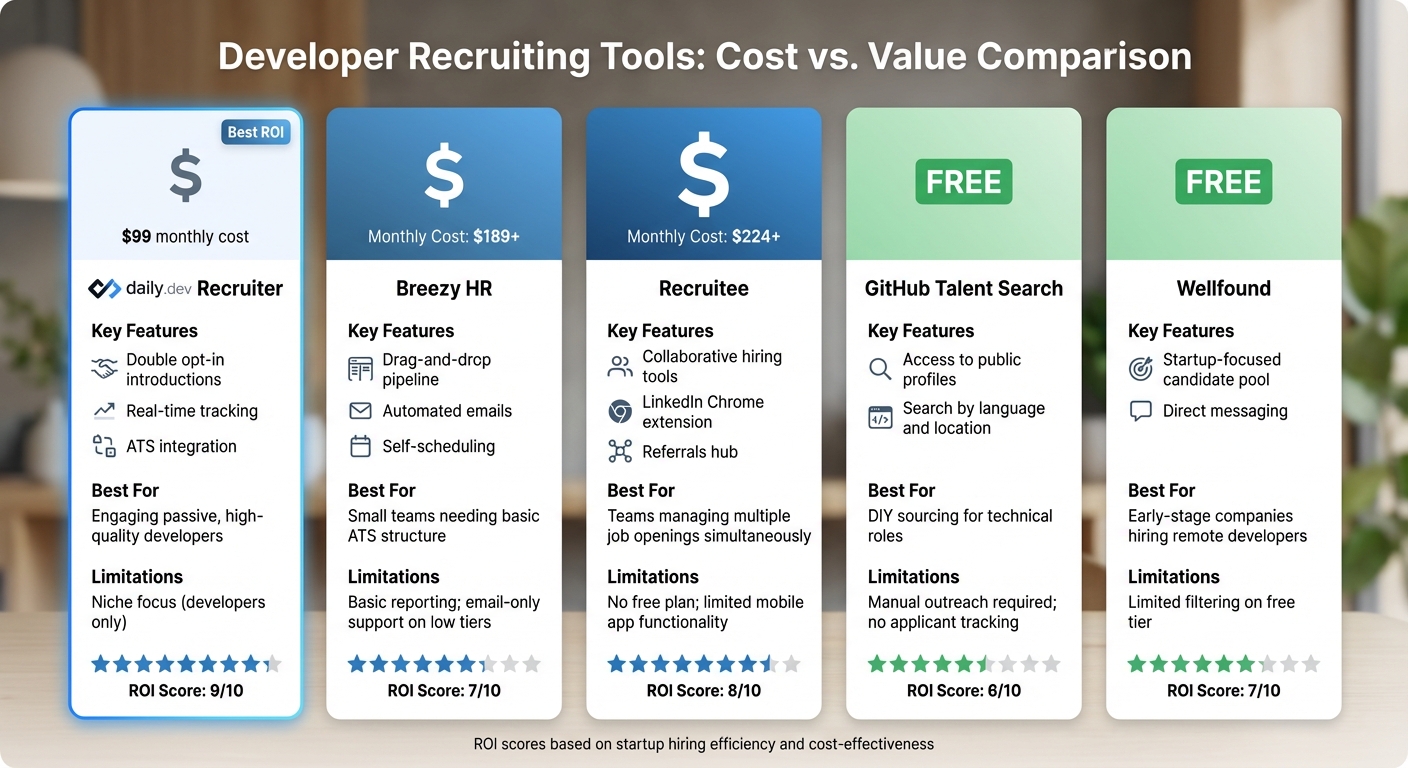 {Affordable Developer Recruiting Tools Comparison: Costs, Features & ROI for Startups}
When choosing recruiting tools, it's all about finding the right balance between cost, time savings, and quality improvements. Free plans can help organize your hiring pipeline, but paid tools often save significant time and effort when hiring. For startups working with tight budgets, this analysis can guide you toward securing top developer talent without overspending.
Comparison Table
Here's a breakdown of key features, costs, and potential return on investment (ROI) for various recruiting tools:
| Tool | Monthly Cost | Key Features | Best For | Limitations | Startup ROI Score (1-10) |
|---|---|---|---|---|---|
| daily.dev Recruiter | $99 | Double opt-in introductions, real-time tracking, ATS integration | Engaging active vs passive developer recruitment targets | Niche focus (developers only) | 9/10 |
| Breezy HR | $189+ | Drag-and-drop pipeline, automated emails, self-scheduling | Small teams needing basic ATS structure | Basic reporting; email-only support on low tiers | 7/10 |
| Recruitee | $224+ | Collaborative hiring tools, LinkedIn Chrome extension, referrals hub | Teams managing multiple job openings simultaneously | No free plan; limited mobile app functionality | 8/10 |
| GitHub Talent Search | Free | Access to public profiles, search by language and location | DIY sourcing for technical roles | Manual outreach required; no applicant tracking | 6/10 |
| Wellfound | Free | Startup-focused candidate pool, direct messaging | Early-stage companies hiring remote developers | Limited filtering on free tier | 7/10 |
Among these, daily.dev Recruiter stands out with the highest ROI. Its double opt-in introductions ensure you're only connecting with developers who are genuinely interested, eliminating the inefficiency of cold outreach. For startups that need quick, high-quality connections, this tool can be a game-changer. At $99/month, it provides a cost-effective way to streamline developer engagement.
On the other hand, Breezy HR and Recruitee are better suited for managing candidates across different hiring stages. While they excel at organizing and tracking applicants, they don't directly source talent. Free options like GitHub Talent Search and Wellfound offer access to candidate pools but require more manual effort, such as outreach and filtering.
"Breezy HR is perfectly adequate... It's trying to be good enough at a price that doesn't require board approval." - Terry "The Tool" Shepard, The Daily Hire
For startups, the key is to combine free tools for sourcing with targeted investment in solutions that address specific challenges. If you're struggling to get responses from developers, daily.dev Recruiter is a smart investment. Need help managing a growing pool of candidates? Consider an ATS like Breezy HR, which offers affordable plans for startups. The goal is to avoid paying for features you won’t use and focus on tools that save time and improve candidate quality.
Next, we’ll dive into DIY sourcing strategies to complement these tools.
DIY Sourcing Strategies Without Paid Tools
Tight budgets don’t have to mean limited recruiting options. By combining manual sourcing techniques with free tools, startups can build a strong talent pipeline without breaking the bank. These DIY strategies can be highly effective when you know where to look and how to connect with potential candidates.
Networking in Developer Communities
Developers often gather in online spaces to share knowledge, solve problems, and collaborate on projects. These communities are goldmines for finding skilled professionals.
Start with GitHub, a hub for developers contributing to open-source projects. Use its advanced search features (e.g., language:javascript, location:Minneapolis, followers:>4) to pinpoint active contributors. Pay attention to those working on popular repositories - they’re not just skilled but also demonstrate teamwork and problem-solving abilities.
Another valuable resource is Stack Overflow, where developers answer technical questions. Check out the "Top Users" section and filter by tags like React or Python. Reviewing their answers gives you insight into their technical expertise and communication skills. Reputation points and tag-specific badges can help you identify standout contributors.
Don’t overlook Reddit. Subreddits such as r/webdev, r/rust, or r/MachineLearning are packed with conversations where developers share insights and solutions. By actively participating - answering questions, sharing helpful resources, and contributing to discussions - you can build credibility and form connections that may lead to future hires.
Remember, sourcing talent is a marathon, not a sprint. Building genuine relationships over time can lead to better results when the right opportunity arises .
Using Social Media and Content Engagement
Social media platforms also offer cost-free ways to connect with talented developers. Many developers share their expertise through articles, posts, or discussions, giving you a glimpse into their skills and thought processes.
Platforms like Dev.to, Hashnode, and Hacker News are excellent places to start. Developers who publish content here often showcase not only their technical knowledge but also their problem-solving approach. Reading their articles can reveal how they think and communicate - key traits for any role.
On platforms like X (formerly Twitter), follow technical hashtags such as #rustlang or #webdev to find developers engaged in real-time discussions. These conversations can help you identify individuals passionate about emerging technologies.
You can also amplify your reach by involving your current team. Encourage your engineers to share their experiences - whether it’s about a hackathon, a challenging project, or a unique solution they developed. Developers often trust insights from peers more than corporate messaging. Having your technical team take the lead in outreach can make your efforts feel more authentic and relatable.
Here’s a quick summary of effective DIY strategies across popular platforms:
| Platform | Best DIY Strategy | Key Metric |
|---|---|---|
| GitHub | Search by language/location; check contributors on repos. | Repository stars and follower counts. |
| Stack Overflow | Use "Top Users" by tag; Google X-ray search for answers. | Reputation points and badges. |
| Join niche subreddits (e.g., r/webdev, r/rust). | Community upvotes and quality of posts. | |
| X (Twitter) | Follow hashtags like #rustlang; join tech discussions. | Engagement in real-time conversations. |
| Dev.to / Hashnode | Read articles to assess expertise and communication. | Article reactions and follower numbers. |
Consistency is key. Regular engagement in these spaces helps you build a tech talent pipeline. Keep track of promising candidates in a simple spreadsheet and nurture those relationships over time. While this approach takes effort, it’s cost-free and aligns with a technical-focused recruiting strategy.
When to Invest in Paid Tools vs. Bootstrap
Deciding when to move from free tools to paid solutions can make or break your recruiting strategy. A key factor to consider is your quarterly hiring volume. For startups hiring fewer than 10 people per quarter, sticking with a bootstrap setup costing $0–$50 per month is usually enough. Tools like GitHub and Google Sheets can handle these smaller-scale recruiting needs effectively. However, once hiring ramps up to 10–30 candidates per quarter, investing in a lightweight, paid applicant tracking system (ATS) priced between $50–$200 per month becomes a smart move. For companies hiring more than 30 candidates per quarter, enterprise-level solutions costing $200 or more per month are often essential to manage the added complexity .
Another clear indicator that it's time to invest is when team coordination starts to break down. If your recruiting team spends more time sorting out responsibilities than sourcing candidates, inefficiencies like duplicate outreach or missed follow-ups can quickly damage your employer brand. Upgrading to better tools can streamline these processes and free up your team to focus on what matters most .
To put costs into perspective, consider these benchmarks for paid platforms: LinkedIn Recruiter Lite costs about $170 per month per seat, while LinkedIn Recruiter Corporate ranges between $835 and $1,080 per month per seat . These tools can be invaluable for high-volume hiring, but for startups making just a couple of hires each quarter, such expenses might not make financial sense.
For most startups, a hybrid approach works best. Continue using free tools for passive sourcing, and only introduce paid solutions when hiring volumes or coordination challenges justify the expense. Regularly reviewing your quarterly hiring needs and the return on investment (ROI) will help you decide when it’s the right time to upgrade your recruiting toolkit.
Conclusion
Hiring top-notch developers without breaking the bank is entirely doable. The secret lies in choosing recruiting tools that fit your hiring volume and team size. For startups with low hiring needs, free platforms like GitHub Talent Search, Wellfound, and daily.dev Recruiter can be game-changers, offering access to active candidates - 90% of whom are open to new opportunities - without straining your budget. As your hiring needs grow, the right tools not only help you manage costs but also speed up the hiring process.
While free sourcing strategies are a great starting point, scaling your efforts becomes much smoother with an affordable applicant tracking system (ATS). These tools streamline recruitment workflows without the hefty price tag of enterprise solutions. And remember, speed is critical - most top tech talent is snapped up within 10 days. Affordable tools that help you move quickly can save you from costly delays in productivity.
For most startups, a hybrid approach works best. Use free tools to engage with passive candidates and build community connections, then integrate paid solutions when your hiring volume increases. Focus on platforms that facilitate warm, double opt-in introductions rather than relying on cold outreach - developers are more likely to respond if they've already shown interest in your company.
Craft job descriptions that highlight 3–4 key skills to attract qualified candidates and reduce noise. Reconnect with strong candidates from past searches to save time and effort. Use market data from resources like Glassdoor or Levels.fyi to set realistic salaries, and dedicate regular time each week to sourcing talent to maintain a steady pipeline. By blending free and affordable tools with smart, hands-on strategies, you can attract top talent without overspending.
FAQs
What’s the cheapest hiring stack for my first developer hire?
To create a cost-effective hiring stack for your first developer hire, mix free and budget-friendly tools. Start with daily.dev Recruiter at $99/month for high-response connections. Use free platforms like GitHub to source talent, and opt for affordable applicant tracking systems (ATS) such as Breezy HR or Recruitee. This combination keeps expenses low while giving you access to skilled candidates and efficient pipeline management - ideal for startups working with tight budgets.
How can I find good developers on GitHub without spamming them?
When connecting with developers, prioritizing ethical practices and building trust is essential. A great starting point is analyzing GitHub profiles. These profiles offer valuable insights into a developer's skills, contributions, and areas of interest. By taking the time to understand their work, you can craft personalized and relevant messages that genuinely reflect your interest.
Avoid the trap of sending generic or mass messages - they often come across as impersonal and can alienate potential collaborators. Instead, focus on creating meaningful, long-term relationships founded on transparency and mutual value. This approach not only respects developers' preferences but also significantly boosts the likelihood of positive engagement.
When should a startup pay for an ATS instead of using spreadsheets?
When handling recruitment manually starts to feel overwhelming, it’s probably time for your startup to consider an Applicant Tracking System (ATS). Some clear indicators include receiving a large number of applications, juggling multiple hiring channels, or struggling to coordinate effectively with your hiring team. An ATS helps simplify these processes, minimizes mistakes, and enhances the overall candidate experience. This makes it a smart move for scaling your recruitment efforts and staying competitive as your team expands.
.png)