Hiring developers in 2026 is harder than ever. The talent shortage is growing, with 2 million open positions expected this year, up from 1.4 million in 2025. Key challenges include increasing demand for AI skills, senior developer retirements, and stricter immigration policies. Companies face longer hiring timelines, higher salaries (senior developers now average $235,000), and lower offer acceptance rates (down to 51%).
To succeed, focus on these strategies:
- AI Expertise is Key: AI skills are now essential, with AI-generated code making up 29% of developers' work. Companies need candidates who can manage AI systems and validate outputs.
- Skills Over Degrees: Nearly 30% of job postings no longer require degrees. Skills-based assessments speed up hiring and improve retention.
- Hiring remote developers and global sourcing: Offshore hiring is rising, and remote work preferences are reshaping recruitment. Companies offering flexible work options attract 10x larger talent pools.
- Streamlined Hiring Processes: Use developer assessment tools to reduce hiring timelines, automate repetitive tasks, and improve candidate matching.
- Retention Matters: Developers value flexibility, growth opportunities, and seeing the impact of their work. Offering learning budgets, mental health support, and meaningful projects helps retain talent.
Start planning now to stay competitive. Speed, transparency, and trust are critical in today’s market.
::: @figure 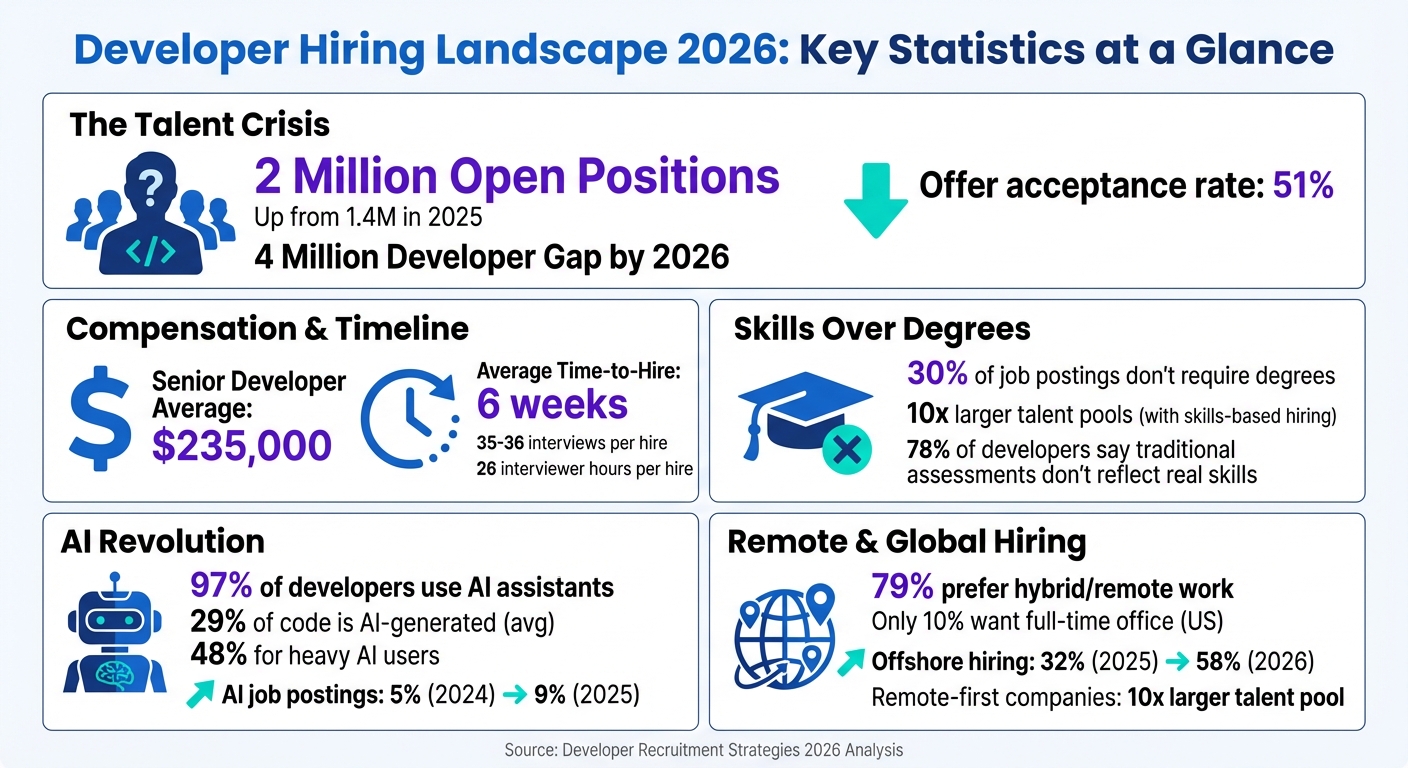 {Developer Hiring Statistics and Trends for 2026}
Major Trends in Developer Hiring for 2026
Three major shifts are redefining how companies approach hiring developers this year. These changes aren't just trends - they're shaping the future of recruitment and could mean the difference between filling a role in weeks or being stuck in hiring limbo for months.
Growing Demand for AI and Specialized Developers
AI expertise has gone from being a "bonus" to a must-have skill. In fact, job postings requiring AI knowledge increased from 5% in 2024 to 9% in 2025, and the trend shows no signs of slowing down . But it’s not just about knowing how to use AI tools. Companies are actively searching for developers who can manage AI systems capable of handling tasks like debugging and code refactoring .
The next big leap? Integrated AI capabilities. By the end of 2026, AI-powered voice and video tools are expected to dominate customer support and sales workflows . Python's popularity in job postings has risen from 15% to 18%, and the demand for "algorithmic thinking" has jumped from less than 0.5% to over 2% in just a year .
"We will start treating AI agents like junior staff with job titles, budgets, and spending limits. Once an agent can issue a refund or buy inventory, it stops being a tool and becomes a worker." - Cathy Gao, Partner, Sapphire Ventures
Today, 97% of developers use at least one AI assistant in their work, with AI now responsible for generating an average of 29% of their code. For heavy users, that number climbs to 48% . This shift has led 84% of engineering leaders to increase productivity expectations within their teams . As technical demands grow, hiring criteria must evolve to match this complexity.
Skills-Based Hiring Over Degrees
The importance of degrees is fading fast. Nearly 30% of job postings no longer list a professional degree as a requirement . Companies that prioritize skills over credentials have expanded their talent pools by nearly 10 times on average . Why? Because 78% of developers believe traditional assessments don’t reflect the skills needed for the job .
Organizations using skills-based assessments have cut their hiring timelines significantly - from months to just weeks. They’re also 107% more likely to place the right talent and 98% more likely to retain top performers . Problem-solving skills are now seen as more critical than formal AI certifications, with 73% of talent leaders highlighting the importance of critical thinking to validate AI-generated outputs .
"Critical thinking skills are vital to work with AI successfully. I can't see somebody being great at AI without having exceptional critical thinking skills. You need critical thinking to understand what's a hallucination versus real data." - Scott Erker, Senior Client Partner at Korn Ferry
This shift toward skills-based hiring is also breaking geographical barriers, opening up new opportunities for global talent.
Global Talent Pools and Hybrid Work
The developer shortage is real, with a projected gap of 4 million developers by 2026 . To bridge this gap, offshore hiring is expected to climb to 58% by 2026, up from 32% in 2025 . Companies are no longer treating offshore teams as temporary contractors. Instead, they're fully integrating them into workflows, from Slack channels to daily standups .
At the same time, 79% of developers worldwide prefer hybrid or remote work, and only 10% of U.S. developers are interested in full-time office roles . Companies insisting on full-time office attendance have seen a 30% drop in offer acceptance rates .
"If your employee value proposition (EVP) is strong enough... you might be able to impose your workplace demands. But for most organizations, you need to match your office policies with what the talent you want expects." - David Ellis, Senior VP of Talent Transformation at Korn Ferry
Remote-first companies enjoy access to a 10x larger talent pool compared to those limiting themselves to a 30-mile radius of a physical office . Flexible work policies are now the top recruiting strategy for 61% of talent leaders . On the flip side, companies sticking to traditional office setups often face the need to offer salaries 25-40% higher to attract local talent willing to commute .
The takeaway? Embrace global, flexible hiring strategies - or prepare to compete with higher costs for a shrinking pool of local candidates.
How to Source Developers in 2026
Finding and hiring developers in 2026 requires a more thoughtful and precise approach than ever before. The days of sending out generic cold emails are fading fast. Companies that succeed are focusing on building trust, meeting developers where they already engage, and using AI tools to make smarter matches based on deeper insights - not just keywords. Clarity and transparency are key from the very beginning.
Use daily.dev Recruiter for Warm Introductions
Cold emails often end up ignored. Enter daily.dev Recruiter, a tool designed to connect you with developers who are already active in professional spaces, discussing real technical challenges. Instead of spamming inboxes, this platform facilitates warm, double opt-in introductions. When you post a job, developers receive detailed information about the role, including the tech stack, the problems they’ll work on, and growth opportunities. This ensures that only genuinely interested candidates join the conversation.
Consider how AI-powered hiring tools are transforming recruitment. For example, in 2025, General Motors introduced an AI assistant called "Ev-e" to handle candidate communications. This tool slashed interview scheduling time from 5–7 days to just 29 minutes, saving the company an estimated $2 million annually . Similarly, Chipotle Mexican Grill used a virtual assistant, "Ava Cado", to hire 20,000 employees. It reduced their hiring time from 12 days to just four and increased application completion rates from 50% to over 85% .
One major advantage of platforms like daily.dev Recruiter is their ability to target the 40% of developers who are active in their communities but not actively job hunting. By integrating with developer hiring platforms and ATS systems and using focused screening questions, you can streamline introductions while avoiding duplicate outreach.
Build Relationships in Developer Communities
Developers are more likely to trust companies that actively engage in their communities. This means going beyond job postings. Contribute to open-source projects your team relies on, share real stories about overcoming technical hurdles, or host virtual hackathons to showcase your company culture.
Investing in developer communities can significantly speed up hiring. For instance, Soliton Technologies used HackerEarth coding challenges in 2025 to fill eight developer roles. By focusing on coding contests rather than traditional resume reviews, they completed the hiring process in less than a month .
"Money is important, but it functions as a representation of recognition, not value. This is why a personal note from a project's leaders goes so far."
- Jeff Osier-Mixon, Open Source Community Manager, Intel Corporation
To build credibility, companies can support open-source contributions by allowing developers to dedicate up to 50% of their work hours to these projects. Hosting AMAs (Ask Me Anything) sessions with your CTO or sponsoring technical meetups also strengthens your standing. Remember, 70% of senior developers prioritize purpose and the "why" behind the work over flashy perks .
Apply AI Tools for Better Candidate Matching
AI is revolutionizing how companies find and match developers. Modern AI tools go beyond basic keyword searches, analyzing a candidate’s side projects, learning habits, and technical interests. This approach creates smaller, highly qualified candidate pools .
By 2026, AI agents will play a larger role in recruitment, functioning almost like junior team members with their own budgets and defined roles . As Venky Ganesan, Partner at Menlo Ventures, said: "2026 is the 'show me the money' year for AI" . Companies are focusing on measurable outcomes, including faster and more efficient hiring processes.
AI can also help identify candidates who contribute to open-source projects or engage with emerging tech trends, ensuring your pipeline stays aligned with your company’s technical culture. However, it’s critical to prioritize data privacy by obtaining explicit consent from candidates and avoiding unauthorized data scraping.
These strategies are paving the way for faster, more effective hiring in 2026 - without compromising on quality.
Speed Up Hiring Without Sacrificing Quality
On average, it takes about six weeks to fill a position, and technical roles in 2025 required around 35–36 interviews and 26 hours of interviewer time per hire . While reducing time to hire is important, it should never come at the expense of quality. The key is to eliminate unnecessary steps while still maintaining a thorough evaluation process. Streamlining these steps lays the groundwork for strategies that align technical evaluations with the expertise of recruiters.
Simplify Technical Assessments
Abstract coding puzzles are losing their appeal among top developers. In fact, 66% of developers prefer practical challenges that reflect real-world tasks over algorithm-based puzzles . Focus on assessments that involve tasks like building a React component, integrating APIs, or debugging live codebases - projects that mirror the actual work developers handle daily.
Additionally, 82% of developers now rely on AI tools like GitHub Copilot or ChatGPT in their workflows . When designing assessments, consider how candidates interact with these tools. Can they critically evaluate AI-generated code and understand its logic? This blend of human and machine problem-solving reflects modern workflows in 2026.
"The era of LeetCode-style algorithmic puzzles dominating technical hiring is rapidly coming to an end." - HackerRank
Another approach is to use progressive assessments where candidates work on the same codebase across multiple rounds, adding complexity with each stage. This method provides insight into how they adapt to evolving requirements - a crucial skill for engineering roles. Companies using optimized technical assessments have reported an 83% reduction in the time engineers spend on candidate evaluations . These streamlined methods not only save time but also improve alignment between recruiters and technical teams.
Align Recruiters with Engineering Teams
A lack of coordination between recruiters and engineering managers often leads to wasted time - whether by screening unqualified candidates or overlooking strong ones. To avoid this, recruiters should be treated as strategic partners rather than just resume filters.
Start by holding formal intake meetings with a structured agenda. Define the "must-have" and "nice-to-have" skills, clarify the role's business goals, and establish clear evaluation criteria . Including both recruiters and hiring managers in the initial candidate searches ensures everyone is on the same page, helping refine search parameters and keywords . This upfront collaboration reduces delays later in the process.
Interestingly, 46% of sourced hires come from candidates already in your ATS or CRM . These "rediscovered" candidates are eight times more likely to be hired than new applicants, as they've already been vetted. By tagging rejection reasons (e.g., "timing" or "specific skill gap"), you can quickly revisit qualified candidates when similar roles open up .
Use ATS and Automation Tools
Automation can free up valuable time for tasks that require deeper focus. Recruiters using generative AI have reported a 20% reduction in their workload, allowing more time for detailed candidate evaluations .
Modern AI tools go beyond basic keyword searches by analyzing patterns in a candidate's career - such as project experience, tenure, and leadership roles - to find better matches . For example, Electrolux Group adopted Phenom's AI-powered platform to streamline job recommendations and scheduling. The results? A 51% drop in incomplete applications, a 9% reduction in time-to-hire, and a 78% increase in time saved through automation . Similarly, Domino's used Pandologic's automated job advertising to cut their cost per applicant by nearly 86% .
Start with low-risk automation tools like self-scheduling for interviews, automated reminders, and centralized feedback collection. AI can also transcribe virtual interviews and summarize key insights for the engineering team, accelerating decision-making without compromising rigor. However, it's essential to regularly audit these tools to ensure they aren't perpetuating biases or disadvantaging candidates with unconventional backgrounds .
"AI is enabling recruiting teams to be more human, not less." - LinkedIn
Companies using AI-assisted messaging are 9% more likely to make quality hires compared to those that don't . By integrating automation thoughtfully, you can not only shorten hiring timelines but also improve candidate alignment with the technical demands of the role.
Hiring engineers?
Connect with developers where they actually hang out. No cold outreach, just real conversations.
Match Developer Expectations and Improve Retention
Recruiting skilled developers is only part of the challenge. Retaining them is just as critical. By 2026, 40% of developers plan to leave their current roles within a year, often citing limited growth opportunities and uncompetitive pay as the main reasons . Companies that thrive will be those that truly understand what developers want in recruitment processes and tailor their strategies to meet those expectations.
Offer Flexibility and Work-Life Balance
Flexible work arrangements are no longer perks - they’re necessities. Today, 94% of developers expect flexible hours, and 80% want location flexibility . Forcing employees into full-time office schedules will not only shrink your talent pool but also increase salary demands .
Beyond scheduling, developers are prioritizing mental health and personal time. For instance, 40% of developers are drawn to 4-day work weeks as a way to achieve better balance . Companies are responding by introducing mental health breaks, wellness programs (like gym memberships and healthcare benefits), and asynchronous work policies that give developers control over their schedules .
"Talent acquisition is about people - and human intelligence will always be the differentiator." - Jeanne MacDonald, CEO of Recruitment Process Outsourcing, Korn Ferry
Some organizations are even going a step further by offering unique perks, such as "Fridays for Open Source" or dedicated time for passion projects. These initiatives allow developers to explore personal interests or experiment with new tools, creating a more fulfilling work environment .
Provide Learning and Growth Opportunities
Developers aren’t just looking for jobs - they’re seeking meaningful careers. 78% of developers prioritize learning opportunities over salary increases, and 44% will reject offers that don’t provide a path to building future-ready skills . Moreover, 61% of developers without access to learning opportunities plan to leave their current roles within a year .
To address this, many companies are offering annual learning budgets ranging from $3,000 to $10,000 for certifications, courses, and conferences . Others are introducing AI stipends of $5,000 or more to encourage experimentation with emerging tools and technologies . These investments signal a commitment to employees’ long-term development.
Some companies are also turning to internal mobility programs. For example, Schneider Electric launched an AI-driven "open talent market" in 2019 after discovering that 47% of departing employees left due to a lack of internal visibility for career growth. The platform matches employees with internal opportunities based on their skills and goals . Similarly, CDM Smith implemented the "Career Compass" program, which helps employees set actionable goals and align their daily work with long-term aspirations. This initiative saved the company $3.2 million through improved retention, and 34% of mentees received promotions compared to just 13% of non-participants .
Other organizations are embracing creative approaches to career growth. Spotify’s "growth is not linear" philosophy allows developers to participate in "Gigs" and "Job Swaps", enabling them to explore new skills across departments without being confined to a single role . Amazon offers programs like Amazon Technical Academy and "Associate2Tech", which help non-technical employees transition into software engineering roles .
Show the Impact of Their Work
Developers want to see how their efforts make a difference. Just as precision hiring and AI-driven tools enhance recruitment, clearly demonstrating the impact of their work is key to keeping developers engaged.
"If companies don't invest in their developers - whether through pay, career growth, or meaningful work - developers will invest in themselves. And that may well mean leaving." - HackerRank 2025 Developer Skills Report
Your Employee Value Proposition (EVP) should be woven into every interaction - whether it’s on your careers page, in developer job descriptions, or through internal communications. Rather than listing generic requirements, showcase how your company values its workforce and highlight the real-world impact new hires can make . Video testimonials featuring employees solving critical challenges can be particularly effective .
For example, Ingredion introduced an EVP campaign called "Create the Future with People Who Care", which was integrated across platforms like LinkedIn and Workday. This effort led to a 32% increase in careers page traffic and a 650% jump in applications via Indeed . Similarly, UBS launched the "Recruiting at Speed" campaign during the Credit Suisse migration in 2024, successfully filling 300 bilingual roles on time by leveraging senior leaders as ambassadors and using multi-lingual storytelling .
Sharing real-world technical challenges and success stories can also resonate deeply with developers. Highlight how a team solved a complex problem under pressure or how a small tweak managed a traffic surge . Supporting open-source contributions, hosting hackathons, and engaging with developer communities further demonstrates your commitment to innovation and impact beyond internal projects.
Measure Results and Plan for 2026
As recruitment strategies evolve, measurable results are now the ultimate indicator of success. With only 0.5% of applicants being hired today , it’s clear that precision and efficiency are more important than ever. Tracking the right metrics can help you evaluate whether your approach is hitting the mark.
Track Key Recruitment Metrics
The focus should shift from sheer volume to quality over quantity. Smaller, well-targeted pools of candidates with higher response rates often yield better outcomes .
Start by monitoring time-to-hire and hiring velocity to gauge how quickly critical roles are being filled. For technical positions, the process has become more rigorous, averaging 35–36 interviews and requiring 26 interviewer hours per hire - a 33% increase compared to previous years . Keep an eye on candidate conversion rates to identify where candidates drop out of the process. If your offer acceptance rate falls below the benchmark of 82% - the highest since 2021 - your process may need adjustments .
"Recruiting in 2026 will be defined by automation and insight, not intuition. Data is now every recruiter's most valuable asset." - Metaview
Sourcing effectiveness is another critical area. Candidates sourced directly are 8x more likely to be hired than those from general job boards . Even more striking, 46% of sourced hires now come from "rediscovered" candidates already in your CRM or ATS . This highlights the untapped potential sitting in your existing talent database.
Don’t overlook recruiter workload. Tracking metrics like job requisitions per recruiter can help ensure your team isn’t overburdened, which can lead to rushed decisions and a poor candidate experience .
These metrics are the building blocks for a forward-thinking recruitment strategy that prepares you for 2026.
Cold Outreach vs. Warm Introductions: A Comparison
To optimize your hiring efforts, it’s essential to understand the trade-offs between cold outreach and warm introductions. Each approach has its strengths and weaknesses, but warm introductions are proving to be a game-changer.
Comparison of Sourcing Methods:
| Metric | Cold Outreach (Job Boards/Cold Email) | Warm Introductions (Opt-in Platforms) |
|---|---|---|
| Likelihood of Hire | Baseline | 8x higher than job boards |
| Time-to-Hire | Slower due to manual screening | 40–60% faster |
| Candidate Engagement | Low response rates, high drop-off | Higher engagement from opt-in interest |
| Recruiter Efficiency | High manual effort required | Reduced screening time through pre-qualified pools |
The takeaway? Warm introductions through opt-in platforms and AI-powered tools deliver faster results and better candidate quality. While cold outreach still has its place, it shouldn’t be your primary strategy anymore.
Build Your 2026 Recruitment Plan
Developing a recruitment plan for 2026 means transitioning from reactive hiring to predictive workforce planning. Align your hiring strategies with anticipated business needs 18–36 months in advance instead of scrambling to fill roles as they arise .
Start by focusing on skills over credentials. Mapping critical roles to core competencies allows you to identify transferable skills and broaden your talent pool to include non-traditional candidates who bring the right abilities . Companies using AI in recruiting have reported 36% lower costs and 24% better identification of top candidates .
Improve your candidate experience by auditing your application process. Have someone outside your team apply for a role and document pain points like confusing forms, slow responses, or unclear job descriptions. Address these issues systematically. Implement speed SLAs, such as a 24-hour invite window for qualified applicants and a 48-hour review period, to maintain momentum . Remember, top developer candidates are typically off the market within 10 days .
Build continuous talent pipelines by engaging alumni, past applicants, and referrals - even when they’re not actively job hunting . Use AI analytics to track representation across sourcing channels and interview panels, identifying and reducing bias .
Finally, benchmark quarterly. Regularly review your compensation and benefits against market data, especially as pay transparency laws expand in states like Illinois and Massachusetts . With 61% of tech professionals citing salary as their top priority, staying competitive is non-negotiable .
"The future belongs to those who adapt now, blending technology with human intelligence to hire better, faster, and fairer." - Metaview
Your 2026 hiring strategy should balance automation with human insight. Use AI to handle tasks like high-volume sourcing and initial screenings, while recruiters focus on building relationships, understanding candidate motivations, and aligning hires with company culture . This blend of technology and human expertise is what sets apart companies that merely fill roles from those that build exceptional teams.
Conclusion
The developer hiring landscape in 2026 demands a fresh perspective on recruitment strategies. With the growing talent shortage and rising costs, sticking to traditional methods just won’t cut it anymore.
To succeed in this competitive market, focus on three key elements: speed, transparency, and trust. In a world where top developers are off the market in a matter of weeks, delays beyond two weeks can cost you the best candidates. Being upfront about salary ranges, highlighting real opportunities for impact, and building authentic connections within developer communities can make all the difference. These steps not only attract talent but also set the foundation for leveraging advanced tools in your hiring process.
Technology is a game-changer for recruiters. AI tools can dramatically improve both efficiency and quality. By automating repetitive tasks, you’ll have more time to focus on what truly matters - engaging with developers, ensuring cultural alignment, and building long-term talent pipelines. As Metaview aptly states, "Recruiting in 2026 will be defined by automation and insight, not intuition".
To stay ahead, start planning now. Launch your 2026 hiring strategy in Q4 2025 to avoid the January hiring rush. Take a close look at your candidate experience, shift from degree-based qualifications to vet technical skills through skills-based assessments, and prioritize building ongoing talent communities so you’re ready to fill roles as they arise. Respect, transparency, and real opportunities for growth will resonate with developers and set your company apart.
The race for talent is already in full swing, and 2026 will only turn up the heat. By focusing on clear communication, community engagement, and a mix of human insight and advanced tools, you can turn this challenge into a competitive advantage. The future belongs to recruiters who are ready to hire smarter and faster.
FAQs
What are the best strategies to attract developers with AI expertise in 2026?
To attract AI-driven developers in 2026, emphasize how your company provides opportunities to work on groundbreaking AI projects that make a difference. Back this up with concrete examples, like offering funding for AI experiments or maintaining an in-house lab for prototyping advanced solutions. Sharing success stories - such as how a recent AI initiative boosted performance or resolved a customer challenge - can make your roles stand out.
Leverage AI-powered recruiting tools to find candidates with the right skills, like expertise in frameworks such as PyTorch or TensorFlow. Tailor your outreach by referencing their recent projects or contributions to demonstrate genuine interest. Additionally, connect with the AI community by sponsoring meetups, organizing hackathons, or supporting open-source initiatives. These efforts not only build credibility but also ensure your brand stays on the radar of top AI talent.
Why is skills-based hiring better than focusing on degrees?
Skills-based hiring brings several clear benefits compared to traditional degree-focused recruitment. By focusing on what candidates can do rather than the credentials they hold, companies can simplify their hiring process, cut costs, and reduce employee turnover. It also opens the door to a much broader talent pool by eliminating unnecessary degree requirements, allowing businesses to connect with skilled individuals from a variety of backgrounds.
This approach is particularly valuable in industries like tech, where demands shift quickly. Hiring based on skills ensures new team members are prepared with the specific abilities needed to excel in their roles. The result? Stronger teams and better outcomes. For companies navigating today’s fast-changing job market, this strategy offers a practical way to stay ahead.
How do flexible work options help retain top developer talent?
Flexible work options - such as remote setups, hybrid schedules, or adjustable hours - are becoming essential for addressing the changing priorities of developers. Giving them the freedom to decide where and when they work boosts job satisfaction, minimizes burnout, and strengthens trust. These factors play a big role in keeping employees around for the long haul.
Developers often collaborate across time zones and perform their best during uninterrupted "deep-work" sessions. Flexibility allows them to sync their work hours with their most productive times, which enhances their performance and deepens their connection to the company. Businesses that offer these flexible arrangements not only save on turnover costs but also stand out as desirable employers in an increasingly competitive landscape.
.png)