Losing developers is expensive and disruptive. It costs 1.5–2 times a developer's annual salary to replace them, with senior-level departures costing $150,000–$300,000. Beyond money, turnover leads to lost knowledge, reduced team productivity, and increased stress for remaining employees.
Why Developers Leave:
- Career growth issues: 69% leave due to a lack of advancement opportunities.
- Poor management: 71% of turnover is tied to bad leadership.
- Burnout: 83% of developers report burnout, often from unrealistic workloads or too little time spent coding (just 16% of their week).
- Uncompetitive pay and outdated tools also play a role.
How to Improve Retention:
- Hire Right: Transparent job descriptions and better onboarding reduce early exits.
- Career Development: Clear promotion paths, individual growth plans, and mentorship programs keep developers engaged.
- Balanced Workloads: Avoid burnout by redistributing tasks, reducing interruptions, and improving planning.
- Better Management: Empathetic, supportive managers lower turnover by over 25%.
- Fair Pay & Recognition: Competitive salaries, bonuses tied to results, and meaningful acknowledgment build loyalty.
Retention starts before hiring and requires consistent effort. Reducing turnover saves money and boosts team productivity - it's worth the investment.
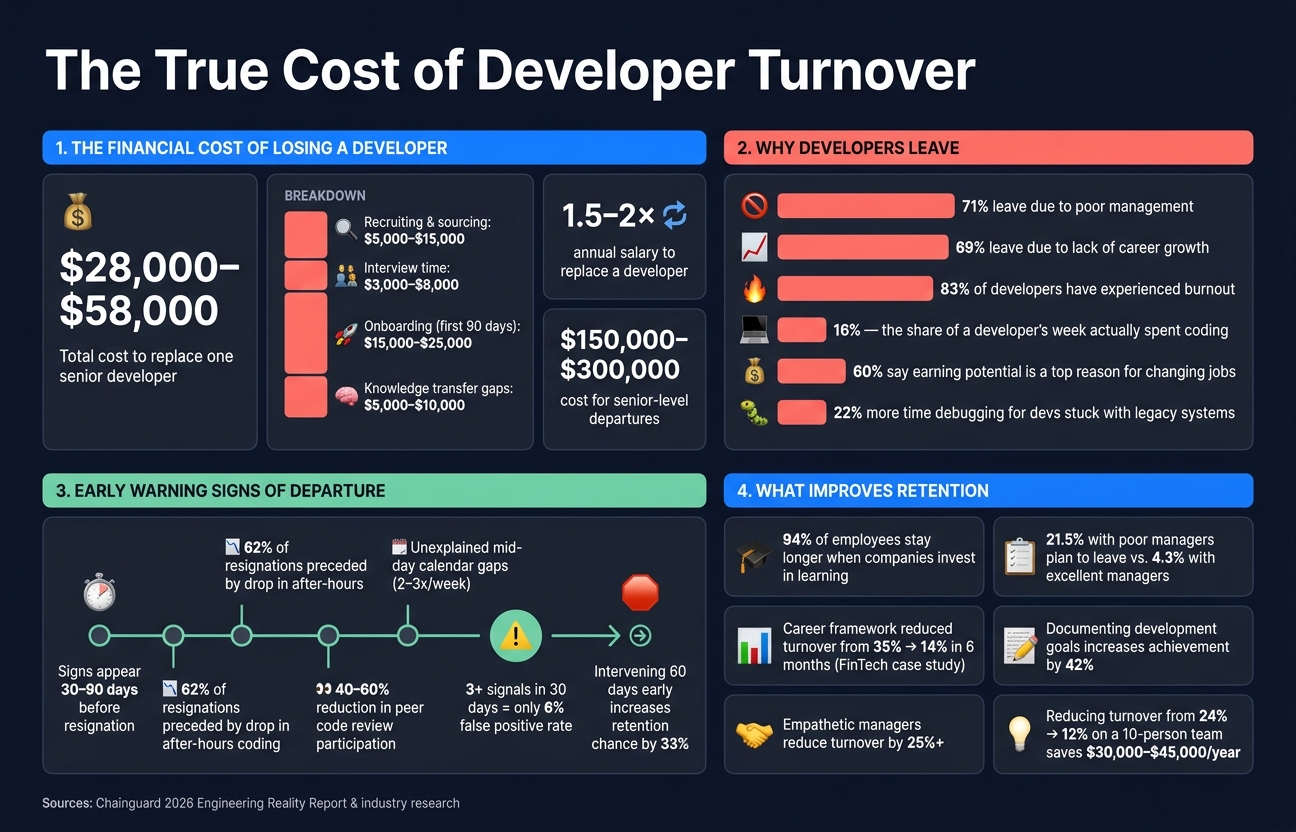
Why Developers Leave: Root Causes and Warning Signs
The Most Common Reasons Developers Quit
One of the main reasons developers decide to leave their jobs is a lack of career growth. In fact, nearly 69% of developers cite this as their primary reason for seeking new opportunities . When there's no clear path for advancement, it's only natural for them to start exploring other options.
Another major issue is poor management. A staggering 71% of voluntary turnover is tied directly to bad management . Interestingly, the quality of a manager often has a bigger impact on a developer's decision to leave than broader company-level issues . Beyond management, uncompetitive salaries, limited technical challenges, and outdated tools also push developers to move on. For example, those stuck working with legacy systems and high technical debt spend 22% more time debugging compared to peers with better-maintained codebases . This constant frustration takes a toll over time.
Burnout is another serious problem. 62% of tech employees report chronic stress due to unrealistic workloads, and 83% of software developers admit they've experienced burnout . A big part of this stems from how their time is spent. While 93% of developers say writing code is the most rewarding part of their job, they only spend about 16% of their week actually coding . When so much of their time is consumed by non-coding tasks, it’s easy to see why they might start looking for a change.
"When your best people spend 84% of their time on everything except the work they love, departure is a matter of when, not if." - Chainguard 2026 Engineering Reality Report
These issues don’t just affect morale - they come with a hefty financial impact, making it essential to understand the true cost of turnover.
How to Measure Turnover Costs
Many companies underestimate the cost of losing a developer because they only account for recruiting expenses. But the real cost is much higher when you include lost productivity, knowledge gaps, and the burden placed on the remaining team to fill in the gaps.
A more realistic breakdown includes four key areas for every departure:
- Recruiting and sourcing: $5,000–$15,000
- Interview time from the engineering team: $3,000–$8,000
- Onboarding with reduced productivity (first 90 days): $15,000–$25,000
- Knowledge transfer gaps: $5,000–$10,000
Altogether, that’s $28,000–$58,000 for losing a senior developer, and that doesn’t even account for the disruption to team dynamics.
To get a clearer view of these costs, tools like Workday, BambooHR, and Lattice can track important retention metrics, such as tenure trends, voluntary versus involuntary turnover, and department-specific attrition rates . Combining this data with regular salary benchmarking can help you spot potential flight risks before they turn into resignations.
Early Signs a Developer May Be Leaving
Developers often show subtle signs they’re planning to leave 30 to 90 days before giving notice - a critical window for intervention . The key is knowing what to watch for.
One common signal is a noticeable drop in after-hours coding activity, which shows up in 62% of resignation cases . Developers who were once highly engaged may still submit pull requests but participate far less in reviewing their teammates’ work - reducing their involvement by 40–60% . Their commit messages might become overly brief, such as "fix bug", instead of providing detailed context. They may also grow quieter in meetings or Slack conversations.
"If someone who's been coming to you with their ideas suddenly stops, it's a huge sign they're on the way out the door." - Jason Cole, Tech Consultant
Unexplained gaps in their mid-day calendar (2–3 times a week) can also indicate they’re interviewing elsewhere . When three or more of these signals appear within 30 days, there’s only a 6% chance it’s a false positive, making it a strong indicator they’re preparing to leave . Acting early is crucial - intervening 60 days before a resignation notice increases your chances of retaining them by about 33% .
Hiring Right: How Better Recruiting Reduces Early Turnover
Understanding why developers leave is only part of the equation. The real challenge lies in making smarter hiring decisions right from the start. Many early departures happen because there's a disconnect between what candidates expect and the reality of the role. Since recruitment sets those initial expectations, being upfront and clear during the hiring process is crucial. When your messaging aligns with the actual job, you create a solid foundation for long-term retention.
Writing Job Descriptions Developers Actually Want to Read
Too often, job descriptions feel like endless checklists of qualifications instead of honest conversations about the role. This approach doesn't resonate with developers, who are increasingly wary of overly polished pitches that highlight perks while glossing over the realities of the job.
What works better? Transparency. Provide specifics about the tech stack, the level of decision-making autonomy, and the challenges the team is tackling. Developers want to know if they'll be solving interesting problems or stuck maintaining outdated systems. They also value clarity about career growth opportunities and their ability to make meaningful technical decisions.
A transparent job description does more than attract the right people - it also helps filter out those who might not be a good fit. This upfront honesty saves time and sets the stage for better alignment between candidates and the role.
Finding Developers Through Trusted Communities
Cold outreach isn't just ineffective - it can harm your reputation. Traditional methods like mass emails or generic LinkedIn messages often yield response rates below 1% . Developers have grown skilled at tuning out these impersonal approaches.
Instead, connect with developers where they already engage. Tools like daily.dev Recruiter are designed for this purpose. Unlike static resume databases, daily.dev Recruiter connects you with developers who are actively participating in their field - reading, building, and staying informed. Every interaction requires mutual opt-in, ensuring that conversations only happen when there's genuine interest from both sides.
"Trust is our moat. We protect it at all costs. Most recruiting tools burn trust to scale - we'll scale because we protect it." - Nimrod Kramer, daily.dev
This trust-based approach leads to more meaningful interactions, ensuring candidates who enter the process are already aligned with the role. Once you've found the right candidates, a strong onboarding process becomes critical to keeping them engaged.
Onboarding That Keeps New Developers Around
Even the best hires can leave if the onboarding process falls short. It can take 6 to 12 months for a developer to reach peak productivity in a new role . Those early months are crucial for building their confidence and commitment.
Effective onboarding starts before the official first day. Send hardware, set up system access, and share an onboarding agenda as soon as the offer is accepted. Assigning a mentor and providing early tasks - like completing a first code commit - can help new hires feel confident and capable right away.
Take Google's onboarding process as an example. Their structured approach leads to 77% of new hires reporting a positive experience and a 25% faster path to full productivity compared to less organized programs . A clear 30-60-90 day plan with defined milestones gives new developers a sense of progress and purpose, making it less likely they'll second-guess their decision to join your team.
Career Growth: Giving Developers a Reason to Stay
After onboarding, the next big challenge is keeping developers engaged and motivated. Career growth plays a critical role here. In fact, 94% of employees stick around longer when companies invest in their learning and development . On the flip side, 45% of workers leave in search of better professional development opportunities . So, career growth isn’t just a nice-to-have - it’s a core retention strategy. By focusing on long-term development, companies can show developers they have a future worth staying for.
Building a Clear Career Progression Path
Uncertainty about promotions and career advancement can push even the best developers to leave. When people don’t know what’s required to move up, they start looking for opportunities elsewhere.
To fix this, create a structured engineering ladder that spells out levels, expectations, and promotion criteria. A great example is Sourcegraph, which designed its framework in 2020 as the company grew from 50 to over 200 employees. Engineering Manager Chris Pine and VP of Engineering Nick Snyder led the effort, creating a seven-level system (L1–L7) evaluated across three areas: Proficiency, Execution, and Teamwork. Managers spend 5.5 hours each quarter calibrating promotions based on clear, objective criteria, removing the guesswork that often causes frustration .
"If we leave people wondering for a month or more if they will be getting a promotion, we're creating needless anxiety and uncertainty." - Sourcegraph Career Framework
Another key feature to include is a dual-track system. Not every talented developer wants to become a manager. By offering an Individual Contributor (IC) path - where technical experts can grow in both title and pay without taking on people management - companies can keep their top engineers engaged . A well-defined ladder sets the foundation, but the next step is helping developers map out their personal journey.
Creating Individual Development Plans That Work
While a career ladder shows developers where they can go, an Individual Development Plan (IDP) helps them figure out how to get there. The key is to collaborate with developers rather than dictating the plan.
Start with a self-assessment where developers identify their strengths, areas for improvement, and long-term aspirations. Then, work together to set SMART goals - Specific, Measurable, Achievable, Relevant, and Time-bound. Tie these goals to real projects so that growth happens through hands-on work. Review and update the plans quarterly to keep them aligned with changing priorities and interests .
"Professional development planning identifies an employee's long-term goals while breaking down the skills they need to reach them." - TestGorilla
Research shows that simply documenting development goals can increase achievement rates by 42% . It’s a small step that can make a big difference in retention.
Learning Opportunities and Mentorship Programs
Even the best development plan won’t go far without resources to back it up. Yet, 46% of developers report having little to no dedicated time for learning at work, and over half say they’d consider leaving a job that doesn’t offer enough growth opportunities .
To address this, allocate time and budget for learning. For example, fund conference attendance, certifications, or online courses, and dedicate 15–20% of work hours to skill-building. One mid-size FinTech firm did just that - allowing engineers to spend 15% of their time on innovation while implementing a career framework - and saw turnover drop from 35% to 14% in just six months .
Pair these efforts with a structured mentorship program. Connecting junior developers with senior engineers helps build technical skills while fostering a sense of belonging. The goal is simple: help developers feel invested in the company’s future, not just their next paycheck.
Work Culture and Workload: What Keeps Developers Engaged
Culture and workload often influence whether developers stay or leave - and the good news is, these areas can be improved if you know where to focus.
Keeping Workloads Balanced
When workloads spiral out of control, it’s usually a system issue, not an individual one. Ashley Russell, author of CodePulse, explains it perfectly:
"Burnout is a management failure, not a personal weakness. If your engineers are burning out, you have a system problem - bad workload distribution, poor planning, insufficient tooling, or toxic culture."
A great way to spot workload imbalances is by monitoring Git activity. For example, if one developer is handling over 30% of complex pull requests, it’s time to redistribute tasks to prevent burnout . Similarly, rethink on-call schedules - don’t expect someone paged at 3 AM to attend a 9 AM meeting the same day .
Protecting focus time is another game changer. Research shows that a single interruption can lead to 22 minutes of lost productivity . Cutting down on unnecessary meetings and using asynchronous communication for updates can help developers stay in the zone and produce their best work.
These adjustments naturally tie into the importance of effective management in keeping developers engaged.
Training Managers to Lead Developer Teams Effectively
Just as strong onboarding can prevent early exits, skilled management helps retain developers long-term. The stats are telling: 21.5% of employees with poor managers plan to leave, compared to just 4.3% of those with excellent managers . This isn’t just a "nice-to-have" - it’s a direct factor in retention.
"People don't leave companies, they leave managers." - Ashley Russell, Author, CodePulse
Empathetic managers with technical know-how can reduce developer turnover by over 25% . To achieve this, managers should:
- Hold regular 1:1 meetings focused on career growth and addressing concerns, not just project updates.
- Provide clear, timely feedback to help developers improve and feel supported.
- Create a safe environment where developers can voice concerns about deadlines or workloads without fear .
When developers feel heard and supported, small issues can be resolved before they escalate into resignation letters.
Competitive Pay and Meaningful Recognition
Workload and management are key, but fair compensation and recognition are just as crucial for keeping developers engaged. While career growth sets the direction, pay and acknowledgment ensure developers feel valued every day.
60% of developers say earning potential is a top reason for changing jobs . To stay competitive, regularly benchmark salaries against market data and adjust pay proactively.
Recognition also goes a long way. Tie bonuses to measurable outcomes, like hitting sprint goals or shipping features, and invest in high-quality hardware to show you value their productivity. These investments cost far less than replacing an engineer . Additionally, specific, thoughtful recognition - like awards for helpful code reviews or knowledge-sharing - feels more genuine than generic praise .
| Recognition Type | Why It Works |
|---|---|
| Transparent pay bands | Builds trust by removing uncertainty around compensation fairness |
| Outcome-based bonuses | Rewards tangible achievements, not just attendance |
| High-quality tools | Signals respect for developers’ time and productivity |
| Specific peer recognition | Makes acknowledgment feel personal and meaningful, rather than performative |
Conclusion: Making Retention an Ongoing Priority
Developer retention is a constant challenge. The average software engineer stays in a role for just 16 months, with nearly 70% leaving before reaching two years . Keeping developers engaged and motivated isn’t something that can be addressed sporadically - it requires consistent, ongoing effort. Retaining top engineering talent isn't just for hiring season or when someone resigns; they need to be part of your everyday operations.
Putting energy into retention pays off in tangible ways. For example, reducing turnover from 24% to 12% on a 10-person team can save $30,000–$45,000 annually while also recovering 8–12 months of lost productivity . These are results you can achieve with changes that are well within your control.
One effective tool is the stay interview. This straightforward, regular check-in gives developers a chance to share what’s working and what might be causing frustration. Conducting these conversations at key intervals - like 90 days, 6 months, and 1 year - can help you uncover potential issues before they lead to a resignation . As tech consultant Jason Cole wisely pointed out:
"If someone who's been coming to you with their ideas suddenly stops, it's a huge sign they're on the way out the door."
FAQs
How do I calculate our true developer turnover cost?
To figure out the cost of developer turnover, you need to account for both direct and indirect expenses. These include costs tied to recruitment, onboarding, lost productivity, and the impact on team morale. Here's a simple formula often used:
Turnover Cost = Recruitment Cost + Onboarding Cost + Productivity Loss + Morale Impact
Replacing a developer isn’t cheap. It can range from 50% to 200% of their annual salary, depending on how senior they are and how complex their role is. This makes it crucial to understand and address these factors.
What are the earliest signs an engineer is about to quit?
A noticeable decline in after-hours coding activity can be an early indication that an engineer might be planning to leave. In fact, this behavior has been observed in 62% of resignation cases, often signaling a drop in engagement and motivation.
Which retention changes deliver results the fastest?
Reducing turnover effectively requires a structured, data-driven strategy. This approach can deliver impressive results - such as cutting developer attrition by as much as 60% in just six months. To see meaningful progress quickly, focus on actionable strategies that align with what developers truly value. These include opportunities for career growth, maintaining a healthy work-life balance, and creating a workplace culture that keeps employees engaged and motivated.
.png)