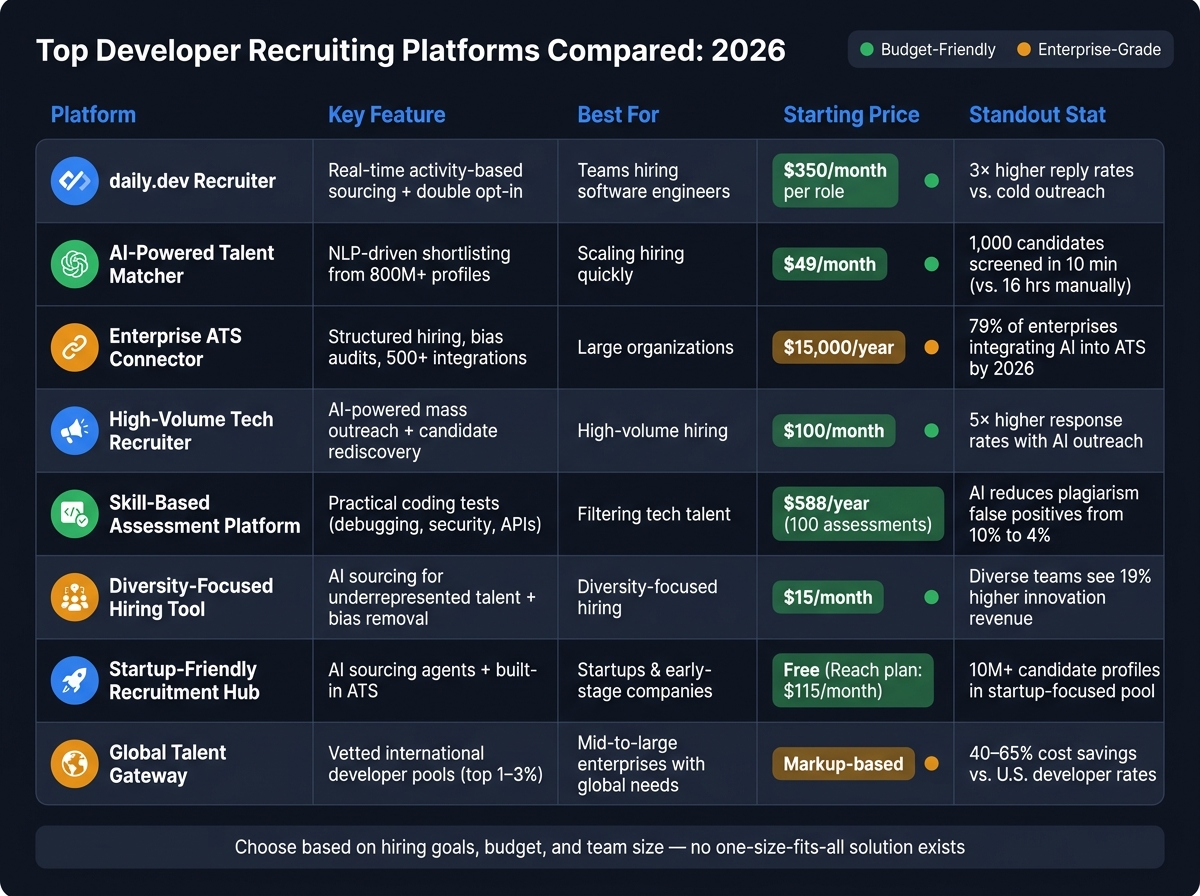
Hiring developers in 2026 is harder than ever. The process is slow, expensive, and filled with challenges like low response rates, passive candidates, and fraud in remote hiring. Choosing the right recruiting platform can save time, money, and frustration. Here's a quick overview of the top platforms and how they address specific hiring bottlenecks:
- daily.dev Recruiter: Targets active developers based on real-time activity. Offers higher response rates with a double opt-in system. Pricing: $350–$1,000/month per role.
- AI-Powered Talent Matcher: Uses AI to find hidden talent and automate screening. Pricing: $49–$399/month.
- Enterprise ATS Connector: Advanced tools for structured hiring and bias audits. Pricing varies ($15,000–$150,000/year).
- High-Volume Tech Recruiter: Ideal for mass hiring with AI-powered outreach and rediscovery tools. Pricing: $100–$169/month.
- Skill-Based Assessment Platforms: Focus on practical coding tests to filter candidates effectively. Pricing: $588–$6,000/year for 100 assessments.
- Diversity-Focused Hiring Tools: Helps source underrepresented talent and reduce bias. Pricing: $15–$15,000/year.
- Startup-Friendly Recruitment Hub: Affordable tools tailored for startups. Pricing: Free–$115/month.
- Global Talent Gateway: Access international developer pools with cost savings of 40–65%. Pricing is markup-based.
Quick Comparison
| Platform | Key Feature | Best For | Starting Price |
|---|---|---|---|
| daily.dev Recruiter | Real-time activity-based sourcing | Teams hiring software engineers | $350/month per role |
| AI Talent Matcher | AI-driven shortlisting | Scaling hiring quickly | $49/month |
| Enterprise ATS Connector | Structured hiring & analytics | Large organizations | $15,000/year |
| High-Volume Recruiter | AI-powered mass hiring tools | High-volume hiring | $100/month |
| Skill-Based Assessments | Practical coding tests | Filtering tech talent | $588/year |
| Diversity Tools | Sourcing underrepresented talent | Diversity-focused hiring | $15/month |
| Startup Recruitment Hub | Affordable startup hiring tools | Startups | Free |
| Global Talent Gateway | International developer pools | Global hiring needs | Markup-based |
Each platform solves different problems, so choose based on your hiring goals, budget, and team size.
1. daily.dev Recruiter
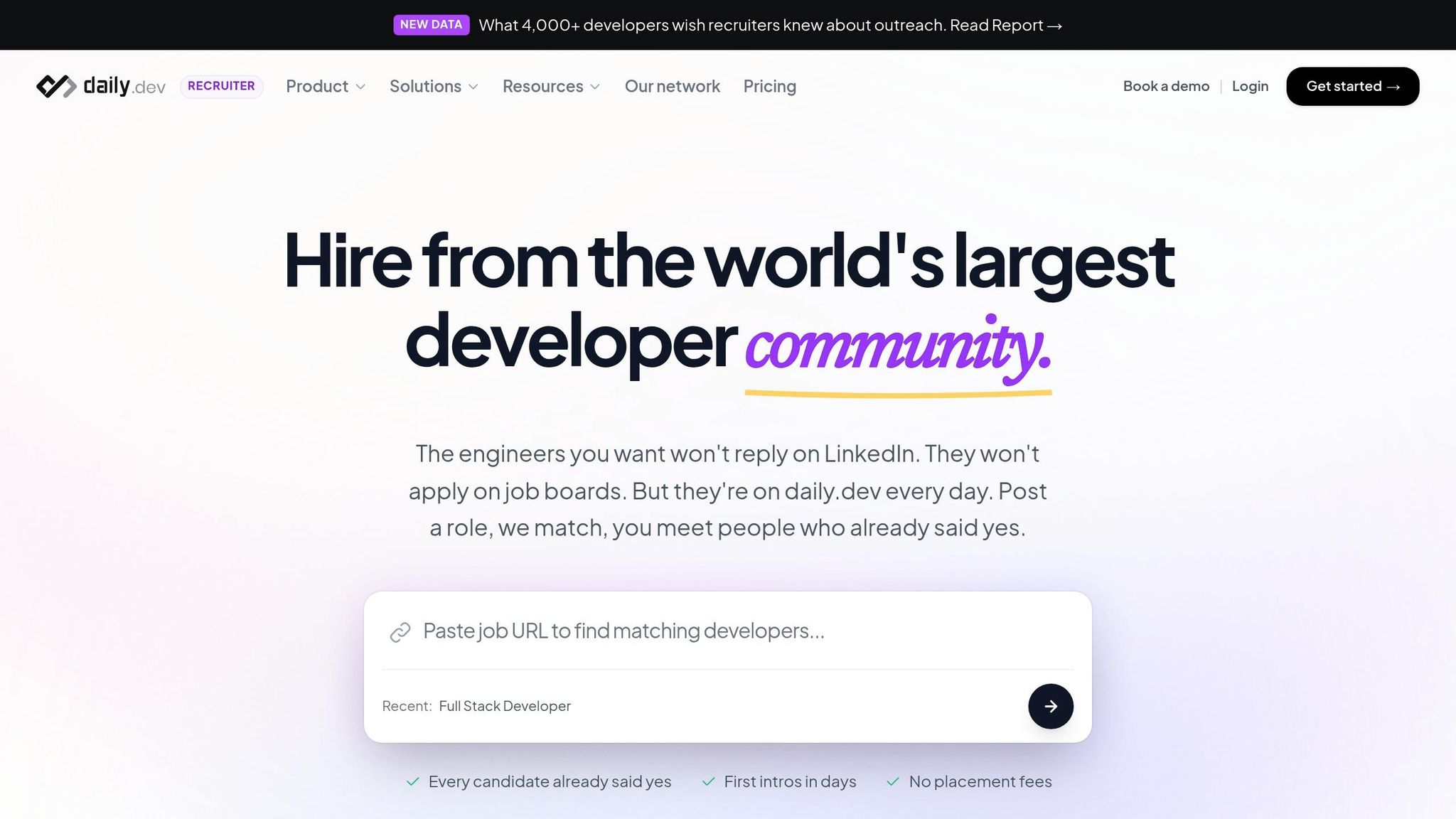
daily.dev Recruiter taps into a thriving community of over 1 million active developers, using real-time behavioral data - like what developers are reading, building, and engaging with - to pinpoint top talent. Instead of relying on outdated mass outreach, this platform identifies candidates based on their actual professional activity, giving recruiters a head start before these developers even update their resumes. It’s a smarter, more efficient way to source talent.
What sets daily.dev Recruiter apart is its double opt-in system. Both recruiters and developers must express interest before any conversations take place. Job opportunities are presented privately to matched candidates, cutting out ghosting, spam complaints, and unnecessary screening calls. daily.dev reports that this method achieves reply rates three times higher than traditional cold outreach and boasts a perfect outreach trust score - far outperforming the sub-1% trust rates often seen with cold emails .
The platform handles important pre-screening tasks automatically. Before candidates are added to your pipeline, it verifies details like their timezone, location, tech stack, and seniority level. Plus, its built-in intelligence tools track where candidates drop off in the process and measure key metrics like time-to-hire, helping recruiters refine their approach .
When it comes to pricing, daily.dev Recruiter keeps things straightforward with flat monthly rates - no placement fees or long-term contracts. The Agent plan starts at $350 per month per role, offering standard matching and unlimited warm introductions. For faster results, the Super Agent plan costs $1,000 per month per role, providing a matching process that’s three times quicker, deeper candidate insights, and seamless two-way integration with developer hiring platforms and ATS tools like Greenhouse, Lever, Ashby, and Workable. For companies with larger hiring needs, a custom Tailored plan is available through their sales team .
2. AI-Powered Talent Matcher
AI-driven talent matchers have moved far beyond simple keyword-based searches. By leveraging natural language processing (NLP), these tools can interpret implied requirements, ensuring candidates with relevant skills, like Python expertise, are identified - even if those skills aren’t explicitly mentioned in their profiles. Take Riem.ai, for instance. It evaluates over 30 million GitHub events monthly to assess actual code quality. This is a game-changer, especially since many software engineers are passive candidates who rarely update their profiles. AI screening has become essential for uncovering this hidden talent pool .
These tools don’t just stop at identifying candidates - they now streamline the entire screening process. AI systems can automatically sort candidates into tiers based on "must-have" and "nice-to-have" criteria, providing clear reasoning for each decision. For example, Juicebox's "PeopleGPT" enables recruiters to describe roles in plain English, accessing a database of over 800 million profiles . The efficiency gains are staggering: automated evaluation tools can reduce the time needed to process 1,000 candidates from 16 hours to just 10 minutes . With reported accuracy rates of up to 95% , these tools directly address inefficiencies in hiring pipelines.
The impact of these advancements is tangible. In 2025, Vodafone reported a 50% reduction in cost-to-hire after implementing Eightfold AI for workforce planning and candidate matching . Their Director of TA Analytics & Automation highlighted the results:
"Eightfold increased our productivity per recruiter by over 50%."
When it comes to pricing, options vary widely. Riem.ai offers subscription plans ranging from $49 to $399 per month, while Juicebox starts at $119 per month . However, many enterprise-level platforms require a demo call before disclosing pricing, which can complicate quick comparisons and make it harder to link costs to performance outcomes.
That said, the effectiveness of AI-powered matchers depends heavily on the quality of the input data. Vague job descriptions lead to vague matches. Recruiters who define specific 30-day objectives - like "launch a payments MVP with Stripe integration" - give the AI clear parameters to work with, resulting in much stronger candidate shortlists.
3. Enterprise ATS Connector
Enterprise ATS platforms have come a long way from just tracking applicants. By 2026, around 79% of enterprise organizations will have integrated AI resume parsing and automation into their ATS systems . These advanced tools now serve as the backbone of talent operations. For developer hiring, an effective system should offer structured scorecards, bias audits, seamless integrations, and quick deployment. These features directly influence both the quality of candidates and the efficiency of sourcing.
The quality of the candidate pool can vary significantly depending on the platform. For instance, Ashby ranks the highest with an AI Visibility Score of 94/100, followed by Greenhouse at 91/100 . Greenhouse emphasizes structured hiring by ensuring every role has a clear scorecard and all interviewers are calibrated, which keeps hiring decisions data-driven instead of relying on intuition . On the other hand, Workday Recruiting scores 76/100 and struggles with high candidate drop-off rates due to a complicated application process . The ability to integrate sourcing methods effectively is just as essential for streamlining the hiring process.
When it comes to tech hiring, strong sourcing capabilities are non-negotiable. Greenhouse offers over 500 native connectors but relies on an external CRM for outbound sourcing. Ashby, however, combines ATS, CRM, and scheduling into one platform, with deployments completed in as little as 3 weeks . For large-scale tech hiring, iCIMS can handle up to 50,000 candidates per requisition, making it a solid choice for high-volume recruitment .
Pricing transparency in this space is a common pain point, as most enterprise platforms require a demo call before revealing costs. Here’s a quick summary of publicly available pricing and implementation timelines:
| Platform | Estimated Annual Cost | Implementation Time |
|---|---|---|
| Greenhouse | $15,000 – $150,000+/year | 2–12 weeks |
| Ashby | $30,000 – $120,000+/year | 2–4 weeks |
| iCIMS | $15,000 – $40,000+/year | 2–6 months |
| SmartRecruiters | Starts at ~$14,995/year | 2–6 months |
| Workday Recruiting | Custom (bundled with HCM) | 9–18 months |
Here’s a tip: when evaluating an enterprise ATS, don’t stop at a dashboard demo. Instead, ask vendors pointed questions like, "What is our source-of-hire quality by channel?" Static reports often miss the nuanced insights critical for developer hiring . Platforms that can confidently provide these details should definitely make your shortlist.
4. High-Volume Tech Recruiter
High-volume recruiting platforms are built to handle the challenges of hiring at scale, especially for technical roles. When it comes to mass developer hiring, speed and efficiency are everything. These platforms excel where traditional technical hiring tools often fall short, offering faster sourcing, screening, and candidate engagement.
A major advantage is access to expansive candidate pools. Tools like Gem and hireEZ pull data from over 45 sources - including GitHub, Stack Overflow, and LinkedIn - to create detailed profiles of over 800 million professionals . Similarly, Pin aggregates data from 850 million profiles and achieves five times higher response rates using AI-powered outreach . Nick Poloni, President of Cascadia Search Group, highlighted the tool's impact:
"I jumped into Pin solo toward the end of 2025 and closed out the year with over $1M in billings during just the final 4 months - no team, no agency."
These platforms also simplify the search process by replacing complex Boolean strings with natural language queries. For example, recruiters can type something as straightforward as "ML engineer with production deployment experience", and the platform handles the rest . Additionally, they enable candidate rediscovery, helping recruiters tap into their existing ATS databases to find candidates who have since gained the required skills .
Screening candidates is another area where these platforms shine. Conversational AI tools like Humanly engage candidates 24/7 through chat, SMS, and voice, automating early-stage screening without requiring manual input . Meanwhile, integrations with tools like HireVue and HackerRank allow for proctored coding tests, with AI reducing plagiarism false positives from 10% to 4% across 35,000 applicants . Features like interview intelligence tools can save recruiters up to 10 hours per week .
Pricing for these platforms varies depending on the features and scale. Here's a quick overview:
| Platform | Starting Price | Pricing Model |
|---|---|---|
| Gem | ~$135/user/month | Startup plan; Enterprise ~$3,600–$4,000/year |
| hireEZ | $169/user/month | Tiered; Enterprise ~$7,000+/year |
| Pin | $100/month | Starter; Business tier at $249/month |
| Humanly | Custom / Quote-based | Premium enterprise SaaS |
| Eightfold AI | Custom / Quote-based | Pricing not publicly disclosed |
While enterprise-grade tools often require custom quotes, platforms like Gem and Pin offer more predictable tiered pricing, making them a good starting point for companies looking to scale without committing to large, open-ended contracts.
5. Skill-Based Assessment Platform
Skill-based assessment platforms are shifting focus toward practical, job-relevant challenges rather than outdated puzzles like inverting binary trees. As the Code Assess AI team aptly put it:
"Inverting binary trees doesn't predict job performance. Debugging broken APIs, fixing security vulnerabilities, and optimizing slow queries do."
The traditional approach often allows unqualified candidates to progress, wasting valuable engineering resources. To address this, QuickScreen assessments - short, 10–15 minute tests embedded directly in job postings - help efficiently screen candidates for high-volume roles.
Several platforms cater to different market needs. HackerRank, with its library of over 2,000 challenges and a 4.2/5 G2 rating from 1,200+ reviews, is a favorite among large enterprises. On the other hand, Codility (4.5/5 from 800+ reviews) and TestGorilla (4.5/5 from 1,500+ reviews) are popular choices for mid-sized companies. Code Assess AI specializes in debugging and security-focused tasks, while DevSkiller's RealLifeTesting™ offers tailored simulations for senior-level roles, moving away from artificial coding exercises.
Pricing transparency is a key differentiator, with some platforms offering clear costs while others require contacting sales for quotes. Here’s an estimate of yearly costs for 100 assessments:
| Platform | Est. Cost for 100 Assessments/Year |
|---|---|
| Code Assess AI | ~$588 (Growth plan) |
| TestGorilla | ~$900 (Pro plan) |
| Coderbyte | ~$1,200 (Business plan) |
| HackerRank | $3,000–$6,000 (estimated) |
| Codility | $5,000+ (estimated) |
The length of assessments should align with the hiring stage. For initial filtering, short QuickScreen tests are ideal. More in-depth evaluations, lasting 30–60 minutes, are better suited for senior candidates. However, keep in mind that longer tests (45–90 minutes) often lead to high drop-off rates - over 60% of candidates may not complete them.
6. Diversity-Focused Hiring Tool
With hiring challenges on the rise, methods for enhancing diversity in technical recruitment can make a big difference. Building a diverse engineering team isn’t just about fairness - it delivers real business results. Companies that rank in the top quartile for gender and ethnic diversity are 25% to 36% more likely to outperform financially, and diverse management teams see 19% higher innovation revenue. However, despite these benefits, a staggering 76% of hires still come from a single source. Let’s look at how AI-powered platforms and niche job boards are reshaping the hiring landscape.
Expanding Talent Pools Through AI and Niche Platforms
Platforms like SeekOut (rated 4.8/5) use AI to identify underrepresented candidates, helping companies expand their reach. Niche job boards also play a crucial role. For example:
- Jopwell connects employers with Black, Latinx, and Native American professionals.
- PowerToFly focuses on improving gender diversity in the workplace.
These platforms don’t just source resumes - they build active, engaged communities of candidates.
Reducing Bias in Hiring Processes
Beyond sourcing, these tools help ensure fair evaluations. Platforms like PMaps, HireHunch, and Breezy HR remove personal details early in the hiring process. Features such as "Incognito Apply" anonymize candidate names, replacing them with neutral identifiers (e.g., "Adjective + Animal") until the interview stage. Meanwhile, HackerEarth (rated 4.9/5) takes a skills-first approach, assessing candidates based on coding ability rather than resumes or GPAs.
A Real-World Success Story
One standout example of diversity-focused hiring comes from Attest, a consumer research company. In April 2026, Attest began listing salary ranges in all job postings to address the "Ask Gap." This gap often sees minority women requesting up to 40% less than their white male peers. Led by Emily Meiklejohn, this initiative increased candidate diversity without raising the number of declined offers.
Pricing Overview
Pricing for these tools varies significantly depending on features and scale:
| Platform | Starting Price | Pricing Model |
|---|---|---|
| Manatal | $15–$19/user/month | Transparent subscription |
| Canditech | $75/month | Team plan |
| HackerEarth | $99/month | Growth plan |
| Greenhouse | ~$500/month | Quote-based |
| SeekOut | $2,150/year | Recruit Lite |
| Textio | $15,000/year | Small team rate |
| HireVue | $35,000/year | Essentials plan |
For mid-sized tech teams, HackerEarth and Greenhouse strike a good balance between reducing bias and managing costs. These tools not only help build diverse teams but also ensure that hiring processes are fair and effective.
7. Startup-Friendly Recruitment Hub
For startups, every hire is critical, and every dollar has to be stretched wisely. Wellfound (rated 4.2/5 on G2) is specifically designed with startups in mind, attracting engineers, machine learning practitioners, and data scientists who are already interested in startup and growth-stage opportunities. This focus creates a natural advantage - unlike generic platforms like LinkedIn, which often see reply rates as low as 5% , Wellfound’s marketplace model is tailored to significantly improve those numbers. Its specialized features cater to the unique challenges startups face when sourcing and screening talent. Implementing effective developer sourcing strategies is essential for these lean teams to compete with larger tech firms.
Candidate Pool and Sourcing
Wellfound offers access to a massive database of over 10,000,000 candidate profiles . These aren’t just passive job seekers - they’re professionals who have deliberately opted into a startup-centric ecosystem. To make sourcing even easier, the platform includes automated candidate sourcing agents. These tools allow lean recruiting teams to run multiple searches simultaneously, using plain English or even voice-to-text. For example, you can describe your ideal hire as an “ML engineer with production experience in transformer models,” and the platform will surface relevant matches .
Screening Without the Guesswork
Beyond sourcing, Wellfound includes tools to streamline screening. The Company Selectivity Filter helps recruiters assess candidates based on the hiring standards of their previous employers. Before reaching out, you can also review key details like salary expectations, equity preferences, and ideal company size. This avoids wasting time on mismatched candidates .
"The marketplace model attracts technical candidates actively interested in startup and growth-stage roles, creating a self-selection effect that materially improves response rates compared to cold outreach on generic platforms." - Rachel Macfarlane, Product Education & Community Enablement Lead, Wellfound
For teams that need additional support, Wellfound’s Autopilot managed tier combines AI with expert recruiters to handle high-volume profile reviews. This service quickly delivers a shortlist of qualified, interested candidates. Pricing for this tier is customized and requires a conversation with their sales team .
Pricing Transparency
Wellfound’s features are designed to make startup recruitment both efficient and affordable. The entry-level Reach plan starts at $115/month, making it accessible for early-stage companies. There’s also a free tier that includes a built-in applicant tracking system (ATS), which can help startups manage inbound applications without needing to invest in separate tracking software .
| Feature | Startup Benefit |
|---|---|
| AI Agents | Conduct multiple searches without expanding your team |
| Company Selectivity Filter | Identify candidates from top-tier tech environments quickly |
| Preference Data | Avoid outreach to candidates outside your salary or equity range |
| Built-in ATS | Simplifies applicant tracking without extra costs |
It’s worth noting that Wellfound’s candidate pool is heavily focused on technical and startup roles, which might limit its usefulness for non-technical positions .
8. Global Talent Gateway
Global talent platforms open up a world of possibilities by connecting you with developers from across the globe. These platforms use AI-driven matching systems to sift through millions of profiles - Turing, for example, boasts a database of over 3,000,000 vetted developers . The goal? To match candidates with the right technical expertise, seniority, and project requirements.
Candidate Pool and Vetting
One of the standout features of these platforms is their rigorous screening process. Take Toptal, for instance, which claims to accept only the top 3% of applicants, and Crossover, which focuses on the top 1% . The multi-step evaluation process often includes automated technical tests, live coding exercises, and communication assessments. This thorough vetting ensures you’re accessing a pre-qualified pool of candidates, saving your hiring team hours of initial screening. This aligns with the broader goal of using advanced tools to make tech recruitment more efficient.
Sourcing Across Regions
Another major perk is the ability to tap into regional cost differences. For example, developers in Eastern Europe typically charge $25–$70 per hour, while those in Latin America range from $20–$60 per hour. This translates to savings of 40–65% compared to U.S. rates . Many platforms also offer filters for time-zone overlap, which is especially helpful for U.S. companies looking to hire nearshore talent in Latin America who can work standard business hours . With these sourcing and cost advantages in mind, understanding pricing structures becomes the next key step.
Pricing Transparency
Most global platforms use a markup-based pricing model, where a hidden margin is added to developer earnings . This lack of transparency can make budgeting tricky, particularly for smaller companies. As a result, these platforms tend to be a better fit for mid-to-large enterprises that have the resources to negotiate custom terms .
| Factor | What to Expect |
|---|---|
| Candidate vetting | Multi-stage technical and communication screenings |
| Geographic coverage | Eastern Europe, Latin America |
| Cost savings vs. U.S. rates | 40–65% lower hourly rates |
| Pricing model | Markup-based; rates rarely disclosed publicly |
| Best fit | Mid-to-large enterprises with international hiring needs |
Pros and Cons
When it comes to recruiting developers in 2026, understanding the trade-offs of various platforms is essential. Each option has its own strengths and weaknesses, and the best fit depends on factors like your team size, budget, hiring timeline, and the type of developer you're targeting. Using a developer hiring checklist can help ensure you cover all necessary steps during this evaluation.
| Platform | Strengths | Weaknesses | Best Fit |
|---|---|---|---|
| daily.dev Recruiter | Warm, double opt-in introductions; access to active, engaged developers; transparent pricing; no cold outreach needed | Focused solely on developers, not broader tech roles | Teams hiring software engineers who value higher reply rates and quality over sheer volume |
| AI-Powered Talent Matcher | Quick shortlists (within 24–72 hours); AI-driven matching from large talent pools | Hidden markup pricing; variable candidate quality; lower developer satisfaction | Teams needing to scale hiring rapidly |
| Enterprise ATS Connector | Advanced analytics; 500+ integrations; reduces hiring bias | Steep learning curve; high cost (e.g., Greenhouse starts at ~$5,000–$6,000/year) | Large organizations with structured, data-driven hiring processes |
| High-Volume Tech Recruiter | Extensive global talent pool; flexible pricing (e.g., Upwork: $15–$150+/hour) | Requires significant manual vetting; inconsistent quality | Short-term projects or gig-based work |
| Skill-Based Assessment Platform | Top-tier vetting (e.g., Toptal: top 3%; Arc.dev: top 2.3%); risk-free trial periods | Premium pricing ($60–$180+/hour); limited coverage for niche tech stacks | Critical engineering roles requiring top talent |
| Diversity-Focused Hiring Tool | Highlights underrepresented talent using GitHub and patent data; strong DEI filters | Inconsistent contact quality; complex interfaces | Teams with active diversity hiring mandates |
| Startup-Friendly Recruitment Hub | Transparent cost-plus pricing; fast matching; budget-friendly (e.g., Manatal: $15/user/month) | Often focused on specific regions (e.g., LATAM, Eastern Europe) | Early-stage startups and small businesses |
| Global Talent Gateway | Access to international developer pools; significant cost savings (40–65% compared to U.S. rates) | Markup-based pricing lacks transparency; requires self-managed vetting | Mid-to-large enterprises with global hiring needs |
Key Takeaways for Recruiters
Transparent pricing models matter. Platforms using cost-plus pricing - where both the developer's salary and platform fees are visible - help align incentives between all parties. In contrast, markup-based platforms often hide their margins, which can lead to frustration and higher turnover once developers discover discrepancies in their pay .
Post-hire support can make a difference. While most platforms focus solely on placement, only a few offer tools for retention or ongoing developer satisfaction monitoring. For long-term roles, this kind of support can play a critical role in maintaining a productive and happy team .
Conclusion
Picking the right developer recruiting platform boils down to three main factors: who you’re hiring, how fast you need them, and what your budget looks like.
For teams looking to hire software engineers, daily.dev Recruiter offers a standout solution. Its warm, double opt-in approach connects you directly with active, engaged candidates, ensuring higher reply rates and smoother candidate validation. By leveraging behavioral data for matching and automating pre-screening, it cuts through the clutter of cold outreach, delivering candidates who genuinely align with your job requirements.
One often-overlooked detail is pricing transparency, which plays a big role in retention. Platforms with cost-plus pricing align incentives between you and the developer, while markup-based models can create friction when developers discover hidden margins .
As remote hiring continues to expand, passive candidates now make up a large portion of the developer talent pool. This is where daily.dev Recruiter shines, using proactive, targeted sourcing to reach skilled professionals before they even think about updating their resumes . It’s a solution tailored to the realities of today’s hiring landscape.
The takeaway? There’s no one-size-fits-all platform. The best choice depends on your team’s goals, whether it’s prioritizing engagement, simplifying workflows, or finding candidates who meet your exact needs.
FAQs
Which platform type fits my team size and hiring speed?
The right platform for you largely hinges on your team size and hiring priorities. For smaller teams or those aiming to hire quickly, platforms that leverage AI for automation and efficient outreach can be a game-changer. On the other hand, larger teams focused on scaling while maintaining quality may lean toward platforms offering predictive hiring tools and structured assessments. Choose a tool that aligns with your goals - whether that’s speed for smaller operations or thorough evaluations for larger-scale hiring.
How do I avoid low reply rates and candidate ghosting?
To boost reply rates and cut down on ghosting, prioritize engagement and clear communication. Automated outreach tools can help you manage multi-channel messaging effectively, but personalization is key - tailor messages to reflect each candidate's goals and aspirations.
Building trust is equally important. Use double opt-in introductions to show respect for candidates' time and preferences. Be upfront about timelines and expectations to avoid misunderstandings.
Finally, stay responsive. Quick replies and consistent updates throughout the hiring process keep candidates engaged and show them you're invested in their experience.
What pricing model is best for budgeting and retention?
The best pricing model for your hiring strategy depends on your specific needs and objectives. Subscription-based plans can be a great choice for predictable costs, making budgeting easier while offering scalability. If retaining employees is a priority, platforms with engagement tools - like behavioral matching - can help build loyalty and reduce turnover. For businesses with fluctuating hiring demands, tiered pricing provides flexibility by adjusting costs based on hiring volume, ensuring you stay efficient without compromising access to skilled talent. A mix of predictable pricing and retention-focused features often yields the most effective results.
.png)