Scaling an engineering team to 500+ requires a system that balances speed, quality, and efficiency. Traditional talent acquisition for engineering teams often crumbles under the demands of high-volume recruitment, especially in a competitive market where top developers are hired within 10 days while enterprises average 44 days per hire. Here’s how to build a scalable hiring engine:
- Specialized Hiring Teams: Use sourcing specialists, screening coordinators, and interview schedulers to streamline workflows and reduce recruiter workload.
- Structured Processes: Define clear hiring stages, use scorecards for objective evaluations, and set service-level agreements (SLAs) to eliminate delays.
- Technology Integration: Leverage tools like ATS platforms, coding test platforms, and developer-focused sourcing tools to automate tasks and manage pipelines efficiently.
- Multi-Channel Sourcing: Engage developers on platforms like GitHub, Kaggle, and Hugging Face, and use AI-powered tools like daily.dev Recruiter for warm, pre-qualified leads.
- Data-Driven Decisions: Track metrics like time-to-fill, offer-to-join rates, and 90-day retention to identify bottlenecks and maintain hiring standards.
Scaling beyond 500 engineers isn’t just about hiring faster - it’s about building a system that ensures quality, reduces risk, and respects candidates’ time.
Laying the Foundation for Enterprise-Scale Hiring
Enterprise hiring often stumbles due to delays in internal coordination. As Dinesh Agarwal of V3 Staffing explains:
"Enterprise hiring fails mainly due to internal coordination delays, not a lack of candidates."
To overcome these delays, it's crucial to build a strong hiring foundation. This involves tackling three key areas from the start: headcount planning, recruiting team structure, and compliance risk management.
Workforce Planning and Role Segmentation
Setting vague hiring goals like "we need 80 engineers this year" doesn't work when scaling. Effective workforce planning requires breaking down those numbers by function (e.g., frontend, backend, QA, DevOps), seniority (Junior, Mid, Senior, Staff, Principal), and squad alignment.
Adopting a squad model early can make a big difference. These cross-functional teams - typically 6–8 engineers focused on a specific product or user journey - provide a clear framework for planning. For example, when a new squad is formed, you’ll know exactly which roles and skill levels are needed. A good rule of thumb: 1 senior engineer for every 3 junior engineers to avoid mentorship bottlenecks as the team grows .
Before opening a new role, create a concise, one-page profile that outlines the problem the hire will address and their expected impact within their first 90 days . This practice helps eliminate vague job descriptions that can attract unsuitable candidates and slow down the hiring process.
Choosing Your Developer Hiring Operating Model
When it comes to organizing your recruiting efforts, two common models are centralized (one recruiting team for all business units) and decentralized (each engineering team handles its own hiring). However, neither approach works well on its own once you reach 500+ engineers. A hybrid hiring pod model, combining the strengths of both, tends to work best at scale.
In this model, small recruiting pods are embedded within specific engineering domains but are coordinated by a central operations team. Each pod typically includes a sourcing specialist, a screening coordinator, and an interview scheduler. This structure allows for deeper market expertise and faster hiring pipelines.
The key to making these pods effective is accountability. Set strict SLAs (service-level agreements) for every stage of the process - such as requiring hiring managers to provide feedback within 48 hours or ensuring the first interview is scheduled within a set timeframe. Without these guardrails, delays can quickly snowball, especially when managing multiple searches simultaneously.
Once your hiring structure is in place, the next step is addressing compliance and minimizing risks as your team scales.
Compliance and Risk Management in Developer Hiring
At the enterprise level, compliance becomes a major operational concern. The table below highlights common risk categories and strategies to mitigate them:
| Risk Category | Critical Consideration | Mitigation Strategy |
|---|---|---|
| Legal | EEOC / Bias | Use structured interviews and standardized scorecards |
| Data | GDPR / CCPA | Implement automated data retention and destruction policies |
| Financial | Pay Inequity | Establish fixed salary ranges for role tiers |
| Operational | Technical Debt | Maintain a high hiring standard despite volume pressures |
| Security | Fraud Management | Use AI-driven identity and background verification tools |
To reduce bias and ensure fair hiring decisions, shift from informal interviews to structured scorecards and predefined rubrics. GitLab, for example, introduced standardized interview projects with clear objectives and scoring criteria during its rapid growth phase. This allowed hiring decisions to be based on objective scores rather than subjective opinions .
Additionally, your recruiting tools need to meet enterprise-level security requirements. Any technical hiring tools like an applicant tracking system (ATS) or sourcing software must support features like right-to-work verification, equal opportunity monitoring, and proper data retention policies. This becomes especially important when hiring across multiple states or internationally.
Building a Scalable Hiring Engine
Once you’ve established a solid hiring structure and compliance framework, the next step is creating a system that can handle high volumes of candidates without compromising on quality.
Standardizing the Hiring Funnel
Most hiring pipelines fail under pressure because they’re not built to handle scale. The solution? Clearly define every stage of the funnel before the surge begins.
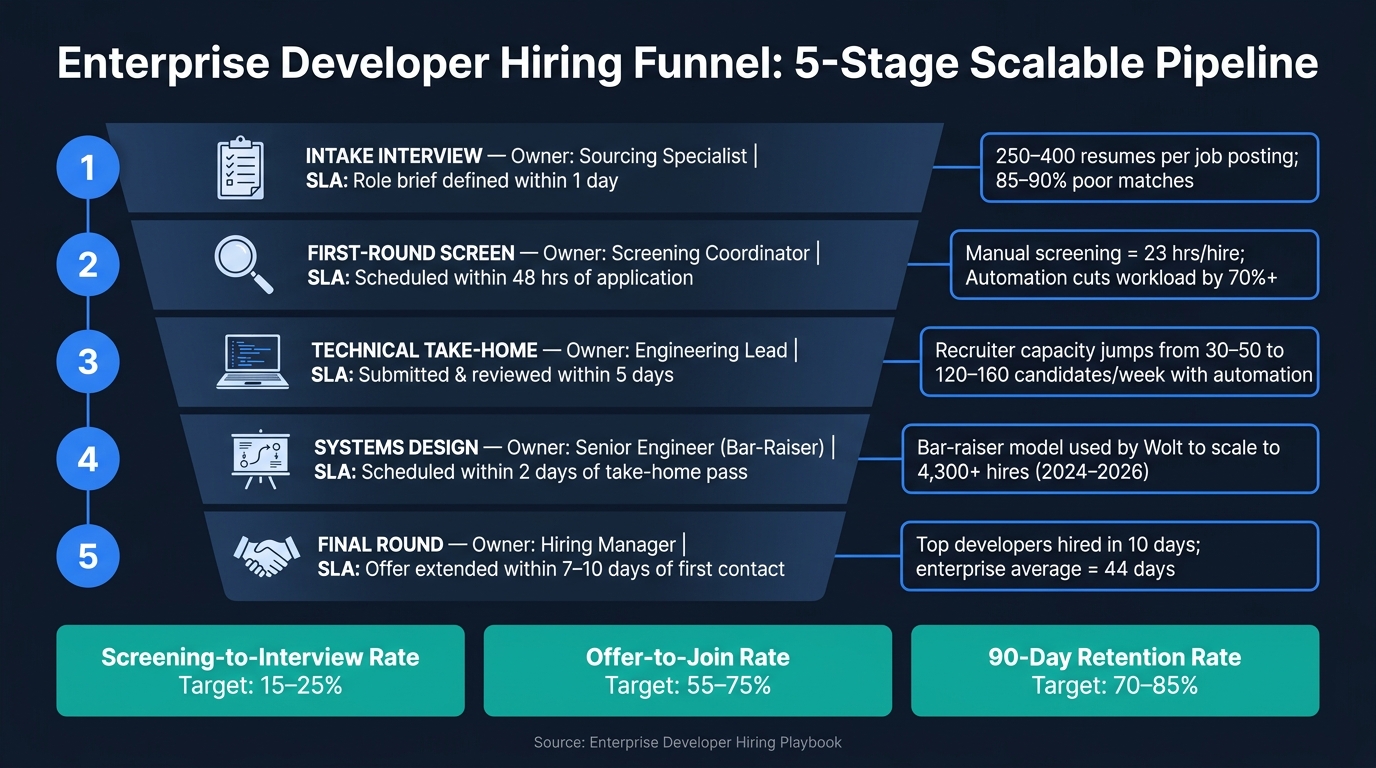
A typical high-volume developer hiring process includes five stages: intake interview → first-round screen → technical take-home → systems design → final round . Each stage should have a dedicated owner, a set time frame, and a specific output - usually a scorecard score - to determine whether the candidate advances.
Here’s the reality: the average job posting attracts 250–400 resumes, with 85–90% being poor matches . Screening all these manually takes about 23 hours per hire, with administrative tasks consuming 40–60% of a recruiter’s time . Automating the early stages - like resume reviews and initial screenings - can reduce this workload by 70% or more, boosting recruiter capacity from 30–50 candidates weekly to 120–160 .
"Most hiring systems collapse not because companies can't find enough applicants, but because they receive too many unqualified ones, and the right signals arrive too late." - Nawal Mishra, JusRecruit
Here’s a real-world example: In early 2026, ClearDesk CEO Aman Makkar invested $30,000 in a custom AI-powered hiring system. This tool scored resumes on a 0–100 scale based on a predefined rubric and conducted initial screening interviews autonomously. The result? ClearDesk managed 30,000–40,000 applications per month while cutting their 30% no-show rate, which had previously been a major issue with human-first screening methods .
Once your funnel is structured, the next step is making sure your tools and systems work seamlessly to support it.
Selecting and Integrating Your Hiring Tech Stack
An effective tech stack is key to keeping your hiring engine running smoothly. For developer hiring, you’ll need three essential tools: an ATS (Applicant Tracking System) for managing pipelines, a coding assessment platform for technical evaluations, and a developer-focused sourcing tool to connect with passive developer candidates.
When it comes to ATS platforms, your choice depends on your team’s specific needs:
| Platform | Best For | G2 Rating |
|---|---|---|
| Gem | AI-driven enterprises combining ATS, CRM, and sourcing | 4.7/5 |
| Ashby | Teams needing deep customization and detailed reporting | 4.7/5 |
| Greenhouse | Teams with established structured workflows | 4.4/5 |
| SmartRecruiters | Global teams with multi-language and compliance needs | N/A |
For sourcing developers, traditional job boards often fall short. Developers are more likely to be found in technical spaces - like open-source communities or engineering forums - rather than browsing job sites. daily.dev Recruiter is a tool that taps directly into these spaces, connecting you with developers actively engaging with technical content, rather than inactive profiles. This approach is essential for understanding developer needs and aligning your outreach with their career goals.
To keep your hiring process efficient, all tools - ATS, sourcing platforms, scheduling systems, and assessment tools - should integrate seamlessly. This ensures data flows automatically, reducing manual handoffs and maintaining momentum. Features like automated scheduling reminders, scorecard updates, and synced data across platforms can significantly reduce recruiter workload while keeping the pipeline moving.
Using Data to Drive Hiring Decisions
Once your tech stack is set up, use the data it generates to refine your hiring process and ensure it scales effectively, even for hundreds of hires.
Scorecards are only useful if everyone agrees on what they’re evaluating. Before scaling, clearly define what "senior" means for your engineering roles. This isn’t just about titles - it’s about identifying specific skills, behaviors, and potential red flags. Without this clarity, two interviewers might leave the same conversation with completely different impressions.
Regular calibration sessions can help. Bring hiring managers together to review recent decisions, compare scorecards, and address any inconsistencies. For example, Super.com, under Henry Shi’s leadership, hired over 500 people by 2026. They used a Notion-based recruiting hub to centralize scorecards, ensuring consistency as their team tripled in size within just 12 months .
At this stage, it’s not just about speed - it’s about quality. Keep an eye on these metrics to gauge your process:
- Screening-to-interview conversion rate: 15–25% indicates your filters are effective.
- Offer-to-join rate: 55–75% shows your process and candidate experience are resonating.
- 90-day retention rate: 70–85% reflects whether your hires are sticking around and ramping up effectively .
"Hiring fifty engineers who churn at six months because they never got properly ramped is worse than hiring thirty who stay and become productive." - Martin Bernard, Tribe
Sourcing and Engaging Developers at Scale
Once your hiring funnel is standardized and your tech stack is set up, the next hurdle is keeping that funnel full without compromising on quality. For engineering teams of 500+ professionals, relying solely on one sourcing channel or waiting for applications won't cut it. You need a deliberate, multi-channel strategy running simultaneously.
Running a Multi-Channel Sourcing Strategy
The best hiring teams don’t wait for developers to come to them - they go to the spaces where developers already showcase their skills. Moving beyond generic job boards is essential. Instead, focus on platforms where technical expertise is on display.
Platforms like GitHub, Kaggle, and Hugging Face are excellent for sourcing technical talent. GitHub lets you find engineers through their contributions to repositories, Kaggle highlights top data scientists via competition rankings, and Hugging Face connects you with engineers publishing real-world models. High-value employee referral programs also play a key role. For instance, Tenex spent $5,000 on a public referral program in early 2026 and hired 15 engineers in just 37 days .
Here’s a quick overview of effective sourcing channels for developers:
| Channel | Best For | Candidate Quality |
|---|---|---|
| GitHub | ML Engineers, MLOps | High (verified work) |
| Kaggle | Data Scientists | High (ranked) |
| Hugging Face | LLM/GenAI Engineers | High (published models) |
| daily.dev | Passive Developers | High |
| AI Slack/Discord | Niche Specializations | Medium–High |
| University Pipelines | Junior Roles | Medium |
Another overlooked talent pool is made up of founding engineers from recently failed startups. These individuals often bring broad, high-ownership experience. Communities like Indie Hackers or specialized groups such as the Claude code community are great places to find them .
When reaching out, personalization makes all the difference. Mentioning a developer’s specific open-source contributions or Kaggle competition results helps your message stand out from generic recruiter emails. This is crucial because many developers misunderstand job descriptions when they are too vague or generic. Time is another key factor - top-tier developers often juggle offers from multiple companies, so moving quickly from first contact to an offer is essential .
Using daily.dev Recruiter for Developer-First Sourcing
Adding a specialized tool to your sourcing strategy can take developer engagement to the next level. Cold outreach often falls flat - LinkedIn InMail, for example, has an average response rate of just 5%. In contrast, daily.dev Recruiter uses a warm, double opt-in method that ensures every conversation starts with a candidate who has already reviewed the role and shown interest. This approach achieves a 100% trust score .
Instead of lengthy developer job descriptions, daily.dev Recruiter uses concise, technical briefs that focus on what developers care about most: the tech stack, team size, salary range, and the challenges they’ll work on. This not only respects their time but also ensures you’re connecting with genuinely interested candidates.
Additionally, the platform integrates seamlessly with ATS systems like Greenhouse, Lever, Ashby, and Workable. This automation keeps your pipeline moving by streamlining candidate profile creation and status updates.
Beyond immediate outreach, building long-term relationships is essential for sustained success.
Building Long-Term Talent Pipelines
Not every strong candidate is ready to make a move right away. At scale, treating every "not yet" as a dead end can be a costly mistake. Candidates who make it far into your hiring process but don’t receive an offer remain valuable. For niche roles, where the talent pool might be limited to fewer than 1,000 people nationwide, nurturing these connections over 6–8 weeks can mean the difference between filling a position quickly and leaving it unfilled for months .
Simple follow-ups - like sharing a relevant article, providing project updates, or sending a quick check-in message - can keep relationships alive without being intrusive.
Platforms like daily.dev also help you track engagement with targeted technical content. This allows you to spot developers showing early signs of job-seeking interest, often weeks before they update their resumes or appear on job boards. Reaching out early gives you a significant edge over teams that wait until candidates are actively in the market.
"The fee isn't the cost. The delay is the cost." - Tim Kirby, Startup Advisor
The ultimate goal is to maintain a constantly evolving talent pipeline so you’re never starting from scratch when a new role opens.
Optimizing Hiring Metrics and Candidate Experience
Once your sourcing channels are humming and your pipeline is full, the next big challenge is moving candidates through the process efficiently. The trick? Doing it quickly without compromising on quality or leaving candidates with a negative impression of your company.
### Reducing Time-to-Hire Without Lowering Standards
Speed is often underestimated in hiring. Did you know the average time-to-hire for senior developers has climbed to 68 days - a 21% increase from the previous year ? Meanwhile, top candidates are entertaining three to five job offers at any given time . Every extra day you take to decide is another chance for a competitor to make their move.
One way to speed things up is to parallelize interview stages. Instead of the traditional approach - one round, wait for feedback, then schedule the next - consider blocking off dedicated interview days for specific roles. For instance, you could host "Backend Tuesdays" and process up to 200 candidates in a single day, delivering same-day decisions . Pre-booking interview slots can also reduce the time-to-shortlist from 5–10 days to just 2–4 days, allowing you to extend offers within 7–10 days of first contact . It’s an aggressive timeline, but entirely doable if your process prioritizes speed from the start.
Of course, moving quickly doesn’t mean lowering your standards. A fast process is only effective if it’s paired with a rigorous evaluation system.
Maintaining High Standards During Hypergrowth
When you’re scaling fast, there’s a real risk of standard drift - where different interviewers apply inconsistent criteria, causing your hiring bar to shift without anyone realizing it. The solution? Calibration.
Host monthly calibration reviews where recruiters and hiring managers compare scores for similar candidate responses side by side . This ensures everyone stays aligned on what qualifies as "good." Combine this with fixed scoring rubrics that outline clear pass/fail criteria for key competencies like problem-solving and system design. These rubrics reduce subjective debates and keep decisions consistent.
Another powerful tool is the "bar-raiser" model. Assign senior engineers to focus solely on assessing technical depth, leaving hiring managers free to evaluate culture fit and handle closing . Wolt successfully used this approach, combining structured interviews with specialized recruiting teams to scale to 4,300+ hires between 2024 and 2026 .
And let’s rethink how we evaluate technical skills. Replace generic whiteboard coding tests with project-based assessments - whether it’s take-home assignments or live system design discussions. These methods reflect real-world job conditions and assess practical judgment, not just interview prep.
"The best developers ship well, not interview well. The correlation between interview charisma and actual output was nearly zero." - Martin Bernard, Author
Creating a Developer-Centric Candidate Experience
Beyond metrics and technical evaluations, the way candidates experience your hiring process can make or break your reputation. Developers talk, and word of a bad experience spreads fast on social media and within professional circles. When you’re managing a team of 500+ engineers, your candidate experience becomes a key part of your employer brand.
The basics are often overlooked but incredibly important: clear communication at every stage, no unexplained delays, and a process that respects candidates’ time. Avoid lengthy, multi-round loops that drag on for weeks. Instead, focus on what you might call return-on-time-spent - evaluate candidates in as few steps as possible .
Honesty goes a long way. Be upfront about the challenges of the role, whether it’s infrastructure issues, workload expectations, or compensation structure. This “anti-selling” approach may seem counterintuitive, but it helps filter for genuine fits and shows respect for candidates. It also reduces offer declines and early attrition. Axis Bank, for example, scaled its hiring process using an AI-powered ATS while maintaining a 4.8/5 candidate experience score .
Lastly, make remote hiring the default. With 74% of developers preferring remote or hybrid work , offering asynchronous assessments and flexible scheduling isn’t just a nice-to-have - it’s essential for attracting top talent.
Measuring Success and Scaling Beyond 500 Engineers
Tracking Core Recruitment Metrics
When scaling beyond 500 engineers, it's not enough to rely on intuition - success depends on tracking the right metrics. These numbers help you understand if you're hiring efficiently, competitively, and sustainably. It's about more than speed; it's about ensuring you're bringing in the right talent and keeping them.
Here are four key metrics every hiring team should monitor:
| KPI | What It Tells You | Benchmark |
|---|---|---|
| Time-to-fill | How quickly roles are filled | (use a hiring timeline planner to optimize this) 7–14 days (high-volume) / 22–35 days (enterprise) |
| Screening-to-interview | Quality of sourcing efforts | 15–25% |
| Offer-to-join | Candidate experience and competitiveness | 55–75% |
| 90-day retention | Quality and fit of hires | 70–85% |
If your offer-to-join rate dips below 55%, it could signal issues with your candidate experience or compensation packages. Similarly, if 90-day retention drops under 70%, it may indicate that your hiring standards have slipped during rapid growth. These metrics aren't just numbers - they're a diagnostic tool to identify where things might be going wrong.
Using Data to Find and Fix Bottlenecks
Metrics show you what’s happening, but analytics help you understand why. To address bottlenecks in a hiring process handling hundreds of open roles, dig deeper into the data.
Start by analyzing time-in-stage reporting. This helps you pinpoint where candidates are getting stuck - whether it’s a delay in receiving feedback from a hiring manager or a scheduling bottleneck between interviews. For example, if 40% of candidates are dropping out during a specific technical assessment, it’s worth investigating whether that stage is effectively evaluating the right skills or simply acting as a roadblock.
"Recruiting analytics turns scattered hiring data into a strategic advantage." - Marcos Junca, Taleva
To make analytics work, treat your hiring data with care. Regular audits, consistent tagging (e.g., avoiding discrepancies like "LinkedIn" vs. "LI"), and meaningful rejection reasons (e.g., "Lacks Go experience" instead of "Not qualified") are essential. Clean data enables deeper insights, such as breaking down offer decline rates by department, recruiter, or compensation band, to identify and address specific issues.
Adjusting Hiring Structures as Teams Grow
As you scale, your hiring structure will need to evolve. Raylene Yung, an engineering leader at Stripe, highlights this natural progression:
"I've found our processes run well for about six to nine months before we need to update them."
For teams with 300–400 engineers, the generalist recruiter model often starts to falter. Shifting to specialized roles can help avoid bottlenecks, allowing team members to focus on specific steps in the hiring process.
Beyond 500 engineers, consider organizing teams into cross-functional squads of 6–8 members with clear responsibilities. This reduces coordination challenges and makes it easier to recruit for well-defined roles. Hiring pods can mirror this structure, focusing on specific domains like Infrastructure, Machine Learning, or Frontend, each with tailored rubrics and interview processes.
If you're expanding globally, offshore staff augmentation can be a cost-effective strategy. Offshore senior engineers can cost $48,000–$120,000 annually, compared to $180,000–$250,000 for their U.S.-based counterparts. With a well-run model, you can still achieve a developer retention rate of 95%, making it a viable option for scaling efficiently.
Conclusion: Building a Scalable, Developer-First Hiring Process
Growing to a team of 500+ engineers requires a well-thought-out system. This includes using standardized processes, structured scorecards, and accurate data, and creating a candidate experience that respects developers' time and expertise.
Successful companies lay the groundwork by documenting their culture and hiring principles early on, prioritizing Developer Experience from the start, and treating sourcing as an opportunity to build trust. As Henry Shi, Co-founder of Super.com, shared after scaling to over 500 employees and surpassing $200 million in annual revenue:
"You need to hire differently, because you need 5 people (instead of 50) who can 10x their output with AI."
This level of internal organization must be paired with a thoughtful approach to reaching candidates. Tools like daily.dev Recruiter tackle this challenge by connecting hiring teams with developers through warm, double opt-in introductions. These interactions happen on a platform where engineers are already learning and engaging, ensuring that every introduction is pre-qualified. The result? Fewer unproductive conversations and stronger, more meaningful connections from the very beginning.
FAQs
When should we switch to hiring pods?
When scaling teams quickly - especially when reaching around 50 to 100 engineers - consider switching to hiring pods. This method can help maintain high standards, streamline coordination, and support efficient team growth. It’s a strategy often backed by proven enterprise scaling frameworks designed to manage rapid expansion without sacrificing quality.
What should a 90-day role profile include?
A 90-day role profile is a roadmap for a new hire's first three months. It should clearly define expectations, objectives, and key results to guide their performance. This approach not only ensures a smoother integration but also establishes measurable goals to track their progress and success.
What hiring metrics are most important at 500+ engineers?
When growing to a team of 500+ engineers, it's crucial to prioritize metrics that align with long-term goals. Key areas to track include candidate quality, time-to-hire, and pipeline velocity to ensure recruitment efforts remain efficient and effective. Keep an eye on diversity in the candidate pool, new hire retention rates, and interview-to-offer ratios to maintain a well-rounded and sustainable hiring process.
Additionally, evaluating the performance of sourcing channels and automation tools can highlight areas for improvement. Lastly, monitoring candidate experience scores is essential for refining workflows and fostering a thriving, high-performing engineering environment.
.png)