Many companies wait until roles open to start recruiting developers. This reactive method often leads to rushed hires, higher costs, and missed opportunities with top talent. Here's the core insight: 70% of top developers are passive candidates not actively job hunting, but they’re open to the right opportunity. These developers are active on platforms like GitHub, Stack Overflow, and daily.dev - not job boards.
To attract and engage these skilled professionals, you need a proactive, community-driven approach. Build relationships early by engaging where developers already spend their time. Use behavioral signals, like GitHub contributions or Stack Overflow activity, to identify talent. Focus on permission-based outreach - ask for consent before pitching roles. This approach respects developers, builds trust, and leads to better hires.
Key Takeaways:
- Passive candidates are more likely to stay longer and perform better.
- Focus on developer communities like GitHub and Stack Overflow.
- Use double opt-in introductions to boost response rates (30–45%).
- Share transparent details (salary, tech stack) to establish trust.
- Track engagement metrics to refine your pipeline and improve results.
Why Traditional Developer Recruitment Pipelines Don't Work
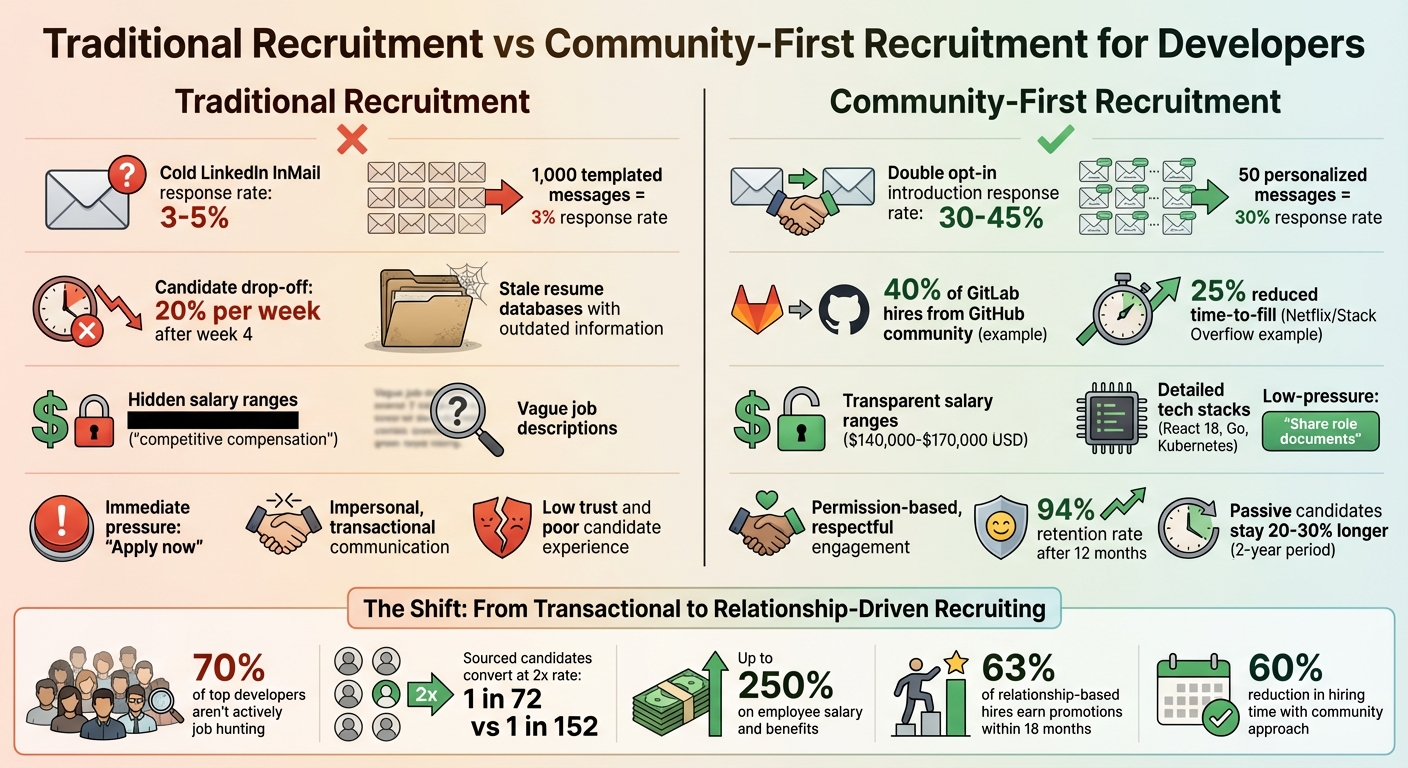
Traditional recruitment methods often involve posting jobs and waiting for applications to roll in. This passive approach misses the mark on how developers actually operate and prefer to connect with employers. Companies that only start recruiting when a position opens up face lengthy, expensive hiring processes that frequently end with hiring whoever is available - not necessarily the best fit.
Low Engagement and High Candidate Drop-Off Rates
Cold emails and generic job board postings rarely grab attention. Why? They lack the personal touch and often come across as impersonal or irrelevant. Data shows that sending 50 personalized messages can achieve a 30% response rate, while blasting 1,000 templated messages results in only 3% responses. Developers are inundated with recruitment emails daily, most of which are ignored or deleted.
Traditional outreach tends to feel transactional, with subject lines like "Exciting Opportunity at [Company]" and vague job descriptions that hide key details, such as salary. This lack of effort signals to developers that recruiters haven’t done their homework. On top of that, recruitment delays work against you - every week past the fourth week in the hiring process sees about 20% of the initial candidate pool accepting other offers. Starting from scratch with cold outreach only makes this worse, leaving recruiters scrambling to find candidates with the right skills.
Difficulty Identifying the Right Talent
Even when engagement improves, outdated candidate profiles create another hurdle. Resume databases often feature stale information that doesn’t reflect a candidate’s current skills, interests, or career goals. Without real-time insights, recruiters waste hours sifting through profiles that no longer represent a candidate’s actual abilities.
What’s missing? Behavioral signals that show what developers are actively working on - whether they’re learning new technologies, contributing to open-source projects, or showcasing expertise in their communities. Without this data, hiring becomes a guessing game, dragging out timelines and increasing the risk of hiring someone who isn’t the right fit.
Poor Candidate Experiences
Low engagement and mismatched skills are only part of the problem. Impersonal communication also damages trust, which is critical for building strong relationships with developers. Generic outreach and vague messaging hurt your employer brand and lead to negative experiences that developers are quick to share within their networks. This can deter other top candidates from even considering your company.
The difference between traditional and modern approaches is stark. Traditional methods rely on hidden salary ranges ("competitive compensation"), unclear job descriptions, and immediate pressure to "apply now." On the other hand, developer-first strategies focus on transparency and respect. For example, they include clear salary ranges in USD ($140,000–$170,000), detailed tech stacks (React 18, Go, Kubernetes), and low-pressure next steps like sharing role documents instead of demanding an immediate application.
This approach is especially important for passive candidates - those who aren’t actively job hunting but are open to opportunities. These candidates tend to stay with companies 20-30% longer over two years compared to active job seekers, but they require transparency and a thoughtful approach to even consider engaging.
The Community-First Approach to Developer Recruitment
Don’t sit back and wait for developers to come to you - go to where they already spend their time. Developers often dedicate hours each week on platforms like GitHub, daily.dev, and Stack Overflow rather than browsing traditional job boards. A community-first approach means showing up in these spaces, offering value, and building genuine relationships long before you need to hire. This shift from cold outreach to meaningful engagement reshapes how developers view your company. For example, engaging developers through daily.dev’s warm, double opt-in introductions results in response rates of 30–45% - a stark contrast to the 3–5% response rates typical of cold LinkedIn InMails . The key difference lies in trust and context. Developers on these platforms are already engaged and open to thoughtful interactions, not generic pitches.
While building a community presence takes time, the results are worth it. GitLab, for instance, reports that 40% of its hires come from community interactions on GitHub. Similarly, Netflix recruiters leveraging Stack Overflow have reduced time-to-fill by 25% by focusing on high-reputation users . These successes come from consistent involvement that positions your company as a trusted and valued part of the developer ecosystem. Let’s explore how you can identify top talent on these platforms.
Using GitHub Activity to Identify Talent
GitHub is where developers showcase their skills through actual work. Details like contributions, repositories, stars, forks, and pull requests provide a deeper understanding of a developer’s expertise than any resume. For instance, a developer with 100+ stars on machine learning projects likely has niche expertise. Regular commit activity shows they’re actively coding, not just listing outdated skills .
To identify potential candidates, look for specific signals such as commit frequency, collaboration through pull requests, and the complexity of their projects. GitHub’s search filters let you narrow down developers by programming language (e.g., Python, JavaScript, or Go) and activity level. For example, searching for developers with recent React 18 commits who contribute to open-source projects can uncover highly skilled individuals before you even make contact. This approach prioritizes real-world expertise over self-reported skills, giving you a clearer picture of their abilities.
Engaging with Developers on daily.dev
daily.dev is home to over 500,000 developers who come to learn, share, and discuss the latest trends in software development . It’s a vibrant space where regular participation - commenting, sharing insights, and joining discussions - can build your credibility over time.
The platform’s personalized feeds make it easier to spot developers interested in specific technologies, highlighting those who are continually learning and growing. By tracking engagement through likes, comments, and shares, you can identify active learners. Hosting AMAs (Ask Me Anything sessions) about your engineering culture or technical challenges creates natural opportunities to connect. This kind of ongoing interaction shows your commitment to the developer community while strengthening your talent pipeline.
Building Presence on Stack Overflow
Stack Overflow offers a unique lens into developers’ problem-solving skills in real time. Reputation scores on the platform highlight technical expertise. For example, a developer with 10,000+ reputation points and accepted answers in tags like React or Kubernetes has consistently demonstrated advanced problem-solving abilities. This public record of contributions allows recruiters to quickly gauge a developer’s technical depth .
To establish your own presence, participate actively by answering questions, upvoting high-quality posts, and earning badges in relevant technology tags. Over six to twelve months, consistent, non-promotional contributions can help build credibility and attract inbound interest from developers. When reaching out, referencing specific contributions - such as a detailed answer on optimizing PostgreSQL queries - shows you’ve done your research and value their expertise. This kind of authentic participation reinforces the community-first mindset that’s essential for building a sustainable talent pipeline.
Permission-Based Relationship Building: How to Establish Trust
Once you've established a connection within a community, the next step is earning trust through permission-based outreach. For passive candidates - who make up a striking 70% of top talent - this means seeking consent before diving into career opportunities . Instead of pushing roles, start by asking for their permission to discuss opportunities. Keep the focus on their career aspirations rather than your immediate hiring needs.
Switching from a transactional approach to one based on consent signals respect. A short, thoughtful message that acknowledges their current successes shows you view them as collaborators, not merely prospects . Developers are far more likely to engage when they feel respected and valued, which can lead to stronger, lasting relationships. And when the timing is right, these relationships can help fill roles faster by using effective strategies to find passive developer candidates.
How Double Opt-In Introductions Work
The double opt-in approach involves a simple, two-step process to ensure genuine interest. First, send a low-pressure message - this could be through GitHub comments or LinkedIn - asking if they’re open to a quick chat about their work. Make it personal by referencing something specific, like their open-source projects or Stack Overflow contributions. If they respond positively, follow up with a second confirmation to discuss opportunities or continue the conversation .
This process naturally filters out those who aren’t interested. For example, a tech recruitment firm using AI tools adopted this method by starting with GitHub comments that praised developers’ contributions. They then requested a brief conversation, which led to higher engagement rates with passive candidates. Directors noted that this approach saved time and resulted in better candidate matches . Platforms like daily.dev Recruiter also rely on this warm, double opt-in model for every introduction, ensuring developers explicitly agree to engage.
By using double opt-in introductions, you set the stage for open and transparent communication, which is essential for building trust.
Transparent Communication Practices
Transparency is about being upfront - whether it’s about current job openings, company values, or even challenges your team is facing. If there’s no immediate job available, say so in your initial message. For instance, a note like, "We’re impressed by your Stack Overflow answers and would love your thoughts on our tech stack when roles align", avoids a pushy tone and builds credibility .
Offer value from the start. Share insights about the industry, provide feedback on their work, or connect them with someone in your network. Before discussing roles, follow up with meaningful content . For developers, showing you understand their work by referencing technical details like "distributed systems at scale" can go a long way . This value-first approach creates a sense of reciprocity and positions you as a helpful resource rather than just another recruiter.
How to Nurture Passive Candidates Over Time
Once you've established trust and secured permissions, the focus shifts to nurturing these connections over time. The goal here is to deepen relationships gradually, so when the timing is right, career conversations feel natural and mutually beneficial.
Passive candidates can be nurtured through phases: awareness, connection, relationship, and conversion . A consistent outreach cadence - every 4 to 8 weeks - works well. Share low-pressure, value-driven resources during this time. This approach respects their busy schedules while positioning you as a helpful resource rather than just another recruiter.
Personalized Communication and Content Sharing
Every interaction should feel tailored to the individual. If a developer is active in distributed systems discussions on Stack Overflow, you might send them articles about scaling challenges or invite them to a roundtable on microservices architecture. For someone contributing to open-source security projects on GitHub, insights on emerging security trends or your company’s secure development practices could spark their interest.
Context matters. A developer who has been in the same role for three years might appreciate content on career growth. On the other hand, someone who just completed a major project might respond well to recognition of their achievement and insights into similar challenges your company is tackling. Stay alert to trigger events like leadership changes, equity vesting, or project completions - these are moments when candidates are more likely to engage .
Segmentation Based on Skills and Career Goals
Divide your talent pool into three groups: Ready-Now (available immediately), Warm (interested but not ready yet), and Cool (future potential) . Each group requires a distinct approach.
- Ready-Now candidates should receive direct scheduling links to expedite conversations.
- Warm candidates benefit from personalized check-ins and invitations to technical events.
- Cool candidates can be kept engaged with valuable content every 6–8 weeks.
Beyond availability, segment candidates by technical expertise, seniority, and career aspirations. For example, a senior backend engineer aiming for leadership roles will need different content than a mid-level frontend developer focused on mastering new frameworks. This targeted approach ensures your outreach feels relevant, not generic.
Tracking Engagement Metrics
To understand what works, monitor time-to-engagement - the average time it takes for a candidate to show genuine interest after initial outreach . A shorter time indicates your content and employer branding strategies are resonating. Track engagement through metrics like open rates, click rates, and reply rates to fine-tune your timing and approach .
Compare your results to benchmarks. For instance, double opt-in approaches often yield 30–45% response rates, far exceeding the 3–5% typical for cold LinkedIn InMail . Additionally, track your passive candidate hire rate to gauge the return on investment (ROI) of nurturing versus traditional job postings . Use A/B testing on subject lines, content formats, and outreach timing to discover what resonates with different developer personas . These insights help refine your strategy, making the transition from relationship-building to active engagement seamless.
Building Long-Term Community Presence vs. Transactional Outreach
A long-term community presence shifts recruitment from a transactional approach to one rooted in relationships and engagement, making it especially effective when working with developers.
Transactional outreach treats hiring as a one-off process, where candidates are contacted only when job openings arise. This method often falls short with developers because the best talent isn’t actively job hunting. Instead, they’re busy contributing to projects on GitHub, answering questions on Stack Overflow, or keeping up with trends on platforms like daily.dev. When recruiters reach out solely with job postings, they’re competing with countless others doing the exact same thing, making it hard to stand out.
By contrast, establishing a long-term community presence means becoming part of the ongoing conversation. It’s about connecting with developers by contributing to their spaces, sharing knowledge, and building rapport long before a position opens up. The goal isn’t to be everywhere but to focus on the 2-3 platforms where your target audience spends the most time. This proactive approach reduces competition for passive candidates and leads to faster, higher-quality hires. In fact, companies that adopt this strategy can reduce hiring time by up to 60%, all while improving the caliber of candidates they attract .
Candidates sourced from these communities also tend to stick around longer. They gain a deeper understanding of your company’s culture and technical focus, which makes their eventual transition smoother. When the time comes to discuss a role, it feels more like a natural continuation of an existing relationship rather than a cold introduction. This shift from transactional outreach to authentic engagement lays the groundwork for effective community management.
The Role of Dedicated Community Management
Maintaining a consistent community presence requires dedicated effort. Recruiters already managing job requisitions can’t be expected to also handle ongoing engagement across multiple platforms. That’s where community managers come in. These team members focus solely on relationship building without the immediate pressure to hire. Their work might include conducting informational interviews even when there are no openings, attending key industry conferences, and keeping a detailed database of engaged professionals .
Community managers take the lead in identifying potential candidates through platforms like GitHub, daily.dev, and Stack Overflow. They join discussions, offer insights, and build genuine connections.](https://recruiter.daily.dev/resources/recruit-developers-open-source-communities/) The key is transparency - acknowledging that while there may not be an immediate opportunity, the goal is to foster long-term relationships. This honest approach respects the fact that developers may explore other opportunities first, but it keeps the door open for future collaboration.
Measuring Community Health and Candidate Quality
To ensure that your community efforts translate into tangible results, it’s important to track specific metrics. Start by measuring engagement levels: response rates to outreach, participation in discussions, and the depth of relationships with passive candidates . Then, evaluate conversion metrics, such as how many community-sourced candidates are hired, their time-to-fill compared to traditional methods, and their performance after 90 days .
You should also compare the cost per hire of community-sourced candidates to those from job boards or external recruiters, factoring in onboarding time and productivity ramp-up . Retention rates at 90 and 180 days are another critical measure . These metrics reveal the true value of a strong community presence - not just quicker hiring, but better hires who are more likely to thrive and stay with your organization because they joined through a genuine connection rather than a transactional pitch.
Using Behavioral Signals to Identify Candidates
Behavioral signals bring a data-driven edge to recruitment, moving it beyond guesswork. Instead of relying on static resumes, you can evaluate real-time actions that showcase what developers genuinely know and care about. For instance, a developer who merges React pull requests weekly is actively honing their expertise. Similarly, someone regularly answering Kubernetes questions on Stack Overflow demonstrates not just technical knowledge but also a collaborative mindset - traits that often indicate a strong team fit.
What makes behavioral signals so powerful is their unfiltered nature. Developers aren’t curating these activities for recruiters; they’re simply engaging in their craft on platforms like GitHub, daily.dev, and Stack Overflow. This authentic activity provides deeper insights into their skills, interests, and career trajectory than self-reported profiles ever could. For example, a developer contributing to open-source projects consistently for six months shows a genuine commitment to that technology, not just a resume filled with buzzwords. These insights can help you build a stronger talent pipeline by focusing on candidates who demonstrate real expertise.
Understanding Developer Activity Patterns
To make the most of behavioral signals, start by analyzing developer activity across key platforms. Look at both the frequency and quality of their contributions. On GitHub, for example, a developer with 50+ commits each month in your tech stack shows steady engagement. But don’t stop there - examine other metrics like pull request acceptance rates and repository stars. High-quality contributions that peers recognize and merge are strong indicators of technical skill and teamwork.
Stack Overflow can also offer valuable insights into problem-solving abilities. Developers with answer acceptance rates above 30% and steady reputation growth over six months often have deep domain expertise. Pay attention to their performance in specific tags - highly upvoted Python answers, for instance, can be a public testament to their knowledge. Similarly, on daily.dev, look for patterns like upvoting 20+ articles weekly on cloud-native technologies or engaging in discussions about DevOps. These behaviors can reveal where a developer’s current professional interests lie.
Consistency and recency are key. A developer who was highly active two years ago but hasn’t contributed recently might have shifted focus. In contrast, someone with 10+ meaningful interactions per month over the past 90 days is clearly engaged in their craft. Cross-platform consistency also strengthens your assessment. If a developer’s GitHub repositories, Stack Overflow activity, and daily.dev habits all reflect aligned tech interests, you’re likely identifying a high-potential candidate with genuine intent.
Prioritizing Outreach Based on Behavioral Signals
Once you’ve gathered activity metrics, prioritize outreach by assigning weighted scores to key signals as part of a proactive sourcing strategy. For example, you might allocate 40% weight to recent high-impact activities (like merged pull requests), 30% to a strong skill-role match, 20% to overall engagement volume, and 10% to cross-platform consistency. This scoring system helps you focus on the top 20% of candidates whose activity patterns suggest both capability and readiness for new opportunities.
When reaching out, make your messages personal and specific. Reference the GitHub project that impressed you or the Stack Overflow answer that highlighted their expertise. A personalized approach, rooted in observable behavior, can significantly improve response rates compared to generic outreach.
It’s also wise to track which signals work best for your organization. For instance, if developers who star repositories in your tech stack tend to respond more often, adjust your scoring to give that signal more weight. Similarly, if high reputation scores in certain Stack Overflow tags correlate with successful hires, factor that in. Regularly update your data - every two weeks is a good cadence - and always validate signals with context. For example, while a hobby project might look impressive, contributions to production-grade open-source tools are a better predictor of professional fit.
Conclusion
Recruiting top developer talent requires a shift away from outdated, transactional methods. The traditional “spray-and-pray” approach - sending out mass, impersonal messages - no longer resonates with developers. Instead, strategies like permission-based engagement, active participation in developer communities, and analyzing behavioral signals pave the way for more meaningful connections, especially with passive candidates who might ignore a cold LinkedIn pitch.
The numbers speak volumes: companies that focus on relationship-driven recruiting achieve 94% retention rates after 12 months, compared to the 20% turnover seen within the first 45 days of rushed, transactional hiring. Additionally, 63% of candidates hired through relationship-based methods earn promotions within 18 months . These results highlight the value of prioritizing connection over quick wins.
To get started, immerse yourself in the platforms developers already use. Pay attention to behavioral signals like commit frequency or answer acceptance rates to identify potential candidates, but always approach them with transparency. Be upfront about key details like your tech stack, salary range, and work model to align with what developers want. This honesty lets candidates self-select, ensuring your time is spent on those who truly align with your company.
Here’s another compelling stat: sourced candidates convert at twice the rate of traditional applicants - 1 in 72 versus 1 in 152. Companies with a strong, comprehensive pipeline strategy also report up to 250% ROI on employee salary and benefits thanks to improved retention . These aren’t minor improvements - they’re game-changing outcomes that grow exponentially as your community presence matures.
The key is to think long-term. Build relationships without expecting immediate results, contribute value before making requests, and focus on metrics like retention and career growth rather than just time-to-hire. By committing to this approach, you’ll not only secure top talent but also create a sustainable pipeline that supports your organization’s future success.
FAQs
How do I find passive developers without job boards?
To reach passive developers without relying on job boards, shift your focus to community involvement and building genuine connections. Engage with developers on platforms like GitHub or Stack Overflow by contributing meaningful content, taking part in discussions, and establishing trust over time. Pay attention to behavioral cues, such as recent contributions or profile changes, to spot potential candidates. Emphasize tailored, honest communication to nurture lasting relationships rather than adopting a purely transactional approach.
What should I track to measure pipeline ROI?
To get a clear picture of your developer talent pipeline's ROI, focus on tracking a few key metrics:
- Cost savings per hire: This helps you understand how much you're saving compared to traditional hiring methods.
- Time-to-fill: Measures how quickly you can fill open roles, reflecting the efficiency of your pipeline.
- Candidate quality and retention rates: Indicates how well your hires fit the role and stick around long-term.
- Engagement metrics: Look at things like response rates and involvement in community activities to gauge candidate interest and interaction.
- Behavioral signals: Metrics like GitHub activity can offer clues about a candidate's skills and ongoing contributions.
These metrics give you a snapshot of hiring efficiency, candidate alignment, and the overall value of your strategies, helping you fine-tune your approach.
How can I do permission-based outreach without sounding pushy?
To make permission-based outreach feel more respectful, it's important to focus on clear consent and tailored communication. Always start by obtaining explicit permission before contacting someone. Be upfront about job details to set clear expectations from the beginning.
Engage with developers by participating in their communities and offering something valuable first - like useful insights or relevant resources. Craft messages that are personalized to their specific skills and interests. Most importantly, aim to build lasting relationships rather than focusing solely on short-term recruitment goals. This approach helps establish trust and rapport over time.
.png)