Struggling to hire senior DevOps engineers? Here’s why take-home tests might be the problem.
- 20% of candidates drop out when asked to complete take-home tests, and the most skilled engineers are often the first to leave.
- Lengthy, irrelevant tasks (taking 10+ hours) and poor communication drive candidates away.
- Most tests don’t reflect actual DevOps work, like building CI/CD pipelines or managing infrastructure.
- 77% of developers say assessments feel disconnected from real job responsibilities.
- Candidates value transparency: clear expectations, realistic time limits, and feedback improve completion rates.
What works better?
- Short, focused tasks (1–2 hours) based on real job scenarios.
- Paid assessments ($150–$300) to show respect for candidates’ time.
- Live problem-solving sessions or reviews of past work.
- Upfront clarity on salary, tech stack, and role expectations.
If your take-home test completion rate is under 60%, it’s time to rethink your process. Respect candidates’ time, streamline assessments, and make the hiring experience better for everyone.
::: @figure 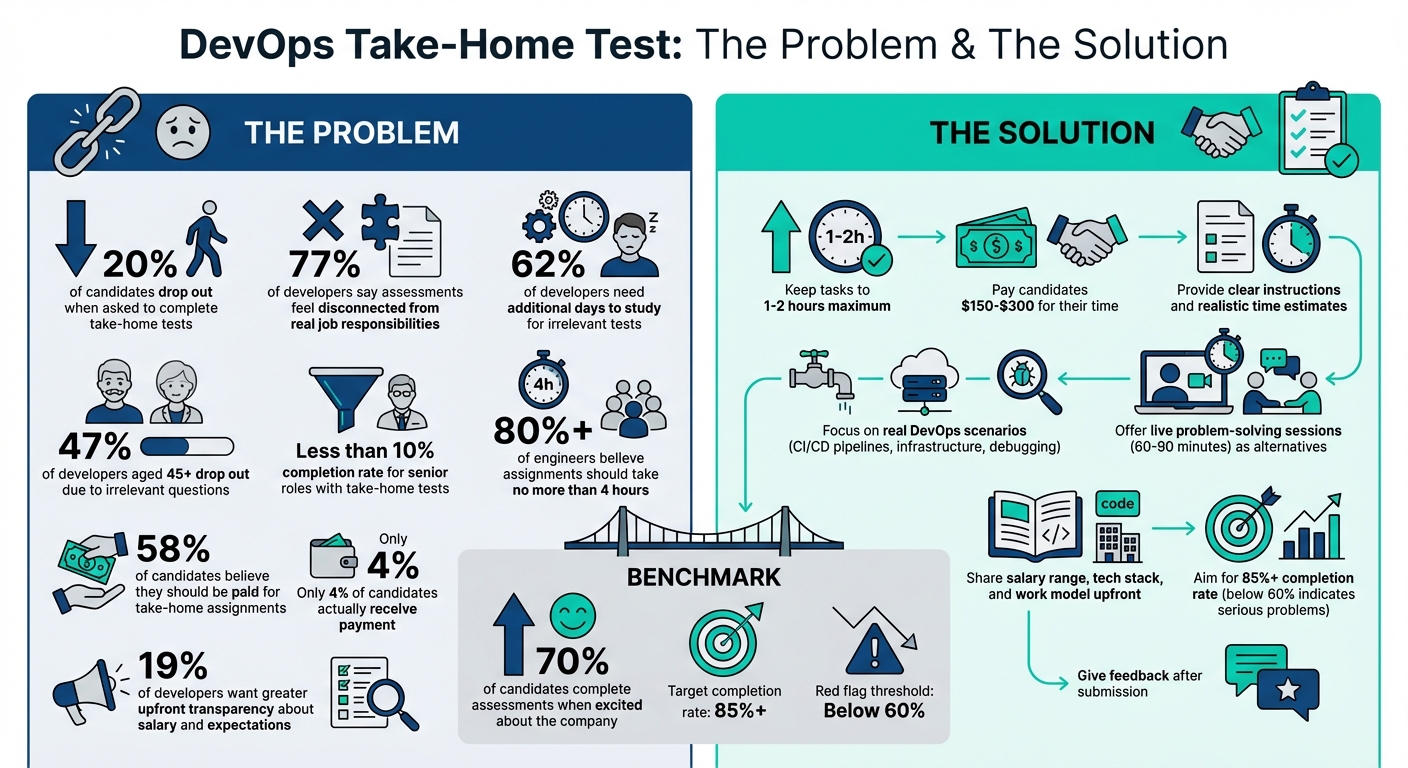 {DevOps Take-Home Test Statistics: Drop-Off Rates and Candidate Preferences}
Why DevOps Take-Home Tests Don't Work
Take-home tests often fall short because they overlook how DevOps engineers actually work and fail to respect their time. This disconnect suggests that some companies may not fully understand or value the role of these professionals.
Unrealistic Time Expectations
A common issue with take-home tests is the misjudgment of how long they take to complete. What’s labeled as a "3-hour task" can easily balloon into 8–10 hours once setup, debugging, and final touches are factored in . Over 80% of engineers agree that these assignments should take no more than 4 hours, with most preferring a 2-hour cap . Despite this, companies continue to send out tasks that could consume an entire weekend.
For senior candidates, who are often balancing multiple job offers and responsibilities, these lengthy tasks can be a dealbreaker. According to Metric Collective, completion rates for senior roles drop below 10% when take-home tests are involved . As Kevin J. Dolan, an engineer at Metric Collective, put it:
"For senior roles it [the completion rate] was less than 10%... it's just too much to ask of these great candidates to toil away at take-home tests when they can just as easily line up interviews with other companies that don't ask for them."
Long assessments, especially those requiring 8–12+ hours, also unintentionally exclude candidates with family or caregiving responsibilities or those managing demanding full-time roles . This narrows the talent pool and frustrates candidates who feel their time isn’t being respected.
Misaligned with Real DevOps Work
Another major flaw is that many take-home tests fail to reflect the actual challenges of a DevOps role. DevOps engineers focus on tasks like incident response, creating CI/CD pipelines, managing infrastructure as code, and solving production issues. Yet, companies often assign generic coding puzzles or abstract algorithm problems that have little to do with the job's realities.
This mismatch forces candidates to spend extra time preparing for irrelevant challenges. In fact, 62% of developers report needing additional days to study for such tests . The problem is even more pronounced among older candidates, with nearly 47% of developers aged 45 and up dropping out of the hiring process due to irrelevant questions .
Lack of Guidance and Feedback
Poor communication is another common frustration. Many take-home tests come with unclear instructions, leaving candidates unsure of what’s expected . Even worse, companies often fail to provide any feedback after the test. Candidates may spend 5–10 hours completing an assignment, only to submit it and hear nothing - not even a rejection email.
This lack of acknowledgment is a major contributor to negative candidate experiences . It signals disrespect for the time and effort invested, and it can harm the company’s reputation. Developers frequently share their hiring experiences, and one instance of complete silence can quickly spread through industry networks. Additionally, requiring candidates to work in isolation - without opportunities to ask clarifying questions - fails to reflect the collaborative nature of real DevOps work .
Better Ways to Assess DevOps Candidates
Reevaluating how you assess DevOps candidates can make a significant difference in identifying the right talent. By aligning assessments with actual DevOps tasks, you not only respect candidates' time but also improve the quality of your evaluations. Patrick McKenzie from Stripe emphasizes the value of work sample testing, where candidates tackle tasks that closely resemble their potential day-to-day responsibilities . The focus should be on the core of a real challenge your team has faced, avoiding unnecessary busywork.
1–2 Hour Focused Tasks
Create tasks that are concise, taking no more than 1–2 hours, and center them on relevant DevOps scenarios. Examples include debugging logs, parsing configurations, or building a CI pipeline using your specific tech stack . Before rolling out the task, have one of your engineers complete it to ensure it fits within the designated time frame. Pilot testing ensures the exercise is reasonable and respects candidates' time.
Allow candidates to use resources, as they would in a real-world setting. Treat the results as a starting point for a deeper conversation, rather than a strict pass/fail test. Follow-up discussions can explore trade-offs, shortcuts, and how they might approach the task differently with more time . Pairing these tasks with fair compensation also demonstrates respect for candidates' efforts.
Paying Candidates for Their Time
Compensating candidates for their time is a simple yet impactful way to stand out. While 58% of candidates believe they should be paid for take-home assignments, only 4% actually are . Offering a fixed payment between $150 and $300 not only values their effort but also encourages your team to keep the scope focused. It’s a small investment that levels the playing field, particularly for candidates managing multiple responsibilities.
Live Problem-Solving Sessions
Instead of take-home assignments, consider hosting live problem-solving sessions lasting 60–90 minutes. For instance, you could walk candidates through an incident post-mortem from your production environment or discuss a recent architectural challenge. This method allows you to evaluate their technical judgment, communication skills, and real-time problem-solving abilities. It also addresses concerns about AI-generated code by observing their thought process as it happens . Another option is to review existing work, which can provide even more insight into their abilities.
Reviewing Existing Work
Many DevOps professionals showcase their expertise through public GitHub repositories, blog posts, or open-source contributions. Reviewing these can often reveal more about their skills than a simulated test. Spend 30–60 minutes discussing a project they’re proud of or even conduct a reverse code review of one of your company’s codebases . Offering this as an alternative assessment method can provide a more personalized and insightful evaluation .
How Transparency Reduces Drop-Off
Candidates are far more likely to complete assessments when they have a clear picture of the job they're applying for. The numbers speak for themselves: 19% of developers say they want greater upfront transparency about salary, expectations, and company culture more than any other change in the hiring process. When job details are vague, candidates often assume the worst - low pay, unclear responsibilities, or a chaotic work environment.
Being transparent helps address the perception that companies value their own time more than the candidate's. Sharing clear, detailed information shows respect for the candidate's effort and sets the tone for a more balanced and fair process. It also creates a roadmap for what crucial details should be shared before expecting candidates to invest their time.
What to Share Before Sending Assessments
Before asking candidates to commit even an hour to an assessment, give them the information they need to decide if the role is a good fit. Start with the essentials:
- Salary range in USD: Avoid wasting time on both sides by ensuring compensation expectations align.
- Work model: Specify if the role is remote, hybrid, or on-site, and clarify any location-based requirements.
- Tech stack: Share details about the frameworks, tools, and versions they’ll be working with daily.
Go beyond the basics by outlining the team structure and the types of projects they’ll tackle. Explain your development workflow, including deployment frequency and code review practices. When it comes to the assessment itself, provide key details like:
- Expected duration (ideally 2 hours or less).
- What skills or competencies the test evaluates.
- What falls outside the scope of the assessment.
- A point of contact for questions.
- A timeline for feedback after submission.
Why Clear Expectations Matter
When candidates know what to expect, they’re more likely to complete the process. In fact, 70% of candidates finish take-home assessments because they’re already excited about the company. Transparency about the role and workplace culture builds that enthusiasm early on.
Clarity also reduces unnecessary stress. Sixty-two percent of developers feel they need to over-prepare because they don’t know what will be asked. By sharing a realistic time estimate - ideally tested by your own engineers - and clearly defining what the assessment evaluates, you help candidates focus on the task at hand. This not only boosts completion rates but also improves the quality of submissions, creating a better experience for everyone involved.
Tracking and Improving Your Assessment Process
To ensure your assessment process is effective, keep an eye on conversion rates at every stage. Start by tracking how many candidates receive the assessment, how many begin it, and how many complete it. If your completion rate dips below 60%, it’s a red flag that something is fundamentally wrong with your process. Aline Lerner, founder of interviewing.io, offers a blunt perspective:
"If your completion rate is below, say, 60%... then it's DEFINITELY time to make a change. Honestly... if people aren't completing them at least 85% of the time, it's probably time to make a change - losing more than 15% of your candidates to attrition at any given stage in the funnel is bad".
If more than 15% of candidates drop out at any stage, it’s a clear sign that your process needs attention. The next step is to pinpoint exactly where candidates are disengaging.
Where Candidates Drop Off
The gap between starting and completing the assessment can reveal a lot. A noticeable drop-off often suggests that the task is too complicated, takes longer than expected, or has technical setup issues. Compare the actual time candidates spend on the assessment to your estimated time. For example, if you say the task takes one hour but candidates are spending five, that’s a glaring issue. Similarly, monitor your pass-through rate - if only 10% of completed assessments meet your hiring standards, the test may be poorly designed or disconnected from the role’s requirements.
Learning from Candidate Feedback
Feedback is key to improving your process. Send a brief survey to every candidate who completes the assessment. Focus on three questions: Was the time estimate accurate? Did the task align with the DevOps work described in the job posting? Were the instructions clear? These insights will help you understand if your assessment is asking candidates to solve irrelevant problems - something 77% of developers already feel is a common issue in hiring assessments. Use this feedback to fine-tune your process and create a more relevant and efficient evaluation.
### DevOps Interviewing Techniques for a Streamlined Process
For senior DevOps roles, a simpler approach can make a big difference. Start with a 30-minute conversation about their experience, followed by a 60–90 minute live discussion that reviews a real incident or architecture decision. If additional evaluation is necessary, assign a focused task - something that takes 1–2 hours and reflects actual job responsibilities, like reviewing a Terraform configuration or suggesting improvements to a CI/CD pipeline. This method respects candidates’ time while still providing the technical insights you need. Plus, it keeps experienced professionals engaged, avoiding the frustration of lengthy homework assignments.
Conclusion
High drop-off rates in DevOps take-home tests highlight a flawed process that undervalues candidates' time and fails to align with the realities of the role. A striking 77% of developers report that these tests don't reflect the necessary skills for the job, and while 58% expect compensation for their efforts, only 4% actually receive it.
To tackle these challenges, consider a focused approach: keep assessments concise - 1 to 2 hours maximum - and tailor them to practical DevOps tasks, such as evaluating Terraform configurations or analyzing real-world incidents. Offering a small payment, like $100–$200, shows respect for candidates' time and effort. Clear instructions, realistic time expectations, and thoughtful feedback can further enhance the experience.
Using data to refine the process is key. For example, if your completion rate falls below 85%, it signals deeper issues. Pay attention to metrics, listen to candidate feedback, and address pain points like unclear directions, overly long tasks, or irrelevant assessments.
The most successful companies treat hiring as a collaborative process that values candidates' expertise. By aligning tests with the daily challenges of DevOps, as outlined above, you create a fair and effective system. Thoughtfully designed evaluations, transparent communication, and a commitment to continuous improvement not only reduce drop-off rates but also attract and retain the best DevOps professionals.
FAQs
How can companies design better take-home tests for DevOps roles?
To design take-home tests that genuinely connect with DevOps candidates, focus on crafting tasks that mirror the responsibilities they’d face on the job. Skip the generic coding challenges and instead, create practical scenarios like troubleshooting a simulated incident, analyzing a production alert, or building a CI/CD pipeline for a microservice. These kinds of exercises let candidates demonstrate their problem-solving, scripting, and systems thinking abilities while keeping the workload manageable - ideally no more than a few hours.
Make sure expectations are crystal clear from the start. Specify details like the time required, tools involved (e.g., Terraform, Docker, Kubernetes), and how the test will be evaluated. Offering a small payment for completed work not only respects the candidate’s time but can also encourage higher participation. Afterward, providing constructive feedback helps candidates appreciate the process and leaves them with a positive impression of your company.
Lastly, ensure the test reflects your team’s actual workflows. For instance, if version-controlled collaboration is part of your team’s routine, incorporate that into the test. By keeping the tasks relevant, concise, and respectful of candidates’ time, you’ll not only attract top-tier DevOps talent but also create a smoother, more engaging hiring process.
Why should companies pay candidates for take-home assessments?
Paying candidates for take-home assessments sends a clear message: your company values their time and effort. This simple gesture can go a long way in reducing drop-off rates, especially among senior candidates who often juggle packed schedules and demanding responsibilities.
By offering compensation, you’re not just respecting their professional commitment - you’re also creating a more positive and engaging candidate experience. It sets the tone for trust and professionalism right from the start, showing that your company prioritizes fairness. This can make top-tier talent more inclined to participate in your hiring process and view your organization in a favorable light.
Why is transparency crucial in hiring DevOps engineers?
Transparency plays a crucial role in building trust and maintaining candidate engagement throughout the hiring process. Developers appreciate having clear, upfront details about key aspects of the job - like salary, technologies used, team structure, and work model. When this information is shared early on, candidates feel their time is valued, making them more likely to fully participate in assessments.
On the flip side, unclear expectations - especially regarding the scope, difficulty, or feedback for take-home tasks - can deter candidates, particularly senior engineers juggling tight schedules. Providing realistic time estimates, straightforward instructions, and prompt feedback demonstrates respect for their time and significantly reduces the likelihood of drop-offs.
By offering a transparent and realistic glimpse into the role and its responsibilities, you not only enhance the candidate's experience but also improve the chances of finding a strong match between the company and the candidate. This approach builds trust, boosts assessment completion rates, and ultimately leads to better hiring outcomes.
.png)