Diverse engineering teams drive better decisions, higher profitability, and more innovation. Companies with diverse management teams see up to 35% higher financial returns and 19% more innovation revenue. Yet, many organizations struggle to build and retain diverse talent due to biases and outdated hiring practices.
To overcome these challenges, focus on these actionable steps:
- Expand Sourcing Channels: Partner with HBCUs, bootcamps, and community organizations to access underrepresented talent.
- Reduce Hiring Bias: Use structured interviews, scoring rubrics, and take-home projects instead of subjective methods or whiteboard tests.
- Write Inclusive Job Descriptions: Avoid exclusionary terms like "rockstar" or "ninja" and emphasize skills over rigid experience requirements. Understanding how job descriptions impact developer hiring is the first step toward building a more diverse pipeline.
- Retain Diverse Talent: Foster belonging through psychological safety, transparent promotions, and leadership representation.
Retention is as critical as hiring. Track promotion rates, leadership demographics, and turnover to ensure diverse employees thrive long-term. Success isn't just about hiring numbers - it's about creating a workplace where everyone can grow and contribute.
This guide offers practical strategies to improve every stage of the hiring pipeline, from sourcing to retention, ensuring diversity becomes a lasting strength in your engineering teams.
::: @figure 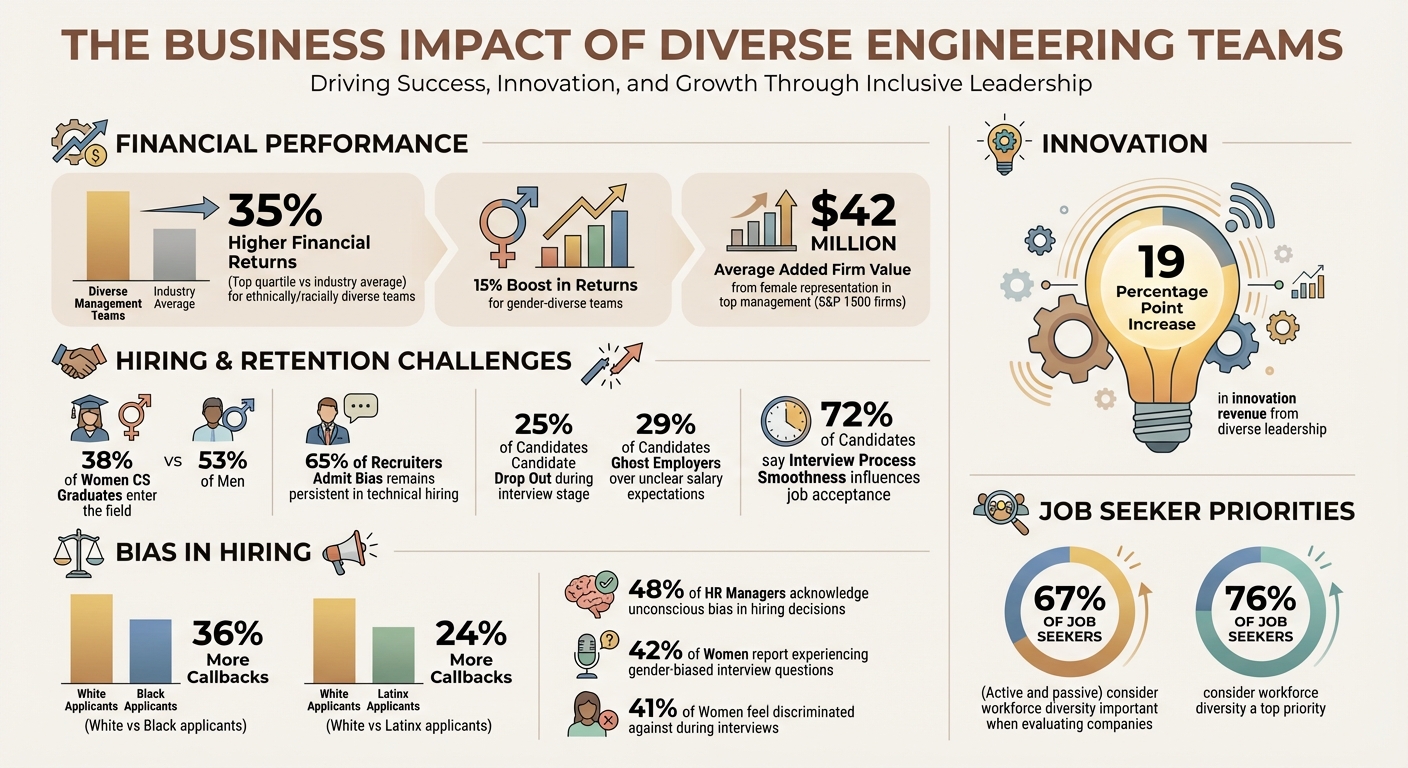 {The Business Impact of Diverse Engineering Teams: Key Statistics}
Why Diverse Engineering Teams Improve Business Outcomes
Diversity is more than just a buzzword - it delivers measurable results. Companies with management teams in the top quartile for ethnic and racial diversity see financial returns up to 35% higher than the industry average, while gender-diverse teams achieve a 15% boost in returns . Beyond finances, diverse leadership sparks innovation, driving a 19 percentage-point increase in innovation revenue .
Better Problem-Solving and Innovation
The financial edge of diverse teams often stems from their ability to solve problems and innovate more effectively. Different backgrounds mean team members approach challenges with unique perspectives. Studies show that cognitively diverse teams solve problems faster, thanks to varied ways of processing information and interpreting situations . Social sensitivity, balanced participation in discussions, and higher female representation are key contributors to a team's collective intelligence .
A compelling example comes from a 2006 study by Katherine Phillips at the University of Illinois. Groups of three worked on a murder mystery exercise, and racially diverse teams significantly outperformed homogeneous ones. Why? Diverse groups avoided assuming everyone had the same information, prompting better clue-sharing and more thorough analysis . Similarly, research by Cristian Dezsö and David Gaddis Ross on S&P 1500 firms revealed that female representation in top management added an average of $42 million to firm value, especially in innovation-driven companies .
Preventing Groupthink
Homogeneous teams often fall into groupthink, where consensus is reached without challenging ideas. Diverse teams, on the other hand, naturally anticipate differing viewpoints, leading to more thoughtful decisions . Katherine W. Phillips explains it best: "Diversity jolts us into cognitive action," breaking the cycle of groupthink and encouraging fresh ideas .
An experiment by social psychologist Samuel Sommers in 2006 illustrates this point. In mock jury trials, racially diverse six-person juries (four white members and two Black members) were better at analyzing case facts, made fewer errors, and discussed difficult topics more openly than all-white juries. Interestingly, the presence of diversity also influenced white jurors to approach the case more carefully and thoughtfully. This principle translates directly to engineering teams making critical technical decisions .
Understanding Your Customer Base
A diverse engineering team can better reflect and understand the needs of a diverse customer base. Gender diversity, which enhances social sensitivity, helps teams empathize with a broader range of users . Additionally, studies show that ethnically diverse researchers produce work with higher citation rates and greater impact . In the financial sector, innovation-focused banks with more racially diverse teams exhibit notably stronger performance compared to their less-diverse counterparts .
Hiring engineers?
Connect with developers where they actually hang out. No cold outreach, just real conversations.
Where Diversity Efforts Fail in the Hiring Pipeline
Diversity can drive fresh ideas and provide deeper market insights, but missteps early in the hiring process often derail these efforts. Even companies with clear DEI (Diversity, Equity, and Inclusion) goals frequently lose diverse candidates at predictable points. This phenomenon, often referred to as the "leaky pipeline", highlights how small issues at the start can grow into bigger problems later. Identifying and addressing these gaps early is key to improving outcomes. Here's a closer look at where things tend to go wrong.
Limited Sourcing Channels
A major barrier to diversity in hiring starts with where companies look for candidates. Many rely heavily on employee referrals and a narrow set of recruiting networks. This creates a cycle where current employees, who often share similar backgrounds, refer candidates who mirror their own experiences. This "affinity bias" can lead recruiters to favor applicants from familiar schools or workplaces, leaving little room for diverse perspectives .
The statistics tell a compelling story. Among computer science graduates, only 38% of women enter the field compared to 53% of men . This isn’t just about education - it’s about how companies source talent and support early-career professionals.
Biased Resume Screening
Bias in resume screening is another major hurdle. Often, unconscious biases filter out qualified candidates before a human even reviews their application. For instance, recruiters may look for candidates who meet every single job requirement, creating what’s known as the "perfection trap." This approach disproportionately excludes underrepresented talent and shrinks the pool of potential hires.
One way to combat this issue is by adopting a "70% rule", where candidates who meet 70% of the qualifications are considered, with the understanding that additional skills can be taught on the job. This approach not only speeds up hiring but also opens the door to a more diverse group of applicants .
"Unconscious bias during the hiring process refers to the automatic, instinctive attitudes or stereotypes that influence decisions about who to hire for a role."
- Dice Staff
The problem is widespread - 65% of recruiters admit that bias remains a persistent issue in technical hiring . Unfortunately, the challenges don’t stop at resume screening.
Interview and Offer Problems
The interview process is another critical point where diversity efforts often falter. About 25% of candidates drop out during this stage , and 29% ghost potential employers over concerns like unclear salary expectations . These issues are particularly pronounced for underrepresented candidates, who may face weaker offers or experience delays that suggest disorganization.
A well-known example of this problem occurred in February 2022, when former Miami Dolphins head coach Brian Flores filed a lawsuit against the NFL, the New York Giants, and the Denver Broncos. He alleged that his interviews were "shams", conducted only to comply with the Rooney Rule while decisions had already been made . Tokenism like this erodes trust, wastes time, and undermines efforts to build truly diverse teams.
The overall hiring experience matters, too. Seventy-two percent of candidates say that the smoothness of the interview process influences their decision to accept a job offer . Long timelines, impersonal communication, and overly rigid assessments that don’t align with actual job duties can drive away top talent, further compounding the issue.
How to Expand Your Talent Sources
To grow your tech hiring network, look beyond traditional recruitment channels and engage with communities that are often overlooked. Research shows that companies in the top quartile for ethnic and racial diversity see 35% higher returns. Yet, white applicants still receive 36% and 24% more callbacks than Black and Latinx applicants, respectively . The key to addressing this disparity lies in forming meaningful partnerships with organizations that already focus on underrepresented talent. These collaborations create a solid foundation for targeted recruitment and outreach strategies.
Partner with HBCUs, Bootcamps, and Community Organizations
Nontraditional education pathways like coding bootcamps, community colleges, and nano-degree programs produce highly skilled candidates who may not come from conventional academic backgrounds. Similarly, Historically Black Colleges & Universities (HBCUs) and Hispanic-Serving Institutions (HSIs) offer direct access to diverse engineering talent that often gets overlooked when companies focus solely on elite engineering schools.
Take Twitter's initiative in May 2021 as an example. Under the leadership of Dr. Maisha Gray-Diggs, the company enhanced its diverse recruitment efforts by involving senior leaders in targeted events such as Afrotech and Latinas in Tech . This strategic engagement helped attract underrepresented talent directly.
Platforms like Diversify Tech also make it easier to connect with underrepresented professionals. Their talent directory includes around 1,400 professionals, 45% of whom are software engineers, and their email subscriber base exceeds 20,000 . Additionally, organizations like Black Girls Code and General Assembly provide direct access to communities that have historically been excluded from the tech industry. These partnerships allow you to build long-term relationships with passive candidates through "talent pipelining", rather than relying solely on reactive hiring.
Another effective strategy is the 70-30 hiring rule: recruit candidates who meet 70% of the technical requirements and invest in developing the remaining 30% through structured onboarding, mentoring, and upskilling . This approach emphasizes adaptability and problem-solving skills over rigid experience requirements, opening doors to bootcamp graduates and career changers who bring fresh ideas and perspectives. By embracing these methods, you can expand your talent pool while creating more personalized candidate experiences.
Use daily.dev Recruiter's Community-First Approach
Expanding your candidate pool is just the first step; effective outreach is what ensures you connect with the right talent. A community-first approach can make all the difference.
daily.dev Recruiter takes a unique path by engaging with developers where they already spend their time - within trusted tech communities, learning, and networking. Instead of generic, impersonal outreach, the platform facilitates warm, double opt-in introductions that ensure genuine interest and high-context interactions.
Underrepresented developers are more likely to respond to outreach that feels personalized and respectful, especially when it highlights their unique strengths. daily.dev Recruiter’s developer-first design ensures your job opportunities reach pre-qualified engineers who are both active and open to the right opportunity. With 67% of job seekers - both active and passive - considering workforce diversity an important factor when evaluating companies , this credibility-driven approach helps your organization stand out to the talent you want to attract.
Reducing Bias in Technical Interviews
Improving technical interview processes is one of several proven methods for enhancing diversity in technical recruitment. Unfortunately, this is where many diversity efforts falter. Even if you’ve successfully sourced candidates from underrepresented groups, biased interview practices can prevent qualified individuals from moving forward. The solution isn’t about lowering standards - it’s about aligning evaluations to focus on job-relevant skills.
Use Structured Interviews with Scoring Rubrics
Unstructured interviews often rely on gut feelings and subjective impressions, with a predictive validity of just 0.20. This makes them one of the least reliable ways to assess future performance . On the other hand, structured interviews nearly double that predictive accuracy . The key difference? Standardization. Structured interviews ensure every candidate answers the same questions in the same order, evaluated against consistent criteria.
A scoring rubric is essential here. It defines clear benchmarks for what constitutes "excellent", "average", or "needs improvement" for specific technical skills. For example, instead of vague terms like "good communicator", use measurable criteria such as "effectively explains complex technical concepts to non-technical audiences" . This approach shifts the focus from subjective opinions to observable, job-relevant behaviors - especially important when nearly half (48%) of HR managers acknowledge unconscious bias in their hiring decisions .
"Humans' unconscious bias will play a role in any interview, especially if it's not standardized."
- Guillermo Corea, Managing Director, SHRMLabs
To streamline evaluations, focus on 5–7 key competencies to avoid "scoring fatigue" . Encourage interviewers to score candidates independently, reducing the risk of conformity bias, where team members might align with the loudest voice in the room . Calibration sessions, where interviewers review sample answers together, can also help ensure everyone interprets the scoring scale the same way .
Include Diverse Interviewers
Interview panels with varied backgrounds bring different perspectives, leading to more balanced and fair assessments. This is particularly important when 42% of women report experiencing gender-biased or inappropriate questions, and 41% feel discriminated against during interviews . Representation matters - not just for fairness, but because candidates feel more at ease and connected when they see themselves reflected on the panel.
"I find more success when I have a diverse team whose members bring different backgrounds, experiences and voices to the table. New opportunities are found when different voices are heard."
- John Bruggeman, CBTS and OnX
However, it’s important not to overburden employees from underrepresented groups by asking them to participate in too many interviews. Make sure all panelists are trained in structured interviewing and bias mitigation techniques to keep evaluations objective. Additionally, consider starting with phone interviews instead of video calls to reduce biases tied to appearance or socioeconomic factors, like home office setups .
Replace Whiteboard Tests with Take-Home Projects
Whiteboard tests often feel like "gotcha" moments, relying on algorithmic puzzles that favor prior exposure rather than actual skills . These tests can create unnecessary stress and discourage candidates .
Take-home projects are a better alternative. They allow candidates to showcase their technical abilities in a setting that mimics real work . To ensure fairness, review these projects anonymously, focusing solely on relevant skills . Keep the assignments short - no more than 2 hours. Longer tasks can put candidates with caregiving responsibilities or multiple jobs at a disadvantage . Be transparent about the evaluation criteria so candidates know exactly what’s being assessed . To validate the process, have current engineers complete the challenge under the same conditions to confirm it’s realistic .
Writing Job Descriptions That Attract Diverse Candidates
Your job description is your first opportunity to connect with potential candidates. To attract a wide range of qualified talent, avoid vague buzzwords and language that might unintentionally exclude certain groups. Building diverse engineering teams starts with using inclusive language and clearly outlining paths for growth.
Remove Exclusionary Language
The words you choose matter. Terms like "rockstar", "ninja", and "guru" often promote a hero culture that can alienate skilled engineers. Similarly, phrases like "hacker" or "digital native" may discourage women from applying and introduce age-related bias. Studies show that men often apply when they meet only 60% of the qualifications, while women typically wait until they meet 100%. Removing gender-coded terms alone can boost applications by 29% .
"The importance of using bias-free and inclusive language in job ads to ensure organisations are attracting a diverse range of candidates."
– Ben Willmott, Head of Public Policy, CIPD
Instead of relying on jargon, focus on specific technical responsibilities. You can also use a tech job title generator to find standard, inclusive alternatives to internal slang. For example, replace "code wizard" with "Design and implement REST APIs using Python." Swap phrases like "competitive atmosphere" for "collaborative environment" to appeal to a broader range of personality types.
Here’s a guide to rephrasing exclusionary terms:
| Exclusionary Term | Inclusive Alternative | Reason for Change |
|---|---|---|
| Rockstar / Ninja / Guru | Senior Engineer / Specialist | Removes vague, gendered language |
| Digital Native | Tech-savvy / Proficient with [Tool] | Avoids age-related bias |
| Competitive Atmosphere | Collaborative Environment | Welcomes diverse personality types |
| Hacker | Developer / Engineer | Reduces bias against female applicants |
| 5+ Years Experience | Proven ability to build [Specific Task] | Focuses on skills, not arbitrary timelines |
Emphasize Flexibility and Growth Opportunities
Transparent developer job posts reduce barriers and encourage more applicants. Focus on the actual responsibilities of the role rather than abstract personality traits. Frame qualifications as opportunities, such as: "Experience with React preferred, with opportunities to deepen your expertise." This approach invites candidates from varied backgrounds to apply.
Be upfront about flexibility. Clearly outline remote work options, flexible hours, or time zone requirements. This transparency is particularly valuable for candidates with caregiving responsibilities or those unable to relocate. Highlighting mentorship programs and career development paths can also demonstrate that your company values long-term growth.
Finally, include an accommodation statement encouraging applicants to disclose any support they might need during the hiring process. This can help neurodivergent candidates feel more comfortable and welcome . These inclusive practices not only attract a broader range of candidates but also reflect a commitment to fostering diversity in tech recruiting.
Why Retention Matters More Than Hiring Numbers
Once you've improved sourcing and reduced bias in assessments, the next big challenge is keeping diverse talent on board. Hiring engineers from underrepresented groups is a step in the right direction, but it’s not enough. The real measure of success in DEI (Diversity, Equity, and Inclusion) is whether these employees stay, thrive, and advance within the organization. Without retention, all the effort spent on hiring diverse talent is wasted.
"Why groom diverse talent for someone else to show them more appreciation via promotion and leveling?"
– Dr. Maisha Gray-Diggs, VP of Talent Acquisition, Twitter
Twitter offers a strong example of what this looks like in action. Between 2019 and 2021, they promoted diverse talent into executive roles, reinforcing their commitment to retention. Representation matters - when underrepresented engineers see leaders who share their backgrounds, they’re more likely to feel they belong and stay . Similarly, the Financial Times achieved about 35% women and non-binary representation among its permanent London-based engineers by prioritizing retention alongside hiring .
Create Environments Where People Belong
Retention begins with creating a sense of belonging, and that starts with psychological safety. Employees need to feel they can speak openly without fear of judgment. At SAP Signavio, combining bias-aware hiring practices with a focus on psychological safety helped increase diversity in teams from 20% to 40% in just one year .
Transparent and structured promotion processes also play a big role. For example, Stripe’s engineering leaders, Uma Chingunde and Will Larson, moved away from informal practices like "shoulder-tapping" to fill manager roles. Instead, they implemented clear, rules-based systems that ensured promotions were based on skills, not personal connections. This approach helped underrepresented employees secure leadership roles with greater legitimacy .
Employee Resource Groups (ERGs) are another powerful tool for fostering inclusion. At the Financial Times, board-sponsored groups such as "FT Embrace" (focused on minority ethnic experiences), "FT Access" (for disabilities), and "ProudFT" (for LGBT+ employees) actively shaped internal policies, including trans-inclusive practices .
Leadership also plays a critical role in creating inclusive environments. Managers should actively ensure underrepresented voices are heard in meetings, whether that means intervening when someone is interrupted or encouraging quieter team members to share their input. Offering remote work options can also broaden access to diverse talent pools in tech hubs .
"You keep people by being an inclusive place, and one where historically underrepresented people get opportunities and promotions."
– Sarah Wells, Tech Director, Financial Times
Track Turnover Rates by Demographics
Belonging is key, but it’s not enough on its own. Measuring outcomes is equally important. If you’re not tracking who’s leaving and why, you won’t know if your DEI efforts are working. High turnover rates among specific groups can point to issues like a lack of belonging or barriers to career advancement .
To uncover potential biases, monitor turnover, promotions, and pay rates by demographics. For instance, if entry-level hires from underrepresented groups aren’t advancing at the same rate as their peers, they may leave for companies that offer clearer growth opportunities .
"For underrepresented talent, unfortunately, looking for a new role might be the only way to advance in their careers and their financial security journey."
– Daniela Herrera, DEI Consultant
Transparency is essential when collecting diversity data. Explain why the data is being gathered and how it will be used. Setting public goals, like achieving gender parity by a specific year, signals that diversity metrics are just as important as business outcomes. Without clear, measurable goals, organizations risk sending the message that inclusion isn’t a real priority .
Measuring DEI Progress Without Tokenizing People
Measuring diversity, equity, and inclusion (DEI) progress isn’t just about counting heads - it’s about assessing systemic change. Focusing solely on entry-level hiring numbers misses the bigger picture. Instead, organizations need to examine where power, pay, and advancement opportunities truly reside.
"Metrics can gauge success and create accountability for programs at your company... When shared responsibly, they can also collectively hold the industry accountable."
– Project Include
Be wary of inflated metrics that obscure real gaps. For instance, some companies artificially boost their engineering diversity stats by including administrative or non-technical roles in their engineering teams . This approach not only damages trust but also hides the lack of representation in leadership and decision-making roles where it matters most.
To avoid tokenizing employees and protect their privacy, adhere to the "rule of five", which means only reporting on demographic groups with at least five members . Additionally, using third-party survey platforms that mask identifying details - like IP addresses - can encourage honest, anonymous participation .
Look at Engineering Leadership, Not Just Entry-Level Hires
To truly measure DEI progress, leadership demographics must be part of the equation. Representation in leadership roles - like VPs, Directors, and Engineering Managers - shows whether diverse talent is advancing or stuck in junior positions. If diversity is only visible at the entry level, the problem has simply shifted up the pipeline.
In May 2021, Twitter set an example by hiring Nick Caldwell as VP of Consumer Engineering, Ari Font Litijos as Director of Machine Learning Ethics Transparency and Accountability, and promoting Joy Su to VP of Product Foundation and Jessie Link to VP of Team Development . These moves demonstrated a commitment to leadership diversity, ensuring underrepresented engineers could see themselves reflected at the top.
Another key metric is tracking reporting lines. If most employees report to managers from a single demographic, it could signal systemic issues. Diverse leadership often attracts and retains diverse talent, making this an area worth monitoring .
Setting clear, time-bound goals - like increasing women in leadership by 15% over two years - can help drive accountability and ensure progress .
Track Promotion Rates and Employee Feedback
Leadership metrics are just one piece of the puzzle. To confirm that diverse talent is advancing fairly, track promotion and compensation data. If certain groups are underrepresented in promotions or face slower career progression, it suggests invisible barriers may exist. Metrics like "Time to Promotion" can reveal whether underrepresented engineers are advancing as quickly as their peers .
Compensation equity is just as critical. Regularly audit salaries, bonuses, and equity distributions - both historically and over the past year - by demographic groups. For example, if women engineers consistently earn less than men at the same level, it’s a sign that your DEI efforts need deeper scrutiny .
| Metric Category | Key Metrics to Track |
|---|---|
| Leadership | Demographics of VPs, Directors, and Board members; percentage of employees reporting to diverse managers |
| Advancement | Promotion rates by demographic; time to promotion; access to mentorship and high-visibility projects |
| Compensation | Salary, bonuses, and equity (historical and recent) by race/gender |
| Retention | Voluntary vs. involuntary attrition by demographic; insights from stay interviews |
Conduct stay interviews to understand why top talent chooses to remain at your company. These proactive conversations often provide more actionable insights than exit interviews, which only reveal why employees leave . Lightweight pulse surveys - 10 questions or fewer - conducted every six months can also help gauge employee sentiment without overwhelming participants .
"The real story emerges when you look at who stays and who leaves. High turnover among certain groups is often a warning sign that your workplace culture needs attention."
– Dropboard
Finally, monitor attrition rates by demographic to identify where underrepresented groups might be dropping out. For example, if diverse candidates reach final interview rounds but receive fewer offers, it could point to bias in an ethical tech recruiting process. Similarly, if they leave within six months of joining, onboarding or team culture issues might be to blame .
Transparency is essential. Companies with over 200 employees should share diversity reports at least once or twice a year internally. Without transparency, trust in leadership’s DEI efforts can erode .
Conclusion
Creating diverse engineering teams requires rethinking how you source, evaluate, and retain talent. Companies with diverse teams outperform industry norms by 35% , and 76% of job seekers now consider workforce diversity a top priority . Sticking to traditional university pipelines could mean missing out on highly qualified candidates.
Start by taking actionable steps. Use tools like Textio to audit your job descriptions and eliminate gender-coded language (e.g., "ninja" or "rockstar"). Shift your focus to technical assessment tools before reviewing resumes to evaluate candidates based on skills rather than educational pedigree . Incorporate structured interviews with scoring rubrics to ensure every candidate is measured against consistent criteria, avoiding subjective judgments.
"Focus on performance objectives and what a person needs to be able to do and achieve. By doing this, you'll attract candidates with diverse backgrounds and skills that will become assets to your business."
– Hosea Chang, COO, Hayden Los Angeles
Hiring is just the beginning - retention is equally important. If your diverse hires leave within six months, your efforts won’t yield real results. Monitor promotion rates and turnover by demographics to uncover gaps in your company culture. Pay attention to your engineering leadership roles, not just entry-level positions, to measure genuine progress. This ensures diversity, equity, and inclusion (DEI) initiatives make an impact at every level of your organization.
daily.dev Recruiter offers a community-first approach to connect with underrepresented developers in spaces where they feel most comfortable. By focusing on warm, double opt-in introductions rather than impersonal cold outreach, you can build meaningful relationships with passive talent. Developers can quickly identify performative DEI efforts, so it’s essential that your actions genuinely align with your messaging.
FAQs
What should I measure to prove DEI progress in engineering?
Tracking progress in diversity, equity, and inclusion (DEI) within engineering teams requires monitoring specific metrics. Start with baseline diversity data to understand where your team currently stands. Keep an eye on representation in hiring pipelines to ensure diverse candidates are being considered. Pay attention to retention rates for underrepresented groups to identify areas needing improvement. Lastly, measure progress against your inclusion goals to see how your efforts are shaping workplace culture. Together, these metrics offer a clear view of how your DEI initiatives are evolving over time.
How do I make technical interviews fair without lowering the bar?
To maintain high standards while ensuring equity in technical interviews, adopt structured interviews with a consistent set of questions for all candidates. Train interviewers to recognize and mitigate unconscious bias, which can unintentionally influence decisions. Additionally, create an environment that supports inclusivity by offering flexible scheduling options and considering the diverse circumstances of candidates. By prioritizing the evaluation of skills and potential over unrelated factors, you can uphold a fair process without compromising expectations.
How can I retain diverse engineers after the first 6 months?
Retaining engineers from diverse backgrounds means creating a workplace where everyone feels valued and supported. Start by ensuring clear pathways for career growth, offering opportunities for continuous skill development, and providing benefits that address a variety of needs. Regularly seek feedback, acknowledge accomplishments, and actively work to identify and address biases within the organization.
Retention should be treated as a critical Diversity, Equity, and Inclusion (DEI) metric. This approach fosters long-term engagement and builds a culture where engineers feel appreciated and empowered well beyond their initial onboarding period.
.png)