Relying only on LinkedIn for hiring developers limits your reach and results. Here’s why and how to fix it:
- 75% of developers are passive candidates who aren’t actively job hunting or updating LinkedIn profiles.
- LinkedIn’s cold InMail response rates for senior engineers can drop below 3%.
- A LinkedIn Recruiter license costs ~$1,000/month, yet doesn’t access developers contributing to open-source projects or engaging in niche communities.
Key Alternatives to LinkedIn:
- GitHub: Evaluate technical skills through contributions and code quality.
- Stack Overflow: Identify expertise via peer-validated reputation scores.
- Developer Communities: Engage on Discord, Slack, and Reddit for niche skills.
- Conferences & Hackathons: Meet developers directly in professional settings.
- Niche Job Boards: Platforms like Hacker News target tech-focused candidates.
Steps to Build a Multi-Channel Recruiting Strategy:
- Audit LinkedIn reliance: Check response rates, cost-per-hire, and developer sourcing data.
- Choose 4–6 platforms based on hiring needs (e.g., GitHub for technical roles, Reddit for insights).
- Use tools like daily.dev Recruiter to connect with passive talent through warm, opt-in introductions.
- Track metrics: Monitor response rates, cost-per-hire, and candidate quality to refine your approach.
By expanding beyond LinkedIn, you can access a broader talent pool, improve response rates, and reduce costs.
The Risks of Relying on LinkedIn Alone for Developer Hiring
While LinkedIn is a well-known platform, depending solely on it for recruiting developers can seriously narrow your reach within the developer community. In technical recruiting, sticking with what feels familiar doesn't always lead to meaningful connections with top talent.
One of the biggest issues is limited reach. According to the 2025 Stack Overflow Developer Survey, nearly 75% of developers are not actively seeking new roles - 45.6% are entirely passive, and another 28.8% are only somewhat open to opportunities . This means a huge portion of the developer workforce exists outside LinkedIn's active candidate pool. Additionally, LinkedIn profiles often lack the detailed technical insights found on platforms like GitHub or Stack Overflow, where skills and expertise are reflected through contributions and reputation scores .
How to Audit Your Current LinkedIn Reliance
Start by evaluating your recruiting data from the last 90 days. Pay attention to these three metrics:
- The percentage of outreach done through LinkedIn
- Response rates for senior technical roles
- Your tech recruiting costs
If you're seeing response rates below 3% for outreach to backend or senior engineering candidates - a common benchmark for Series A–C companies - it’s a sign that LinkedIn isn’t delivering. Many teams that incorporate platforms like GitHub and Stack Overflow into their recruiting process report faster hiring times, cutting their median time-to-fill from 45 days to just 14 days .
This kind of audit can reveal the limitations of LinkedIn and highlight the risks of relying on a single recruiting channel.
What Goes Wrong With a Single-Channel Approach
Using LinkedIn as your only sourcing tool amplifies these problems. Senior engineers often receive repetitive and ineffective InMail messages, leading many to mute recruiters within 48 hours of a search going live . The competition for the same small pool of candidates drives response rates even lower. On top of that, LinkedIn only showcases candidates with active and searchable profiles, leaving out many talented engineers who contribute to open source projects or engage in developer communities outside of LinkedIn.
A single-channel strategy doesn’t just limit your reach - it systematically overlooks high-value, passive talent that could be critical to your team’s success .
Where Else to Find Developers: A Channel-by-Channel Breakdown
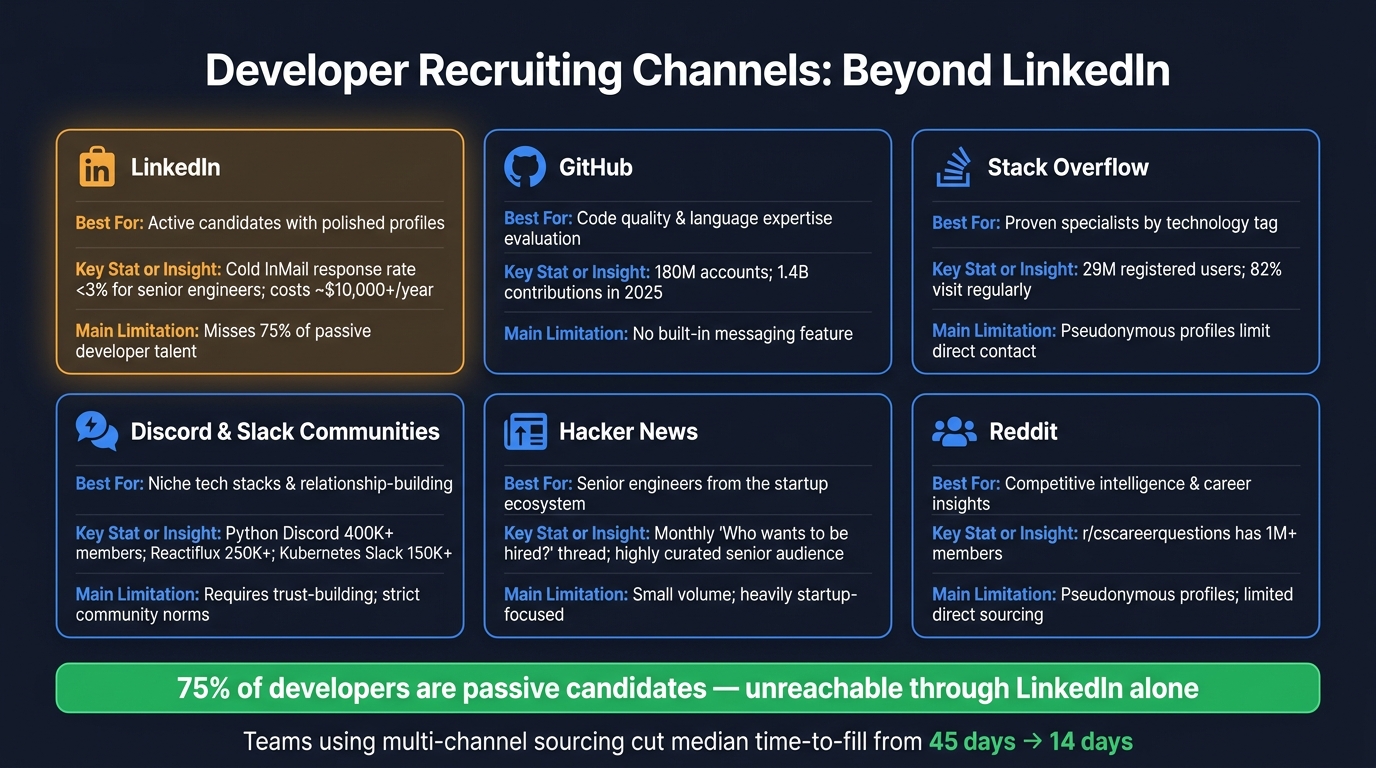
Looking beyond LinkedIn opens up a world of opportunities to connect with developers where they naturally spend their time. From active online communities to open source projects and specialized events, these channels offer unique ways to engage with developers on their terms. Here's a closer look at what each channel brings to the table.
Community-Based Recruiting Channels
Developers often gather in communities centered around the tools and programming languages they use every day. These platforms provide direct access to developers in their element, offering insights into their skills and interests.
Stack Overflow is home to 29 million registered users, with 82% visiting regularly . Its peer-validated reputation system is a goldmine for identifying expertise. For instance, a high score in a tag like "Kubernetes" signals real-world problem-solving skills that other engineers have found helpful - a far stronger indicator than a keyword on a resume.
Discord and Slack servers host real-time discussions among developers. Communities like the Python Discord (400,000+ members), Reactiflux (250,000+ members), and the Kubernetes Slack (150,000+ members) are active and highly relevant to specific tech stacks . To make an impact here, avoid sending unsolicited messages. Instead, use designated #jobs channels and provide clear details, including salary and tech stack specifics.
Reddit offers a unique perspective through subreddits like r/cscareerquestions (1 million+ members) and r/experienceddevs. While direct sourcing is limited due to pseudonymous profiles, the candid conversations provide valuable insights into what developers prioritize - whether it's compensation, company culture, or remote work flexibility .
Open Source Contributions as a Talent Pool
GitHub serves as a public portfolio for software engineers, with 180 million accounts and 1.4 billion contributions recorded in 2025 . This platform allows you to evaluate not just technical skills but also work habits and communication abilities.
For example, a consistent contribution graph spanning 40+ weeks a year can signal reliability, while detailed pull request descriptions and constructive feedback responses highlight strong communication and problem-solving skills. Using GitHub's advanced search (e.g., language:rust location:"San Francisco" followers:>20), you can filter candidates by language, location, and follower count . Since GitHub lacks a direct messaging feature, you'll need to find contact information in profile bios, linked websites, or git commit logs. Personalizing your outreach by referencing their work is key to building rapport.
Beyond code contributions, attending developer events can deepen your engagement with this talent pool.
Developer Events and Conferences
Conferences and hackathons offer face-to-face (or virtual) opportunities to connect with developers who are actively honing their craft. These events create a natural setting for conversations that feel authentic rather than transactional. Hosting a workshop or sponsoring a technical talk can showcase your company’s expertise and values before any direct recruiting begins. This approach allows developers to engage with your team organically, fostering trust and interest.
Niche Job Boards and Developer-Focused Platforms
In addition to community spaces, developer platforms vs. niche job boards provide a targeted way to reach developers. Unlike general job boards, these platforms are designed specifically for technical roles, attracting candidates who are already exploring new opportunities.
Take Hacker News, for instance, which runs a "Who wants to be hired?" thread on the first day of each month. This thread consistently attracts senior engineers from the startup ecosystem . While the audience is smaller, it's highly curated, making it easier to connect with experienced professionals.
The key takeaway here is signal quality. These platforms prioritize technical context - like contributions, discussions, and reputation - over self-reported skills, giving you a clearer picture of a candidate’s abilities before initiating a conversation.
| Channel | Best For | Main Limitation |
|---|---|---|
| GitHub | Code quality, language expertise | No built-in messaging |
| Stack Overflow | Proven specialists by technology tag | Pseudonymous profiles |
| Hacker News | Senior engineers at startups | Small volume, startup-heavy |
| Discord / Slack | Niche tech stacks, relationship-building | Requires trust, community norms |
| Competitive intelligence, career insights | Pseudonymous, limited direct sourcing |
How to Build a Multi-Channel Recruiting Strategy
Identifying the right channels is just the beginning; creating a workflow that balances team energy and budget is the real challenge.
How to Choose Your Core Channel Mix
To build an effective recruiting strategy, focus on 4–6 channels that align with your hiring needs:
- Specialist roles (e.g., Staff Engineer, ML Infrastructure): Platforms like GitHub and open source contributions can help you gauge technical expertise. Pair this with Stack Overflow to validate skills through peer recognition.
- High-volume hiring: Start with AI-powered sourcing strategies to scale your efforts. Add communities like Reddit and Discord to attract candidates with inbound interest.
- Senior and leadership roles: Explore Hacker News and attend industry conferences to meet experienced professionals. Open source maintainer lists can also reveal top technical leaders.
- Niche technologies (e.g., Rust, Elixir): Join language-specific Discord or Slack communities where specialists naturally gather.
According to Stack Overflow's 2025 Developer Survey, nearly 75% of developers are not actively seeking jobs (45.6% are not looking, and 28.8% are only somewhat open) . This means a large portion of the talent pool is outside LinkedIn's reach. Tools like daily.dev Recruiter can help bridge this gap by streamlining introductions and fostering warm candidate engagement.
How daily.dev Recruiter Fits Into a Diversified Strategy
Platforms like GitHub, Stack Overflow, and Discord are invaluable but often require hours of manual effort for each candidate . This is where daily.dev Recruiter comes in. It enhances your outreach by connecting you with passive talent through warm, double opt-in introductions. Developers on this platform are already engaged in learning and professional development, and they’ve signaled openness to opportunities - eliminating the awkwardness of cold outreach.
For example, LinkedIn InMail response rates for backend engineers can dip below 3%, whereas daily.dev Recruiter offers a more personalized and trusted connection . This tool doesn’t replace community sourcing but complements it. Use platforms like GitHub and Stack Overflow to evaluate technical skills, and rely on daily.dev Recruiter to make meaningful introductions in a space developers trust.
How to Allocate Time and Budget Across Channels
Once your channel mix is set and tools are integrated, it’s time to allocate resources wisely. Use your AI-powered sourcing platform as the foundation for volume hiring and contact discovery, and save manual community sourcing for roles that require deeper engagement. While platforms like GitHub, Stack Overflow, and Reddit are free, they can be time-consuming. On the other hand, events and conferences can range from $0 to over $5,000, depending on sponsorship levels . Shifting resources away from more expensive options, like LinkedIn Recruiter (which costs over $10,000 annually), can improve efficiency .
"The sourcing data is incredible, scanning 850M+ profiles with recruiter-level precision to uncover perfect-fit candidates I'd never find otherwise. Best of all, the outreach feels genuinely personalized and non-generic, driving sky-high reply rates." - Nick Poloni, President, Cascadia Search Group
For smaller teams, the key is to avoid overextending. Focus on 2–3 channels that align with your hiring needs. Let AI handle the bulk of candidate discovery, and reserve manual efforts for high-impact tasks - like referencing a candidate’s specific pull request, Stack Overflow answer, or personal project in your outreach.
How to Measure and Improve Channel Performance Over Time
Once your multi-channel strategy is up and running, the next hurdle is figuring out what's actually delivering results. Without proper tracking, you risk wasting both time and money.
Key Metrics to Track for Each Sourcing Channel
To gauge performance effectively, keep an eye on these metrics across all your channels:
- Response rate: Measure the percentage of candidates who reply to your outreach. Comparing response rates between channels can highlight which ones deserve more attention.
- Screen-to-quality ratio: Track how many screening calls lead to strong candidates. A low ratio might mean the channel isn’t attracting the right audience for your needs.
- Interview-to-offer ratio: Look at how many interviews are needed to make one offer. This helps you assess how well a channel pre-qualifies candidates before they enter your pipeline.
- Cost per hire: Add up all expenses for a channel (tools, time, sponsorships) and divide that by the number of hires it produces.
- Candidate seniority mix: Check if the channel is bringing in candidates at the right experience level. For instance, a channel that mostly generates junior candidates won’t help much if you’re searching for a Staff Engineer.
- Remote readiness: If you’re hiring for a distributed team, track whether candidates have asynchronous communication skills and are located in compatible time zones.
These metrics form the foundation for a tracking system that helps you make informed adjustments over time.
How to Set Up a Channel Tracking System
Start by adding a "Source" field in your ATS or using a shared spreadsheet to log where each candidate comes from. This makes it easier to spot trends during monthly reviews. Be specific when tagging candidates - note whether they came from a community, event, or platform.
"Context beats cold outreach. When you know what a developer is working on... your first message can be relevant instead of generic." - Nimrod Kramer, CEO, daily.dev
Tools like daily.dev Recruiter can simplify this process. Their double opt-in model ensures that every introduction is intentional and logged, giving you cleaner, more reliable data on how candidates engage with your outreach.
Once your tracking system is set up, use the insights to fine-tune your resource allocation across channels.
How to Rebalance Your Channel Mix Based on Results
Every 60–90 days, review your channel data to pinpoint underperforming sources. For example, a channel with a high volume of candidates but a low screen-to-quality ratio may not be worth the investment. In such cases, adjust your targeting criteria or shift resources elsewhere.
Focus more effort on channels that consistently produce candidates who advance past the first interview. For hard-to-fill roles, manual sourcing - like reaching out to GitHub contributors - often delivers better results than high-volume methods. On the other hand, for roles requiring large-scale hiring, developer sourcing tools can handle the initial stages, freeing your team to focus on meaningful interactions. This ongoing, data-driven approach ensures you’re always refining your recruitment strategy for better outcomes.
Conclusion: Building a Developer Recruiting Strategy That Does Not Depend on One Channel
Relying solely on LinkedIn for recruiting can limit your reach and drive up costs. With nearly 75% of developers not actively engaging with LinkedIn's candidate pool , and cold InMail response rates for backend engineers at Series A–C companies dropping below 3% , it's clear that sticking to one platform puts you in direct competition for a small slice of talent.
A smarter approach? Go where developers already spend their time. Platforms like GitHub, niche communities, specialized events, and other tech-focused spaces are where developers actively showcase their skills. Whether they’re contributing to open-source projects, answering questions on Stack Overflow, or diving into technical discussions, these activities provide tangible evidence of expertise - no resume required.
This multi-channel strategy doesn’t just expand your reach - it also makes your outreach more personal. Tools like daily.dev Recruiter align perfectly with this approach. By tapping into an active developer community, it ensures every introduction is warm and double opt-in, meaning developers have already expressed interest in hearing from you.
To make this work, aim for a mix of 4–6 channels, monitor quality hire metrics, and adjust based on the data. Recruiters who integrate community-driven sourcing and use effective tools have cut their median time-to-fill from 45 days to just 14 days . This highlights how a balanced, data-driven approach can deliver faster and better results.
Ultimately, a strong recruiting strategy is built on trust, relevance, and being present where developers are most active. By diversifying your channels and consistently tracking performance, you set the foundation for long-term success.
FAQs
Which 4–6 channels should I prioritize for my roles?
To broaden your approach to recruiting developers, concentrate on platforms and spaces where they already spend their time. Here are some key channels to consider:
- Community-driven platforms: Developers frequently engage on platforms like daily.dev, Stack Overflow, Discord, Reddit, and even local meetups. These spaces are ideal for connecting with them organically.
- Open source hubs: Platforms like GitHub and GitLab offer a wealth of talent. Analyze contributors and project maintainers to identify skilled developers.
- Events and conferences: Whether virtual or in-person, these gatherings provide opportunities to meet developers who are passionate about their craft.
- Specialized job boards: Look into job boards specifically designed for developers to target candidates more effectively.
By tapping into these channels, you can enhance your outreach and connect with skilled developers who align with your needs.
How do I reach GitHub developers without built-in messaging?
If you're looking to connect with developers on GitHub, start by analyzing their public profiles and activity. GitHub offers advanced search filters that make this process easier. You can narrow down your search by location, programming language, or even repository activity to find the right candidates.
Once you’ve identified potential developers, take a closer look at their profiles. Pay attention to their recent commits, pinned repositories, and the number of stars their projects have received. These elements can give you a good sense of their expertise and interests.
After identifying promising profiles, cross-reference their GitHub information with contact databases to locate verified contact details. Use this information to craft a personalized outreach message tailored to their skills and contributions. Since GitHub doesn’t have a direct messaging feature, this method ensures you can connect with developers effectively and professionally.
What’s the simplest way to track performance by channel in my ATS?
Your ATS likely includes built-in dashboards and reporting tools that can help you monitor how well your recruitment channels are performing. To get the most out of these features, set up UTM tracking or use custom source tags whenever you post jobs. This ensures you can accurately attribute candidates to their source.
Pay close attention to metrics like:
- Source of hire: Where your top candidates are coming from.
- Response rates: How often candidates are engaging with your job postings.
- Quality of hire: The long-term success and performance of hires from different channels.
Review these metrics regularly - quarterly is a good rule of thumb. By analyzing this data, you can pinpoint which channels are driving the best results and tweak your recruiting strategy accordingly. Data-driven adjustments can make a big difference in finding and attracting the right talent.
.png)