When hiring tech talent, relying too much on LinkedIn can hurt your results. Here’s why:
- Limited reach: Only 10% of the workforce is actively job hunting, and about 30% of software engineers aren’t even on LinkedIn.
- High competition: LinkedIn is crowded with recruiters, so your outreach often gets ignored.
- Outdated profiles: LinkedIn profiles may not reflect a candidate’s current skills, unlike platforms like GitHub or Stack Overflow.
The solution? Use a multi-channel recruiting strategy. Diversify with platforms like GitHub, Stack Overflow, developer networks, and events to find untapped talent. These methods can improve response rates, candidate quality, and hiring efficiency.
Key tips:
- Search GitHub for developers by tech stack and review their code contributions.
- Use platforms like daily.dev Recruiter for targeted outreach and higher response rates.
- Engage in forums like Reddit or Discord by offering value before mentioning roles.
- Build a referral program with cash bonuses and track its effectiveness.
- Sponsor or attend tech conferences to connect with developers face-to-face.
Track metrics like response rates, time-to-hire, and quality-of-hire to measure channel performance. Start small by reallocating 20% of your recruiting budget to a new channel, then refine based on results.
Diversifying your efforts ensures you connect with skilled candidates others might overlook, improving your hiring outcomes.
Why Relying Only on LinkedIn Is Risky
LinkedIn's popularity among recruiters has created a highly competitive environment where everyone is chasing the same pool of candidates . With so many recruiters using it as their primary channel, it’s easy for your outreach to get lost. Imagine a candidate receiving dozens of generic InMails every day - your message is just one among many, making it hard to stand out.
Here’s another problem: not all talent is on LinkedIn. In fact, about 30% of software engineers don’t even have a LinkedIn profile . That’s a huge chunk of potential hires you’re missing right off the bat. Meanwhile, platforms like GitHub and Stack Overflow are brimming with developers - GitHub has 65 million users showcasing active code repositories and tech tags, and Stack Overflow boasts 14 million developers with up-to-date data from their Q&A contributions . These platforms are where developers actively engage with their craft, but if you’re only on LinkedIn, you’re overlooking them entirely.
Another issue is LinkedIn’s sheer volume of activity. Developers are inundated with messages, leading many to ignore, filter, or even block outreach attempts . Unlike more focused platforms where developers participate in meaningful ways, LinkedIn’s broad networking scope often results in lower engagement . Many developers now prefer skill-specific sites where they can demonstrate their work rather than rely on static endorsements, meaning your messages on LinkedIn are more likely to be ignored or marked as spam.
Speaking of static, LinkedIn profiles are often outdated or self-reported, offering limited insight into a candidate’s current skills. In contrast, platforms like GitHub and Stack Overflow provide real-time data on coding activity, allowing you to evaluate verifiable skills rather than outdated claims. Relying solely on LinkedIn means you risk basing hiring decisions on incomplete or stale information, which can hurt the quality of your hires. This reliance on a single channel is especially problematic as the tech hiring landscape continues to evolve .
For remote roles, the competition is even fiercer. Recruiters are vying for the same visible candidates, which makes it harder to stand out . At the same time, relying on LinkedIn means you’re missing out on diverse talent pools available through specialized forums and developer communities. This is why it’s crucial to expand your recruiting efforts beyond LinkedIn. Diversifying your channels gives you a better chance to connect with engaged, skilled candidates who might otherwise fly under the radar.
Hiring engineers?
Connect with developers where they actually hang out. No cold outreach, just real conversations.
How to Build a Multi-Channel Recruiting Strategy
To attract top developer talent, it's essential to align your recruiting platforms with the type of candidates you're targeting. For example, GitHub and Stack Overflow are ideal for finding coders, while referrals and events work well for networked professionals. Engaged developers can often be reached through active communities. Use a CRM to track interactions across these channels, and aim for a mix like this: 40% digital platforms, 30% events, and 30% referrals, adjusting based on results .
A consistent brand presence and timely follow-ups across all channels are crucial. Imagine a developer encountering your brand on GitHub, meeting your team at a conference, and then hearing about your company through a referral. That kind of consistent exposure builds trust. This multi-channel approach also helps overcome the over-saturation of platforms like LinkedIn, giving you access to talent that might otherwise go unnoticed. Studies show this strategy can improve the quality of hires by 25-40% compared to sticking with just one channel . Start by tracking metrics like sourcing volume, response rates (aim for over 10%), and time-to-interview for each channel through your ATS. Then, evaluate how each channel supports your hiring goals.
Finding Developers on GitHub
GitHub is a goldmine for identifying skilled developers. Start by searching for keywords that align with your tech stack, such as specific programming languages or frameworks. Dive into repositories to review code quality, commit frequency, and project complexity. Pay close attention to contributions to open-source projects, as the "Contributions" graph on a profile can reveal a developer's consistency and expertise .
Look for repositories with stars and forks, as these indicators reflect community recognition - a sign that other engineers respect their work. Developers active in relevant repositories are often passive candidates, meaning they aren't actively job hunting but possess the exact skills you're looking for .
Connecting with Developers on daily.dev Recruiter
The daily.dev Recruiter platform simplifies the process of connecting with pre-qualified developers. It uses double opt-in introductions, ensuring you're only reaching developers who are genuinely interested in recruiter outreach. Since the platform matches developers based on their skills and interests, your outreach feels relevant and avoids the "spam" label. This approach achieves 30-50% higher response rates compared to cold emails .
Developers on daily.dev are already engaged in tech content and continuously updating their skills. Reaching out through this platform places your opportunities in front of them at the right time, without disrupting their workflow .
Participating in Developer Communities and Forums
Developer communities like Discord, Reddit (e.g., r/programming), and forums like Hacker News are excellent places to connect. However, the key is to offer value first. This can mean answering questions, sharing helpful resources, or hosting AMAs on technical topics. Avoid immediately posting job openings, as many communities have strict rules against direct recruiting .
Engage authentically to build rapport over time. Once you've established trust, you can subtly mention job opportunities when they naturally fit into the conversation. Developers who are active in these spaces are often highly skilled and value genuine interactions over sales pitches .
Identifying Talent on Stack Overflow
Stack Overflow is another valuable platform for finding developers. Use relevant tags, like React or Python, to search for candidates. Focus on users with reputation scores above 10,000, as these scores reflect proven expertise. Review their top-voted answers to understand their problem-solving skills and check how recently they've been active .
Pay special attention to developers active in niche tags that match your specific hiring needs. These individuals are often passive talent who aren't actively job hunting but demonstrate their skills publicly. Personalized outreach that references their contributions can achieve 20-30% higher engagement than generic messages .
Setting Up Employee Referral Programs
Employee referral programs can be a powerful tool for sourcing talent. Create a portal where employees can submit referrals and offer tiered cash bonuses of $1,000-$5,000, with higher amounts for harder-to-fill roles. To keep the program engaging, consider adding perks like extra PTO or public recognition .
Track metrics like your referral-to-hire ratio and promote the program through internal newsletters. Referrals are highly effective, with a 45% retention rate after four years, according to Dice data. Since your employees know your company culture and technical needs, their recommendations often result in great hires .
Meeting Developers at Tech Conferences and Events
Tech conferences like AWS re:Invent or PyCon are excellent opportunities to connect with developers. Sponsor booths or sessions to boost your visibility, and come prepared with business cards and a clear understanding of your tech stack. To make genuine connections, consider hosting roundtables or hackathons where developers can interact with your team .
Follow up within 24 hours on LinkedIn, referencing specific conversations you had at the event. Offering remote roles at these conferences can broaden your reach, allowing you to tap into talent from across the country .
How to Measure Recruiting Channel Performance
::: @figure 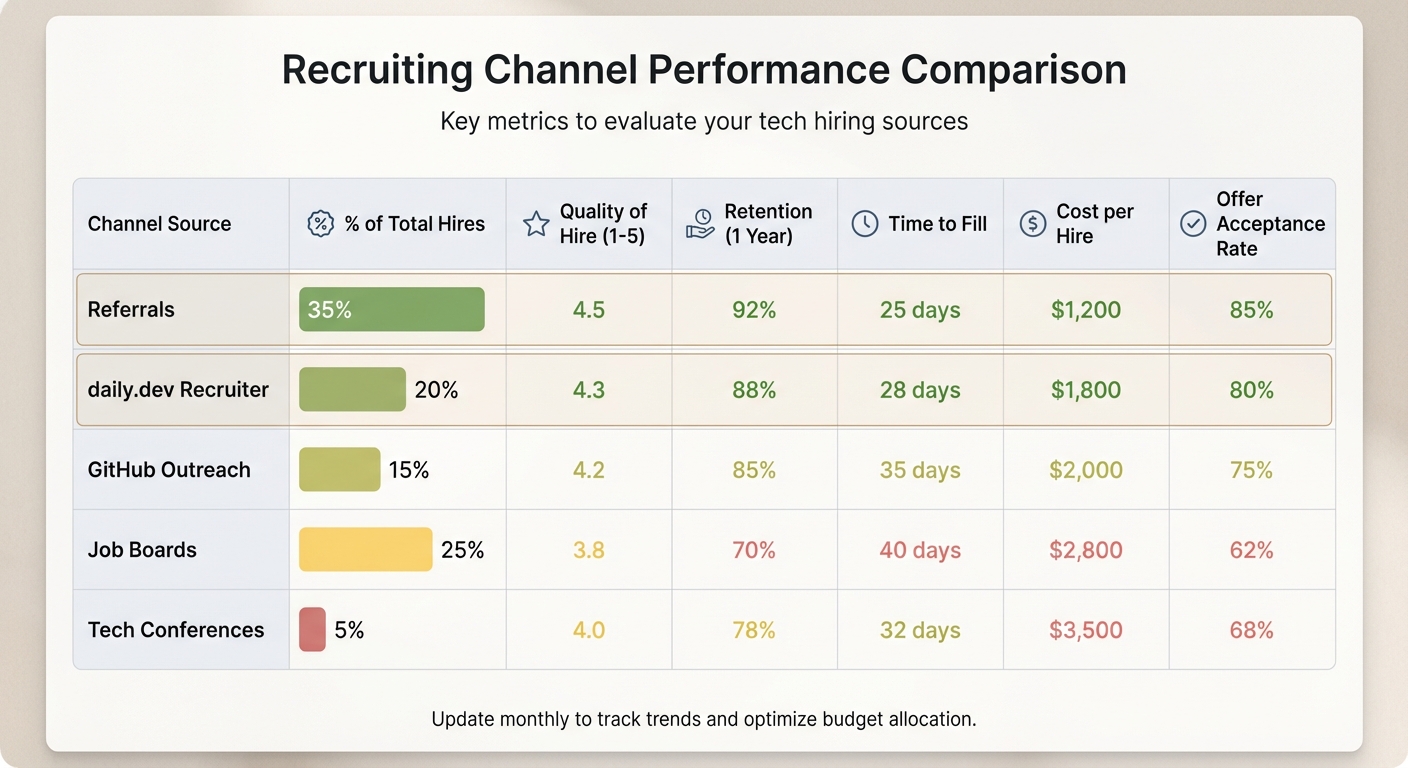 {Tech Recruiting Channel Performance Comparison: Metrics and ROI by Source}
Keeping track of key metrics is essential for making recruitment decisions based on data. Your applicant tracking system (ATS) should be equipped to capture metrics like reducing time-to-hire (or time-to-fill), cost-per-hire, offer acceptance rate, and quality-of-hire. These metrics serve different purposes: time-to-hire highlights process delays, cost-per-hire pinpoints spending efficiency, and quality-of-hire - assessed through performance reviews, retention rates, and time-to-productivity - reflects how well new hires perform in the long run. These foundational metrics pave the way for a deeper analysis of each recruiting channel.
To gauge channel effectiveness, consider which sources consistently deliver candidates who excel in technical screenings. For instance, while job boards might bring in a high volume of applicants, they often require more effort to filter out unsuitable candidates. On the other hand, referrals or platforms like daily.dev Recruiter may produce fewer applications but often deliver higher-quality candidates with less screening required.
Metrics to Track for Each Channel
In addition to the core metrics, it’s worth measuring engagement levels, especially for outreach-focused channels. While response rate benchmarks can vary, tailoring messages to specific candidates often boosts engagement. Tracking the offer acceptance rate offers insight into how well your compensation packages and workplace culture align with candidate expectations - low acceptance rates could point to issues with targeting or negotiation strategies. Post-interview surveys can also provide valuable feedback on candidate satisfaction (cNPS), helping you identify and address pain points in the hiring process.
Another important metric is the diversity hiring rate, which reflects your ability to tap into diverse talent pools. Some channels naturally connect you with a broader range of candidates, making this metric crucial for building a well-rounded team. Comparing volume metrics with retention data can also reveal whether certain channels are consistently delivering hires who stay with your company over time.
Comparing Channels with a Performance Table
A performance table is a practical way to compare recruiting channels and track trends over time. By examining key performance indicators side by side, you can make data-driven decisions about where to focus your efforts. Here’s an example:
| Channel Source | % of Total Hires | Quality of Hire (1-5) | Retention (1 Year) | Time to Fill | Cost per Hire | Offer Acceptance Rate |
|---|---|---|---|---|---|---|
| Referrals | 35% | 4.5 | 92% | 25 days | $1,200 | 85% |
| daily.dev Recruiter | 20% | 4.3 | 88% | 28 days | $1,800 | 80% |
| GitHub Outreach | 15% | 4.2 | 85% | 35 days | $2,000 | 75% |
| Job Boards | 25% | 3.8 | 70% | 40 days | $2,800 | 62% |
| Tech Conferences | 5% | 4.0 | 78% | 32 days | $3,500 | 68% |
Regularly updating this table - ideally every month - can help you spot trends and adjust your strategy. Channels that consistently perform well might deserve more resources, while underperforming ones may need to be re-evaluated or even paused.
How to Allocate Your Recruiting Budget
Start by understanding the financial impact of unfilled roles. On average, vacancies cost businesses $500 per day in lost productivity . For instance, a two-week hiring delay can rack up significant costs, making it worthwhile to invest in quicker recruiting channels. To calculate this, divide the role's annual revenue contribution by 220 workdays. If the result is above $300–$500, it’s a clear signal to allocate more resources toward faster hiring methods. This approach highlights the importance of prioritizing efficiency in recruitment.
Low-cost strategies like referrals, organic outreach on platforms like GitHub, and engaging with active developer communities often deliver exceptional results without straining your budget. In 2025, over 40% of HR budgets were directed toward talent acquisition . Additionally, internal recruitment is far more cost-effective - about 2.3 times cheaper - compared to external agencies, which typically charge 20–25% of a new hire’s first-year salary .
With vacancy costs in mind, structure your budget to make every dollar count. A tiered allocation strategy can help you focus resources effectively. For high-volume, repeatable roles, lean on referrals and organic social channels that require smaller investments. For specialized or revenue-critical positions, allocate higher budgets to premium platforms like daily.dev Recruiter, sponsored ads, or niche job boards. To maintain flexibility, set "tripwires" to monitor performance. For example, if a channel's cost-per-hire exceeds your target for two straight weeks, cut that budget by 15% and redirect funds to better-performing channels .
"Hiring the right talent is important, but doing it without breaking the bank? That's what makes a truly successful hire." - Hyreo
Balance your spending to improve both candidate quality and volume. Instead of pouring money into ads to increase applications, allocate $500–$1,000 per recruiter for tools that enhance the candidate experience with quick wins. This could include automated scheduling systems or personalized outreach platforms. A great example is Unilever, which in 2025 saved 100,000 hours of recruitment time and significant costs by using an AI-powered video interview system. This not only reduced time-to-fill but also cut overhead expenses . Investing in process efficiency often delivers better returns than simply increasing ad budgets.
How to Build Your Presence in Developer Communities
Establishing credibility in developer communities requires genuine participation and a commitment to adding value. Developers can easily spot recruiters who only show up to post job openings. Instead, focus on contributing first and recruiting second. Engage in discussions, answer questions, and interact with content developers are already sharing. This approach may take time, but it positions you as someone who respects and understands the community. These efforts lay the groundwork for building meaningful, lasting relationships.
Start by listening more than you speak. Spend a few weeks observing how communities like Reddit, Discord, or daily.dev operate before diving in. Pay attention to the kinds of content that get the most attention, the recurring questions, and the tone of conversations. When you do start engaging, make your contributions genuinely helpful. Share things like industry reports, technical articles, or insights on hiring trends that developers care about. By focusing on quality over quantity, you’ll earn respect and recognition, which is far more impactful than spamming promotional material.
Recognition is a key driver of trust in developer communities. As Jeff Osier-Mixon, Open Source Community Manager at Intel Corporation, explains:
"Money is important, but it functions as a representation of recognition, not value" .
This highlights the importance of authentic engagement over aggressive recruiting tactics. Developers value acknowledgment of their work and thoughtful participation in discussions. Instead of steering every conversation toward job opportunities, take time to comment on their projects, appreciate their contributions, and engage in discussions on their terms. This kind of recognition builds trust and strengthens your reputation within the community.
Consistency is essential for maintaining long-term relationships. Devote 30 minutes each day to authentic participation - upvote insightful posts, share relevant resources, and respond to questions about your company’s tech stack or engineering culture when appropriate. By the time you mention open roles, you’ll have established enough credibility that developers will take you seriously. People are much more likely to consider opportunities from someone they’ve seen consistently adding value than from a stranger dropping job links.
Track your progress by measuring community engagement separately from traditional recruiting metrics. Monitor how many meaningful conversations you initiate, the level of engagement with the content you share, and how your reputation evolves over time. The goal is to build a long-term talent pipeline rather than focusing solely on immediate hires. When developers recognize your name and trust your contributions, they’ll be more inclined to reach out when they’re ready to explore new opportunities - and they might even bring talented colleagues with them. Use these engagement insights to refine your overall recruiting strategy and strengthen your multi-channel approach.
Using Content to Attract Developers
Incorporating well-crafted content into your recruiting strategy can help you connect with developers on a deeper level.
Start by creating technical content that addresses real challenges developers face. This could include tutorials on popular frameworks like React or Angular, in-depth explorations of algorithms and data structures, or troubleshooting guides for tools like Docker and Kubernetes . When your content genuinely helps developers solve problems or improve their skills, they’re more likely to remember your company when they’re ready for a career move.
Tailor your content to match the needs of different experience levels. For example:
- Technical tutorials are ideal for junior and mid-level developers eager to expand their skills.
- API references and documentation serve as valuable resources for developers across all levels.
- Case studies that highlight complex problem-solving or large-scale system design resonate with senior and lead developers.
Interactive content, like coding challenges and test platforms, can also be a powerful way to engage active job seekers while giving them a chance to showcase their skills in a natural, non-intimidating way .
Some of the best content ideas often arise from real-world developer frustrations. For example, monitor recurring issues on GitHub or look into niche problems developers frequently search for solutions to. Then, create "how-to" articles that tackle those specific issues . If a tutorial on "Uploading Images with Cloudinary" gains traction, consider updating it for newer technologies like Next.js 14 or adapting it for different programming languages like Rust or Go. This approach keeps your content relevant and valuable as the tech landscape evolves.
It’s equally important to ensure your job descriptions match the technical depth of your content. Avoid vague statements like "modern tech stack" or "competitive salary." Instead, be specific: "React 18 with TypeScript, Node.js backend, PostgreSQL, deployed on AWS using Docker" and "$140,000 - $170,000 range + $5,000 AI stipend." Developers also appreciate clarity about the work itself - such as "redesigning our authentication system for 10M+ users" - over generic phrases like "high-impact projects." Transparency like this builds trust and attracts candidates genuinely interested in your work.
Finally, distribute your content strategically on platforms where developers already spend time. Post tutorials on sites like Dev.to or Hashnode without including recruitment pitches - focus purely on delivering value . Use GitHub to showcase your team’s code and maintain polished README files. Platforms like daily.dev Recruiter allow you to share technical content and transparent job descriptions directly in developers’ learning workflows. Aim for a 90/10 split: 90% helpful, value-driven content and 10% promotional material. This balance strengthens your credibility and ensures your content complements a broader multi-channel recruiting strategy.
Conclusion
Relying only on LinkedIn for tech hiring puts you at a disadvantage in today’s crowded recruiting environment. With recruiters swarming the same pool of visible candidates, you risk missing out on the hidden talent that isn’t actively engaging on LinkedIn .
To overcome this, adopt a multi-channel strategy that taps into diverse and often overlooked talent pools. Employee referrals remain a standout option, but you can go further by incorporating GitHub sourcing, engaging with developer communities, using strategic content marketing, and leveraging platforms like daily.dev Recruiter. These tools connect you with developers right where they’re honing their skills, ensuring you access talent that other recruiters might miss.
Making this shift doesn’t have to be overwhelming. Start small: reallocate 20% of your recruiting budget to a new channel - whether it’s GitHub, referrals, or a developer-focused community. Monitor key metrics like response rates, candidate quality, and time-to-fill on a weekly basis using proven sourcing strategies. This data-driven approach ensures you can refine your strategy and focus resources where they deliver the best results.
Building trust with passive candidates takes effort, but it’s worth it. By sharing valuable content consistently - following the 90/10 rule (90% helpful content, 10% promotional) - you position your brand as a trusted resource rather than just another recruiter. Over time, this approach creates a steady talent pipeline that thrives even as individual channels become saturated.
FAQs
Which recruiting channels should I add first?
Start by exploring platforms where developers frequently share their expertise and collaborate, such as GitHub, Stack Overflow, Reddit, and developer hubs like Hacker News or Dev.to. These spaces are goldmines for evaluating skills through their code contributions, detailed answers, and overall participation. Prioritize platforms that allow for personalized engagement and foster community interaction - this approach helps you connect with passive candidates while gaining a clearer picture of their technical abilities.
How do I approach developers on GitHub without sounding spammy?
When reaching out to developers on GitHub, it’s important to be genuine and thoughtful. Start by exploring their repositories and contributions to get a sense of their skills and interests. Then, craft a personalized message that mentions specific projects or work you find impressive. Steer clear of generic or mass messages - these often come across as insincere. Instead, explain clearly how their expertise aligns with what you're looking for. Always prioritize respectful, opt-in communication to build trust and create meaningful connections without seeming spammy.
What metrics best prove a channel is worth the budget?
When evaluating the effectiveness of a recruiting channel, several key metrics can provide valuable insights:
ROI (Return on Investment): This metric measures how cost-effective a channel is by comparing the money spent to the results achieved. It’s a straightforward way to gauge whether a channel is worth the investment.
Cost per Hire: This tracks the total expenses involved in hiring a candidate through a specific channel. It helps identify which channels are more budget-friendly.
Quality of Hire: This focuses on the long-term success and performance of candidates sourced through a channel, offering a deeper look at the impact of hiring decisions.
Source of Hire: This identifies which channels consistently bring in top-performing candidates, helping recruiters focus on the most productive sources.
By analyzing these metrics together, you can get a clearer picture of how efficient and impactful each recruiting channel truly is.
.png)