Hiring engineers through referrals is faster, cheaper, and leads to better retention. Traditional recruiting costs $24,000–$30,000 per hire and takes 39–55 days. Referrals? Just $2,000–$5,000 and 29 days. Plus, 70% of referred engineers stay beyond four years, compared to 25% from job boards.
Why referrals work:
- Higher success rates: 34% of referrals receive job offers vs. 2–5% from job boards.
- Better retention: Referred hires stay longer and are 25% more profitable.
- Cost savings: Reduce recruiting expenses and turnover by 20%.
To succeed, focus on:
- Ease of use: Keep referral submissions under two minutes.
- Transparency: Provide real-time updates on referral status.
- Tailored incentives: Offer tiered bonuses ($1,500–$15,000+) for different roles.
Avoid pitfalls like referral fatigue and bias by simplifying the process, rewarding diverse referrals, and ensuring every candidate goes through the same technical hiring best practices. Referrals, when done right, are the most effective way to build strong engineering teams.
::: @figure 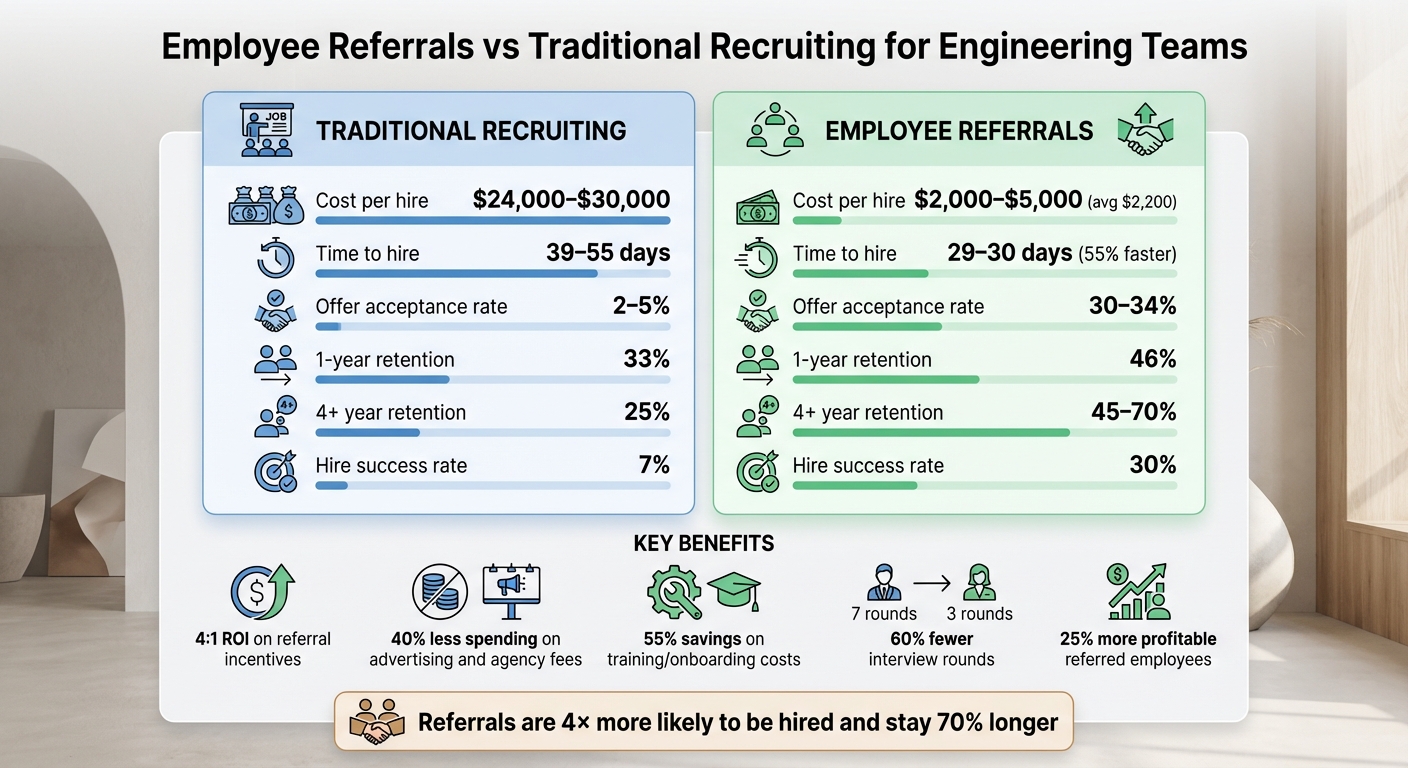 {Employee Referrals vs Traditional Recruiting: Cost, Speed & Retention Comparison}
Why Referrals Outperform Other Hiring Channels for Engineers
When it comes to hiring engineers, referrals consistently outshine other channels. The numbers speak for themselves: referred candidates are hired at a 30% rate, compared to just 7% for those from job boards or cold outreach (which often requires improving developer response rates through better targeting) . That’s over four times the success rate, making your engineering team’s network an incredibly effective talent pool.
Referrals don’t just improve hiring rates - they’re also much faster. On average, referral hires fill roles 55% faster, cutting the typical 55-day hiring process down to around 30 days . This speed comes from engineers acting as an informal first filter, assessing candidates for both technical skills and team compatibility . For example, Stripe prioritized referral speed as a key metric, reducing time-to-hire by 35% and sourcing 55% of their engineering hires through referrals . Ramp experienced similar success, with referrals accounting for over 60% of hires during a high-growth period, adding 100+ employees in just 18 months while meeting a 30-day close target . Faster hiring doesn’t just fill roles quickly - it also contributes to better retention over time.
Retention is another major win for referral-based hiring. After one year, 46% of referred hires stay with the company, compared to 33% of hires from career sites . Even more impressively, referred employees tend to stay 70% longer . This is partly because referred candidates often come in with realistic expectations, having already heard about the company’s culture and day-to-day work from someone they trust.
The financial benefits of referrals are just as compelling. At an average cost of $2,200 per hire, referrals are nearly half as expensive as other hiring channels while delivering a 4:1 return on investment for referral incentives . For mid-sized tech companies, this translates to 40% less spending on advertising and agency fees each year . Referrals also cut onboarding costs, saving 55% on training expenses thanks to faster ramp-up times. Plus, they streamline the interview process, reducing the number of interview rounds by 60% - from seven to just three .
"Great people know other great people. In a world of rising recruitment costs and high turnover, data shows employee referrals are the most effective source to attract and retain talent."
– Tawfiq Abu-Khajil, Co-Founder & CEO, Eqo
How to Build a Referral Program Engineers Will Actually Use
The success of a referral program often comes down to its design. Engineers are more likely to use systems that save them time, provide transparent communication, and safeguard their professional reputation. To make it work, the program should seamlessly integrate into their daily routines - no clunky HR portals, no wondering about the status of their referral. By focusing on clear goals, a streamlined process, and transparency, you can create a program engineers trust and actively engage with.
Set Measurable Goals for Your Program
Start by aligning the program’s objectives with your hiring priorities. Avoid vague targets and instead define success with specific benchmarks. For example, you might aim to generate a set number of senior developer leads each quarter using modern sourcing tactics or fill critical positions like Principal AI Engineers. If increasing diversity is a focus, establish a goal such as boosting referrals of underrepresented groups in your pipeline by 25% within six months . Concrete, measurable goals not only help track progress but also make it easier to demonstrate the program’s value to company leadership.
Make the Referral Process Simple
Efficiency is key. Engineers won’t engage with a referral process that feels like a chore. Research shows that if it takes more than two minutes to submit a referral, participation sharply declines . The most effective programs meet engineers where they already are - integrating with tools like Slack or Microsoft Teams so they don’t have to log into separate systems. Keep it simple: ask for just the candidate’s name, LinkedIn profile, and a brief note for context. Automatically record and time-stamp referrals by integrating with your ATS, and offer trackable links for easy sharing via email, text, or social platforms. The smoother the process, the more likely engineers are to participate.
"If it takes an employee more than two minutes to submit a referral, they just won't do it. The process has to feel effortless."
– The Underdog.io Team
Build Trust Through Transparency
Engineers lose interest in referral programs when their efforts seem to disappear into a void. To prevent this, provide real-time updates on their referrals. Automated notifications can inform them when their candidate moves through stages like "Application Received", "Phone Screen", or "Technical Interview." Establish objective rules to handle potential conflicts, such as a time-stamped "first-in" policy for duplicate referrals and a clear 6–12 month window to determine if a candidate is already in your pipeline. Be upfront about referral bonuses - explain that they’re considered taxable supplemental income and processed through payroll. When engineers see that their referrals are handled professionally and transparently, they’ll feel more confident in the program and more inclined to participate again.
"Nothing kills engagement faster than silence."
– The Underdog.io Team
Referral Bonus Structures That Work
Creating a referral program that resonates with engineers requires more than just transparency - it demands a well-thought-out bonus structure. Engineers value rewards that not only provide financial benefit but also align with their professional principles. The most effective programs combine cash incentives with thoughtful perks, use strategic payout schedules, and adjust bonuses based on the complexity of the role. When done right, these programs highlight company priorities and maintain long-term engagement. Let’s dive into how bonus types and payout timing influence participation.
Cash Bonuses vs. Other Rewards
Cash incentives remain the go-to choice for most companies - around 80% offer monetary rewards, with 69% of those falling between $1,000 and $5,000. For engineering roles, the average referral bonus tends to range between $2,400 and $2,500, while mid-level positions may warrant $4,000 to $7,000. High-demand roles, like Principal AI Engineer or Head of Security, often justify bonuses of $7,500 to $15,000 or even higher[6,17]. These amounts are a cost-effective alternative to external recruiters, who typically charge 20–25% of the first-year salary - translating to $30,000 to $45,000 for a $180,000 position.
Non-cash rewards, however, can leave a lasting impression when tailored to what engineers value most. Perks like additional paid time off, tickets to industry conferences, learning stipends, or home office upgrades can foster a deeper emotional connection. Public acknowledgment - whether during an all-hands meeting or in a dedicated Slack channel - taps into the desire for recognition and peer validation. Additionally, charitable donations made in the referrer’s name can frame referrals as acts of goodwill[17,18].
"The language matters: 'We want to thank you for spreading the word' preserves intrinsic motivation while adding a bonus on top."
– Refgrow
Next, let’s explore how payout timing and tiered structures can elevate your bonus program.
When to Pay and How to Structure Tiers
The timing of payouts plays a key role in the success of referral programs. A common approach is to split payments - half upon the new hire’s start date and the other half after 90 days. This method ensures a return on investment by encouraging referrals of candidates who are likely to stay[6,21]. Some companies shorten the waiting period for the second installment to 30 days, which can build trust and provide quicker rewards.
"A split payment model is fast becoming the industry standard... It encourages your team to refer people who are a genuine fit for the long haul, not a warm body to collect a check."
– Underdog.io Team
Tiered bonus structures, which scale rewards based on role complexity, are another effective strategy. Flat-rate bonuses fail to account for the varying challenges of hiring for different positions. Instead, consider this tiered approach:
- Entry-level roles: Bonuses of $1,500–$3,000
- Core technical positions: Bonuses of $4,000–$7,000
- High-demand specialist roles: Bonuses of $7,500–$15,000+
For executive or founding roles, bonuses can exceed $25,000. It’s essential to communicate that these bonuses are taxable supplemental income, processed through payroll, to avoid any confusion after payouts.
| Role Category | Example Roles | Suggested Bonus | Payment Milestone |
|---|---|---|---|
| Entry-Level | Junior Developer, QA Engineer | $1,500–$3,000 | 100% after 30 days |
| Core Technical | Mid-Level Engineer, Senior PM | $4,000–$7,000 | 50% on start, 50% after 90 days |
| High-Demand | Senior AI/ML Engineer, Principal SRE | $7,500–$15,000 | 50% on start, 50% after 90 days |
| Executive | VP of Engineering, Founding Engineer | $25,000+ | Customized based on role |
Source: Compiled from 2025-2026 tech startup benchmarks[6,17].
Common Mistakes That Kill Referral Programs
For a referral program to thrive, it needs to overcome inefficiencies in the process and avoid structural biases that could limit access to diverse, high-quality candidates. Referral programs often stumble due to issues like referral fatigue, amplified biases, and clique hiring. These problems don’t just discourage participation - they can harm your employer brand, restrict your talent pool, and undermine engineering talent retention. For instance, when employees feel their referrals vanish into a "black hole", they’ll stop participating. Similarly, if referrals come exclusively from homogeneous networks, your hiring pipeline will stagnate. Let’s unpack these challenges and explore how to address them effectively.
How to Avoid Referral Fatigue
Referral fatigue sets in when employees feel the process is cumbersome, receive no updates about their candidates, or are overwhelmed by repeated requests. If submitting a referral takes more than a minute or involves clunky manual tracking (like spreadsheets), employees will quickly disengage. Worse, the "black hole" effect - where referrals disappear without acknowledgment - leaves employees feeling undervalued and unmotivated to continue.
To combat this, streamline the submission process so it’s quick and easy - aim for under 60 seconds. Use centralized tools that simplify tracking and communication. Keep the program alive by regularly promoting open roles through internal channels, like Slack or email. Short-term campaigns, such as "referral sprints", can also re-energize engagement. For example, offer a bonus of $1,000 for a hard-to-fill role during a specific month to create urgency. Publicly recognizing employees during meetings or in team chats reinforces that their contributions are appreciated. Once you’ve addressed these logistical hurdles, it’s crucial to tackle the structural biases that can undermine the program.
Preventing Bias and Clique Hiring
One of the biggest risks in referral programs is their potential to reinforce sameness. Employees tend to refer people from their own networks, which often mirror their own backgrounds. If your team already lacks diversity, this approach can deepen the problem. Studies highlight this issue: women of color are 35% less likely than white men to receive referrals. However, targeted efforts can make a difference. For instance, when Intel doubled referral bonuses for underrepresented groups, diverse hires jumped from 32% to 41%. Beyond diversity, clique hiring fosters groupthink, which stifles innovation and limits fresh ideas.
"If the company is currently comprised of white males that all went to a select group of schools or worked together at previous employers, then that is likely to reflect the kind of referrals they are going to deliver."
– David Pollard, Serial HR Tech Entrepreneur
To address these challenges, consider offering bonus multipliers for referrals from underrepresented groups. Ensure all candidates - referred or not - go through the same rigorous interview process to maintain fairness and uphold your hiring standards. Build interview panels that include individuals from varied backgrounds and departments to bring diverse perspectives into the evaluation process. To avoid conflicts of interest, exclude referrals within the same department from bonus eligibility. Finally, balance internal referrals with external sourcing channels that focus on diverse, pre-vetted talent. This dual approach ensures your pipeline isn’t overly reliant on any one network, creating a more inclusive hiring strategy.
How to Measure Referral Program Health
A referral program without measurable metrics is like navigating without a map - it’s all guesswork. To ensure success, you need to track the entire process, from the initial referral submission to long-term employee retention. Employee referrals are responsible for 40% of all tech hires , so understanding the factors that drive success is crucial for building strong engineering teams.
Key Metrics to Track
Start by looking at the participation rate - the percentage of employees who submit at least one referral. A rate below 25–40% could indicate issues like a cumbersome process or ineffective incentives . Next, examine your referral-to-hire ratio. The tech industry standard is about 10:1 . If your ratio is higher, it might mean your team needs better guidance on what makes a strong candidate.
Another key metric is reducing time-to-hire. Referrals should lead to faster hires compared to other channels. Then there’s cost-per-hire, which highlights your program’s return on investment. For example, offering a $5,000 referral bonus for a Senior Engineer earning $150,000 saves around $24,500 compared to hiring through an external recruiter who charges 20% .
Retention rate is the ultimate measure of success. Referred hires tend to stay longer - 46% are still with the company after one year, compared to 33% for hires from job boards . Even more impressive, 45% of referred employees remain for over four years, compared to just 25% from job boards . Lastly, track the diversity impact of your referrals by monitoring the demographics of submissions. If the referral pool lacks diversity, the issue might lie in who is participating, not just in who gets hired.
| Metric | What It Measures | Industry Benchmark (Tech) |
|---|---|---|
| Participation Rate | % of employees submitting at least one referral | 25–40% |
| Referral-to-Hire Ratio | Referrals needed to make one hire | 10:1 (Lower is better) |
| Time-to-Hire | Days from application to offer acceptance | ~29 days |
| Retention Rate | % of hires staying beyond 1 year | ~45–46% |
| Referral Hire Rate | % of total hires from referrals | 30% or higher |
These metrics don’t just validate your program - they provide a roadmap for actionable improvements.
Using Data to Improve Results
Once you’ve identified these metrics, use them to refine your referral program. A centralized dashboard, available through your ATS or a dedicated platform, can help you visualize trends and uncover bottlenecks that might go unnoticed in spreadsheets. For instance, if you see high submission rates but low hire rates, it could mean a quality mismatch. To address this, provide clearer role descriptions and examples of ideal candidates .
Look for departments with strong referral performance and share their strategies across the company . If certain roles are consistently hard to fill, consider offering tiered bonuses to incentivize referrals for those positions . Analyze where diverse candidates drop out of the process; if they’re being screened out despite strong qualifications, it could be due to unnecessary credential requirements blocking their progress .
Transparency is key - automate feedback so referrers receive updates in real-time. This prevents the "black hole" effect, where a lack of communication discourages future participation . Regularly compare your referral program’s performance against other hiring channels. If referrals aren’t delivering faster hires, lower costs, and better retention, adjust your incentives, simplify the process, or improve communication until the data reflects progress. By fine-tuning these metrics, you’ll build trust and ensure your team continues to recommend top-notch candidates.
Combining Referrals with Passive Sourcing
Referral programs and passive sourcing aren't opposing strategies - they complement each other perfectly. Referrals bring warm introductions and often align with your team's values, while passive sourcing broadens your reach beyond immediate networks. Together, they create a balance of fast, high-retention hiring and scalable outreach. As Juicebox aptly described it, "AI for volume, referrals for warmth" . This combination also paves the way for advanced techniques like network mapping.
Network mapping takes referrals a step further by turning passive data into actionable insights. By analyzing your employees' professional connections - like their LinkedIn networks - you can identify potential candidates who already share a connection with your team . Instead of relying solely on employees to recall and suggest contacts, network mapping uncovers new paths for introductions. This proactive approach can yield 2–5× more candidates compared to traditional, passive referral programs .
Referrals naturally thrive on trust, and passive sourcing amplifies this by tapping into extended networks. For example, during its hyper-growth phase from 2024 to 2026, Ramp used modest cash bonuses ($500–$2,000) alongside AI-driven network mapping to triple its candidate pool. This strategy helped Ramp source over 60% of its hires through referrals, adding more than 100 employees in just 18 months . Similarly, Stripe cut its time-to-hire by 35% and now fills 55% of its engineering roles through a structured referral program that prioritizes speed and warm connections .
To maximize referrals, engage new hires early by asking targeted questions like, "Who was the best software developer you worked with at your last company?" This method taps into their fresh network connections, leading to precise referrals. PURE, for instance, sourced 40% to 60% of its employees through referrals simply by asking new hires for recommendations right after they joined .
For challenging roles, tiered incentives can motivate employees to dig deeper into their networks. Offering higher bonuses for specialized or senior positions - like $5,000 for a Senior Engineer versus $1,000 for an administrative role - encourages employees to tap into passive talent pools . InMobi took this further by offering culture-specific rewards, such as Royal Enfield bikes in India and Vespa scooters in the U.S., for engineering manager referrals. This creative approach boosted their referral rate from 20% to 50% in a 900-person organization . Pairing tiered incentives with passive sourcing not only identifies candidates who meet most requirements but also creates opportunities to invest in onboarding and close skill gaps. This integrated strategy strengthens your hiring pipeline and reinforces your overall recruitment efforts.
Conclusion
Creating a referral program that engineers trust starts with streamlined processes, open communication, and respect for their networks. The easier it is to participate, the more likely engineers are to engage. For instance, keep the submission process short - under two minutes - and provide real-time updates so referrers can see if their candidate is "Interviewing", "Hired", or not moving forward.
To align with engineering culture, it’s important to acknowledge the varying complexities of different roles. A one-size-fits-all bonus doesn’t reflect the effort required for roles like a Principal AI Engineer compared to an entry-level support position. Tiered incentives - ranging from $1,500 for junior roles to $15,000+ for highly specialized positions - are more effective. Split payouts (e.g., 50% at hire and 50% after 90 days) also encourage long-term fits and reduce referral fatigue.
Trust is built through transparent tracking and clear reward criteria. Engineers need clarity on referral rules, such as how duplicate submissions are handled, eligibility windows, and tax implications. This prevents disputes and ensures credibility. Public recognition - like shoutouts in Slack or during all-hands meetings - can further motivate employees by fostering a sense of ownership in building their team.
Consistency in engagement is just as critical. A referral that disappears into a black hole without feedback discourages future participation. Engineers are more likely to refer their peers when they trust the process to be fair and open. As Taylor Graf from Hunter Recruiting puts it, "Transparency is essential in the referral program to maintain trust and ensure fairness" .
The numbers back this up: referred hires stay 70% longer, are 25% more profitable, and get hired 55% faster than candidates from other sources . With this comprehensive approach, a well-structured developer referral program becomes the most effective way to boost engineering recruitment and strengthen your organization’s hiring outcomes.
FAQs
What makes a developer referral program work for engineers?
A developer referral program designed for engineers works best when it’s straightforward, reliable, and motivating. The process should allow for quick and easy referrals - think email submissions or short calls. Offering appealing incentives, whether it’s cash bonuses or other perks, adds to the program’s appeal. Trust plays a key role here; engineers are more likely to get involved if the program feels transparent and avoids any hint of bias or overcomplication. To keep participation strong, focus on clear communication and track key metrics like referral submission rates to measure and maintain success.
How much should engineering referral bonuses be?
In the U.S., referral bonuses for engineering roles usually fall between $1,500 for entry-level positions and $15,000 or more for senior or highly specialized roles. For particularly challenging technical positions, bonuses can even climb to $25,000. Many companies adopt tiered systems that adjust payouts based on the complexity of the role. Beyond cash rewards, some businesses also offer non-monetary incentives as part of these programs. This approach underscores how employee networks can be a powerful tool for sourcing top-tier talent while keeping hiring costs manageable.
How do you prevent bias in engineering referral hiring?
Preventing bias in referral-based hiring within engineering starts with structured interviews and skills-based assessments. These tools focus on a candidate's qualifications rather than subjective opinions, ensuring a fair evaluation process.
Another key step is involving diverse hiring panels. This approach minimizes affinity bias, where decision-makers might favor candidates similar to themselves. Alongside this, raising awareness about unconscious biases helps hiring teams recognize and address these tendencies.
Finally, expanding referral networks to include a variety of communities plays a big role. By reaching out to underrepresented groups, companies can avoid homogeneity and work toward a more inclusive and balanced hiring process.
.png)