Want developers to choose your company? Focus on what truly matters to them. Developers care less about perks like free lunches or office dogs and more about technical challenges, learning opportunities, and the quality of their peers. Your employer brand - shaped by Glassdoor reviews, engineering blogs, open-source contributions, and community presence - can either attract or repel top talent.
Key Takeaways:
- What Developers Look For: Work-life balance, technical depth, clear salary details, and credible peer reviews.
- Why HR Branding Fails: Developers prioritize meaningful work and team quality over superficial perks.
- How to Build Trust: Publish technical blogs, contribute to open source, and engage in authentic community discussions.
- Metrics to Track Success: Monitor developer recruitment metrics like inbound applications, offer acceptance rates, and Glassdoor scores.
Developers trust evidence, not corporate claims. Show your team’s technical strengths and transparency to build a brand they’ll want to be part of.
What Developers Look for in an Employer
The 5 Signals Developers Check Before Applying
Before a senior engineer even considers replying to your recruiter message, they've likely already formed an opinion about your company. Research indicates that the average engineer spends just 3 minutes researching a company across 4–5 sources before deciding whether to engage or move on . That means every signal they encounter has to immediately establish your credibility.
Here are the key signals developers evaluate during that short window:
| Signal | What Developers Look For | Red Flag |
|---|---|---|
| Glassdoor | WLB (work-life balance) score > 3.0; overall rating ≥ 3.5 | "Recommend to a Friend" rate below 60% |
| Engineering Blog | Recent posts (within 3 months); technical depth | Last post over 6 months old; overly promotional content |
| LinkedIn Tenure | Stable team; long average tenure | Average tenure less than 18 months |
| Careers Page | Salary bands; clear remote policy; detailed tech stack | Stock photos; vague descriptions with minimal specifics |
| Community Sentiment | Honest feedback on Reddit, Hacker News | No presence; only corporate or generic responses |
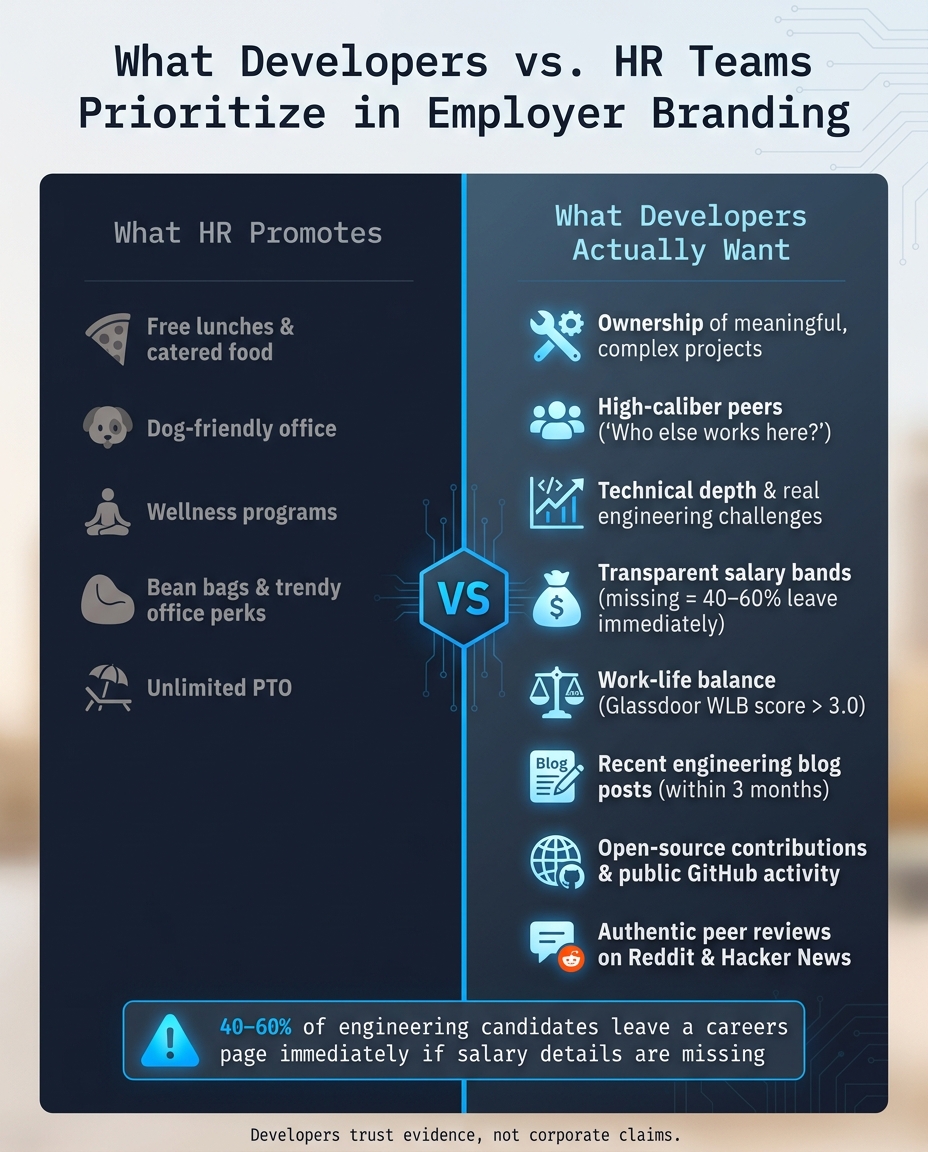
One major dealbreaker? Missing salary details. A lack of transparency here causes 40–60% of engineering candidates to leave a careers page immediately . These signals reveal what truly drives a developer’s decision to engage - and it’s rarely about free snacks or trendy office perks.
What HR Prioritizes vs. What Developers Actually Want
There’s often a disconnect between what HR teams promote and what developers care about. HR tends to highlight perks like catered lunches, wellness programs, or office dogs. But developers? They’re looking for something entirely different.
"Serious engineers do not care about your bean bags. They do not care about your 'culture' as defined by perks. They care about one thing. Who else works there, and what problems are they solving?" - Ninad Pathak
What grabs a developer’s attention? Ownership of meaningful projects, the caliber of their peers, and the complexity of the challenges they’ll face. For example, a job description that starts with "rebuilding a data pipeline for 10x scale" will always resonate more than one that leads with "unlimited PTO and a dog-friendly office." Specific, technical language shows respect for their expertise, while vague messaging does the opposite.
How Developers Form Opinions About Your Company
The trust gap between HR messaging and what developers value becomes even more apparent when you consider how developers form opinions. They don’t trust what your company says about itself. Instead, they trust what other developers say - especially in spaces where authenticity is harder to fake, like Reddit or Hacker News. A single trusted comment on these platforms can outweigh even the most polished careers page .
Even more influential than peer feedback are technical artifacts. Your engineering blog, post-mortems, and open-source contributions act as a litmus test for your engineering culture . For instance, Cloudflare has earned respect from senior engineers by publishing detailed post-mortems of outages. These reports include specifics like BGP routing errors and the exact lines of code involved, signaling a commitment to transparency and technical accuracy over PR spin .
"Your artifacts - code, products, design - say more about your engineering culture than any copy on a careers page." - JobsByCulture
Developers rely on evidence from peers and technical outputs more than corporate messaging. To build a reputation that resonates with engineers, your external narratives must consistently demonstrate your technical strengths and authenticity.
How to Build an Employer Brand That Appeals to Developers
Build an Engineering Blog That Developers Actually Read
An engineering blog offers a window into your team's mindset and the challenges they tackle daily. Developers often use it to gauge whether the problems your team solves are interesting and whether they'd enjoy working alongside your engineers.
What developers want is real talk. They’re drawn to raw, technical details - like how you handled a high-load database migration or resolved a major outage - not polished marketing fluff. For instance, Netflix’s in-depth analysis of their "Chaos Monkey" tool, which deliberately disrupts production servers to test resilience, became a powerful recruiting tool. It attracted engineers who thrive in high-pressure and high-trust environments . This kind of transparency builds trust by showing your team’s technical depth and willingness to share lessons learned.
"By opening the hood and showing the engine (grease, leaks, and all) you prove that you are running a serious racing team." - Ninad Pathak, Marketing Strategist, Pathak Ventures
To maintain credibility, aim for consistency - publish posts monthly and let your engineers sign their names to their work. This personal touch reinforces the authenticity of your content .
Once your blog is up and running, take it further by showcasing your team's open source contributions.
Use Open Source Contributions to Build Credibility
Open source projects serve as a direct, unfiltered proof of your team’s technical expertise. A public codebase, complete with commit histories, says more about your standards than any careers page ever could.
"The culture page isn't making claims; it's pointing to evidence. Every external artifact you can point to reduces the credibility gap between what you claim and what candidates believe." - JobsByCulture
Feature your GitHub repositories prominently on your careers page. When engineers share the technical hurdles they overcame within these projects, it reinforces the idea that your team actively contributes to the broader developer community. This resonates with developers who value collaboration and purpose-driven work .
Beyond code, your team's presence in developer communities can further strengthen your brand.
## How to Hire in Developer Communities Without Being Corporate
Authenticity is key when interacting with developer communities. Showing up only when you’re hiring? That’s a fast way to lose trust.
Instead, aim for a consistent and helpful presence. Answer questions on Stack Overflow, participate in GitHub discussions, and have your engineers speak at conferences about the challenges they’ve faced. Etsy’s "Code as Craft" blog is a great example of this approach - it’s written by engineers, in the language developers understand, and focuses on real-world technical stories, not marketing jargon .
"Selling to developers is a cardinal sin for most developer marketing programs." - Darren Yuen, Director of Marketing Programs, Iron Horse
The focus here isn’t on pushing your company’s agenda. It’s about being genuinely useful. Whether it’s troubleshooting at meetups or sharing lessons learned, these efforts build trust and credibility far beyond any job posting could. To find the right spaces for these interactions, explore the best communities for sourcing developers.
How to Measure the ROI of Employer Branding
The Metrics That Matter Most
The credibility of your engineering brand directly impacts hiring success. While recruiting teams often track impressions and click-through rates, these don't tell the full story. Instead, focus on metrics like inbound application rate, offer acceptance rate, and time-to-fill for technical roles.
- Inbound applications reveal if developers are discovering your company organically, without needing extensive outreach.
- Offer acceptance rate shows whether candidates stay engaged after going through your hiring process.
- Time-to-fill reflects how effectively your employer brand "pre-sells" opportunities before recruiters even reach out.
For example, an applicant-to-interview ratio above 12% suggests your branding is attracting qualified talent . Another key metric is your Glassdoor rating - a score below 3.5 is often a dealbreaker for senior engineers, and a work-life balance rating under 3.0 can make outreach efforts fall flat . These aren't just numbers - they're critical indicators of how your brand is perceived.
"Start with your goals. Without clear goals, you'll never be able to measure success. If your goal is to drive awareness, there's a metric for that. If your goal is to get clicks to job openings, there's a metric to that." - Carmen Collins, Social Media & Talent Brand Lead, Cisco
How Better Branding Improves Your Hiring Funnel
A strong employer brand creates a ripple effect throughout the hiring process. Companies with well-established brands fill roles up to twice as fast and can cut hiring costs by as much as 50% . That’s not just an advantage - it’s a game-changer.
Take Alloy Financial, for instance. In 2024, this 270-person fintech company revamped its employer branding by highlighting its transition from a monolith to a microservices architecture. The result? A 127% increase in qualified applicants, an 87% boost in offer acceptance rates, and a 40% drop in reliance on third-party recruiters . Their approach wasn’t flashy; it was straightforward and technically detailed.
On the flip side, a poor employer reputation can be costly. Half of all candidates will reject an offer if they perceive the company negatively, often because broken hiring processes have damaged their trust, even when the salary is higher . Worse, companies with weak reputations often have to pay around 10% more in base salary just to compete for the same talent . Employer branding isn’t just about image - it directly affects your hiring budget.
"Pick metrics that you know you can have an impact on, but that also move the needle on your overall recruitment goals." - Hannah Fleishman, Inbound Recruiting Manager, HubSpot
How daily.dev Recruiter Puts Your Brand in Front of Developers
Creating great content - like engineering blogs, open source projects, and authentic team stories - is only part of the equation. The real challenge? Making sure the right developers actually see it.
This is where daily.dev Recruiter steps in. It places your engineering content, job postings, and open source projects directly in developers' daily feeds. Since developers use daily.dev to read and learn, your brand shows up naturally within their workflow - not as a disruptive ad. This approach helps pre-qualify candidates, so by the time they see your job listing, they’re already familiar with your team from a technical article or project.
With 75% of developers being passive but open to new opportunities , consistent and contextually relevant branding is key. By ensuring your content reaches this audience, daily.dev Recruiter turns awareness into a tangible talent pipeline.
Conclusion: How to Build a Developer-First Employer Brand
Key Strategies to Remember
A developer-first brand stands out by emphasizing technical achievements over surface-level perks. Developers value what engineers share and what your code reveals about your operations. This means showcasing real technical accomplishments instead of relying on overused benefits. Top companies have shown that being transparent about engineering practices leads to better recruitment results. Their success highlights a key truth: engineering culture often matters more to developers than just compensation. Over time, a strong engineering brand creates lasting benefits - companies with a well-established developer brand report 53% lower recruitment costs and 41% faster time-to-hire . These aren't small gains; they represent a fundamental change in how talent discovers and chooses you.
"The content you put out defines the caliber of talent you bring in." - Ninad Pathak, Founder, Pathak Ventures
With these principles in mind, the next step is to apply strategies that transform your employer brand into a magnet for top talent.
Next Steps to Strengthen Your Employer Brand
A developer-first brand thrives on authenticity, built around real technical achievements rather than flashy perks. To get started, focus on refining the signals your company sends to the developer community.
Begin with quick, impactful changes. Include salary ranges in job postings and outreach emails - this simple step can significantly improve recruiter response rates. Review your careers page to ensure it highlights your technical strengths and transparent practices. Share details like how often your engineers deploy, the tools and technology you use, and clear career paths for both individual contributors and management roles .
Next, build sustainable habits that reinforce your brand over time. Commit to publishing at least one high-quality technical blog post every month, written and credited to your engineers . Support open-source contributions. Engage with Glassdoor reviews to show you value feedback. When reaching out to candidates, reference something specific about them - a project they’ve worked on, a talk they’ve given, or a repository they maintain .
"The actionable takeaway isn't 'write better messages' - it's 'fix your public culture signals so that engineers want to engage before they even read your message.'" - JobsByCulture Report
The ultimate goal is to move from actively searching for talent to attracting it naturally. When developers are already familiar with your team, your challenges, and your culture, your employer brand becomes the most powerful tool in your recruitment arsenal.
FAQs
What should we fix first to make developers trust our company?
To earn the trust of developers, start by refining your company’s reputation and cultural presence. Developers often turn to employee reviews and ratings as part of their research process. Make sure these reviews are up-to-date, highlight positive experiences, and avoid issues like poor work-life balance ratings, which can raise concerns.
Additionally, emphasize your company’s technical culture in ways that feel genuine. A transparent engineering blog and active involvement in open source projects can go a long way in building trust. These efforts demonstrate a commitment to the developer community and showcase the values developers care about.
What’s the fastest way to improve our “signals” before we start hiring?
If you're looking to attract top developer talent quickly, focus on creating a genuine and noticeable presence that resonates with developers. Here are a few ways to stand out:
- Level up your engineering blog: Share posts about real technical challenges your team has tackled or projects you've worked on. This gives potential hires a glimpse into your team's expertise and problem-solving abilities.
- Get involved in open source: Contributing to open source projects highlights your team's technical skills and commitment to the developer community.
- Be transparent about your culture: Use platforms like Glassdoor to share honest stories about your workplace. Authentic insights help build trust with candidates.
- Connect with developer communities: Attend events, host meetups, or participate in online discussions. Being part of the community shows you're approachable and invested.
These steps not only create trust but also help you attract talented developers more effectively.
How do we prove our engineering culture without sounding like marketing?
When showcasing your engineering culture, let the proof do the talking. Engineers value authenticity, so focus on real examples that demonstrate your team's technical expertise and problem-solving approach. Here’s how you can do it:
Engineering Blogs: Publish detailed articles about challenges your team has tackled, the solutions they’ve implemented, and lessons learned along the way. These posts not only highlight your team’s knowledge but also provide value to the broader tech community.
Open Source Contributions: Share the projects your team has built or contributed to. Open source work is a fantastic way to showcase your commitment to collaboration and innovation. Highlight why these projects matter and how they solve specific problems.
Tech Stack Deep Dives: Offer a behind-the-scenes look at your technology choices and the reasoning behind them. Engineers appreciate transparency about decision-making processes, trade-offs, and the evolution of your stack.
To make your content even more engaging, include real stories and day-in-the-life features. For example, spotlight a team member’s journey through a complex project or share how your team approaches code reviews and collaboration. Skip the stock photos and overly polished marketing language - engineers are drawn to genuine, unfiltered insights over flashy presentations.
By focusing on these authentic and evidence-based approaches, you’ll build trust and credibility with your audience.
.png)