In 2026, attracting IT professionals isn't just about offering high salaries. Developers now prioritize workplace transparency, growth opportunities, and meaningful projects. Key insights include:
- 86% of job seekers research company culture, reviews, and leadership before applying.
- 75% of developers are open to new roles, even if not actively job hunting.
- 72% trust employee feedback over corporate messaging, making employee voices crucial.
To stand out, focus on:
- A clear Employee Value Proposition (EVP): Highlight autonomy, learning, transparency, and remote work.
- Honest storytelling: Share real employee experiences, technical challenges, and leadership insights.
- Modern hiring tools: Use platforms like daily.dev Recruiter to connect with developers effectively.
::: @figure 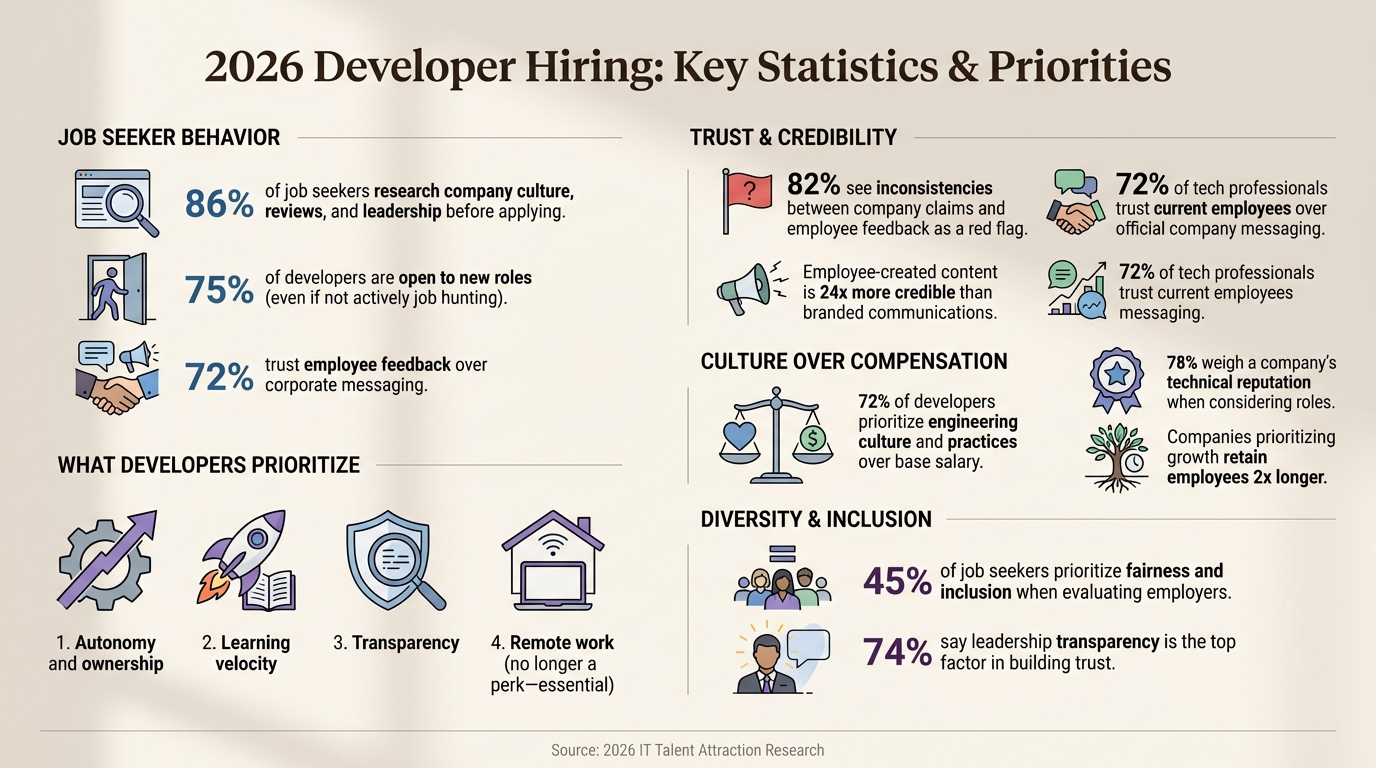 {2026 Developer Hiring Statistics and Priorities}
Creating a Developer-Focused Employee Value Proposition
What Developers Want in 2026
The landscape of what attracts developers has shifted dramatically. Today, developers value purpose over perks - things like free lunches and office games don't hold the same appeal. Instead, they're drawn to opportunities where they can collaborate with AI, tackle complex architectural challenges, and make a meaningful impact . With AI tools like GitHub Copilot taking over repetitive tasks, developers are no longer just writing code - they're architects and orchestrators. Your Employee Value Proposition (EVP) needs to reflect this shift, emphasizing how AI will amplify their abilities rather than replace them.
Developers are also focusing on four major areas when evaluating opportunities:
- Autonomy and ownership: They want control over problem spaces and decision-making.
- Learning velocity: Developers see roles as environments to accelerate their learning, aiming to compress years of growth into months.
- Transparency: Clear communication about salary ranges and challenges in the tech stack is a must.
- Remote work: This is no longer a perk - it's an essential part of how they work .
Companies that prioritize growth and development retain employees twice as long as those that don't . This makes career progression a powerful differentiator in attracting and keeping top talent.
Matching Your EVP to Developer Expectations
To align your EVP with what developers want, start by identifying what sets your company apart. Survey your top developers to pinpoint 3-4 key differentiators - whether it's your tech stack, AI-driven projects, or career growth opportunities. Be specific. Instead of vague promises, quantify what developers will achieve or learn. For example, instead of saying, "you'll work on exciting projects", explain that they'll be "building a real-time recommendation engine with vector databases and fine-tuning LLMs." This clarity helps attract candidates who are eager to solve complex problems .
Go a step further by publishing engineering blogs that highlight your team’s technical philosophy. Share how you tackle challenges like reducing p99 latency or scaling distributed systems. These insights appeal to developers' intellectual curiosity and demonstrate the kind of work they can expect .
Transparency is key. Use "Total Rewards Statements" to break down compensation clearly - include salary, equity value at different exit points, 401(k) matches, and wellness stipends. Add an "Equity 101" guide to explain concepts like strike prices and vesting schedules. This level of detail not only builds trust but also helps candidates make informed decisions .
Lastly, tailor your EVP to different developer personas. Some developers are skill-focused, prioritizing rapid learning. Others are impact-focused, looking for roles where they can contribute to causes like climate tech. Some value autonomy and ownership, especially senior engineers who want decision-making authority. And others seek technical challenges, wanting to escape legacy systems and work on cutting-edge projects . By understanding which persona you're targeting, you can craft messaging that feels genuine and resonates deeply, creating an employer brand that stands out in a competitive market.
Hiring engineers?
Connect with developers where they actually hang out. No cold outreach, just real conversations.
Presenting Your Company Culture Honestly
Developers are quick to spot when a company isn’t being genuine. In fact, as of 2026, a staggering 82% of candidates see inconsistencies between a company’s claims and employee feedback on platforms like Glassdoor as a major red flag . The takeaway? Transparency isn’t just nice to have - it’s essential.
The days of polished corporate messaging dominating the narrative are over. Now, employee-generated content (EGC) is leading the way. Why? Candidates trust what employees say three times more than corporate statements . Even more compelling, employee-created content is viewed as 24 times more credible than branded communications . This makes it clear: the voices of your developers carry far more weight than any carefully crafted marketing pitch.
By aligning your messaging with a clear Employee Value Proposition (EVP) and showcasing an honest portrayal of your company culture, you can earn the trust of developers.
Making Leadership Visible to Developers
Developers don’t just care about your tech stack - they’re also interested in the people behind it. When leaders like your CTO or Head of Engineering share their thoughts on technical decisions, reflect on past challenges, or explain the reasoning behind architectural choices, it builds a direct connection with potential hires.
Encourage your technical leaders to engage on platforms where developers are already active. This could mean joining niche industry podcasts, speaking at local Python meetups, or creating whiteboard-style videos that break down complex systems. Sharing personal insights about company milestones or lessons learned can make a big impact. Take HubSpot as an example: in January 2026, they achieved a 90%+ offer acceptance rate by publishing their "Culture Code", which included transparent salary bands and stories of failure. This openness led to over 80,000 job applications annually .
Sharing Real Stories About Your Workplace
A clear EVP might attract talent, but authentic storytelling cements your brand’s credibility.
Start with the basics: ditch generic stock photos. Seventy-one percent of candidates notice when companies use these instead of real workplace images . Instead, create content like "Day in the Life" videos that spotlight specific roles. For instance, a video showing a backend developer tackling a database scaling challenge can help candidates picture themselves as part of your team.
Spotify’s "Spotify Life" program is a great example of how employee-led storytelling can shine. They’ve empowered rotating employees to manage their social channels for three months at a time, bypassing the typical corporate approval process. The result? Over 500,000 Instagram followers and an engagement rate eight times higher than their corporate accounts . Similarly, Shopify’s ambassador program generates over 5,000 employee posts each month, with 40% of new hires citing this content as a key factor in their decision to join .
It’s also important to share the less glamorous sides of your workplace. Talk about technical debt, the realities of on-call rotations, or the challenges of being in a growth phase. Microsoft embraced this approach in early 2026 by focusing on a "growth mindset" in their branding. They shared stories of failures and career pivots, which led to a 50% increase in applications from top universities . Additionally, responding to every Glassdoor and Indeed review within 48 hours shows that leadership values feedback, attracting candidates who appreciate an authentic and responsive workplace culture.
Using daily.dev Recruiter to Connect with Developers
Why Developer-First Platforms Work Better
Traditional recruiting methods are losing their edge. Developers are tuning out spammy LinkedIn messages and gravitating toward hiring processes that value their time and align with their skills and interests .
This is where developer-first platforms stand out. They create double opt-in connections, meaning both the recruiter and the developer agree to the introduction . This mutual agreement reflects the respect and fairness that candidates are looking for . With a community of over 1 million developers, daily.dev Recruiter takes a fresh approach by using real-time signals - like what developers are reading, building, and engaging with - rather than relying on outdated resumes . Nimrod Kramer sums it up perfectly:
"Recruiting should be built on context, not spam. Developers shouldn't have to sift through irrelevant offers from strangers who don't understand their work."
This high-intent matching process reduces the number of interviews needed per hire by half . It ensures you're connecting with developers who are genuinely interested, making the process more efficient and meaningful.
How daily.dev Recruiter Strengthens Your Employer Brand
Beyond making targeted connections, daily.dev Recruiter helps enhance your employer brand. A strong employer brand is built not just on messaging but on the overall candidate experience. Generic, impersonal outreach can come across as unprepared, while context-driven introductions that reflect a developer's work and interests build trust and credibility.
With daily.dev Recruiter, you can go beyond standard job descriptions by creating technical challenge briefs . This matters because top-tier developers are drawn to intellectual challenges and problem-solving rather than flashy buzzwords or generic perks. By identifying talent based on their active engagement, you’re showing a deeper understanding of the developer community - something that’s increasingly vital, especially as 86% of job seekers in 2026 are expected to research a company before applying .
The platform also safeguards the trust developers have in the daily.dev community. As the team at daily.dev emphasizes:
"Trust is our moat. We protect it at all costs."
When developers see you using a platform they already trust - one that prioritizes their privacy and intent - it strengthens your employer brand. Instead of sending out impersonal messages, you can offer a candidate experience that starts with respect and genuine insight. This thoughtful approach not only reinforces your company’s reputation but also aligns with the transparent, authentic culture that attracts top IT talent.
Showing Your Commitment to Innovation and Career Growth
Highlighting AI Projects and Modern Technology
As Full Scale explains:
"Great developers don't just want jobs - they want to join engineering stories worth being part of."
In 2026, your tech stack is more than a collection of tools - it's a reflection of your company's direction and whether it offers room for developers to grow. For many, 78% of developers weigh a company's technical reputation when considering new roles . Stagnation is a deal-breaker for top talent. That’s why it’s not enough to simply mention AI or machine learning in your projects. Instead, share the reasoning behind your technical decisions. For example, explain why you chose Go for microservices or how Kubernetes is helping you scale. This kind of transparency highlights your technical depth and proves your team is making thoughtful, forward-looking choices .
Take Alloy Financial as an example. This 270-person fintech company revamped its employer brand by documenting its transition from a monolith to microservices between 2025 and 2026. By sharing specific engineering challenges and solutions, they saw a 127% increase in qualified applicants and an 87% improvement in offer acceptance rates . They didn’t just talk about innovation - they demonstrated it through detailed engineering stories that appealed to developers looking for complex, meaningful work.
Another way to stand out is by sharing your technical challenges through engineering blogs. Dive into topics like performance optimization, production retrospectives, or how your team tackled scaling issues. A 450-person B2B SaaS company took this approach by creating a public repository for Architecture Decision Records (ADRs) and launching an engineering podcast. The result? A 215% increase in senior-level inbound applications and a 68% reduction in time-to-hire for senior roles .
Providing Training and Career Development Programs
Continuous learning isn’t just a bonus anymore - it’s a key strategy for retaining top developers. In 2026, skills-based hiring has taken the spotlight, with expertise in AI and cloud technologies often outweighing traditional degree requirements .
Show your commitment to growth by offering learning stipends, certification support, and conference budgets as part of your Employee Value Proposition . Additionally, establish dual career paths that outline clear advancement opportunities for both management and technical roles . This ensures developers can grow within your company without being forced into roles they don’t want.
Bring your growth-focused culture to life with real stories. Highlight internal mobility examples, like an employee moving from QA to Backend Developer within a year. Authentic employee stories resonate - 72% of tech professionals trust current employees more than official company messaging . Plus, adding video content to job ads can boost candidate engagement by over 30% .
Interestingly, 72% of developers place more importance on engineering culture and practices than base salary . This means investing in training and development can be more appealing than simply raising pay. Highlight your mentorship programs, internal knowledge-sharing sessions, and policies like "learning time" allocation to show that professional growth is woven into your daily operations.
Making Inclusivity, Flexibility, and Transparency Part of Your Brand
Building a Workplace That Welcomes All Developers
In 2026, diversity isn't just a buzzword - it's a game-changer for attracting top talent. 45% of job seekers prioritize fairness and inclusion when evaluating potential employers . Developers, in particular, are looking for proof of commitment, not empty promises.
To stand out, share measurable diversity metrics. Implementing proven methods for technical recruitment diversity ensures these metrics translate into real-world results. Take McKinsey & Company, for example. In 2022, they reshaped their employer brand by publishing an annual 'Diversity & Inclusion Report.' This included detailed data and bold hiring goals, like building a workforce that’s 47% women. They also partnered with HBCUs and programs focused on underrepresented groups, turning a former weakness into a strength . This kind of bold transparency signals that you're serious about change.
Salesforce approached it differently. Their "1-1-1 model" integrates philanthropy into their operations, donating 1% of equity, products, and employee time. They also invested millions in pay equity adjustments and made these actions central to their recruitment messaging . The takeaway? Actions speak louder than words.
Start with fairness in hiring. Use diverse interview panels and standardized questions to minimize unconscious bias . Go a step further by conducting regular pay equity audits and publishing the results. 74% of employees say leadership transparency is the top factor in building trust . When candidates see you're willing to be held accountable, they’re more likely to believe in your mission.
Lastly, let your team members share their stories. Short videos (under 60 seconds) featuring employees from underrepresented backgrounds can be incredibly impactful . Real experiences resonate far more than polished campaigns. This authentic approach not only highlights inclusivity but also sets the tone for embracing flexible work - a must-have for developers in 2026.
Offering Remote Work and Flexible Schedules
Remote work has evolved from a perk to a baseline expectation. In 2026, the companies thriving in the talent market are those that embed flexibility into their core identity .
Make remote work options a key part of your job descriptions. HubSpot, for example, embraced a "remote-first" identity by sharing thought leadership on distributed work. This helped them attract professionals who value autonomy . By emphasizing flexibility, you show it's a fundamental part of how you operate - not an afterthought.
Remote work also opens doors to global talent while cutting costs. For instance, a senior US-based developer might cost $250,000+ annually, whereas global remote seniors typically range between $45 and $95 per hour . Beyond cost savings, this approach helps build a more diverse and adaptable team.
To make remote work successful, train managers to lead distributed teams effectively. Focus on outcomes rather than hours worked, using metrics like Cycle Time and PR Throughput to measure success . This shift creates an environment where developers can excel on their own terms.
Showcase your remote culture with "day-in-the-life" content. Highlight how your team collaborates across time zones, maintains a strong culture without a physical office, and handles asynchronous communication. Companies with strong employee experience programs see up to 28% higher retention rates . Flexibility isn’t just a nice-to-have - it’s a major factor in keeping your team engaged.
Being Open About Your Tech Stack and Processes
Your tech stack says a lot about your company’s direction, and developers are paying attention. 67% of senior developers research engineering practices before applying for a role .
Be upfront about your tech stack and why you’ve chosen specific tools. For example, explain how Go supports performance or how Kubernetes enables scalability . This level of detail shows you’re making thoughtful decisions rather than following trends.
Don’t shy away from discussing technical debt. Experienced developers know every codebase has its challenges. What matters is how you’re addressing them. Share your plans to improve code quality, modernize legacy systems, or refactor problem areas. This kind of openness builds trust and demonstrates a commitment to growth .
Consider sharing Architectural Decision Records (ADRs) or examples of trade-offs you’ve made. One SaaS company with 450 employees created a public ADR repository and launched an engineering podcast. The result? A 215% increase in senior-level inbound applications and a 68% reduction in time-to-hire for senior roles . When developers see you value transparency and autonomy, they’re more likely to align with your culture.
Document your software development lifecycle, from code review standards to deployment frequency and incident management. 72% of developers prioritize a company’s engineering culture and practices over base pay . By being transparent about how your team works, you’ll attract candidates who genuinely fit your approach and values.
Conclusion
Hiring top IT professionals in 2026 goes beyond offering flashy perks or delivering generic mission statements. Success in this area hinges on building trust through honesty, showcasing forward-thinking practices, and cultivating a workplace culture that genuinely reflects your outward promises. Companies that excel in attracting talent treat employer branding as a core hiring strategy, not just a marketing add-on.
To move forward, focus on creating a developer-centered Employee Value Proposition (EVP). Highlight aspects like your advanced tech stack and clear paths for career development. Be upfront about salary ranges, diversity statistics, and your hiring processes. Encourage your developers to share their real experiences through blogs and videos, emphasizing your commitment to flexibility and inclusivity.
Here’s an important stat: 72% of tech professionals trust what current employees say over official company messaging . When your internal culture aligns with what you promise to the outside world, you stop competing solely on salary and start attracting talent through culture, growth opportunities, and meaningful work.
The hiring game has changed - nearly 75% of developers are open to new roles, even if they’re not actively job hunting . This means your employer brand needs to work continuously, warming up passive candidates long before you reach out. This often requires a dedicated passive candidate strategy to build trust over time. Tools like daily.dev Recruiter can help you meet developers where they already are - engaging with content, learning, and connecting - turning cold outreach into meaningful conversations.
Don’t wait. Define what makes your company stand out, ensure transparency in your job listings, and empower your team to share their stories. By taking action now, you can create a workplace that naturally attracts top talent, setting the stage for your company’s growth and success.
FAQs
How do I define a strong developer EVP for 2026?
To craft an EVP that truly connects with developers in 2026, focus on being genuine and aligning with what tech professionals care about most. Developers are increasingly drawn to opportunities that promise career advancement, a collaborative company culture, and involvement in forward-thinking innovation - especially in areas like AI and skill-building.
Make sure to emphasize:
- Exciting, cutting-edge projects: Highlight your involvement in technologies and initiatives that push boundaries.
- Opportunities for continuous learning: Showcase programs, workshops, or resources that help developers grow and stay ahead in their field.
- A transparent and supportive environment: Demonstrate how your culture encourages open communication, feedback, and teamwork.
Adding authentic employee testimonials is a great way to reinforce your message. Real stories from your team can lend credibility and make your EVP feel more relatable, resonating deeply with developers' aspirations and values.
What should we share publicly about our tech stack?
Your tech stack isn’t just a list of tools and technologies - it’s a window into your team’s engineering culture, problem-solving approach, and technical identity. Why does this matter? Because 72% of developers care more about these aspects than compensation when deciding where to work. They’re actively researching how your team operates before they even consider applying.
So, what should you emphasize? Focus on what sets your team apart. Are you leveraging cutting-edge tools to tackle complex challenges? Do you have unique workflows that encourage experimentation and creativity? Highlight how your processes and technologies reflect a forward-thinking mindset and a commitment to pushing boundaries.
For example, if you’re using modern frameworks like React or Vue, explain how they enable rapid iteration and collaboration. If your team has adopted DevOps practices, share how automation and CI/CD pipelines have streamlined your development cycles. These details don’t just showcase your technical expertise - they also demonstrate a culture of efficiency, learning, and growth.
Ultimately, your tech stack tells a story about how your team works, learns, and innovates. Make it a story developers want to be part of.
How can daily.dev Recruiter help with passive developers?
daily.dev Recruiter helps employers stand out by highlighting your company’s culture, values, and opportunities through storytelling and targeted campaigns. This method is designed to connect with developers who may not be actively searching for jobs but are open to hearing about the right opportunities.
By focusing on important aspects like diversity, inclusion, and transparency, daily.dev Recruiter builds trust and keeps your company on the radar of skilled tech professionals. This approach ensures your organization is seen as a credible and appealing place to work.
.png)