94% of candidates want interview feedback, but only 7% receive it. This gap creates a major opportunity for companies to improve their candidate experience for technical roles. Developers, in particular, expect clear and constructive feedback due to their reliance on feedback loops in their daily work.
Key takeaways:
- Feedback builds trust and reflects your company’s values.
- Timely, specific feedback (within 24–48 hours) shows respect for candidates’ efforts.
- Constructive feedback helps candidates grow and leaves a positive impression, even after rejection.
- Poor experiences lead 52% of candidates to decline offers, and 72% share negative feedback online.
Providing actionable feedback strengthens your employer brand, increases reapplication rates, and turns even rejected candidates into potential advocates for your company.
::: @figure 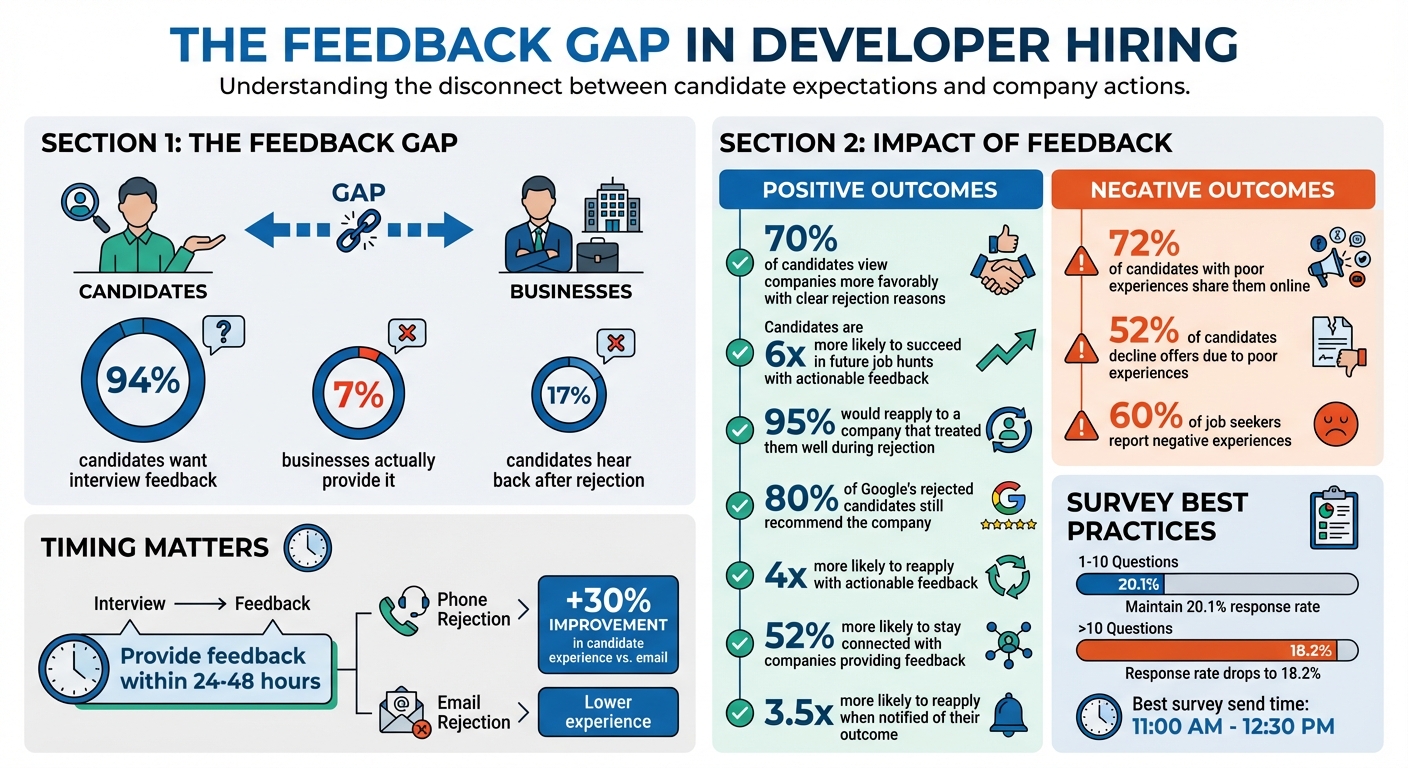 {Developer Candidate Feedback Statistics and Impact on Hiring}
How Feedback Shapes Developer Candidate Experience
Feedback plays a crucial role in shaping how developers perceive your company and reflects the values your organization upholds.
Providing Closure and Respect
Timely feedback acknowledges the effort candidates put into the hiring process. Developers dedicate significant time to technical assessments, coding challenges, and interviews. Communicating clear outcomes within 24–48 hours demonstrates that you value their time and effort.
The statistics back this up: timely responses significantly increase candidates' willingness to engage in the future . For instance, 70% of candidates view companies more favorably when they receive clear rejection reasons . Yet, only 17% of candidates report hearing back after a rejection , which often leaves them feeling disillusioned with the process.
"If we promise applicants a response within 14 days, we must achieve that timeline." - Industry Expert
Meeting feedback deadlines isn't just about professionalism - it shows that your company keeps its word. If you fail to deliver feedback on time during hiring, candidates may question your reliability once they’re on the team.
Respectful communication also creates an opportunity to provide feedback that supports growth. This is where rejection can evolve into a learning experience.
Supporting Professional Growth
Constructive feedback offers candidates a roadmap for improvement. The benefits are clear: candidates who receive actionable interview feedback are six times more likely to succeed in future job hunts .
The key lies in being specific. Avoid vague comments like "you need more experience." Instead, offer details. For example: "This role requires two years of customer-facing experience; focusing on leadership in your current position would strengthen your profile." For technical roles, point to specific areas for improvement, such as: "Your coding examples lacked detail about scalability in the ABC project."
Here’s how specific feedback compares to vague feedback:
| Feedback Type | Vague | Specific |
|---|---|---|
| Technical | "Your coding skills weren't strong enough." | "Your coding examples lacked detail regarding scalability in the ABC project." |
| Experience | "We need someone with more experience." | "This role requires 2+ years of customer-facing experience; we suggest honing this in your current role." |
| Soft Skills | "You need to be more confident." | "Providing more detailed examples of how you tackle technical challenges would improve your delivery." |
Specific, actionable advice builds trust and keeps candidates engaged with your brand. You can take it a step further by recommending resources - like courses or articles - that help candidates address their gaps.
Building Employer Brand Reputation
When feedback is both respectful and growth-oriented, it enhances your reputation within developer communities. How you handle feedback directly influences how your company is perceived. Negative experiences can spread quickly: 72% of candidates who have a poor hiring experience will share it online or within their professional network . In close-knit tech circles, these stories travel fast - 77% of developers in South Africa and 85% in the Netherlands openly discuss their hiring experiences .
On the flip side, companies that provide thoughtful feedback often turn rejected candidates into brand advocates. For example, 95% of candidates say they’d consider reapplying to a company that treated them well during rejection . Google exemplifies this: 80% of their rejected candidates still recommend the company . Their feedback process fosters goodwill that extends beyond individual hiring decisions.
Offering constructive feedback also increases the likelihood of candidates considering your company for future roles. In fact, candidates are four times more likely to reapply when they’ve received actionable feedback . In a competitive industry where top talent is often passive, building these long-term relationships gives your company a distinct edge. Every rejected candidate who leaves with a positive impression could become a future applicant, a referral source, or even an advocate for your employer brand.
What Makes Feedback Effective for Developer Candidates
Providing effective feedback during the recruitment process can significantly elevate how developer candidates view your company. While earlier we touched on the importance of closure and growth, this section dives deeper into what separates truly impactful feedback from generic responses. The numbers tell a clear story: although 94% of candidates want interview feedback, only 7% of businesses actually provide it. It's not just about if you give feedback - it's about how you deliver it. Let’s explore the key elements that make feedback resonate.
Clarity and Specificity
Feedback should be grounded in facts, not feelings. Avoid vague or subjective comments, and instead, point to specific examples. For instance, instead of saying, "Your coding skills weren't strong enough", offer something concrete like, "Your response to the scalability question lacked detail on load balancing". If the job required three years of React experience and the candidate only had one, state that clearly. This kind of evidence-based feedback helps candidates understand exactly where they fell short.
Using tools like interview scorecards ensures feedback is based on documented observations rather than general impressions. To make feedback even more useful, provide actionable next steps. For example, instead of simply identifying a skill gap, suggest resources such as: "We recommend taking a course on AWS architecture to strengthen this area". This approach transforms rejection into a learning opportunity and demonstrates that you care about the candidate's growth.
Timeliness and Relevance
Timely feedback shows respect and keeps the process professional. Delays in communication can frustrate candidates, with two of the top reasons for drop-offs in developer hiring pipelines being a lack of respect for their time and a drawn-out process. Quick updates reduce the stress of waiting and allow candidates to move forward confidently.
Transparency also plays a big role. Even if there are delays, keeping candidates informed - like saying, "The hiring manager is still conducting interviews, but you remain under consideration" - can help them feel valued. Interestingly, candidates who are notified of their outcome are 3.5 times more likely to reapply for another position at your company.
"Never ever reject a candidate that you've spoken to or met with over email. It's an absolute crime if you do."
- Brendan Browne, VP of Global Talent Acquisition, LinkedIn
Taking the time to deliver rejection feedback over the phone instead of email can improve the candidate experience by nearly 30%. While it requires more effort, this personal touch leaves a lasting positive impression and builds trust with candidates.
Personalization and Professional Tone
Generic feedback can feel dismissive, but personalized feedback builds connections. Referencing specific moments from the interview shows that you paid attention and genuinely evaluated the candidate's performance. This level of detail fosters a sense of respect and professionalism.
Start by highlighting the candidate’s strengths, then move into constructive feedback, and finish with encouraging remarks. This balanced approach makes it easier for candidates to accept feedback without feeling defensive. Critiques should focus on performance rather than personal attributes.
The medium of communication also matters. For high-stakes interviews, prioritize direct calls to deliver feedback. The effort is worth it: 52% of candidates are more likely to stay connected with companies that provide interview feedback, and those who receive constructive feedback are four times more likely to consider your company for future opportunities.
Using Feedback to Improve Developer Recruitment
Collecting feedback from candidates is just the beginning - the real value comes from using that feedback to make meaningful changes. By gathering insights, spotting patterns, and acting on them, you can create a better experience for developer candidates. Let’s explore how to gather this feedback effectively and put it to good use.
Collecting Feedback Through Surveys and Tools
Asking the right questions at the right time is crucial for gathering useful feedback. At Notion, Cuyler Hirata, Head of Recruiting Operations & Analytics, ensures surveys are sent with a 3-day delay. This gives recruiters time to personally communicate decisions before candidates receive automated surveys. Their surveys focus on key aspects, such as whether interviews started on time and whether interviewers shared insights about the company’s values.
The design of the survey matters, too. A mix of quantitative and qualitative questions works best. Surveys with 1 to 10 questions maintain a steady 20.1% response rate, but this drops to 18.2% when surveys exceed 10 questions. Daniel King, Global Talent Acquisition Manager at M-KOPA, uses a seven-question, non-anonymous survey. Most questions are multiple-choice or scale-based, allowing recruiters to follow up with candidates who provide negative feedback. This personal touch often turns detractors into advocates for the brand.
"It's not just about the survey - it's about the personal experience, the constructive critiques, and the raw, unfiltered voices that shape how we improve our processes."
- Daniel King, Global Talent Acquisition Manager, M-KOPA
Timing can also influence response rates. Surveys sent between 11:00 AM and 12:30 PM tend to perform better. For developer-specific feedback, include questions about technical assessments, such as whether coding tests were relevant to the role or unnecessarily long. To minimize bias, send surveys immediately after interviews but before sharing hiring decisions. This ensures feedback focuses on the process itself.
Analyzing Trends to Identify Problems
Raw feedback becomes actionable when it’s organized by recruitment stage and theme. Google’s hiring team uses targeted questions like "I was satisfied with the frequency of communication" instead of broader satisfaction questions, making it easier to pinpoint specific issues. This approach helps identify bottlenecks, whether they involve the application process, technical assessments, or interviewer behavior.
The numbers don’t lie: 60% of job seekers report negative experiences, and 72% of them share those experiences online. Tracking trends in candidate feedback can help you address issues before they harm your reputation. Monitoring metrics like the Candidate Net Promoter Score (calculated as Promoters minus Detractors) on a monthly basis - and breaking it down by department - can highlight which teams excel and which need improvement. Pairing qualitative feedback with metrics like drop-off rates or time spent at each stage can reveal why candidates lose interest.
One common issue is the "black hole" effect, where candidates feel ignored after interviews. If feedback frequently mentions a lack of follow-up, it’s a sign to implement automated status updates or set clear expectations for recruiter response times. Similarly, repeated complaints about unprepared interviewers may call for targeted training or better preparation guidelines.
Once you’ve identified the main pain points, it’s time to act on them.
Implementing Feedback for Continuous Improvement
Use an impact matrix to prioritize changes, focusing first on "high impact, easy implementation" fixes. For example, updating email templates or clarifying job descriptions can be done quickly, while more complex changes, like revamping technical assessments, may take longer to put in place. Google exemplifies this strategy by measuring the experience of every onsite candidate, regardless of the outcome. Their efforts pay off - 80% of rejected candidates still say they’d recommend a friend apply at Google.
Regular stakeholder meetings are key to turning feedback into action. For instance, if certain interviewers consistently receive negative comments like "seemed disengaged", this could trigger additional training or shadowing opportunities. In cases of non-anonymous feedback, reaching out to dissatisfied candidates directly can uncover deeper insights and even turn negative impressions around.
Keep the process ongoing. Track how metrics evolve over time, such as improved survey completion rates or more relevant feedback about technical assessments. This ensures your recruitment process continues to improve based on real experiences, not assumptions. By maintaining a feedback loop, you can adapt to candidates’ needs and create a recruiting process that stands out.
Hiring engineers?
Connect with developers where they actually hang out. No cold outreach, just real conversations.
How daily.dev Recruiter Supports Feedback-Driven Hiring
Creating meaningful connections from the outset is key to a feedback-driven hiring process. daily.dev Recruiter facilitates this by linking recruiters with developers who are genuinely interested in engaging. The platform eliminates cold outreach, replacing it with trust-based conversations that pave the way for constructive feedback. This initial trust lays the groundwork for the detailed processes described below.
Warm, Double Opt-In Introductions
The double opt-in model transforms how recruiters and developers connect. Before a conversation even starts, developers review job briefs - including details like tech stacks, team structures, and compensation - and actively opt in to engage. This ensures that recruiters are only speaking with candidates who have already shown genuine interest, fostering mutual respect and setting the stage for feedback-rich discussions.
This approach addresses a common frustration in developer hiring: the "black hole" effect, where candidates feel ignored or overwhelmed by irrelevant outreach. By opting in, developers signal their readiness for both technical discussions and constructive feedback. The platform’s filtering system further enhances this process - recruiters can search by skills, while developers customize their preferences for company size, remote work options, and salary ranges. This alignment ensures that first interactions are meaningful and focused, rather than generic and impersonal.
Developer-Friendly Job Briefs
Clear and detailed job briefs help streamline feedback by setting expectations upfront. daily.dev Recruiter uses concise briefs that highlight key aspects like technical challenges, framework versions, deployment cycles, and growth potential - helping developers decide if the role is a fit. When candidates have a clear understanding of the position, feedback becomes more precise and actionable.
The platform also allows for custom screening questions tailored to specific technical needs. These responses provide immediate insights, helping recruiters offer personalized feedback. For instance, if a candidate’s response reveals a lack of experience with a particular deployment workflow, recruiters can explain why that gap is significant - turning a rejection into an opportunity for growth. Research shows that 70% of candidates view a company more favorably when they receive specific reasons for not being selected .
By providing detailed job briefs, recruiters establish trust and set the stage for deeper, more meaningful interactions.
Building Trust Through High-Context Interactions
daily.dev Recruiter connects developers with recruiters based on real-time behavior and contributions, rather than static resumes. This behavioral matching represents what Nimrod Kramer, CEO of daily.dev, calls a shift from "fishing and hunting" to intent-driven hiring. As he explains:
"Recruiting should be built on context, not spam. Developers shouldn't have to sift through irrelevant offers from strangers who don't understand their work."
The platform integrates seamlessly with applicant tracking systems (ATS) to automate data syncing and eliminate duplicate records, freeing up recruiters to focus on personalized communication. This automation enables timely feedback - typically within 24 to 48 hours - while the messaging system supports direct, technical conversations about topics like code reviews, architecture, and deployment workflows. These high-context interactions naturally encourage feedback, helping recruiters and developers build trust while navigating the hiring process.
Conclusion
Key Takeaways for Recruiters
Providing feedback can transform developer hiring from a simple transaction into a meaningful relationship-building process. Yet, despite 94% of candidates wanting feedback, only 7% of businesses actually provide it . This disconnect offers a huge opportunity for recruiters who are ready to prioritize communication.
Here’s how to make feedback impactful:
- Share feedback within 24 to 48 hours while the interview is still fresh in everyone's mind .
- Be specific. Instead of vague responses like "not a fit", point to clear technical areas for improvement, such as issues with system design scalability .
- Keep feedback professional by focusing on the role's requirements rather than personal traits, which also reduces legal risks .
The numbers don’t lie - constructive feedback makes candidates six times more likely to secure a job and 3.5 times more likely to reapply . Even companies like Google, where 80% of rejected candidates still recommend the company , prove that thoughtful feedback builds goodwill. On the flip side, poor candidate experiences lead 52% of job seekers to decline offers , making neglecting feedback a costly mistake.
The Role of daily.dev Recruiter in Feedback-Driven Hiring
As outlined, actionable feedback not only elevates the candidate experience but also fosters long-term trust - something deeply ingrained in the daily.dev Recruiter philosophy.
daily.dev Recruiter breaks down the usual barriers to providing feedback by prioritizing trust from the very first interaction. Its double opt-in model ensures developers engage only with opportunities they actively choose, creating a solid foundation of mutual respect. This approach naturally integrates honest, constructive feedback into the hiring process, making it a core part of how daily.dev Recruiter reimagines hiring for developers and recruiters alike.
FAQs
Why does feedback matter in the developer hiring process?
Feedback is a key element in shaping a positive experience for developer candidates. It helps establish trust and encourages openness, showing that you value their time and effort. Providing well-thought-out feedback also reflects professionalism and care, which can enhance your employer brand.
For recruiters, feedback offers critical insights to improve the hiring process, making it more efficient and welcoming for candidates. By focusing on clear, constructive communication, you create a hiring experience built on trust - one that leaves a lasting impression on developers.
How can companies provide meaningful feedback to developer candidates?
Providing meaningful feedback not only helps candidates improve but also enhances their experience with your hiring process. The key is to focus on specific, observable actions from the interview rather than making comments about personal traits. For instance, instead of offering vague critiques, provide actionable suggestions like, "You could elaborate more on your trade-off analysis during system design questions." This kind of feedback builds trust and demonstrates your company’s commitment to transparency and professional growth.
To ensure feedback is effective, deliver it quickly - ideally within a few days - and use a personalized method, such as a phone call or email. Begin by recognizing the candidate’s effort, highlight their strengths, and then provide clear, constructive areas for improvement tied to specific moments during the interview. Whenever possible, suggest actionable next steps, like resources they could explore or offering them the chance to reapply later. These thoughtful practices not only improve the candidate's experience but also enhance your company’s reputation as an employer.
Tools like daily.dev Recruiter can simplify this process by enabling you to send personalized, high-context feedback directly through a developer-focused platform. This ensures your communication feels timely, relevant, and genuinely considerate.
How does providing feedback influence a company's reputation as an employer?
Providing meaningful feedback during the hiring process can greatly influence how a company is perceived. It not only helps establish a sense of fairness but also builds trust with candidates - even those who don’t land the job. A positive experience like this often encourages candidates to speak highly of the company, boosting referrals and strengthening word-of-mouth, which can elevate the company’s reputation as an employer.
When organizations make it a priority to offer thoughtful feedback, they show respect for the time and effort candidates invest. This approach fosters goodwill and helps position the company as a workplace people aspire to join.
.png)