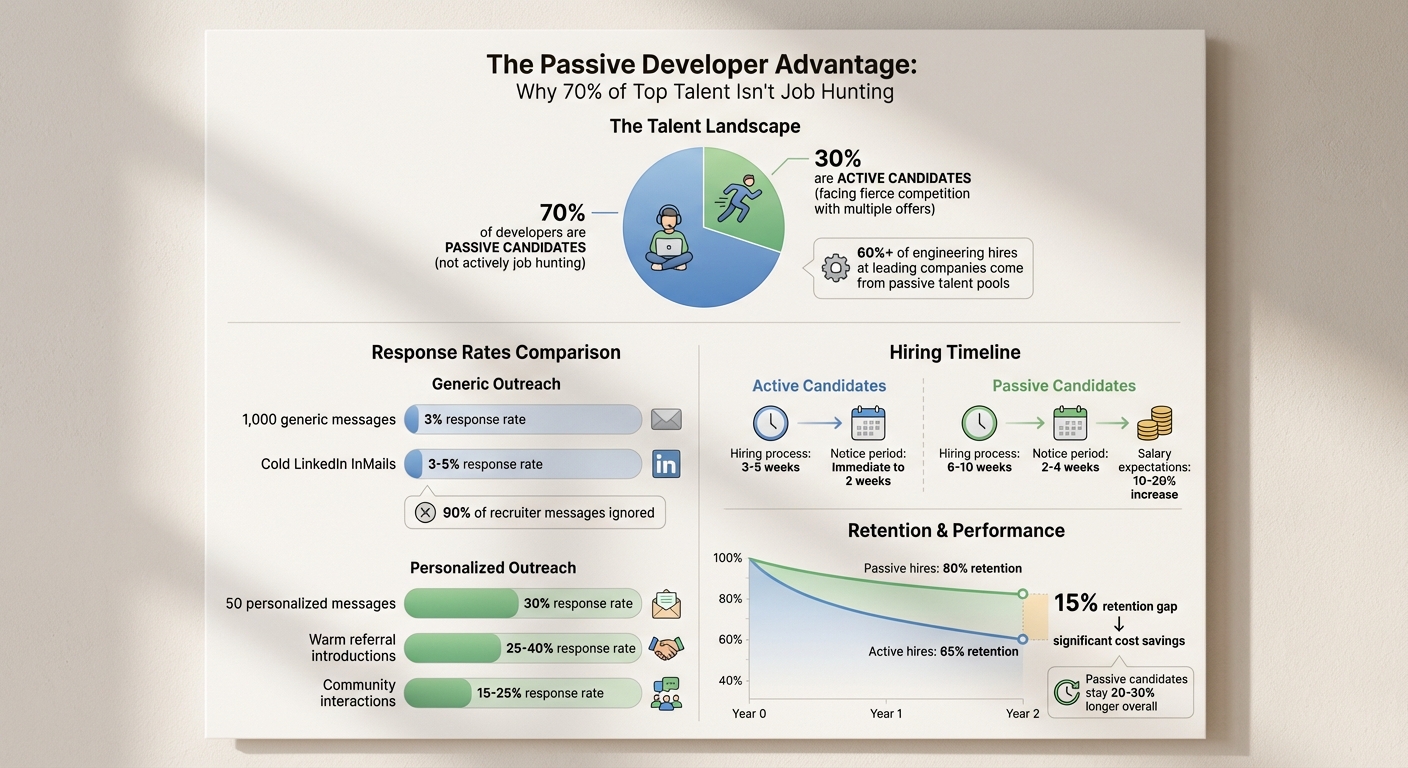
If you're recruiting developers, chances are you're struggling to connect with top talent. Here's the reality: 70% of developers are passive candidates - they're not actively job hunting but are open to the right opportunity. Meanwhile, the competition for the remaining 30% is fierce, with most active candidates juggling multiple offers. Passive candidates, however, tend to stay longer and perform better, making them worth the extra effort.
To connect with passive developers, you need to go beyond LinkedIn and job boards. Instead, focus on where they spend their time - developer communities, GitHub, open source projects, and tech-focused platforms like daily.dev. Look for subtle signals like updated profiles, new certifications, or increased engagement in forums, which often indicate they're open to new opportunities.
The key to success? Personalized, thoughtful outreach. Generic messages fail - most developers ignore 90% of recruiter messages. But a tailored approach referencing their work or interests can boost response rates to over 30%. Engage them in meaningful ways, build relationships over time, and respect their privacy.
Here's a quick breakdown of the process:
- Find passive developers on platforms like GitHub, Discord, Reddit, and daily.dev.
- Spot signals of openness, like profile updates or increased learning activity.
- Craft personalized outreach that highlights their work and offers real value.
- Build trust over time, instead of rushing into a pitch.
What Is a Passive Developer and Why They're Your Best Hires
Passive vs. Active Candidates
A passive developer is someone who isn't actively job hunting. They’re not refreshing their resume or scrolling through job boards. Instead, they’re content in their current role but open to opportunities that genuinely stand out. Developers fall along a spectrum of engagement, ranging from "Actively Searching" (those urgently looking for work) to "Never Moving" (those deeply rooted in their current positions). Somewhere in the middle are "Passively Open" developers - those who might consider a role if it’s compelling enough .
Unlike active candidates, who are ready to jump into a new position immediately, passive candidates often require a 2–4 week notice period. They also wield stronger negotiating power, as they’re usually top performers already appreciated by their current employers . This makes them a more challenging, yet rewarding, group to target when building your team.
Why Passive Developers Are Worth the Effort
When passive developers decide to make a career move, it’s not out of desperation or dissatisfaction. Instead, it’s because the opportunity offers something truly exceptional - whether it’s a more exciting role, a better tech stack, or a mission they deeply connect with.
As one recruiter from daily.dev puts it:
"The best developers rarely need to job search because opportunities come through their network, open source contributions, conference talks, or trusted developer communities."
– daily.dev Recruiter
These developers are thriving in their current roles, earning competitive salaries, and tackling engaging challenges. In fact, over 60% of engineering hires at leading companies come from this passive talent pool. It’s worth noting that passive candidates often expect a 10–20% salary increase to justify a switch, and the hiring process can take 6–10 weeks as they carefully weigh their options. But the time and effort pay off - passive hires tend to stay longer and perform better overall .
Where Passive Developers Actually Hang Out
Finding passive developers starts with knowing where they spend their time. These developers aren’t browsing traditional job boards - they’re immersed in spaces that fuel their curiosity and growth. Let’s dive into the platforms and communities where you’re most likely to find them.
Developer Communities and Platforms
Many passive developers thrive in communities focused on learning and sharing knowledge. Take daily.dev, for example - over a million developers use this platform to stay updated with curated tech articles. It’s not about job hunting here; it’s about growth and staying informed.
Other popular hangouts include Reddit (check out subreddits like r/programming, r/webdev, and r/cscareer), Hacker News, and Discord servers dedicated to specific technologies like React, Rust, or DevOps. These spaces are buzzing with discussions, problem-solving, and skill-building, giving you insight into what developers care about most.
Open Source Projects
Code repositories like GitHub and GitLab are goldmines for spotting talented developers. Open source contributions showcase their coding skills, collaboration abilities, and commitment to learning. Look for activity in repositories with labels like "good first issue", "help wanted", or "up-for-grabs." These tags often attract developers eager to engage and grow within their communities .
By reviewing a developer’s commit history, pull requests, and issue discussions, you can gain a clear picture of the technologies they use and their approach to solving problems. This public activity provides the perfect foundation for personalized outreach that resonates.
Tech Newsletters, Conferences, and Niche Groups
Stack Overflow continues to be a hub where developers seek and share technical knowledge. Beyond that, Slack groups and Discord servers tailored to specific tech stacks are excellent places to build authentic, long-term relationships. Developers join these spaces to connect with peers who share their passions, making them ideal for meaningful engagement.
Meetups and conferences, whether virtual or in-person, attract developers who prioritize professional growth. Similarly, tech newsletters like Bytes, Node Weekly, or Golang Weekly land directly in developers’ inboxes, offering valuable learning opportunities. These channels create a more organic way to connect with developers compared to sending cold LinkedIn messages, allowing you to build relationships in spaces where they’re already invested in their growth.
Signals That a Developer Is Open to Opportunities
Once you've figured out where passive developers spend their time online, the next step is spotting the subtle hints that suggest they're open to new opportunities. Unlike active job seekers, most passive developers won't openly advertise their interest with an "Open to Work" badge. Instead, they leave behind small clues that, when noticed, can reveal the perfect moment to reach out. These signals often appear when they're quietly exploring possibilities, even if they haven't started actively applying.
Profile and Learning Activity
Pay attention to updates on platforms like GitHub, LinkedIn, or daily.dev that showcase new certifications or learning efforts. For instance, if a developer earns an AWS certification, completes a course on Rust, or starts sharing insights about a new framework, it could indicate preparation for a career change. Similarly, a refreshed LinkedIn profile - whether it’s adding new skills, updating their bio, or showcasing recent achievements - can be a strong hint that they’re positioning themselves for future opportunities. These activities often signal that a developer is actively enhancing their professional brand, making it an ideal time to connect .
But it’s not just about profile updates. How developers engage with their projects and communities can also reveal their openness to new challenges.
Contribution and Engagement Patterns
A developer’s contributions to projects can provide valuable insights into their mindset. For example, completing a major release, resolving a significant pull request, or hitting a key milestone on GitHub often marks a time when they might be considering their next steps. External factors also play a role - events like leadership changes, company restructures, layoffs, or even equity milestones (like finishing a vesting period or a post-IPO event) can prompt developers to explore new opportunities.
Additionally, their engagement with career-oriented content can be telling. Whether they’re asking for advice in forums, reading salary guides on daily.dev, or commenting on industry trends, these actions can signal that they’re evaluating their options and might be open to hearing about new roles .
Step-by-Step Passive Sourcing Playbook
To effectively connect with passive developers, you need more than just a list of names. The process requires a thoughtful approach, moving from discovery to building genuine relationships. Here's a step-by-step guide to help you structure your outreach.
Discovery: Where and How to Find Them
Start by clearly defining the skills you're targeting. Are you searching for a senior Rust engineer with open-source contributions? Or maybe a frontend developer with React expertise active in learning communities? The more specific you are, the better your talent pool will be.
Next, look for developers in the spaces where they’re most active. Tools like daily.dev Recruiter can help you identify developers based on their current interests, skills, and engagement. This ensures you're reaching out to individuals who are actively growing and learning.
Expand your search to platforms like GitHub, where you can explore repositories in your target tech stack and review pinned projects - these often showcase work developers are proud of. On Stack Overflow, use the "Tags" section to find contributors deeply involved in specific technologies. Don’t overlook niche communities like Discord servers for particular frameworks or subreddits such as r/rust or r/golang, where developers share insights and tackle challenges.
Once you've compiled a list, evaluate their public activity to determine if they’re a good fit.
Qualification: How to Assess Fit from Public Signals
Before reaching out, take the time to assess whether a developer aligns with your needs. On GitHub, examine their repositories to review original code, documentation, and README files. These can reveal their technical expertise and communication skills. On Stack Overflow, look at their reputation scores for specific tags (e.g., React or Scikit-learn) to gauge their depth of knowledge and community trust.
Pay attention to contribution patterns - consistent activity, such as regular commits or active participation in discussions, signals an engaged developer. Follower counts can also indicate their influence within the community.
Watch for behavioral signals that suggest they might be open to new opportunities. For example, profile updates after long periods of inactivity, new certifications, or increased interaction with professional content can indicate they’re quietly exploring options. These "trigger events" are prime moments to reach out.
Once you've identified a strong candidate, it’s time to craft your outreach.
Outreach: How to Make First Contact
When reaching out, personalization is key. Reference something specific, like a project they’ve worked on, an insightful answer they posted, or a talk they gave. Developers are quick to dismiss generic or templated messages.
Keep your message concise and engaging. If possible, mention competitive salary ranges upfront - passive candidates need to know their time is valued . Be mindful of the platform you’re using. For instance, on GitHub, comment on a relevant issue or pull request rather than sending a cold email. In community spaces like daily.dev or Discord, engage in discussions first to establish credibility before mentioning opportunities.
Avoid mass messaging, immediate pitches, or generic introductions. Instead, focus on offering value. Share an article they might find interesting, ask a thoughtful question about their work, or simply introduce yourself and your company without pressuring them.
Nurture: How to Build a Relationship Before Pitching a Role
Passive hiring takes time and involves building trust. Start with Awareness - share valuable content and participate in community discussions without making any asks. Move to Connection - follow their work and provide introductions that benefit them. Finally, build a Relationship by maintaining regular, meaningful contact.
Follow up every 4 to 8 weeks to stay on their radar without overwhelming them. Share updates like company milestones or technical blog posts they might appreciate . When you’re ready to pitch a role, reference your previous interactions and explain why you thought they’d be a great fit.
Tools like daily.dev Recruiter simplify this process by integrating opportunities into developers’ daily workflows. Instead of relying on cold emails, you can make warm, double opt-in introductions with developers who are already interested in engaging. It’s a natural, trust-based approach to sourcing that benefits both sides.
Outreach Templates That Actually Get Responses
What separates a message that gets ignored from one that sparks a conversation? It often boils down to a few essential ingredients. Your outreach should include a Hook (a clear reason for reaching out), Empathy (showing you understand their perspective), Authority (establishing credibility), a Request (a small, easy-to-act-on ask), and Thanks . Including a specific reason in your message can increase response rates by 47% .
Keep your messages concise - 80 to 125 words is the sweet spot. Longer messages risk being skimmed or ignored. Be specific with details, like including a clear salary range (e.g., "$160,000-$200,000") instead of vague phrases like "competitive pay." Reference something tangible from their work, such as a repository, a technical solution they shared, or a project they contributed to. Your ask should be low-pressure - offering to send a document they can review at their convenience works better than pushing for an immediate call .
Here are three platform-specific templates designed to kick off authentic conversations.
Email Outreach Template
Tip: Personalize your email with a strong hook, show empathy, and make a low-effort request.
Subject: Question about your React work on [Project Name]
Hi [Name],
I came across your [specific contribution] on [Project/Platform] and was impressed by [technical detail - e.g., "how you handled state management in the checkout flow"].
I’m recruiting for a senior frontend role at [Company], where you’d be working on [specific technical challenge - e.g., "building a real-time collaboration tool for 50,000+ daily users"]. The stack includes React, TypeScript, and GraphQL. Compensation ranges from $180,000-$220,000, plus equity.
Let me know if you’d like a quick overview of the role. Either way, great work on [Project].
Best,
[Your Name]
Community DM Template
For platforms like Discord or Reddit, where the tone is more casual, this template helps you fit into ongoing discussions. Tip: Spend time engaging with the community before sending direct messages. Build trust by answering questions and participating in conversations for a few months .
Hey [Name] - I’ve seen your posts in [#channel/subreddit] about [topic] and really liked your perspective on [specific point].
I’m with [Company], and we’re hiring for [role]. The team is tackling [specific technical challenge] using [tech stack], with pay in the $160,000-$200,000 range.
If this sounds interesting, I’d be happy to share more details.
GitHub Outreach Template
When reaching out on GitHub, focus on their actual contributions. Use this tailored approach. Tip: Instead of a cold email, comment on an issue or pull request to start the conversation. Reference their specific work to make your message stand out.
Hi [Name] - I noticed your work on [specific feature/PR] in [Repository]. The way you [technical detail - e.g., "optimized the query performance"] was really impressive.
I’m recruiting for [Company], where we’re building [specific product/feature]. The role involves [technical challenge] using [tech stack]. The pay range is $170,000-$210,000, plus equity.
If you’re interested, I can send over a brief document with more details. Let me know!
Privacy and Ethics in Passive Sourcing
When reaching out to developers who aren’t actively job hunting, it’s essential to prioritize transparency and respect. Under GDPR regulations, recruiters must establish a legal basis for contacting individuals - usually through legitimate interest for initial outreach or explicit consent for storing data long-term. Failure to comply can lead to hefty fines of up to €20 million or 4% of global turnover . To foster trust, start every message by explaining how you found the developer and why you’re reaching out . This small step can go a long way in building rapport.
Unsolicited emails obtained without consent are a no-go . If AI tools are part of your screening process, make sure to disclose their use and have human oversight for all automated decisions . Malin Gustafsson, Chief Innovation Officer at Talentech, emphasizes this point:
"As a recruitment and HR software vendor we consider it our responsibility to only offer secure and compliant solutions to our customers. Also when it comes to AI" .
Keep follow-ups minimal - one reminder after 5–7 days is reasonable, but sending more than two in a week can damage your employer brand . Always include a clear opt-out link in your emails to stay compliant . If a developer exercises their "right to be forgotten" and requests data deletion, act immediately and ensure all third parties are notified . Respecting these boundaries shows your commitment to a trust-driven approach.
Only collect data that’s directly relevant to the role, and avoid asking for unnecessary personal details . Unless you have explicit consent, limit data retention to 6–12 months . Additionally, review any third-party tools you’re using to confirm they meet GDPR standards, and secure Data Processing Agreements to ensure compliance .
When engaging with developers, offer low-pressure next steps, like providing a role description or a team overview they can review at their own pace . This approach respects their time and shows you value them as individuals. By adhering to these privacy and ethics standards, you’ll create a respectful and effective passive sourcing strategy that builds trust and credibility.
Metrics to Track for Passive Sourcing
Tracking the right metrics is essential to gauge the success of your passive sourcing efforts. While passive candidates take longer to hire, they often deliver stronger long-term results. For example, active job seekers typically move through the hiring process in about 3–5 weeks, whereas passive candidates require 6–10 weeks. This extended timeline reflects their more deliberate decision-making process.
Pipeline Metrics
One key metric to monitor is the sourced-to-hire ratio, which measures the efficiency of your passive sourcing efforts. This ratio tracks how many outreach messages are needed to secure a hire and allows you to compare passive sourcing with active recruiting channels. Unlike active candidates, passive ones are less likely to be involved in multiple interview processes at the same time. This can give you better negotiating leverage and reduce the uncertainty of competing offers .
Another critical metric is retention rates. Passive hires tend to stay longer, with about 80% retention at the two-year mark compared to 65% for active hires . This 15% gap represents significant savings in replacement costs and contributes to a more stable team. When you consider the expenses tied to rehiring and onboarding, the upfront time investment in passive sourcing clearly pays off.
Once you’ve assessed efficiency through pipeline metrics, it’s time to focus on engagement metrics to gauge candidate interest.
Engagement Metrics
Response rates can vary depending on the channel and approach. For example, cold LinkedIn InMails typically yield a 3–5% response rate. However, warm introductions through referrals perform much better, with response rates ranging from 25–40%. Developer community interactions fall in the middle, at 15–25% . If your cold outreach response rate is below 3%, it’s a sign that your messaging needs refinement. On the other hand, response rates above 15% indicate your strategy is resonating.
Another important metric is the meeting conversion rate, which measures how many responses turn into actual conversations. Here’s how to benchmark your performance: a conversion rate below 20% is poor, 40–50% is average, and anything above 60% is excellent . Additionally, track your time to first response. Replies within 24 hours suggest strong interest, while responses taking more than 7 days indicate your outreach may not have landed well .
| Metric | Poor | Average | Excellent |
|---|---|---|---|
| Response Rate (Cold) | <3% | 5–10% | >15% |
| Response Rate (Warm) | <15% | 25–35% | >40% |
| Response to Interview | <20% | 40–50% | >60% |
| Interview to Offer | <15% | 25–35% | >45% |
| Time to First Response | >7 days | 2–3 days | <24 hours |
Case Study: Hiring a Passive Developer from Discovery to Offer
A mid-sized fintech company successfully hired a senior frontend engineer through daily.dev Recruiter - without resorting to cold emails or LinkedIn InMails. This case study walks through the entire process, from initial discovery to making an offer, demonstrating how the platform simplifies passive hiring.
Discovery: The recruiter began by posting a role brief tailored to developers with an interest in advanced state management. A senior frontend engineer came across the brief and expressed interest. daily.dev’s AI identified her based on her reading habits and verified her as an active member of the developer community .
Qualification: Before making an introduction, daily.dev Recruiter assessed her technical expertise, seniority level, and timezone compatibility. The recruiter received a warm introduction supported by real-time insights into her current learning and projects, ensuring she was a strong match.
Outreach and Nurture: Instead of rushing into scheduling a call, the recruiter shared a short, detailed document outlining the team structure, tech stack, and product roadmap. Over the next week, they had thoughtful discussions about the company’s frontend architecture and its approach to hiring remote developers. This approach built trust and rapport before moving into formal interviews, showcasing how daily.dev Recruiter makes passive sourcing more effective as part of a lean tech hiring stack.
Outcome: The results were impressive. The developer went from initial contact to accepting an offer in just 42 days - well within the standard 6–10 week timeframe for passive hires. She accepted with a 12% salary increase and, six months later, had already contributed to a major product launch. The recruiter also highlighted that 90% of developers on daily.dev are unresponsive to outreach on other platforms , emphasizing the advantage of connecting with candidates in spaces they already frequent.
Conclusion
The best developers aren’t hanging out on job boards - they’re busy building, learning, and staying active in the communities they love. Traditional recruiting methods like LinkedIn InMails or mass job postings? They just don’t cut it for reaching passive talent. Here’s the proof: sending 50 highly personalized messages nets about a 30% response rate, while blasting 1,000 generic templates barely scrapes 3% . When it comes to sourcing passive candidates, quality beats quantity every time.
The game plan is simple: meet developers where they already are, use proven ways to find passive developer candidates, craft outreach that respects their time, and focus on building genuine connections. Yes, passive candidates take more effort upfront, but they’re worth it - they stick around 20-30% longer over a two-year period compared to active job seekers . That kind of retention can make all the difference.
daily.dev Recruiter makes this process seamless by plugging you directly into the daily workflow of over 1 million developers who are reading, learning, and growing on the platform. Instead of cold messages based on outdated LinkedIn profiles, you get warm, double opt-in connections with developers who are actively engaged and open to the right opportunities. It takes care of the discovery, qualification, and initial engagement, leaving you free to focus on building meaningful relationships with candidates who are ready to chat.
Shifting from active to passive sourcing isn’t just a trend - it’s the key to unlocking the top 70% of engineering talent that never bothers updating a resume. Ditch the outdated methods and start connecting with developers where they already thrive.
FAQs
How do I know if a developer is open to opportunities?
Look for subtle signs that a developer might be open to new opportunities. For example, recent profile updates, earning new certifications, or stepping up contributions to projects can all hint at a shift in focus. Increased activity on platforms like GitHub or active participation in industry discussions might also suggest they're exploring options. Developers who are attending conferences or sharing technical insights often show they’re engaged and open to growth. When reaching out, make sure your approach is personalized and respectful - this helps establish trust and fosters meaningful connections.
Where do developers spend time online?
Developers often turn to platforms like GitHub, Stack Overflow, Reddit, Hacker News, dev.to, and Hashnode. These sites are hubs for sharing code, solving problems, and staying updated on the latest trends.
Beyond these, many developers actively participate in Discord and Slack groups, as well as other industry-focused communities. These spaces provide opportunities to learn, collaborate, and connect with like-minded peers.
What's the response rate for passive candidates?
Response rates for passive candidates usually hover between 6% and 10%. Many passive developers tend to overlook outreach efforts, often because the messages lack personalization and clear communication. To boost engagement, it's essential to create messages that feel tailored to their unique interests and align with their career aspirations.
.png)