Finding experienced tech talent in 2026 is harder than ever due to global competition, skills gaps, and inefficient hiring processes. To succeed, you need faster, smarter strategies. Here's how you can simplify and speed up your hiring process:
- Go Beyond Job Postings: Proactively source talent on platforms like GitHub, Stack Overflow, and niche developer communities.
- Leverage AI Tools: Use AI tools to screen resumes, identify passive candidates, and personalize outreach at scale.
- Write Clear Job Descriptions: Focus on specific skills, responsibilities, and growth opportunities to attract top developers.
- Build a Talent Pipeline: Maintain relationships with passive candidates and pre-qualify talent for future roles.
- Adapt for Remote Hiring: Assess remote work skills, use practical coding tests, and ensure compliance with international hiring laws.
::: @figure 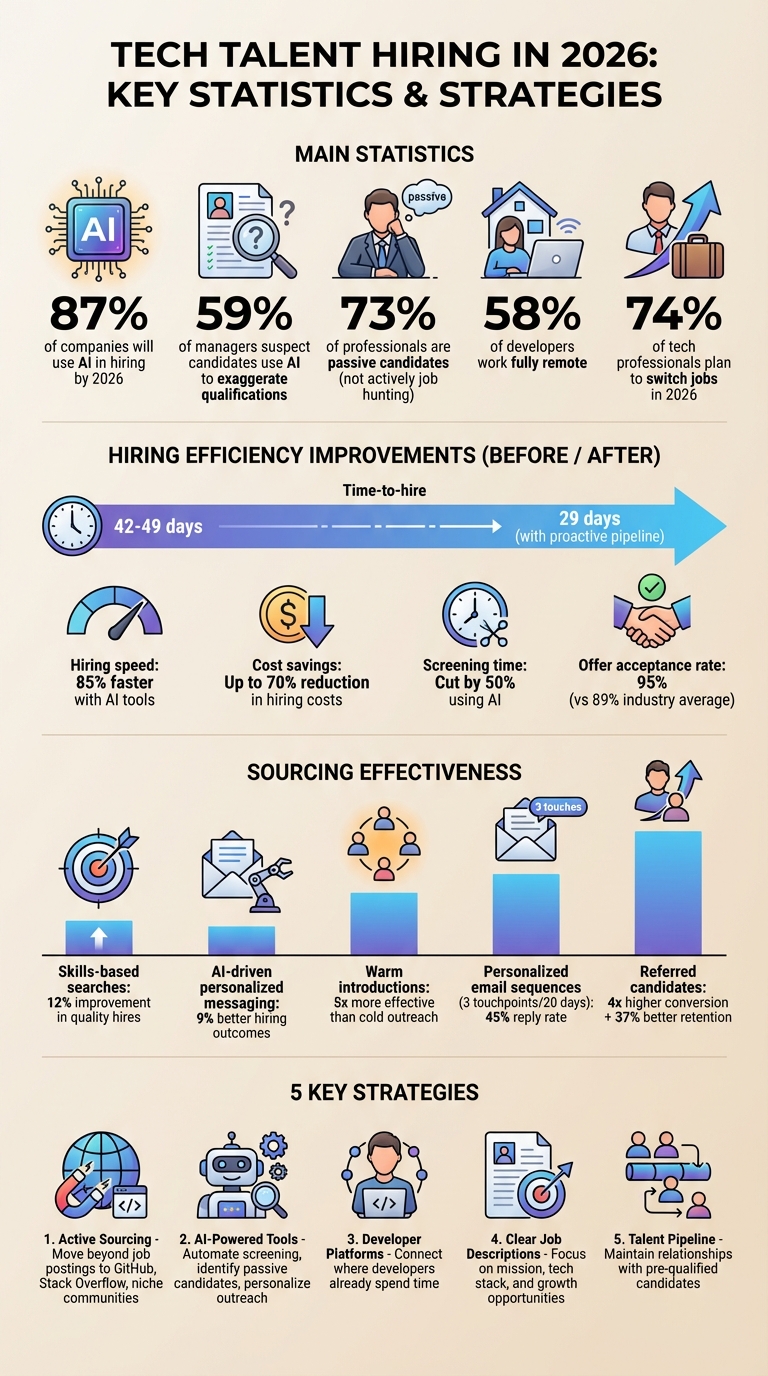 {Tech Talent Hiring Statistics and Strategies for 2026}
1. Move from Reactive to Active Talent Sourcing
The days of posting a job and waiting for applications are fading fast. By 2026, 59% of managers suspect candidates are using AI to exaggerate their qualifications. This results in an influx of low-quality applications, while top-tier developers - those already employed and not actively job hunting - might never even see your job posting. This trend, often referred to as "job hugging", reflects how experienced professionals are staying in their current roles due to economic uncertainty. To reach these skilled individuals, you need to take a proactive approach.
Active sourcing changes the game. Instead of wading through piles of generic resumes, you directly identify developers who meet your criteria and start meaningful conversations. Research shows that companies using skills-based searches improve their chances of hiring quality candidates by 12%. Additionally, leveraging AI-driven personalized messaging boosts the likelihood of finding the right hire by 9%. As Matt Charney aptly states: "The problem isn't sourcing. It's signal."
To succeed, you need to know where developers spend their time, how to filter for the right skills, and how to craft outreach messages that actually get responses. The goal isn’t to reach more people - it’s to connect with the right ones in the right way.
1.1 Find Out Where Developers Spend Their Time
Developers often showcase their expertise on platforms like GitHub, which serves as a modern-day portfolio for open-source contributions. They’re also active on Q&A hubs like Stack Overflow and niche spaces like daily.dev, where they stay current on trends like machine learning and cloud-native infrastructure.
But don’t limit yourself to LinkedIn. While 96% of job seekers use social media during their search, many developers gravitate toward specialized communities like Dev.to, Reddit programming forums, and even Discord servers. These platforms are treasure troves for finding passive talent - developers who are constantly sharpening their skills, sharing their progress on Twitter/X, or contributing fixes to open-source projects.
1.2 Use Boolean Search and Advanced Filters
Once you know where to look, the next step is narrowing your search efficiently. Boolean search is a powerful tool that combines keywords with operators like AND, OR, and NOT to pinpoint candidates with specific technical expertise. For example, a search for "Python AND (Django OR Flask) AND NOT junior" can quickly surface mid-to-senior-level developers with the right skills.
On GitHub, you can filter candidates by their contributions, primary programming languages, and recent activity. Many tech-focused job boards also offer built-in coding challenges to vet technical skills before interviews. The key is precision - don’t just search for generic job titles. If your role requires expertise in "Kubernetes + Terraform + AWS", tailor your search to reflect those exact needs.
1.3 Build Relationships with Personalized Messages
Developers are inundated with recruiter messages, and generic outreach is often ignored. However, personalized email sequences with three touchpoints over 20 days can achieve reply rates of nearly 45% - but only if the messages feel relevant and considerate.
Start by referencing something specific about the developer: a project they worked on, a blog they wrote, or a technology they’re passionate about. Instead of immediately asking them to apply or take a test, suggest a brief 10–15 minute call as the initial step. This lowers the engagement barrier and shows you respect their time. When reaching out to passive candidates, focus on their ability to explain the "why" behind their technical decisions, not just the "how". This often signals senior-level expertise.
Keep your first message concise. The goal is to spark interest and assess availability, not to close the deal right away. As Łukasz Terlecki explains: "The primary objective [of talent sourcing] is to create a cohesive talent pool that operates year-round, ensuring an organization's readiness to meet hiring challenges promptly." By using thoughtful, personalized outreach, you can build a long-term network of talent that’s ready when you need it.
2. Use Developer-Focused Platforms and Tools
When it comes to sourcing tech talent, traditional job boards often fall short. They rely on outdated resumes, self-reported skills, and impersonal outreach - methods that developers tend to ignore. Instead, the future of recruitment lies in developer-first platforms, where skilled professionals already spend their time - reading technical content, contributing to projects, and staying updated on industry trends. By 2026, the most effective recruiters will have shifted their strategies to these specialized spaces.
These platforms provide access to the 73% of professionals who aren’t actively job hunting but are open to the right opportunity . Rather than casting a wide net, you can focus on connecting with developers in environments they trust. Here, their skills and interests are reflected in real-time, making outdated profiles a thing of the past. This approach moves away from generic tactics and toward targeted engagement, creating opportunities to meet developers where they are already active.
The secret lies in prioritizing context over volume. Nimrod Kramer, CEO of daily.dev, explains it perfectly:
Recruiting should be built on context, not spam. Developers shouldn't have to sift through irrelevant offers from strangers who don't understand their work.
By leveraging developer-first platforms, you’re not just sourcing candidates - you’re building meaningful connections. This strategy transforms recruitment into an exercise in precision, offering insights that go far beyond static profiles.
2.1 Connect with Developers Through Warm Introductions
While cold outreach vs. warm introductions shows a stark contrast in success rates—less than 2% for cold vs. five times more effective for warm—the difference is clear . The difference? Trust. When a respected peer makes the introduction, you’re starting with credibility rather than from scratch.
Platforms like daily.dev Recruiter use a double opt-in system, where both the recruiter and the developer agree to connect before any conversation begins . This eliminates inbox clutter and ensures that every interaction is meaningful. Referred candidates not only convert four times more often but also tend to stay with companies longer, with 37% higher retention rates .
To make the most of warm introductions, provide connectors with a short, forwardable email template. Include a polite way for them to decline if the match isn’t right, and always follow up to share the outcome and express your gratitude . This thoughtful process protects relationships and strengthens your network for future opportunities.
2.2 Assess Developers Through Their Contributions
Instead of relying solely on resumes, which highlight past roles, evaluate developers based on their current work. Platforms like GitHub allow you to review real-time coding contributions, problem-solving methods, and tool usage. Stack Overflow answers can demonstrate how well they explain complex topics. Meanwhile, activity on platforms like daily.dev reveals the technologies they’re currently exploring, giving you insight into their evolving expertise.
Recruiters using daily.dev Recruiter report cutting their screening process in half by leveraging behavioral signals . The platform tracks what developers are reading, following, and building, enabling matches based on up-to-date skills rather than outdated titles or self-reported abilities.
When reviewing a developer’s contributions, pay attention to their decision-making process. Senior developers often document their work thoroughly, explain architectural choices, and engage with feedback from the community. These details provide a deeper understanding of their capabilities - something a static list of skills can’t offer. By connecting with developers in the spaces where they work and grow, you’ll gain insights that truly reflect their potential.
3. Write Job Descriptions That Appeal to Experienced Developers
A job description is often your first opportunity to connect with potential candidates. For experienced developers, vague or cookie-cutter postings are an instant turnoff. The difference between attracting top-tier talent and leaving a role unfilled for months often boils down to clarity, transparency, and relevance. Studies reveal that 77% of job seekers prefer well-written, inclusive job descriptions , yet many companies still rely on outdated templates.
With the rise of skills-based hiring and modern technical recruiting, developers are less concerned with arbitrary requirements and more interested in the work they'll do, the team they'll join, and the opportunities for growth. For example, instead of demanding "5+ years of Java experience", focus on outcomes like "Engineers who have scaled consumer apps from 1M to 10M users" . This approach shifts the focus from years of experience to measurable impact, appealing to developers who can showcase results.
In today’s market, 26% of tech roles now require AI expertise, a 98% increase from the previous year . This means job descriptions need to reflect the realities of modern development. Developers want to know if they'll use tools like GitHub Copilot or evaluate AI-generated code. As Matt Studdert, Founder of Frontend Mentor, explains:
The companies resuming junior hiring aren't looking for developers who can prompt ChatGPT. They want developers who can evaluate whether code works, regardless of whether a human or AI wrote it.
The best job descriptions in 2026 tell a story - not just about the role, but about the problems to solve, the tools to use, and the path ahead. This approach builds credibility and sets the stage for a strong candidate experience.
3.1 Describe the Mission and Impact of the Role
Experienced developers want their work to matter. Instead of starting with a list of qualifications, begin with the "why." What challenge does this role address? What measurable difference will the developer make to the product, team, or business?
For instance, instead of saying "Join our engineering team", write something like, "Lead a critical migration from legacy systems to a cloud-native platform." With 67% of tech companies missing their product roadmaps in 2024 due to hiring challenges , developers want to know how their work will directly contribute to success.
Outcome-focused descriptions are effective because they help candidates imagine their contributions in the first 30, 60, or 90 days. What will they deliver? What systems will they work on? Who will they collaborate with? Ryan Delaney, Partner at Cherry Bekaert, puts it this way:
Hiring is no longer about filling a seat - it's about ensuring teams have both the capacity and the systems-focused capability needed to accelerate transformation.
By framing the role around business outcomes - whether that's boosting revenue, reducing risk, or improving efficiency - you attract developers who think strategically and want to make a meaningful impact.
3.2 Be Clear About Tech Stack and Responsibilities
Few things frustrate developers more than vague job postings. In 2026, transparency is essential. Clearly list the tools, languages, and platforms the role involves: Node.js, TypeScript, React, PostgreSQL, AWS .
This level of detail serves two purposes. First, it helps filter out unqualified candidates, saving time for everyone. Second, it draws in specialists who are genuinely excited about the technologies listed. Considering that hiring managers spend only 55 seconds reviewing a developer's portfolio or profile , clarity up front ensures the right candidates apply.
Don’t stop at the tech stack. Be explicit about day-to-day responsibilities and success metrics. For example, instead of saying "Write high-quality code", say "Ensure 90%+ test coverage and participate in peer reviews." Instead of "5+ years of React experience", specify "Proven ability to build production-level React apps." These details shift the focus from arbitrary credentials to demonstrated skills and results.
Additionally, mention integration points like APIs or cloud services to quickly gauge fit. With 44% of workers' core skills expected to change by 2027 , adaptability and systems thinking are just as critical as technical expertise.
3.3 Emphasize Growth and Learning Opportunities
Developers are drawn to roles that promise more than just a paycheck. If your job description doesn’t mention mentorship, training budgets, or career advancement, you’re missing a key opportunity to stand out. Highlighting these aspects shows candidates that your company values long-term growth, not just immediate output.
Be specific. Instead of saying "professional development opportunities", write something like "annual $2,500 learning stipend, quarterly one-on-one coaching sessions, and a clear path to technical leadership roles." This transparency appeals to developers who want to stay ahead of industry trends and deepen their expertise.
With 58% of CFOs acknowledging a critical skills gap within their teams , companies that prioritize upskilling gain a competitive edge. Developers recognize this and gravitate toward organizations that see learning as part of the job. Whether you offer access to conferences, internal mentorship programs, or time for side projects, make it clear that growth is a priority.
Finally, consider publishing total compensation ranges (base, bonus, equity) and interview timelines directly in the job posting. This level of transparency builds trust and speeds up decision-making. In a market where remote positions receive over 50% of applications but make up only 15–20% of job postings , being upfront about compensation and work mode can make all the difference in attracting top-tier candidates.
4. Use AI-Powered Tools to Speed Up Recruitment
Building on targeted developer sourcing and personalized outreach, AI-powered tools are transforming recruitment efficiency, but they cannot replace the human element of trust. By 2026, 87% of companies will rely on AI to streamline their hiring processes, cutting an average of 20% from their weekly workloads. These tools take over repetitive tasks like scanning profiles, sorting resumes, and initiating outreach, allowing recruiters to focus on building relationships, evaluating candidates, and making strategic decisions. Shawna Hondorp, Area Lead at Disher Talent, describes this shift:
The 'new recruiter' is part talent advisor, part strategist, part relationship architect: someone who can prompt and tune AI agents, interpret AI-generated insights, and understand complex candidate motivations.
Organizations using AI report hiring speeds up to 85% faster and see savings of up to 70% in hiring costs.
4.1 Use AI to Find Passive Candidates
A large portion of the global workforce - about 70% - is made up of passive talent, and up to 90% of executive and C-level hires come from this group. These individuals aren’t actively job hunting, so traditional postings often fail to reach them. AI tools step in by identifying "excellence signals" like conference appearances, GitHub contributions, or connections to high-growth companies. Autonomous AI agents can handle sourcing, initial screenings, and scheduling without constant human input. In fact, 52% of talent leaders plan to integrate these autonomous agents into their teams by 2026.
AI integrations with ATS platforms also help by resurfacing past applicants who match current openings, cutting down the need for costly job board postings. Skills-based matching now evaluates candidates based on their career growth and proven abilities, moving beyond just resume keywords or credentials.
4.2 Automate Screening and Profile Analysis
AI screening tools simplify the hiring process by automating resume reviews and extracting details like education, skills, and experience through natural language processing (NLP). For example, AI understands that titles like "Software Engineer II" and "Backend Developer" often represent similar roles. By 2025, nearly all Fortune 500 companies are expected to use some form of automated screening.
Unilever provides a standout example: in 2025, they used AI-driven video interviews and games to evaluate thousands of early-career applicants. This approach filtered out 80% of candidates based on AI-analyzed responses, slashing time-to-hire by 90% and saving 50,000 hours of recruiter time.
AI-powered summarization tools further enhance efficiency by generating concise overviews of resumes and interview notes, helping hiring managers quickly assess candidates. Automated triage systems categorize applicants into "Reject", "Review", and "Priority" groups, preventing backlogs and keeping the process moving smoothly. Companies using AI screening report a 30% reduction in cost-per-hire and a 25% faster time-to-fill.
4.3 Personalize Outreach Messages at Scale
By 2026, generic outreach will no longer cut it - personalized, AI-assisted messages will be key. These tools can boost cold email reply rates from the industry average of 0.5–2% to as high as 6–20%+. AI analyzes data like candidates’ preferred tech stacks, GitHub activity, LinkedIn updates, and even recent funding rounds.
Here’s how different levels of personalization impact response rates:
| Personalization Level | Tactic Example | Expected Reply Rate Lift |
|---|---|---|
| Basic (Automated) | "Hi {{first_name}}, I saw your profile..." | 0-5% |
| Light (Role-Based) | Mentioning current company & title | 5-10% |
| Medium (Achievement-Based) | Citing a public project or skill | 15-25% |
| Deep (Hyper-Personalized) | Referencing a blog post or recent talk | 30-50%+ |
AI drafts outreach messages, but human recruiters step in to add final touches, ensuring the tone remains genuine and relevant. This "human-in-the-loop" approach combines the speed of AI with the nuance of human insight. AI also tracks "company moves" like executive hires or product launches, helping recruiters time their outreach when candidates are more likely to respond. Multi-channel workflows - using email, LinkedIn InMail, SMS, and WhatsApp - further enhance engagement.
Adam Wardlow, VP of Recruiting and Digital Strategy at Inergroup, highlights the value of immediate engagement:
Candidates applying at midnight are engaged right away. That immediate engagement absolutely improves our conversion rates.
While AI can scale research and drafting, it’s essential to verify facts before sending messages. This combination of AI-driven efficiency and human oversight ensures outreach remains effective, helping teams fill roles in weeks instead of months.
5. Build and Maintain a Developer Talent Pipeline
Once you’ve streamlined your outreach efforts with AI, the next step is maintaining a proactive talent pipeline. A well-managed pipeline doesn’t just save time - it can significantly reduce hiring costs. For instance, proactive pipeline management has been shown to cut the average time-to-fill from 42–49 days to just 29 days or less. Companies with strong pipelines also boast offer acceptance rates of 95% or higher, well above the industry average of 89%. On top of that, shifting from reactive to proactive hiring can slash cost-per-hire by up to 50%.
But a talent pipeline isn’t just a list of resumes. It’s a carefully curated group of pre-vetted, engaged developers. This can include "silver medalists" (past candidates who were finalists but not hired), standout professionals you’ve met at industry events, or participants from your company’s own initiatives. A great example is Blackstone’s Career Pathways program and Data Center Academy, launched in 2020. By focusing on internal development and recruiting from underrepresented groups, these programs led to over 10,500 hires while boosting retention rates within the AI infrastructure sector.
5.1 Stay in Touch with Passive Talent
Building relationships with passive candidates is key, as 73% of professionals fall into this category. Informational interviews and periodic check-ins are excellent ways to keep these connections alive. Even if there’s no immediate opening, exploring how a candidate’s skills might align with future needs can pay off down the line. For instance, Google uses a robust networking and referral strategy, encouraging employees to identify talent at industry events and academic conferences. Their formal referral program even rewards employees for connecting the company with qualified candidates.
Re-engaging past applicants is another smart move. By checking in on their career goals, you can gauge where they might fit into upcoming opportunities. Automated nurture sequences can help here - sharing useful content like industry news or webinar invites keeps candidates engaged without overwhelming them with job postings.
5.2 Use Candidate Relationship Management (CRM) Tools
A Talent CRM is not the same as an Applicant Tracking System (ATS). While an ATS functions as a static database of past applicants, a Talent CRM is more dynamic. It serves as a “system of engagement,” allowing you to build relationships with potential hires over time. These tools centralize resumes, track interaction histories, and rank candidates based on future needs, making it easier to find the right talent quickly.
CRMs also allow recruiters to group candidates into dynamic segments based on factors like skills, engagement signals, and intent. This enables more personalized outreach. For example, one company created a segment of "engineering alumni" for a targeted campaign using their CRM. This approach tripled response rates compared to generic outreach and sped up the offer process by 18%. Additionally, integrating interview scores into a CRM can cut recruiter follow-up time by 30%.
With these tools in place, you can focus on building a ready-to-hire pool by pre-qualifying top candidates.
5.3 Gain an Advantage with Pre-Qualified Talent
Having a pool of pre-qualified candidates gives you a significant edge when new roles open up. Companies like Ramp and Perplexity are already leveraging AI-powered sourcing to scan over 30 platforms simultaneously, cutting sourcing time by 80%. These AI agents work around the clock, automatically adding candidates to pipelines based on ideal profiles.
Platforms such as daily.dev Recruiter take a developer-first approach to pipeline building. They connect you with passive, pre-qualified developers in spaces where they’re already active - whether that’s reading, learning, or engaging with their communities. Every introduction is warm, double opt-in, and context-rich, ensuring developers feel respected and recruiters only interact with genuinely interested candidates. This eliminates the need for cold outreach and provides access to a global network of engaged developers who are open to the right opportunity.
6. Improve Your Remote Developer Hiring Process
When it comes to hiring remote developers, adapting your approach is no longer optional - it's essential. With 58% of developers now working fully remote, your hiring process needs to go beyond technical skills. It should focus on qualities like asynchronous communication, self-direction, and the ability to audit AI-generated code.
The tech landscape has evolved significantly. By 2026, AI tools are responsible for generating up to 90% of boilerplate code. This shift means that developers must excel at reviewing and refining AI-generated output rather than just writing code from scratch. Companies now seek "Architectural Thinkers" - professionals who grasp the reasoning behind technical decisions. As noted in one industry analysis:
The Junior Developer role as we knew it in 2022 has largely been replaced by AI-augmented specialists who perform at a mid-level capacity from day one. - Softaims Blog
While technical ability gets candidates in the door, effective communication determines their long-term success. A developer who struggles to explain their pull requests in a short video or provide clear documentation will create hurdles in a remote setup, regardless of their coding skills.
6.1 Check for Remote Work Experience and Skills
Start by evaluating how well candidates handle remote work's asynchronous nature. During interviews, ask behavioral questions like: Can you share an example of solving a problem independently without immediate access to teammates? or How do you document your decisions for others to follow?
Pay close attention to their communication habits throughout the hiring process. Do they respond to emails promptly and professionally? Are they asking thoughtful questions about the role's objectives, or are they solely focused on technical requirements? These behaviors can give you a glimpse into how they’ll perform in a remote environment.
Clear communication is a must. Test this by asking candidates to explain a complex technical solution either in writing or through a short video. This reflects the reality of remote work, where in-person cues and quick desk-side chats are unavailable. Look for candidates who can articulate complex ideas concisely and avoid unnecessary tangents.
Remote developers also need an ownership mindset. During interviews, pay attention to whether they ask about the "why" behind a project, not just the "how." This shows they are capable of strategic thinking and making independent decisions.
For time-zone alignment, establish clear overlap requirements from the start. Many US-based companies require 4–5 hours of synchronous overlap to ensure smooth collaboration. These expectations should be communicated early in the process.
6.2 Use Hands-On Assessments for Technical Skills
Traditional coding tests that focus on algorithms and data structures are becoming outdated. Instead, use take-home challenges that mimic real-world tasks and take about 3–4 hours to complete. These assessments should focus on practical problem-solving rather than theoretical knowledge.
One effective method is to provide candidates with AI-generated code containing deliberate security or performance flaws. Ask them to identify and fix the issues. This approach evaluates their ability to audit code, a critical skill given that 70% of digital breaches originate at the endpoint.
Design challenges to reveal how candidates handle ambiguous requirements. Instead of giving step-by-step instructions, present a realistic scenario and observe whether they ask clarifying questions or proceed based on assumptions.
Assess more than just technical correctness. Pay attention to code maintainability and documentation. A solution that works but lacks clear comments or structure could signal future challenges in collaboration, especially in remote teams that rely heavily on well-documented code.
During live technical interviews, prioritize communication. Ask candidates to walk through their solutions, explain their reasoning, and discuss trade-offs. This not only confirms their technical skills but also ensures they can effectively collaborate in a remote setup.
6.3 Confirm Legal and Payment Compliance
Before sourcing candidates, decide on your engagement model - whether it's hourly freelance, long-term contract, or full-time employment.
For international hires, consider using an Employer of Record (EOR) service to handle payroll, benefits, and compliance with local labor laws. This minimizes the risks of misclassifying employees as contractors and ensures smooth operations across borders.
Account for total costs beyond base pay. Include onboarding expenses, home office stipends (typically $1,500–$2,500), and legal compliance fees, which can quickly offset any geographic salary savings. Here’s what you might expect to pay in 2026:
| Region | Mid-Level (3–5 yrs) | Senior (6+ yrs) | Time Zone Overlap (US) |
|---|---|---|---|
| United States | $90–120/hr | $120–180/hr | Full |
| Eastern Europe | $40–55/hr | $55–75/hr | 4–6 hours |
| Latin America | $35–50/hr | $50–70/hr | 4–8 hours |
| Southeast Asia | $30–45/hr | $45–65/hr | Limited |
Note: AI/ML and cybersecurity specialists typically command a 20–40% premium.
Set up clear payment processes that comply with local regulations. Some countries require specific payment schedules, tax withholdings, or benefits contributions. Document these requirements to ensure consistency.
To avoid recruitment fraud, verify all communication channels. Use official company domains and platforms for hiring discussions. Legitimate employers never request payment or sensitive financial details from candidates during interviews.
Regular compliance reviews are essential to stay updated with changing international labor laws. Assign someone to track regulatory deadlines and update documentation as needed. This proactive approach helps prevent costly violations and ensures a smooth hiring process.
Finally, set up a structured onboarding process with clear 30-, 60-, and 90-day milestones. Pair new hires with a mentor (not their direct manager) to answer questions and help them integrate into the team. A strong start can significantly boost productivity and retention.
Conclusion
Hiring experienced tech talent in 2026 requires a fresh approach. Strategies like active vs. passive sourcing outperform the traditional "wait-and-see" method, while AI-powered tools take the tediousness out of tasks like screening and interviewing. Add developer-focused platforms into the mix, and you can connect with passive talent where they’re already spending their time. The challenge isn’t about finding profiles anymore - it’s about getting senior engineers to respond, especially as they’ve grown weary of conventional outreach methods.
The numbers back this up. Teams using AI-powered sourcing tools cut their time-to-hire by an average of 25%, saving as much as 23 hours per hire through automation. With 79% of companies already integrating AI into their hiring workflows, the question isn’t whether to use these tools - it’s which ones will address your specific challenges.
"The bottleneck is replies. Getting a passive senior engineer to actually respond to your outreach is the hardest part of technical recruiting today." - Nimrod Kramer, CEO, daily.dev
The solution? Focus on building a talent pipeline. With 74% of tech professionals planning to switch jobs in 2026, nurturing relationships with passive candidates gives you an edge when they’re ready to make a move. Pair this with well-crafted, mission-driven job descriptions and a smooth remote hiring process, and you’ll stand out amid the noise that plagues most outreach efforts.
Tools like daily.dev Recruiter address the "reply bottleneck" by engaging developers directly in their learning environments. This creates a new channel to reach talent that’s disengaged from older platforms. With warm, double opt-in introductions, this approach shifts recruiting from generic outreach to a trust-based process, where credibility and intent replace endless cold calls and emails.
FAQs
What signals actually indicate a developer is truly senior?
A seasoned developer stands out by thinking in terms of systems, foreseeing edge cases, and assessing how their work will hold up over time. They excel at breaking down complicated problems into manageable parts, communicating effectively from the start of a project, and offering consistent support to their team. These qualities showcase both their technical know-how and their ability to lead.
How can I use AI in hiring without introducing bias or compliance risk?
To integrate AI into hiring responsibly, it's crucial to equip your recruiting team with the right knowledge and skills. Start by focusing on fairness and transparency when using AI tools. Provide role-specific training that includes hands-on labs and clear, actionable guidelines. Regular coaching sessions can help reinforce these practices over time.
To gauge the effectiveness of your efforts, track key metrics such as time-to-fill, quality-of-hire, and candidate Net Promoter Score (NPS). These indicators can reveal how well your AI-driven processes are working.
Finally, make continuous education and monitoring a priority. This helps reduce bias, maintain compliance, and ensure the AI tools are used ethically throughout the hiring process.
What’s the fastest way to validate remote developers beyond coding tests?
The quickest way to evaluate remote developers, beyond traditional coding tests, is through practical assessments. These assessments should mimic real-world tasks like debugging code, building features, or optimizing performance. Such hands-on exercises offer a much better understanding of a candidate's abilities. On top of that, using AI-powered tools can make the process smoother and more precise, helping to assess problem-solving skills in realistic situations efficiently.
.png)