When your engineering team grows beyond 10 people, hiring gets harder. Your personal network dries up, gut-feeling interviews stop working, and onboarding becomes a bottleneck. To scale effectively, founders need a structured hiring system that balances speed, quality, and alignment with company goals. Here’s what works:
- Founder Involvement: Founders should stay involved in hiring key roles to maintain alignment and signal the importance of engineering.
- Define Roles Clearly: Use frameworks like Missions, Outcomes, and Competencies (MOC) to link roles to business goals.
- Standardize Interviews: Implement scorecards and rubrics to evaluate candidates consistently and reduce bias.
- Streamline Onboarding: Structured programs and buddy systems help new hires integrate faster.
- Expand Beyond Referrals: Use personalized outreach, online communities, and technical challenges to attract top talent outside your network.
- Leverage Tools: Applicant Tracking Systems (ATS), technical assessment platforms, and scheduling tools save time and improve the hiring process.
Scaling hiring is about creating repeatable processes that maintain quality while reducing founder dependency. Focus on clarity, consistency, and speed to grow your team without losing what made it successful in the first place.
::: @figure 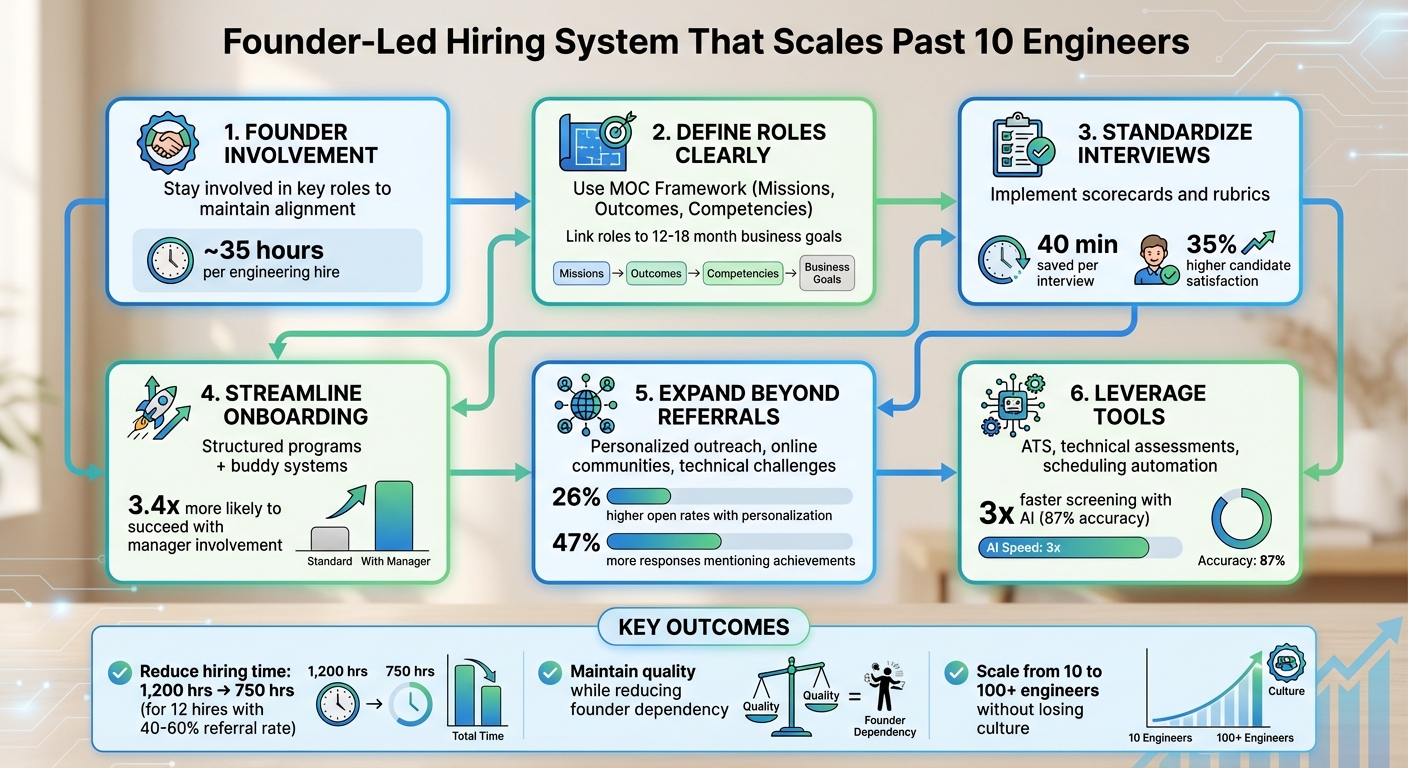 {Scalable Engineering Hiring System: 6-Step Framework for Founders}
Building a Repeatable Engineering Hiring Process
Hitting double digits with your team marks a turning point. Those first ten hires probably relied heavily on gut feelings and coffee conversations. But once you pass that threshold, flying by the seat of your pants stops working. You need systems that work whether you're in the room or halfway across the country. This isn't about burying your team in paperwork - it's about making sure every interviewer uses the same yardstick to measure talent.
The backbone of any hiring process that scales is a framework that links each position to concrete business results, not just a shopping list of programming languages. Without this north star, your team ends up talking past each other - one interviewer obsessing over React skills while another cares only about architecture decisions. Getting everyone aligned solves the communication headaches that typically trip up growing companies and sets you up to hire at scale.
Define Required Skills and Role Expectations
Nailing down exactly what you need stops the crossed wires that plague early-stage companies. Start with what venture capitalists at Andreessen Horowitz call the MOC Framework - short for Missions, Outcomes, and Competencies. Think of it as an internal brief that maps the role to specific business targets for the next 12–18 months .
Mission spells out why you're hiring this person in the first place. Outcomes define the deliverables - actual projects with numbers attached - that they need to hit in their first 12 to 18 months. Competencies cover both the technical chops and people skills required to make those outcomes happen.
| Component | Purpose | Focus |
|---|---|---|
| Mission | The "Why" | Justify the role. |
| Outcomes | The "What" | Specific projects and numerical goals for the first 12–18 months. |
| Competencies | The "How" | Technical and interpersonal skills required to achieve outcomes. |
In early 2022, the team at Carta overhauled their engineering hiring. Instead of posting vague openings for "senior engineers", they identified 15 specific traits they wanted in candidates. This granular approach gave their interviewers a shared language and helped them grow from 40 to 400 engineers without losing quality .
When you write the public job posting, stick to genuine must-haves. Here's a reality check: research shows men typically throw their hat in the ring when they meet about 60% of the listed requirements, while women often hold back until they check every single box . Cut the laundry list. Also, scrub words like "rockstar" or "dominate" from your vocabulary - these subtle signals can push away qualified candidates who don't see themselves in those aggressive terms .
Create Consistent Evaluation Criteria
Once you know what you're hunting for, build scorecards that turn gut feelings into hard data. Every trait you're measuring needs a scale - maybe 1 through 4, or categories like Poor, Mixed, Good, and Excellent - with specific examples of what each level looks like in practice .
Dr. Melissa Harrell from Google People Analytics puts it plainly: "Structured interviews are one of the best tools we have to identify the strongest job candidates (i.e., predictive validity)."
The real mindset shift? Stop treating interviewers as judges delivering verdicts and start treating them as investigators gathering evidence. At Carta, for instance, interviewers stopped making final hire/no-hire calls. Instead, they measured candidates against those standardized scorecards, then handed the data to a hiring committee to make the actual decision .
Every judgment needs to tie back to something concrete the candidate said or did. If an interviewer can't point to a specific moment from the conversation to justify their feeling, that opinion gets tossed out. This keeps things grounded in reality and pushes bias to the sidelines .
Before anyone walks into an interview room, assign each team member a specific lens to look through - maybe technical craftsmanship, systems thinking, or how they'll mesh with your culture. This prevents the awkward situation where three different people all ask about JavaScript closures .
Using preset questions and rubrics saves roughly 40 minutes per interview . Plus, candidates who go through structured processes report being 35% happier with the experience . Standardizing your criteria isn't just about efficiency - it protects the culture and quality that got you this far.
Design Your Interview Process
A scalable process usually runs four to five rounds: an automated screen, a technical coding test, a system design exercise, a conversation with the hiring manager, and a values alignment interview .
Stripe tackled the specialist hiring problem by building custom rubrics and live demonstrations for roles like frontend and infrastructure engineers. This tailored approach boosted their offer acceptance rates and helped them place specialists across every engineering discipline .
For the technical portions, test how candidates think, not whether they've memorized specific syntax. Ditch the trick questions and use problems that mirror real work. The engineering team at Atlassian runs practical coding challenges because, as they say:
"We'd like to see not only how you code, but how you think."
Dan Pupius, who led engineering at Medium, tried something radical: he gave candidates the scoring rubric ahead of time. Knowing exactly how they'd be judged calmed nerves and led to deeper, more technical conversations .
"If you're on a hiring loop and you can't back up a judgment with something the candidate did or said, then it shouldn't count or be shared."
Move fast. Use your rubric data to determine the candidate's level - Junior, Senior, or Staff - before you make the final call . Companies that sprint from final interview to offer letter generally see much higher acceptance rates .
Finding Engineering Candidates Beyond Your Network
Your first few engineering hires might come from people you already know, but as your team grows, that pool dries up fast. Reaching beyond your immediate network takes more than just waiting for resumes to show up - it requires a deliberate system to keep your hiring pipeline flowing. Shifting from "who do I know" to "who should I know" can feel daunting, but with the right strategies, you can consistently attract high-quality candidates, even when your personal connections run out.
Turn Referrals into a Steady Stream of Talent
Referrals can be a goldmine - if you approach them systematically. Instead of casually asking employees for suggestions, sit down with each team member and dig into their past roles, college connections, and professional circles. Who were the best engineers they've worked with? Even if those people aren’t actively job hunting, they’re worth keeping on your radar. Startups with a referral rate between 40% and 60% can cut their hiring time significantly - from 1,200 hours to just 750 for every 12 hires.
To encourage referrals, reward the effort, not just the results. A small thank-you gift for making a referral - even if it doesn’t lead to a hire - can go a long way in keeping employees engaged in the process .
Another tip: maintain a "Must List" - a living document of the top engineers you’ve worked with or admired. Stay in touch with these individuals regularly, even if they’re not currently looking for a new role. As Michael Lopp (also known as Rands) wisely said:
"The humans on your team are not only responsible for all the work; they are the heartbeat of the culture... Your ability to shape the culture is a function of your ability to hire a diverse set of humans who are going to be additive to that culture."
Referrals are just one piece of the puzzle. To reach even further, direct outreach to passive candidates is key.
Connect with Passive Candidates Through Personalized Outreach
Sometimes, the best candidates aren’t actively job hunting. That’s where direct outreach comes in - but generic messages won’t cut it. Do your homework. Dive into a candidate’s GitHub projects, technical blogs, or conference talks. Reference something specific - like how they tackled edge cases in a library or structured their documentation. A personalized subject line alone can boost open rates by 26%, and mentioning a recent accomplishment can increase response rates by 47%.
A structured follow-up sequence - four to five emails spaced out thoughtfully - can double your reply rates, with interest levels jumping by 68%. Highlight what they might be missing in their current role, whether it’s a bigger budget, direct access to leadership, or the chance to lead a groundbreaking project. And don’t underestimate the power of outreach from your executives - it carries extra weight and can make candidates feel valued .
Angela Miller, Head of Talent Acquisition at Moloco, emphasizes the importance of persistence:
"The difference between a great sourcer and a sub-par sourcer is in how much discipline someone has in following up... Response rates on that initial outreach might be 15%, but they might be 50% on the follow-up."
Engage Engineers in Online Communities
Top engineers often gather in online spaces like GitHub, Hacker News, and niche groups such as Tech Ladies or Jopwell. Instead of searching for generic job titles, focus on specific programs, companies, or schools that align with your tech stack. Participating in meetups and technical events can also help you build genuine connections. By sharing your own challenges and engaging in discussions, you can organically introduce job opportunities when the time feels right .
Platforms like daily.dev are another great way to meet developers where they already spend their time - reading articles, exploring new frameworks, and diving into technical content. These platforms facilitate warm, double opt-in introductions, transforming recruiting into a trust-based process [recruiter.daily.dev].
For an even deeper dive into potential candidates’ skills, consider hosting online challenges like "Capture the Flag" events. These not only showcase how engineers think and solve problems but also highlight the technical challenges your team tackles. Sometimes, demonstrating the impact of your product can resonate more than any traditional job description .
Tools That Help Founders Scale Hiring
Keeping track of candidate data, interview schedules, and feedback manually eats up precious time. The right tools can streamline the process, ensuring consistency and quality as your team grows. A great starting point? Use a lightweight Applicant Tracking System (ATS) to centralize your hiring workflow.
Applicant Tracking Systems for Small Teams
An ATS helps organize your hiring process in one place. For early-stage companies, simpler options often work better than complex enterprise platforms. For example, Dover offers a free ATS that startups can set up in minutes. Eric Martin, Head of Sales at Vanta, shared his experience:
"It is easy to get started, it took me 15 minutes to get onboarded, and at the end of it, I was already calibrating whether or not a set of candidates were a good fit" .
For startups looking to consolidate tools, Gem All-in-One combines ATS, CRM, and sourcing features into a single platform. It helps cut technology costs by 30%–50% and boasts a 4.8/5 rating on G2, making it a solid choice for companies with 1–100 employees . As teams scale rapidly, Rippling Recruiting offers seamless integration with payroll and HR systems, automatically triggering onboarding when an offer is signed. Dan Krzmarzick, Co-founder and CFO at Revology, highlighted its value:
"When you're adding 50, 60, 100 employees at a time, you need automation to do that efficiently" .
Another option, Workable, uses AI to rank candidates and has proven effective for decentralized teams. It helped Hugging Face save about 2 hours per week per recruiter, enabling them to grow from 50 to 220 employees across 30+ countries between 2020 and 2024 .
Technical Assessment Platforms
Tracking candidates is just one piece of the puzzle. Validating their skills is equally important, especially for engineering roles. Technical assessment platforms let you screen candidates by their abilities, moving beyond generic tests to simulate tasks like coding a feature or debugging existing code .
These tools evaluate problem-solving, code quality, and even behavioral fit. AI-powered screening speeds up the process, delivering results three times faster than manual reviews with up to 87% accuracy . To keep candidates engaged, limit take-home challenges to 2–3 hours, and use your company’s actual tech stack for assessments . Popular platforms include CodeSignal for engineering-focused tests, while HireVue (rated 4.6/5) and Pymetrics use gamified methods to assess behavioral traits. Combining AI with manual reviews for niche qualifications ensures a balanced evaluation process .
Scheduling and Communication Tools
Once you’ve narrowed down your candidate pool, scheduling and communication tools can simplify logistics. Coordinating interviews shouldn’t feel like a full-time job. Automated scheduling tools allow candidates to book interviews based on your team’s real-time availability. Platforms like Dover, MokaHR, and Greenhouse integrate directly with your calendar, saving time .
For internal communication, set up a dedicated Slack channel (e.g., #eng-hiring) to discuss candidates, share feedback, and organize interview loops without clogging inboxes. To keep passive candidates interested, tools like Lever (rated 4.7/5) provide automated, personalized email campaigns. Zelda Perry, Operations Manager at Rebel Recruiters, praised this approach:
"It's so easy to just drop someone into an automated campaign with Loxo and let the platform do your work for you" .
If a full ATS feels like too much right now, you can still automate workflows by connecting Google Sheets to recruitment processes using tools like Zapier or Make. These solutions free up your time to focus on evaluating candidates, forming connections, and sharing your company’s vision. With the right mix of tools, founders can scale their teams efficiently without sacrificing quality or culture.
Maintain Culture as Your Engineering Team Grows
When your engineering team grows beyond 10 people, culture can no longer be something that new hires simply absorb. Every addition to the team reshapes it. Founders who manage this growth successfully treat culture with the same care as their technical architecture - defining it clearly, creating repeatable processes, and reinforcing it intentionally. This approach ensures both technical and cultural alignment as the team scales.
Evaluate Culture Fit Alongside Technical Ability
In the early days (under 30 employees), it’s essential to define your Mission, Vision, and Culture to create a solid foundation for growth . A helpful tool here is the Mission, Outcomes, and Competencies (MOC) document. This outlines the business case for each role and identifies core competencies like emotional intelligence (EQ), self-awareness, and the ability to attract and inspire talent . Use this document to assess not just technical skills but also these softer, equally critical traits.
Structure your interviews to evaluate culture and technical skills separately. Assign specific interviewers to focus on each area, avoiding redundant questions and ensuring a full-picture assessment . Replace subjective judgments with written rubrics for qualities like communication and influence, scoring candidates based on evidence rather than gut feelings . Use a "Hire/No Hire" scale with no neutral options, forcing interviewers to make a definitive decision. For finalists, go beyond the interview by conducting 360-degree reference checks with 6–9 people, including managers, peers, and direct reports. This helps identify consistent behavioral patterns and confirms cultural alignment .
Onboard New Engineers to Reinforce Company Values
Passing the interview process is just the start - onboarding is where your company’s values become real. Stripe provides a great example with its "Stripe 101" program. By the end of this training, every new hire could summarize at least three company products, and 94.5% reported a positive first-week experience . The program includes over 30 sessions led by more than 80 instructors, covering everything from product knowledge to communication norms specific to Stripe .
A buddy system can also make a big difference. Pair new hires with peers outside their direct team for 1–3 months to help them navigate the company’s language and systems . Manager involvement during onboarding has a huge impact - employees are 3.4 times more likely to feel the process was successful when their manager actively participates . Clear 30/60/90-day goals provide structure and show how the new hire’s role ties into the company’s mission . Stripe’s "/dev/start" program goes even further, grouping new engineers into temporary teams for a few weeks to work on real projects. This reinforces a culture of immediate contribution and technical excellence .
Balance Experience with Growth Potential
Hiring only senior engineers might seem like a safe bet, but it can lead to a stagnant culture where junior team members lack opportunities to grow. Experienced engineers thrive when they mentor others, and structured programs can help them develop leadership skills while supporting less experienced teammates . Role rotations are another way to keep things dynamic, preventing burnout or unexpected departures while encouraging skill-building .
For some roles, attitude and enthusiasm matter more than years of experience. Work product interviews, like coding exercises or "Bug Squash" sessions (where candidates work on real bugs alongside an interviewer), are great for assessing problem-solving skills instead of just credentials . PagerDuty offers a compelling example here. They designed behavioral interview questions aligned with company values rather than the vague idea of "culture fit." This shift contributed to a leadership team where 45% are women and 38% are people of color . As CEO Jennifer Tejada put it:
"Representation matters because it proves to everyone that there's opportunity" .
Striking the right balance between experience and growth potential is essential for building a scalable hiring system that supports a thriving, evolving culture.
Conclusion: Scale Your Hiring Without Losing Quality
Scaling your hiring process requires creating systems that maintain your decision-making standards without needing your constant involvement. Founders who excel at this transition rely on repeatable processes like written rubrics to define evaluation criteria, structured interview frameworks where each interviewer focuses on a specific area, and "Hire/No Hire" scoring to ensure clear decisions are made . These tools aren’t about adding unnecessary red tape - they’re about preserving high standards even when you can’t personally oversee every step. This approach helps protect the culture and values that drove your early success while setting your team up for growth.
As your role evolves, it shifts from conducting every interview to training managers and reviewing outcomes. Start by supervising new managers during their initial interviews, then implement Candidate Review meetings where experienced team members evaluate feedback together . This approach keeps you connected to hiring quality while preventing bottlenecks. Staying involved doesn’t mean sitting in on every interview - it’s about designing systems and monitoring their effectiveness.
Speed is just as critical as structure. Moving quickly helps secure top candidates, and automation paired with clear rubrics can accelerate decision-making without lowering standards. Use practical evaluations like coding exercises or "Bug Squash" sessions to see how candidates solve real problems, rather than just discussing their skills . And don’t skip reference checks - they often provide the most reliable insights into a candidate’s actual performance .
The numbers are on your side. Every engineer you hire expands your recruiting network and boosts your capacity . By creating efficient frameworks, you not only maintain quality but also amplify your recruiting success. Founders typically spend about 35 hours per engineering hire , but that effort pays off when you establish systems others can follow. This frees you up to focus on closing top talent and reinforcing the culture that made your team thrive in the first place.
FAQs
How can founders stay involved in hiring as their team grows?
As startups grow, founders can maintain their involvement in hiring by adopting strategies that balance their participation with the need for efficiency. Early on, founders often take an active role in sourcing candidates, conducting interviews, and making hiring decisions. This hands-on approach helps shape the company’s culture and establish hiring standards. However, as the team expands, the focus should shift toward creating structured processes, scalable workflows, and building a recruiting team aligned with the company’s vision.
Founders can stay engaged by setting clear hiring criteria, participating in interviews for key positions, and ensuring the hiring process reflects the company’s core values. Developing a repeatable hiring system - like maintaining a strong talent pipeline and leveraging data-driven practices - empowers founders to influence critical decisions without slowing down the process. As the company scales, operational tasks can be handed off to recruiters, allowing founders to concentrate on strategic hires and ensuring new team members align with the company’s culture and long-term goals.
What are the advantages of using the MOC Framework to define engineering roles?
The MOC Framework - short for Mission, Objectives, and Constraints - is a tool designed to bring clarity and focus to engineering roles. By clearly defining a role's mission, outlining its key objectives, and identifying any operational constraints, this framework ensures everyone involved understands the expectations. At the same time, it leaves space for engineers to adapt and think creatively as the company evolves.
This method plays a crucial role in improving hiring decisions, particularly as teams grow beyond the initial core group. It helps minimize confusion and misalignment, which can often arise during scaling. Additionally, the framework emphasizes the importance of problem-solving abilities and alignment with company values - two qualities that are essential for founder-led startups looking to expand without losing their identity. In short, the MOC Framework provides a structured yet flexible approach to building a hiring process that grows alongside your business.
How can startups attract top engineering talent beyond their personal networks?
Startups looking to recruit engineering talent beyond their immediate circles need to embrace proactive sourcing strategies and establish structured hiring processes. This means engaging with developer communities, utilizing skills-based hiring frameworks, and incorporating tools like applicant tracking systems (ATS) to create a scalable talent pipeline. Prioritizing a seamless candidate experience, providing clear pay transparency, and using assessments that evaluate problem-solving abilities can significantly expand the pool of potential hires.
In the early hiring stages, founder involvement plays a crucial role. It not only sets the tone for company values but also fosters personal connections with candidates. As the startup scales, introducing standardized interview workflows and monitoring key hiring metrics ensures consistency and supports long-term growth. By combining these approaches, startups can effectively connect with and attract top-tier engineering talent.
.png)