Hiring the right engineers as a founder is one of the most critical steps in building a successful startup. But many founders make avoidable mistakes that can lead to wasted resources, missed deadlines, and even team burnout. Here’s a quick rundown of the most common hiring pitfalls and how to avoid them:
- Rushing to hire: Quick decisions often lead to costly mistakes, with bad hires draining up to $240,000 in resources and delaying product timelines.
- Ignoring team fit: Almost 50% of new hires fail due to poor alignment with team values and work styles, not technical skills.
- Relying only on personal networks: This limits diversity and perspectives, which are essential for solving complex problems.
- Hiring for immediate needs: Focusing solely on current challenges can lead to technical debt and a lack of scalability as the company grows.
- Poor candidate experience: A messy or slow hiring process drives away top talent, costing up to 30% of an employee’s salary in lost productivity.
Solutions:
- Use structured interviews and practical tests to evaluate both technical skills and team fit.
- Broaden your hiring pool beyond personal networks through platforms and communities that connect with specialized talent.
- Focus on long-term potential by hiring engineers who can grow with your company’s evolving needs.
- Streamline the hiring process to ensure clear communication and timely decisions.
By addressing these mistakes, founders can build stronger, more efficient engineering teams that drive long-term success.
Mistake 1: Hiring Too Fast at the Expense of Quality
When deadlines loom and your engineering team is stretched thin, it’s easy to feel the pressure to hire quickly. But rushing to fill roles can be one of the most expensive mistakes you’ll make. Whether it’s pressure from investors, competitors scaling up, or a growing backlog, quick hires often mean settling for candidates without strong qualifications. And while it might feel like a short-term fix, these decisions often lead to long-term setbacks.
What Happens When You Rush Hiring Decisions
Speed in hiring might look like progress, but it often creates more problems than it solves. Skipping essential steps like technical trials, standardized assessments, or thorough reference checks is risky. Each rushed hire can cost a startup around $240,000 - a combination of salary, lost productivity, and the time spent correcting mistakes. On top of that, managers spend about 17% of their time - nearly a full day each week - managing the fallout from bad hires.
The impact doesn’t stop there. Poor hiring decisions often lead to subpar architectural choices or low-quality code that later needs expensive rewrites. This puts additional strain on senior developers, who end up working overtime to fix these issues. Over time, this burnout can drive your best talent to leave. In fact, 60% of bad hires negatively affect team morale and productivity, often leaving you with a team of underperformers once your top contributors walk away.
Solution: Use Structured Assessment Methods
Avoiding these costly mistakes requires a disciplined approach to hiring. The goal isn’t to slow hiring to a crawl - it’s about being rigorous upfront so you can move faster later. Implementing a data-driven process can help you identify qualified technical candidates more efficiently. Structured interviews, for example, have a predictive validity of 51%, compared to just 14% for informal conversations. Start by creating a role scorecard that outlines clear success metrics for the first 30, 60, and 90 days. This forces you to hire with purpose rather than react to immediate pressures.
For technical evaluations, focus on practical tests over abstract challenges. Companies like Stripe use methods like their "Bug Squash" interview, where candidates fix real bugs from their open-source projects. Qualified, on the other hand, keeps pre-screening coding tests to 30 minutes and project-based assessments to 3 hours, balancing thoroughness with respect for candidates’ time. If you’re a non-technical founder, consider bringing in technical advisors or using paid assessment services for deeper evaluations. And don’t skip reference checks - while 20% of employers skip this step, those who do often uncover misleading or fake information in 33% of cases.
"Able people solve problems for you. Unable people create problems for you."
- Kenneth Wu, Founder & CEO, Milk and Eggs
If you’re in a bind and need immediate help, consider hiring contractors or fractional talent to cover gaps while maintaining high standards for permanent hires. By taking a structured and thoughtful approach, you’ll not only avoid costly mis-hires but also build a strong engineering culture. It might feel slower in the short term, but it’s far faster than spending months cleaning up after a bad hire.
Mistake 2: Ignoring Team Fit When Hiring Developers
Hiring a technically skilled developer who doesn't align with your team's values and work style can backfire. In fact, nearly 50% of new hires fail within the first 18 months , and the issue is often not technical ability - it’s a lack of team fit. When this happens, communication breaks down, collaboration suffers, and progress slows.
Why Team Fit Matters for Engineering Success
Technical skills alone aren’t enough to ensure success. When a developer’s communication style or values clash with the team’s, it can lead to delayed projects, strained relationships, and more time spent managing conflicts. Developers who can’t collaborate effectively risk becoming disconnected from the broader business goals, functioning more like isolated contributors than true partners.
The concept of the "brilliant jerk" illustrates this perfectly. Alan Wilson, Co-Founder of Tripwire Interactive, explained:
"Brilliance isn't everything... People can be brilliant and simply not mesh with a team, and for all their brilliance, they end up causing more disruption than enhancing the team as a whole."
Even the most talented individual can harm team morale and cohesion if they don’t align with the group. This kind of disruption can erode trust and psychological safety, prompting your best team members to leave for environments where the mission and work culture resonate with them.
Solution: Interview for Values and Work Style
To avoid these pitfalls, focus on assessing team fit alongside technical skills. Start by clearly defining your team’s core values and translating them into observable behaviors. For instance, instead of a vague value like "integrity", you might define it as "we openly disagree but commit fully once a decision is made."
Use behavioral interview questions to uncover how candidates have handled challenges in the past. Ask about situations involving technical disagreements or project setbacks and pay attention to their responses. Red flags include shifting blame or difficulty accepting feedback.
A 90-minute pairing session on a realistic problem can also provide valuable insight into how a candidate communicates, handles uncertainty, and responds to feedback . Don’t skip reference checks either - specifically inquire about their soft skills, how they manage disagreements, and how they perform under pressure. You could even organize a culture-focused session where your team discusses real-world scenarios, like handling a production outage, to see how the candidate would integrate.
If you’re still unsure, consider a trial project or short consulting period to observe the candidate’s working style before making a full-time commitment. It’s worth noting that 80% of employee turnover is linked to poor hiring decisions stemming from cultural misalignment, not technical shortcomings . Hiring for team fit isn’t just a nice-to-have - it’s essential for long-term success.
Mistake 3: Only Hiring from Your Personal Network
Hiring people you already know can feel like a safe bet - it’s quicker, trust is already established, and onboarding tends to go smoothly. But if you only hire from your personal network, you could unintentionally create a team that lacks the diversity and fresh ideas needed to tackle tough challenges. When everyone shares the same perspective, creativity and problem-solving can take a back seat.
Why Relying on Your Network Can Hold You Back
Your personal network is often made up of people with similar backgrounds - same schools, workplaces, or social circles. This can lead to a team that mirrors you in terms of education, socioeconomic status, race, or gender. While this might feel comfortable, it limits the variety of viewpoints that are essential for innovation, especially in fast-changing industries .
Then there’s the "FAANG trap." Founders sometimes lean on former colleagues from tech giants like Google or Meta, assuming their big-company experience will translate easily to a startup. However, engineers used to established systems and well-defined roles may struggle in the less structured, fast-paced environment of an early-stage company .
There’s also an equity issue. People within your network often have insider advantages - early access to job openings, interview tips, or informal recommendations - that external candidates don’t. As Raylene Yung, Engineering Director at Stripe, explains:
"If you rely primarily on a passive funnel of inbound applicants and referrals, you can end up hiring whoever walks through the door rather than who you really need right now."
This approach can lead to hiring based on convenience rather than qualifications. For instance, you might miss out on specialists like frontend developers or security experts because you’re only considering people you already know .
The bottom line? Limiting your hiring to personal referrals can stifle growth and diversity.
How to Expand Your Recruiting Efforts
To avoid these pitfalls, it’s crucial to broaden your hiring strategies. Start by exploring platforms that connect you with developers outside your immediate circle. For example, daily.dev Recruiter allows you to reach engineers during their learning moments - when they’re engaging with new technologies and building skills. Developer communities typically offer conversion rates of 8–12%, which, while lower than personal networks (15–25%), provide access to a wider pool of diverse and specialized talent .
Another key step is using structured evaluation methods. Implement rubrics to assess all candidates - whether they come from referrals or external sources - ensuring every applicant is judged by the same standards . Track where your hires are coming from and monitor demographic data to make sure you’re not unintentionally reinforcing biases . If you’re a non-technical founder, consider bringing in outside technical advisors to objectively evaluate candidates’ coding abilities, rather than relying solely on recommendations from your network .
Finally, build your employer brand to attract talent proactively. Share your team’s technical challenges, engineering insights, or product demos through blogs and social media. This can help draw in candidates who are genuinely excited about the problems your company is solving - not just those you already know. By widening your reach, you’ll set your team up for long-term success. This foundation is also essential for retaining top engineering talent as your company scales.
Mistake 4: Hiring for Today's Problems Instead of Tomorrow's Growth
When you're under pressure to ship features or fix bugs, it’s tempting to hire for immediate needs. Maybe you urgently need a React developer or someone to handle a specific API integration. But focusing solely on the present can backfire. A team built for today might struggle to adapt as your company evolves, leading to bigger issues down the road.
The Cost of Short-Term Hiring Decisions
Making hiring decisions in "panic mode" often leads to what’s called a "burnout cascade." Senior developers end up spending more time fixing poorly written code than creating new features, which triples their workload . This kind of stress has consequences: teams with high burnout rates ship 47% more bugs . And if a senior developer leaves, replacing them can cost upwards of $133,000 .
Another problem is the risk of a skills mismatch. For instance, hiring someone solely for their expertise in React might seem like a quick fix, but what happens when your tech stack evolves? Constant retraining becomes a drain on time and resources . Adding junior developers to lighten the load doesn’t always help either - it can actually increase senior developers' workload by 60% because of the mentoring required . As Neontri puts it:
"Adding more people to a broken system only creates a bigger, slower, more expensive broken system."
Short-sighted hiring decisions often result in inconsistent code and mounting technical debt . And the financial toll of a bad hire? It’s estimated to be around 30% of the employee's first-year earnings . That’s money that could’ve been better spent finding the right fit from the start.
If you want to avoid these pitfalls, shift your hiring focus from quick fixes to long-term growth.
Solution: Assess Candidates for Growth Potential
The key to avoiding the costs of short-term hiring is to think ahead. Instead of just looking for current technical skills, prioritize candidates who demonstrate learning agility. Strong engineers can typically pick up a new tech stack in 2–4 weeks . Ideal candidates often have 4–8 years of experience - enough to avoid rookie mistakes but still flexible enough for the fast-paced, ambiguous environment of a startup .
Zabie Elmgren, an Investing Partner at Andreessen Horowitz, highlights the importance of hiring for potential:
"The quality of your early hires defines your company's slope."
During interviews, ask reflective questions to gauge a candidate’s growth mindset. For example: "What would you do differently if you rebuilt your last project?" This can reveal their ability to learn from past experiences . Another good question is: "What would you prioritize for the MVP, and what would you leave out?" This helps assess their judgment and ability to focus on what matters most .
To build a well-rounded team, aim for the 70/20/10 Rule: 70% senior or self-sufficient developers, 20% mid-level, and 10% junior . This structure ensures you maintain momentum while creating room for growth. Tools like daily.dev Recruiter can help you screen candidates for qualities like ownership and problem-solving - not just technical skills .
Be transparent with new hires about the company’s growth plans. Let them know that as the company scales, you may bring in more experienced leaders above them. This honesty helps align their expectations with the company’s trajectory and avoids potential resentment later .
Mistake 5: Providing a Poor Candidate Experience
A bad candidate experience can throw a wrench into your hiring process, no matter how promising the candidate. You might find the perfect fit, reach out, and then... nothing. Or worse, they decline before things even get started. This happens more often than you'd think, and the culprit usually isn’t the job itself - it’s how candidates are treated during the hiring process. If your approach feels impersonal, sluggish, or messy, top-tier engineers will quickly move on to more appealing opportunities.
How Poor Candidate Experience Hurts Your Hiring
A chaotic hiring process doesn’t just annoy candidates - it actively drives away the best talent. Delays in communication or decision-making send a loud message: your company doesn’t value their time . Skilled engineers understand their worth, and they won’t sit around waiting for a company that doesn’t show them respect.
Unprepared interviewers make the situation worse. Imagine showing up to an interview only to face generic questions or an interviewer who clearly hasn’t reviewed your resume. For candidates, this screams, “We’re not serious about hiring you” . That’s a deal-breaker for most engineers.
The consequences of a poorly managed hiring process are steep. It can cost up to 30% of an employee’s salary - potentially $240,000 - and delay productivity by 6 to 12 months . Kenneth Wu, Founder & CEO of Milk and Eggs, sums it up well:
"Able people solve problems for you. Unable people create problems for you."
And here’s the kicker: 14% of startups fail because they didn’t assemble the right team . A bad candidate experience doesn’t just cost you one hire - it can jeopardize your entire business.
So, how do you avoid this? It starts with rethinking how you approach candidates.
Solution: Create Warm, Mutual-Interest Connections
The solution is straightforward: treat candidates like individuals, not just names on a spreadsheet. Ditch the generic outreach and aim for warm, double opt-in introductions that focus on mutual interest. Utilizing diverse developer sourcing channels can help you move beyond cold outreach.
Speed is also critical. While traditional hiring processes can drag on for 4–6 weeks , you can cut this down to 1–2 weeks for urgent roles or 2–3 weeks when scaling teams . How? By scheduling multiple interview rounds on the same day instead of spreading them out over weeks . Also, make sure your compensation budget is pre-approved and offers are ready to go before you even start sourcing . This eliminates last-minute delays.
Using tools like daily.dev Recruiter can help streamline the process. Instead of spamming cold emails to random lists, these platforms connect you with developers who are already engaged and interested. Every introduction is warm and mutual, so candidates feel valued, not bombarded. This approach not only helps you secure top talent but also reinforces a modern hiring framework that aligns with your engineering team’s growth goals.
Comparison: Old vs. Improved Hiring Methods
::: @figure 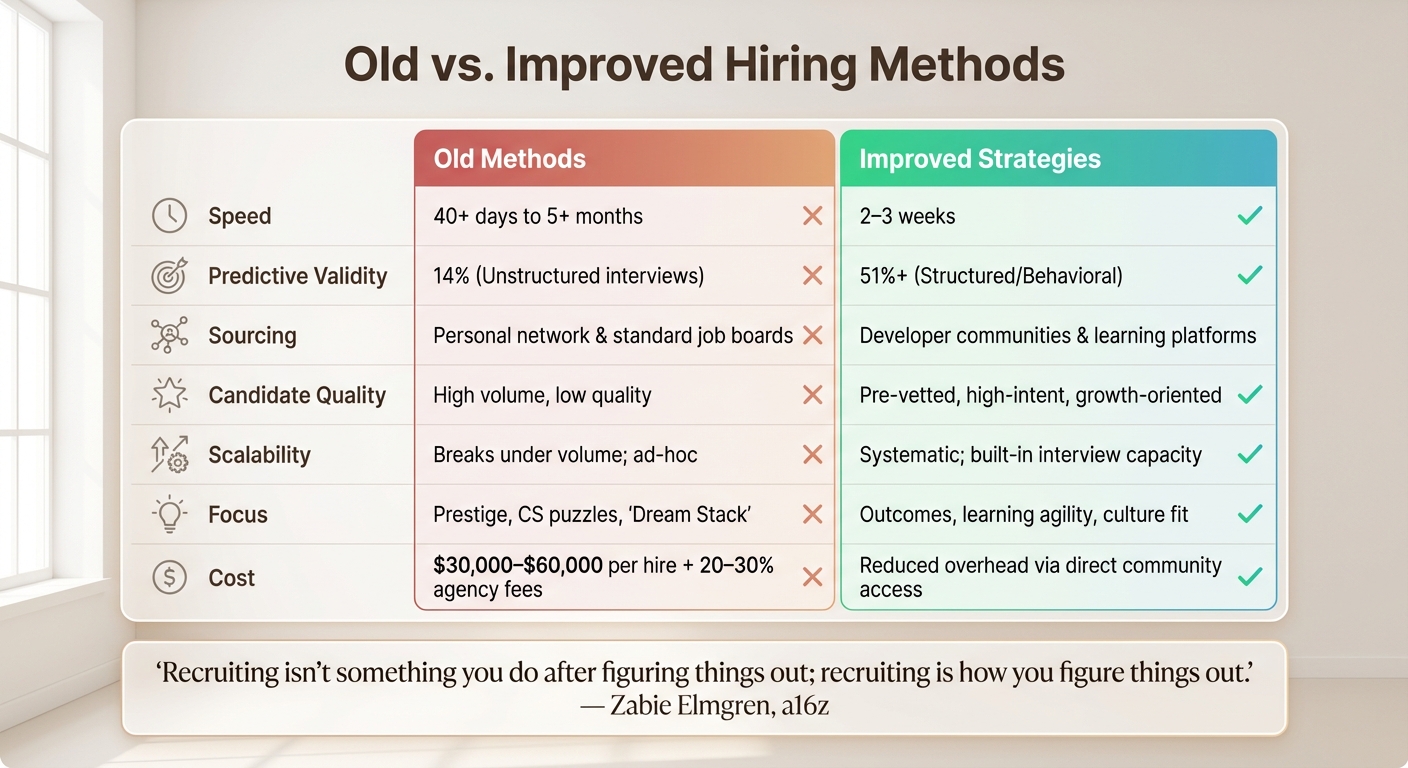 {Old vs Modern Engineering Hiring Methods Comparison}
Expanding on earlier discussions about hiring mistakes, this section dives into why structured, data-driven recruiting methods outperform traditional approaches.
Traditional hiring often relies on guesswork, while improved strategies prioritize data and structure. For instance, unstructured interviews have a predictive validity of just 14%, compared to over 51% for structured methods . This shift replaces uncertainty with informed decision-making. Additionally, traditional hiring processes can stretch from 40 days to five months , whereas modern approaches aim for a much quicker timeline of 2–3 weeks . Speed is crucial - 62% of candidates drop out of hiring processes lasting more than three weeks .
The way candidates are sourced has also evolved. Old methods depend heavily on personal networks or generic job boards, which often result in high applicant volume but low quality . Modern strategies, on the other hand, focus on engaging technically skilled candidates with a growth-oriented mindset . The table below highlights these key differences.
Comparison Table: Old Methods vs. Improved Strategies
| Factor | Old Methods | Improved Strategies |
|---|---|---|
| Speed | 40+ days to 5+ months | 2–3 weeks |
| Predictive Validity | 14% (Unstructured interviews) | 51%+ (Structured/Behavioral) |
| Sourcing | Personal network & standard job boards | Developer communities & learning platforms |
| Candidate Quality | High volume, low quality | Pre-vetted, high-intent, growth-oriented |
| Scalability | Breaks under volume; ad-hoc | Systematic; built-in interview capacity |
| Focus | Prestige, CS puzzles, "Dream Stack" | Outcomes, learning agility, culture fit |
| Cost | $30,000–$60,000 per hire + 20–30% agency fees | Reduced overhead via direct community access |
This shift in strategy reflects a broader understanding of how hiring drives success. As Zabie Elmgren, Investing Partner at a16z, explains:
"Recruiting isn't something you do after figuring things out; recruiting is how you figure things out. It's not a side task. It's the company."
Conclusion: Build Better Engineering Teams Through Smarter Hiring
Hiring mistakes can have a ripple effect. One wrong hire might cost you 6–12 months of runway , and for many startups, the wrong team can lead to failure . Those first 10 hires? They define your engineering culture, set technical benchmarks, and establish workflows that will either draw in or push away future talent . Every choice matters.
Reflecting on the challenges and solutions we've covered, the shift from reactive hiring to a more strategic approach is critical. Rushed decisions, ignoring team dynamics, or sticking solely to personal networks can leave you with a shaky foundation. The tools and strategies outlined earlier - structured assessments, diverse sourcing methods, growth-oriented evaluations, and developer-focused platforms - deliver measurable results. For example, structured interviews offer 51% predictive accuracy compared to just 14% for informal chats . Teams maintaining a 70/20/10 seniority ratio report 43% less burnout and develop features twice as fast . And founders who make hiring decisions within five days are three times more likely to secure candidates compared to those who take two weeks .
Key Takeaways for Founders Hiring Engineers
Quality trumps speed: Leaving a position unfilled is far better than making a bad hire that could set you back 18 months . To close vetting gaps, use a structured developer hiring checklist, hands-on assessments like "Bug Squash" sessions, and back-channel reference checks . Focus on qualities like adaptability, a sense of ownership, and the ability to learn quickly - these traits often outweigh résumé highlights .
Broaden your reach. Leaning exclusively on your personal network can limit both diversity and talent quality. Platforms like daily.dev Recruiter connect you with developers during their learning moments, giving you access to candidates who align with your mission and are eager to grow. Offering meaningful equity (1.5%–3.0% for pre-seed first hires) can help attract partners who are invested in your long-term success rather than just short-term contributors . Lastly, a positive candidate experience - built on clear communication and mutual respect - can transform your hiring process into an impressive first impression of your company.
FAQs
How do I hire fast without lowering the bar?
To hire swiftly without sacrificing quality, start by ensuring your process is well-defined and efficient. Clearly outline the role's requirements and focus on evaluating key traits such as flexibility and a sense of responsibility. Conduct thorough reference checks to validate candidates' backgrounds. While streamlining the vetting process, don’t overlook critical elements like ensuring a good fit with the team’s values and dynamics. Make it a priority to source talent from a variety of backgrounds, and emphasize hiring as a leadership responsibility to draw in top-tier candidates. Remember, moving quickly shouldn’t compromise the long-term success of your team.
How can I test culture fit without being biased?
To evaluate cultural fit fairly, rely on structured methods that emphasize objective criteria tied to your team’s core values. Develop a cultural-fit rubric to create consistent evaluations and minimize bias. Use structured interviews that include realistic, job-related scenarios, and invite team members to participate for a range of perspectives. Additionally, keep an eye on retention rates and performance metrics over time to fine-tune your approach. These strategies ensure evaluations remain fair and effective while aligning new hires with your team’s culture.
What’s the simplest structured interview plan for a small startup?
For small startups, keeping the interview process straightforward is key. A two-step structure works well:
Step 1: 30-Minute Screening
This initial session focuses on understanding the candidate's fit with your team, their communication style, and what drives them. It’s a chance to assess whether their personality and values align with your company’s environment.Step 2: In-Depth Interview
The second step dives deeper into their ability to work independently, their experience in startup settings, and how they approach problem-solving. Instead of technical coding exercises, focus on behavioral questions. These can reveal how adaptable and collaborative they are - qualities that are often more critical in a startup than technical expertise alone.
By skipping overly technical tasks and prioritizing soft skills and relevant experience, this approach keeps things efficient while zeroing in on what truly matters for a small, agile team.
.png)