Frontend hiring often prioritizes volume over quality, leading to wasted time, high costs, and mismatched candidates. Recruiters spend an average of 31 seconds per resume, and companies take 49 days and $14,076 to fill a role. Yet, 40% of hires leave within six months, highlighting the failure to assess readiness.
Here’s why the system struggles:
- Keyword-driven tools miss skilled candidates who don’t use exact phrases.
- Vague job postings attract generalists instead of specialists.
- Cold outreach spams candidates, reducing trust and engagement.
In 2026, readiness means delivering production-ready code, mastering tools like React, TypeScript, and WebAssembly, and solving practical problems. Portfolios showcasing deployed projects and effective AI usage stand out. Companies can improve hiring by focusing on real-world tasks, personalized outreach, and evaluating portfolios for depth and relevance.
The takeaway: Shift from high-volume hiring to readiness-focused methods to save time, reduce costs, and find engineers who contribute effectively from day one.
::: @figure 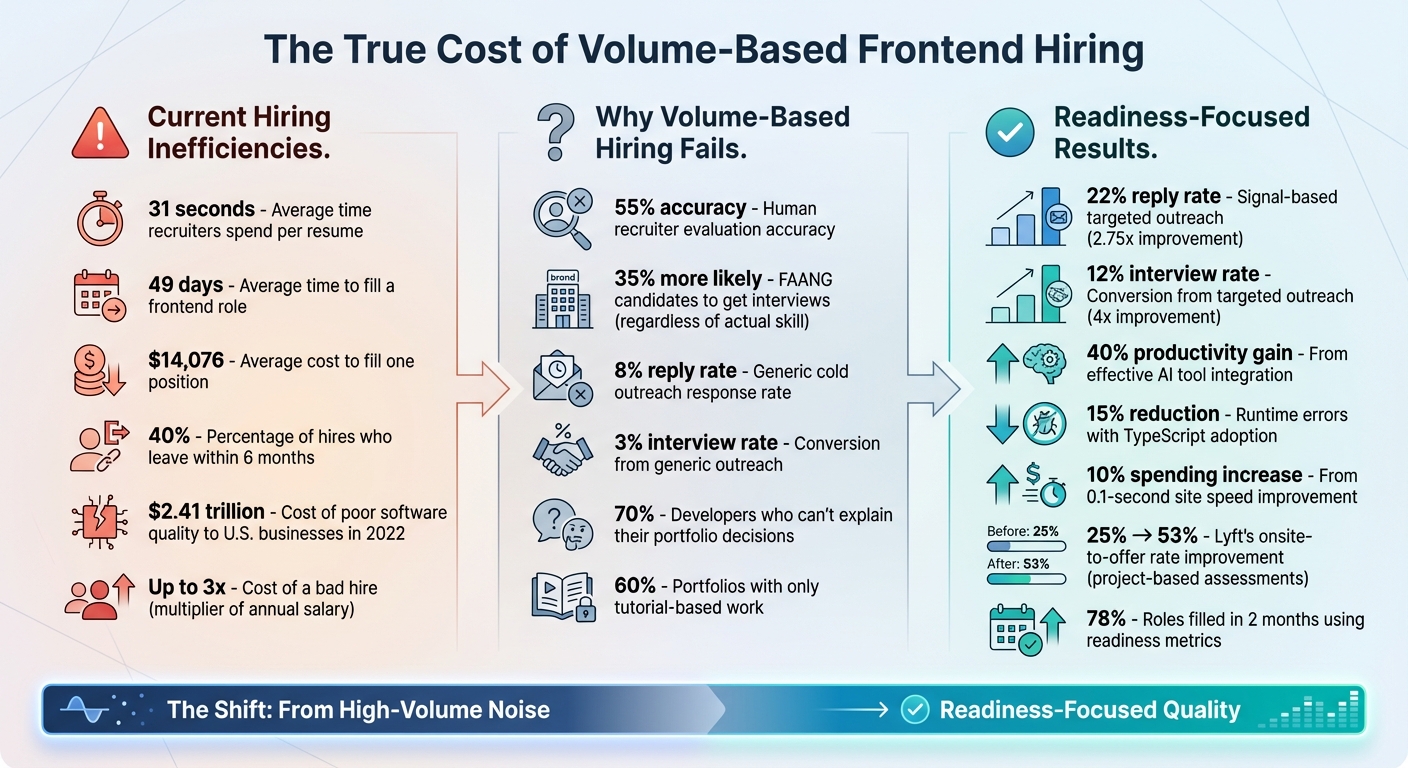 {Frontend Hiring Costs: Volume vs Readiness-Focused Approach Statistics}
Why Frontend Engineer Recruitment Prioritizes Volume Over Quality
Recruitment processes today are built for speed and scale, often sacrificing accuracy in the process. This approach floods recruiters with resumes that look impressive on paper but frequently fail to translate into real-world coding ability. Three key issues fuel this focus on quantity over quality: keyword-driven algorithms, vague job descriptions, and high-volume, impersonal outreach. Together, these factors create a chaotic hiring environment, making it hard to identify candidates who are truly prepared to contribute effectively.
How Keyword Matching Misses Qualified Candidates
Automated resume screening tools rely heavily on keyword matching, prioritizing terms like specific frameworks, buzzwords, or well-known employers. For instance, a candidate who writes "state management" instead of "Redux" or mentions "component libraries" instead of "Material UI" might be completely overlooked by these systems. This overemphasis on keywords often rewards candidates who pad their resumes rather than those with actual, demonstrable skills .
The issue is compounded by the static nature of traditional resumes. A developer actively contributing to open-source React projects or frequently updating their GitHub profile is clearly engaged and skilled. Yet, AI-driven systems tend to ignore these dynamic behavioral signals in favor of outdated, static resumes - some of which may not have been updated in years . To work around these limitations, some candidates resort to tactics like "white fonting" (hiding keywords in white text) or using AI-generated resumes to game the system .
Even when human recruiters step in, they often face overwhelming time constraints. This leads to reliance on shortcuts like scanning for brand names, prestigious degrees, or exact keyword matches. As a result, evaluations are only about 55% accurate, and candidates from well-known companies like FAANG are 35% more likely to land interviews, even if their actual ability to build functional frontend interfaces is unproven . This disconnect between surface-level qualifications and real readiness underscores the broader challenges in the hiring process.
Why Broad Job Postings Attract Mismatched Applicants
Generic job descriptions often result in a flood of unsuitable applicants. For example, a posting for a "full-stack engineer with frontend experience" might attract generalists who lack the in-depth React expertise needed to design complex UIs. When companies list an extensive range of frameworks and even mention backend skills as a bonus, it signals confusion about what they truly require .
"We ask for unicorns… then the codebase is 98% legacy." - Atomys
This mismatch isn’t just frustrating - it’s costly. Overly broad job postings often include unrealistic requirements, like asking for five years of experience in a framework that’s only two years old. These impossible standards can deter qualified candidates from applying while encouraging less experienced applicants to flood the system. The problem doesn’t stop there. Many companies still rely on outdated hiring practices, such as whiteboard puzzles or algorithm tests, which are unrelated to the practical challenges of frontend development.
"The technical interviews? They were looking for puzzle solvers, not problem solvers." - Sarah, Startup Founder
This focus on abstract problem-solving filters out developers who excel at creating accessible, responsive UIs but don’t perform well in artificial test scenarios. As a result, companies often end up hiring candidates who fit a narrow template but struggle to deliver in real-world production environments .
The Problem with High-Volume Cold Outreach
Recruiters often rely on mass outreach campaigns, sending hundreds of generic messages in the hope that a small percentage of candidates will respond. While this approach may maximize volume, it rarely connects with candidates who are genuinely ready to contribute. Instead, it wastes time and erodes trust between employers and potential hires.
A 2025 pilot study involving 200 machine learning engineers compared traditional cold outreach with a more targeted approach. The group receiving generic InMails had an 8% reply rate and a 3% interview rate. In contrast, signal-based outreach - focused on behavioral cues like "Open to Work" indicators and recent profile updates - achieved a 22% reply rate and a 12% interview rate, making it nearly three times as effective .
The failure of cold outreach lies in its disregard for candidate intent. Automated systems that blast messages without considering recent activity lead to poor response rates, wasted recruiter effort, and a tarnished employer reputation among developers who feel spammed.
"Trust is our moat. We protect it at all costs. Most recruiting tools burn trust to scale - we'll scale because we protect it." - Nimrod Kramer, CEO, daily.dev
Shifting the focus from quantity to quality - through tailored sourcing and personalized outreach - can cut through the noise and spotlight candidates who are truly prepared to excel. Up next, we’ll explore what readiness looks like for frontend engineers in 2026.
What Readiness Means for Frontend Engineers in 2026
Being "ready" as a frontend engineer in 2026 goes far beyond listing tools like React or TypeScript on your resume. It’s about delivering production-ready code, leveraging AI in workflows, and embracing the role of a product engineer rather than just a UI developer. The focus has shifted: instead of asking, "Can you code?", companies now care about whether you can solve real-world problems while navigating constraints with sound judgment . This change mirrors broader trends in technology and product development.
A truly prepared engineer in 2026 will have mastery over ECMAScript 2025+ and advanced TypeScript, use WebAssembly for performance-critical tasks, and optimize for new Core Web Vitals metrics that go beyond today’s standards . Accessibility, such as complying with WCAG 3.0, and embedding security through privacy-by-design principles are no longer optional - they’re baseline expectations .
But readiness isn’t just about technical skills. It also involves understanding the bigger picture - what’s now called "product engineering." This role emphasizes user outcomes, backend fluency through API literacy, and architecture choices that align with business goals. As Nimrod Kramer, CEO of daily.dev, explains:
"The signal is can this person solve our kind of problems, with our kind of constraints, with curiosity and care?"
In addition to technical and product expertise, readiness in 2026 requires smart AI integration. Engineers need to show they can use AI tools effectively to boost productivity, with research suggesting gains of up to 40% . However, it’s not about blindly trusting AI. Skilled engineers treat AI-generated code as a starting point, refining and verifying it before deployment . Evidence of this skill often comes through launched projects, polished side ventures, or consistent GitHub activity .
The stakes are high. A bad hire can cost a company up to three times the employee’s annual salary . That’s why readiness is evaluated through real-world tasks like debugging, API integration, and performance tuning - not through abstract algorithm challenges that rarely reflect the job’s demands . The engineers who excel are those who pair technical expertise with product-focused thinking, improve workflows proactively, and bounce back from challenges with determination .
Technical Skills That Indicate Readiness
Technical readiness shines through in practical, measurable ways. It’s not just about listing frameworks on a resume - it’s about showing mastery in JavaScript, TypeScript, and building systems that are both fast and scalable.
Start with JavaScript fundamentals. Engineers who are ready for the challenge know ES6+ features thoroughly, handle asynchronous programming with Promises and async/await, and can confidently explain how the event loop works . They write modular code using ES Modules and apply immutability principles effectively.
When it comes to TypeScript, it’s indispensable for large-scale projects. TypeScript reduces runtime errors by as much as 15% . As Developers.dev puts it:
"TypeScript is no longer optional; it is a critical strategy for reducing runtime errors and improving code maintainability" .
Another key area is performance optimization. Engineers who excel here focus on improving Core Web Vitals (LCP, FID, CLS) using techniques like lazy loading, bundle splitting, and choosing the right rendering strategy - whether it’s SSR, SSG, or ISR . Why does this matter? A 0.1-second boost in site speed can increase online spending by nearly 10%, while a 3-second delay can drive away over half of mobile users . Teams led by performance-savvy engineers often achieve measurable improvements in these metrics .
Beyond coding, system design thinking is crucial. Engineers should know how to choose effective state management tools (e.g., Redux, Zustand, Jotai), understand Micro Front-End architecture, and work seamlessly with REST and GraphQL APIs . They should also have a solid grasp of browser fundamentals - like when to use CORS, caching strategies with E-Tags, and different storage options . A security-first mindset is equally important, with practices to mitigate XSS and CSRF attacks through input sanitization and Content Security Policies .
The modern development landscape also calls for AI-augmented skills. Engineers who use tools like GitHub Copilot to streamline workflows while critically evaluating AI-generated code stand out . As Coders.dev highlights:
"The most critical skill gap in 2026 is the ability to integrate Generative AI tools into the frontend workflow" .
Ultimately, these technical skills come to life in a candidate’s portfolio, where practical experience meets demonstrated expertise.
How Portfolio Projects Reveal Practical Experience
An engineer’s portfolio is where technical knowledge becomes tangible. It’s not just about showcasing skills - it’s about proving the ability to solve problems, make informed architectural decisions, and see projects through from concept to deployment. The best portfolios prioritize production-ready projects over tutorial-based examples.
Strong portfolios highlight a candidate’s technical depth through meaningful project choices. Examples include tackling complex state management, integrating multiple APIs, or addressing significant performance bottlenecks . Projects that showcase modern rendering strategies - like server-side rendering for SEO-critical pages or static site generation for content-heavy sites - demonstrate a solid grasp of trade-offs .
Code quality is another key indicator. Look for how components are structured, how errors are managed, and whether accessibility is prioritized. Do they use semantic HTML and ARIA attributes? Is keyboard navigation implemented correctly? A focus on accessibility reflects professional maturity . Similarly, evidence of a security mindset - like proper input sanitization and Content Security Policy headers - further underscores readiness .
The most compelling portfolios feature deployed projects used by real users. These real-world implementations reveal how an engineer optimizes performance and user experience in environments beyond controlled development settings. Combined with strong interpersonal skills, these projects paint a complete picture of readiness.
Soft Skills: Communication and Team Collaboration
Technical expertise alone isn’t enough - success also hinges on communication and collaboration. A well-rounded frontend engineer can explain complex technical concepts in plain language, offer constructive feedback during code reviews, and approach disagreements with data rather than ego.
The ability to articulate trade-offs is a standout skill. Engineers should be able to explain how performance decisions impact conversion rates, user experience, and long-term maintenance .
Code reviews, in particular, reveal a lot about an engineer’s collaboration style and technical judgment. Effective engineers provide feedback that improves code quality without discouraging teammates. They identify issues like duplicated logic or unclear naming conventions and explain their reasoning clearly . Just as importantly, they’re open to feedback on their own work, seeing it as a chance to improve.
Problem-solving under vague requirements is another hallmark of readiness. For instance, when tasked with building an Instagram-like feed, prepared engineers ask smart questions about scale, performance, and user experience before jumping into code. They break down challenges into manageable parts, plan for failure scenarios, and address edge cases proactively .
Collaboration extends beyond technical discussions. Engineers who understand how their work fits into larger systems - how frontend decisions impact backend operations or design consistency - add real value. They actively contribute to planning sessions, maintain thorough documentation, and mentor junior team members. Together, these traits - technical skill, portfolio depth, and collaborative mindset - set apart candidates who truly elevate a team from those who merely fill a role.
How to Move from Volume-Based to Readiness-Focused Hiring
Transitioning from high-volume outreach to a readiness-focused hiring approach means rethinking how you search for candidates, assess their skills, and initiate conversations. The aim is to connect with developers who are already showcasing their abilities and interest, rather than chasing countless cold leads. Here are three strategies to help you find and engage frontend engineers who are ready to contribute.
Finding Candidates in Developer Communities
A great way to locate talented developers is by exploring communities where they actively share their work and insights. The top frontend engineers often spend time in spaces where they can learn, exchange knowledge, and keep up with the latest trends. Instead of relying on LinkedIn searches or generic outreach, focus on platforms where developers are already engaged professionally. For example, daily.dev Recruiter connects you with developers who are reading technical articles, discussing frameworks, and signaling their openness to new roles. This method replaces cold emails with warm, opt-in connections - developers only see your job posting if it aligns with their interests, and they decide whether to engage.
Screening Candidates Through Their Work
A developer's code can reveal far more than a traditional resume. Reviewing GitHub repositories, portfolio projects, and open-source contributions provides a direct window into their skills. You can also use a short code review exercise to evaluate their technical depth and communication skills using data-driven hiring criteria. Tools like GitHired, for instance, rank candidates by analyzing the quality of their public and private code bases . Another option is to present a messy 100–150 line code sample and ask candidates to identify problems, refactor it for maintainability, and explain their decisions . This approach not only highlights their technical expertise but also their ability to articulate their reasoning - a crucial skill for collaborative work. Combining technical evaluations with personalized outreach further improves engagement.
Using Personalized Introductions and Mutual Opt-In
Mass emails and generic job descriptions often generate more noise than results. Instead, create introductions that are tailored to the developer’s background, referencing specific projects or technologies they’ve worked on. Mutual opt-in systems ensure that developers only hear from you if they’re genuinely interested, leading to higher-quality responses and less wasted effort. To scale this approach effectively, you can incorporate additional steps like video introductions and identity verification to ensure that only serious and interested candidates engage.
Metrics for Measuring Candidate Readiness
Switching to a readiness-focused hiring approach requires clear, actionable metrics to truly gauge a candidate's potential. These metrics go beyond surface-level qualifications, focusing on the ability to make meaningful contributions right away. Here's how to assess readiness through three critical aspects.
Testing Technical Depth and Problem-Solving Ability
It’s not enough for candidates to produce functional code - how they arrive at solutions is equally important. With AI tools now integral to development workflows, simply completing tasks doesn’t cut it anymore. What matters is how candidates approach the process. Evaluate their ability to craft effective prompts for AI tools, debug AI-generated code, and adapt outputs to fit specific system requirements .
For frontend engineers, technical depth includes practical skills like UX design intuition, building responsive layouts across devices, optimizing performance with techniques like lazy loading or debouncing, and ensuring accessibility . Senior candidates, in particular, should demonstrate the ability to navigate and improve complex, existing codebases rather than excelling only in greenfield projects .
Key indicators of strong problem-solving include asking insightful questions to uncover user needs, identifying meaningful test cases, and debugging systematically without excessive guidance .
A great example of this approach comes from Lyft, which partnered with Byteboard to replace traditional algorithm-based interviews with project-based assessments. This shift more than doubled their onsite-to-offer rate (25% to 53%) and helped fill 78% of open roles in just two months . Byteboard’s team summed it up well:
"Traditional whiteboard interviews reliably measured performance anxiety, and that's about it" .
Additionally, reviewing candidates’ real-world project work can further validate their technical competencies.
Reviewing Portfolio Quality and Relevance
A developer’s portfolio is more than a showcase of completed projects - it’s a window into their problem-solving mindset, debugging strategies, and decision-making process . Start by verifying project functionality using the README instructions, then analyze the commit history. Look for logical, incremental commits with meaningful messages instead of vague updates like "fixed stuff" .
Interestingly, about 70% of developers cannot explain the technical decisions behind their portfolio projects, and 60% of portfolios consist primarily of tutorial-based work that lacks independent thinking . To separate genuine experience from superficial work, examine the following:
- Evidence of architectural thinking and separation of concerns
- Thoughtful error handling and attention to edge cases
- Learning progression by comparing older projects with newer ones
Be cautious of red flags like portfolios that mimic popular bootcamp projects, repositories with only a handful of commits, or single-commit uploads that suggest bulk code copying from sources like Stack Overflow . During interviews, ask candidates to discuss trade-offs made during a project and what they’d improve if they were to rebuild it .
Measuring Response Quality and Candidate Interest
Technical skills and portfolio reviews are vital, but a candidate’s engagement during initial conversations often reveals their readiness more effectively. For example, ask candidates to review a 100–150 line code sample and identify problems. Their ability to explain how proposed changes improve maintainability is just as important as the changes themselves .
Candidates who ask thoughtful questions about user experience, accessibility, or the business context before diving into implementation demonstrate the kind of product sense that sets them apart from those focused solely on writing code .
Platforms like daily.dev Recruiter help naturally filter for genuine interest. Developers engage only when they’re curious about the role, reducing the noise of mass outreach. As Erik Bernhardsson, CTO at Better.com, observed:
"The correlation between who did really well in the interview process and who performs really well at work is really weak" .
Focusing on response quality - such as the depth of questions asked, the thoughtfulness of discussions, and the effort put into understanding your team’s challenges - often provides a more accurate measure of readiness than traditional interview performance alone.
Conclusion
Our deep dive into targeted screening and engagement highlights the importance of adopting a readiness-focused hiring model. Moving away from volume-based hiring to a readiness-driven approach produces real, measurable benefits. In 2022 alone, poor software quality - often tied to inadequate hiring practices - cost U.S. businesses a staggering $2.41 trillion. These numbers make it clear: prioritizing readiness over sheer candidate volume isn’t just smart - it’s essential.
By emphasizing metrics like real-world problem-solving, practical engagement, and practical work evaluation, you naturally identify candidates who are prepared to contribute from day one. These individuals aren’t just skilled at writing code - they know how to make informed trade-offs, collaborate effectively, and navigate your team’s unique challenges.
This shift doesn’t just improve individual hires - it reshapes team dynamics. Beyond raising the quality of hires, a readiness-focused approach saves time. You avoid sifting through mismatched applicants or interviewing candidates who look good on paper but lack practical expertise. Instead, you connect with developers who’ve already demonstrated their capabilities.
In the end, this strategy fosters better alignment across the board. Hiring frontend engineers based on readiness - through technical depth, portfolio strength, and genuine interest - leads to teams that deliver stronger products, minimize technical debt, and reduce the need for constant rework. The payoff? Lower costs, faster project completion, and more cohesive team dynamics.
The real question is: how soon can you start leveraging readiness metrics?
FAQs
What does 'frontend readiness' actually mean in 2026?
In 2026, frontend readiness means a developer is equipped to make a real difference within a team and on projects. This goes beyond just knowing the latest frameworks or trendy buzzwords. It’s about having the technical expertise, hands-on project experience, problem-solving skills, and the right team dynamics to contribute meaningfully. The focus is on genuine qualifications that translate into real results.
How can we evaluate readiness without whiteboard or algorithm tests?
When evaluating readiness, consider reviewing portfolios, assigning short take-home projects, and engaging in technical conversations that mirror actual work scenarios. These approaches offer a clearer picture of a candidate's practical skills and ability to solve problems, often proving more effective than traditional whiteboard or algorithm-based tests.
What portfolio signals prove someone can ship production code?
Portfolio elements that highlight the ability to deliver production-ready code include tackling practical problems, participating in open-source projects, and providing clear explanations of technical decisions. These aspects emphasize hands-on expertise and demonstrate a deeper level of preparation and competence beyond basic metrics.
.png)