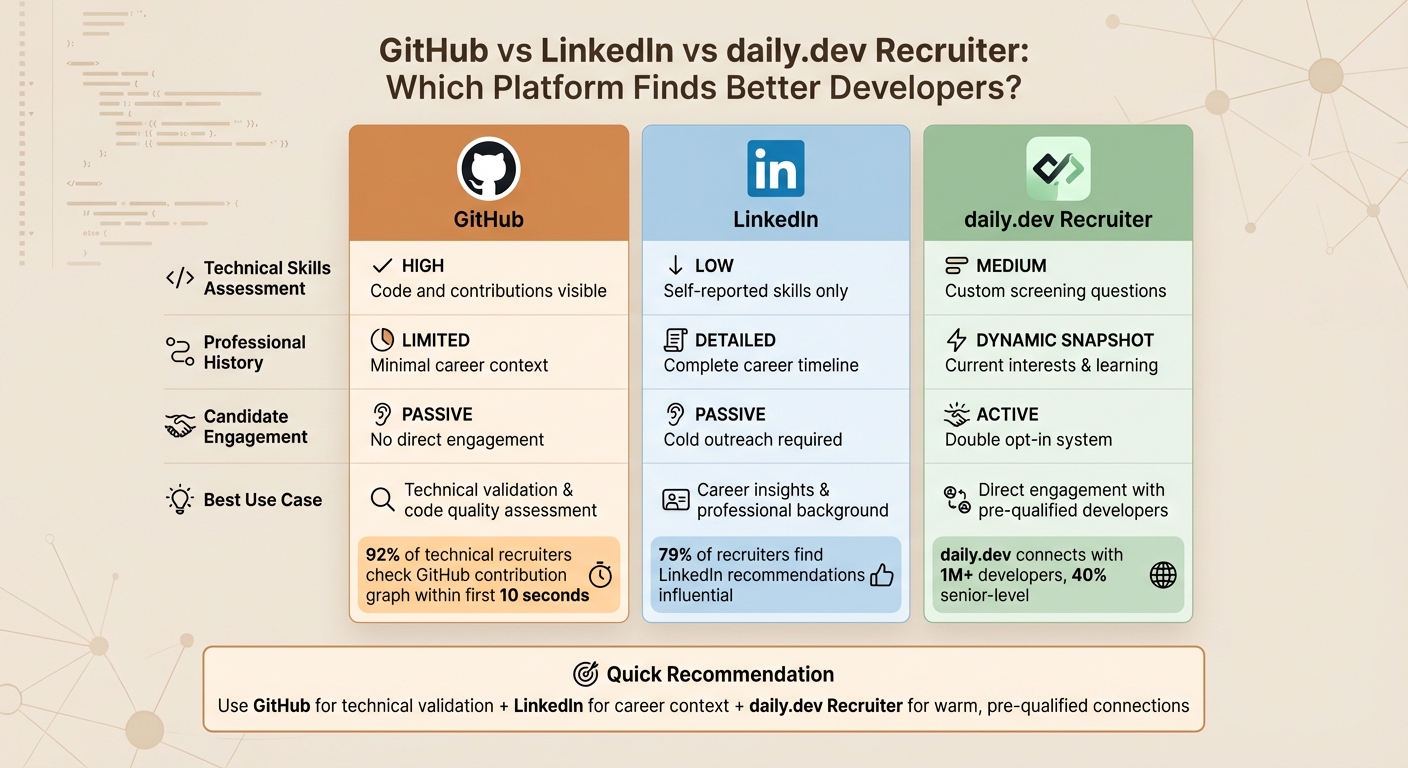
When hiring developers, GitHub and LinkedIn serve different purposes. GitHub showcases a candidate's technical skills through code, contributions, and collaboration, while LinkedIn highlights their professional history, career growth, and endorsements. Using both together can provide a complete picture of a developer's abilities. For a more direct approach, daily.dev Recruiter connects recruiters with developers already interested in new opportunities, saving time and effort.
Key Takeaways:
- GitHub: Best for assessing coding skills, commit history, and recruiting through open-source projects.
- LinkedIn: Ideal for understanding career paths, roles, and professional recommendations.
- daily.dev Recruiter: Connects you with pre-qualified developers who express interest in your roles.
Quick Comparison:
| Factor | GitHub | daily.dev Recruiter | |
|---|---|---|---|
| Technical Skills | High: Code and contributions | Low: Self-reported skills | Medium: Screening questions |
| Professional History | Limited | Detailed | Dynamic snapshot |
| Engagement | Passive | Passive | Active: Double opt-in |
| Best For | Technical assessment | Career insights | Direct engagement with developers |
Use GitHub for technical validation, LinkedIn for career context, and daily.dev Recruiter for warm, pre-qualified connections.
GitHub: Code Activity and Technical Skills
GitHub offers recruiters an unfiltered view of a developer's capabilities. Instead of relying on resumes or self-reported skills, recruiters can dive into actual code, observe contribution patterns, and evaluate how candidates collaborate on projects. This makes GitHub an invaluable tool for assessing technical skills that a resume might not fully capture. Using a developer hiring checklist can help ensure these insights are consistently applied across your sourcing process.
The activity on GitHub speaks volumes about work habits. In fact, 92% of technical recruiters check the GitHub contribution graph within the first 10 seconds of reviewing a profile . That green grid isn't just a design - it’s a snapshot of coding consistency. A Technical Director at a Silicon Valley startup shared:
"The first thing I look at on a candidate's GitHub isn't their code - it's their contribution pattern. A healthy, consistent graph tells me they've integrated development into their lifestyle, not just their résumé."
What Recruiters Can Learn from GitHub Profiles
A GitHub profile is more than just a collection of repositories - it’s a window into a developer's technical journey. Key metrics like commit history reveal whether they push code regularly or in sporadic bursts. Pull requests show their ability to propose changes and adapt to feedback. Repository ownership highlights whether they’ve built projects from scratch or contributed to existing ones.
Code reviews add another layer of insight. Developers who actively comment on pull requests, suggest improvements, or approve changes showcase both technical judgment and communication skills. These interactions provide a glimpse into how they handle feedback and collaborate with others. Sorting repositories by stars or forks can help identify meaningful, recent work instead of profiles filled with untouched forks .
Open-source contributions, in particular, stand out as a measure of real-world experience and skill.
Open-Source Contributions as Proof of Ability
Contributing to open-source projects is a clear indicator of a developer's practical skills. Working within established projects, navigating contribution guidelines, and undergoing public code reviews highlight their ability to adapt to different coding standards. These contributions provide a unique, real-world demonstration of their technical expertise and their ability to collaborate in diverse environments.
LinkedIn: Professional History and Network Connections
LinkedIn offers a unique lens into a candidate's professional journey, complementing platforms like GitHub. While GitHub highlights technical contributions, LinkedIn focuses on career progression, collaboration, and growth. Together, they present a well-rounded view of a candidate. For recruiters seeking senior developers or leadership roles, this professional history is especially valuable.
One of LinkedIn's standout features is its detailed professional timelines. Recruiters can see job titles, company names, employment dates, and even career gaps. Interestingly, 79% of hiring managers are now open to hiring candidates with career gaps . To address this, LinkedIn provides "Career Break" options, such as caregiving or professional development, helping candidates explain these gaps in a structured way. This level of transparency offers deeper insights into a developer's journey beyond just their technical skills.
Another strength lies in LinkedIn's recommendations and endorsements, which validate a candidate's achievements. Research indicates that 79% of recruiters find LinkedIn recommendations influential in hiring decisions, and 70% of hiring managers trust them more than traditional reference letters . Profiles with at least one recommendation receive up to 14 times more views, and candidates with recommendations are three times more likely to be contacted by recruiters . However, recruiters now prefer endorsements that highlight specific, measurable accomplishments - like "reduced server response time by 30%" - over generic praise. This focus on actionable insights makes LinkedIn a powerful tool for evaluating candidates' professional histories.
How to Find Developers on LinkedIn
Recruiters can use LinkedIn strategies like Boolean operators (AND, OR, NOT) and quotation marks to search for specific roles and skills. These searches can then be refined with LinkedIn’s advanced filtering options.
For smaller hiring needs, LinkedIn Recruiter Lite offers over 20 basic filters and 30 monthly InMails. For larger-scale recruitment, LinkedIn Recruiter (Full) provides access to more than 40 advanced filters, 150 monthly InMails, and the full LinkedIn network. It also includes AI-driven tools like predictive matching and a hiring assistant. Behavioral cues, such as the "Open to Work" badge or engagement with a company’s content, can help recruiters identify candidates actively seeking opportunities. While these tools simplify finding potential hires, a deeper dive into their profiles is essential to fully assess their qualifications.
What LinkedIn Profiles Show and What They Miss
LinkedIn excels at providing professional context, offering a clear view of career progression and endorsements from colleagues. Many profiles also link to GitHub, Stack Overflow, or personal blogs, which can help verify technical expertise.
However, LinkedIn has its limitations. It doesn’t offer real-time verification of technical skills. While it’s great for showcasing where a developer has worked, skills lists and endorsements may not always reflect current capabilities. Detailed recommendations can help fill this gap, especially when they focus on specific achievements rather than general traits. Notably, 65% of employers believe candidates with well-documented recommendations are more likely to excel in their roles . This highlights the importance of balancing professional context with up-to-date technical validation.
GitHub vs LinkedIn: Side-by-Side Comparison
This table highlights the key differences between GitHub and LinkedIn, offering a clear perspective on how they serve distinct purposes in technical recruitment. GitHub showcases actual coding activity, while LinkedIn outlines a professional narrative. Using both strategically can enhance hiring decisions. Start with LinkedIn to grasp a candidate's career journey, leadership roles, and aspirations. Then, dive into GitHub to verify technical skills, review code quality, and assess collaboration patterns. This dual approach can help minimize hiring mismatches .
It's crucial not to rely too much on superficial metrics. Instead, focus on recent pull requests and the quality of documented code. As Shubham Sharma, a Software Quality Engineer, explains:
"The notion that a pattern of green squares equates to developer prowess is reductive and often misleading" .
Rather than evaluating commit frequency alone, look closely at meaningful technical contributions .
Platform Comparison Table
Here’s a breakdown of their core attributes:
| Factor | GitHub | |
|---|---|---|
| Technical Transparency | High: Access to code, commits, and peer reviews, offering a direct look at technical skills . | Low: Relies on self-reported skills, job titles, and endorsements, which may be outdated . |
| Profile Completeness | Technical Focus: Displays coding style and problem-solving but lacks broader career context . | Comprehensive: Includes career progression, education, networking, and recommendations . |
| Skill Verification | Direct Evidence: Code repositories, pull requests, and community validation via stars and forks . | Indirect Evidence: Certifications, endorsements, and AI-driven "Recommended Matches" . |
| Assessing Soft Skills Assessment | Indirect: Seen in code reviews, issue discussions, and teamwork on pull requests . | Direct: Recommendations highlighting communication, leadership, and collaboration . |
| Ease of Assessment | Complex: Requires technical expertise to evaluate code quality and collaboration patterns . | Simple: Professional milestones and endorsements are easy to scan . |
| Data Reliability | High: Reflects actual work, though private/proprietary projects may not be visible . | Moderate: Profiles can be polished and may include buzzwords without substance . |
| Recruiter Effort | High: In-depth technical review is necessary to go beyond surface-level metrics . | Low: Standardized sections make profiles quick to review . |
daily.dev Recruiter: Built for Developer Hiring
Platforms like GitHub and LinkedIn often require recruiters to spend hours digging through profiles, sending cold messages, and hoping for a response. daily.dev Recruiter changes the game entirely. Instead of chasing developers, it connects recruiters with engineers who have already expressed interest in new opportunities. Every connection is warm, double opt-in, and pre-qualified, cutting out the guesswork and spam that usually come with traditional recruiting.
This platform taps into a network of over 1 million developers who use daily.dev to stay informed, sharpen their skills, and explore technical content. Recruiters post roles, and developers naturally discover them as part of their daily routine - no cold InMails or intrusive messages involved. If a developer is interested, they opt in. Then, if the recruiter agrees, the connection is made. Both sides give consent before a conversation even starts.
How daily.dev Recruiter Works
The platform's approach revolves around building meaningful, pre-qualified connections. Here's how it simplifies the hiring process:
Recruiters begin by crafting a job brief that focuses on real technical challenges rather than tired buzzwords. Developers come across these briefs while browsing the platform. If a role piques their interest, they can opt in by answering up to three custom screening questions set by the recruiter - questions like "Have you worked on real-time data pipelines?" or "How experienced are you with Kubernetes in production?"
Once a developer opts in and meets the screening criteria, the recruiter reviews their Developer Identity. This isn't just a static resume - it’s a dynamic snapshot of what the developer is currently reading, coding, and learning. This real-time data gives recruiters a clearer picture of the developer's skills and interests. From there, recruiters can approve or decline the introduction. The platform also integrates seamlessly with major ATS tools like Greenhouse, Lever, and Workday, ensuring no duplicate candidates and syncing all relevant data.
Roughly 40% of the talent pool includes senior individual contributors and technical leaders, reducing the time spent filtering through junior profiles or irrelevant candidates. By the time a candidate reaches your inbox, the noise has already been filtered out.
This thoughtful process creates meaningful engagement, making daily.dev Recruiter a preferred choice for developers.
Why Developers Respond on daily.dev Recruiter
Traditional recruiting platforms often rely on cold outreach, which developers tend to ignore due to its impersonal and spam-like nature. daily.dev Recruiter flips the script by ensuring developers take the first step. They’ve already reviewed the job brief, decided it’s relevant, and answered screening questions. This mutual interest eliminates wasted effort and leads to real conversations instead of one-sided pitches.
The platform also respects how developers like to work. It integrates seamlessly into their daily workflow through a browser extension and homepage, making job opportunities feel natural rather than disruptive. There’s no cold outreach, no generic “I saw your profile” messages, and no awkward LinkedIn connection requests. Instead, both parties come to the table ready to engage, creating a smoother and more effective hiring experience.
Conclusion: Picking the Right Platform
Each platform offers distinct advantages: GitHub showcases technical expertise, LinkedIn highlights professional growth, and daily.dev Recruiter connects you with motivated, pre-qualified developers. Understanding these differences helps you align your hiring strategy with the platform that best suits your needs.
For roles requiring deep technical skills, such as senior engineering positions, start by assessing coding ability on GitHub, then verify the candidate’s career history on LinkedIn. If you're hiring for leadership or executive roles, where experience and interpersonal skills matter most, LinkedIn’s professional network is your go-to. Meanwhile, daily.dev Recruiter is ideal for finding skilled developers who may not be actively job hunting but are open to opportunities.
Match the platform to your hiring priorities - whether it's technical assessment, career insights, or direct engagement - to make the most of your recruitment efforts.
FAQs
How can I quickly evaluate GitHub code quality?
To get a quick sense of GitHub code quality, look for a few key indicators. Start with consistent commit frequency - regular updates show ongoing work and dedication. Review pull requests to see if they’re detailed and well-thought-out, reflecting a collaborative and careful coding process. Pay attention to contribution patterns; steady activity and involvement often signal meaningful engagement.
Also, check if repositories are well-maintained, with active projects and clean, organized code. Contribution graphs can provide a visual snapshot of activity and growth over time. This method goes beyond static resumes or profiles, offering a clearer picture of actual skills and involvement.
What GitHub signals matter beyond the green graph?
Beyond the green contribution graph, there are other crucial GitHub signals to consider: code quality, contribution patterns, and community engagement. These factors offer insights into a developer’s technical expertise, dependability, and ability to collaborate. For instance, consistent, well-structured commits can demonstrate strong coding skills, while active participation in open-source projects and resolving issues can showcase teamwork and build a solid reputation. By diving into these metrics, you can gain a clearer picture of a developer’s skills and dedication, going far beyond mere activity levels.
How can I verify LinkedIn skills without tests?
To showcase your skills on LinkedIn without taking tests, focus on optimizing your profile to reflect your expertise. Clearly highlight your skills, accomplishments, and relevant projects in your experience section. This not only demonstrates your abilities but also gives recruiters tangible proof of your qualifications.
Additionally, LinkedIn introduced Skill Verification Badges in 2025. These badges provide an official way to validate your skills, making it easier for recruiters to trust your expertise and helping you stand out from the crowd.
.png)