Struggling with too many technical job applications? You're not alone - 65% of companies face challenges with high-volume hiring. Since 2019, job openings have surged by a third, yet the number of applicants per job has halved. This imbalance puts pressure on recruiters to quickly identify top talent while maintaining a positive candidate experience.
Here’s how to manage high-volume technical recruiting effectively:
- Define clear role requirements: Use precise job descriptions to attract qualified candidates and weed out unqualified ones early.
- Use knockout questions: Automate applicant filtering with yes-or-no questions about non-negotiable criteria.
- Incorporate technical filters: Request GitHub links, portfolios, or self-assessments to gauge skills upfront.
- Leverage structured screening: Break hiring into stages with specific pass/fail criteria to save time.
- Automate routine tasks: Use an ATS to handle resume parsing, scheduling, and communication.
- Track key metrics: Monitor time-to-hire, offer acceptance rates, and funnel conversion rates to improve efficiency.
Efficient processes and smart tools ensure you hire faster without sacrificing quality or candidate experience. Let’s dive into the details.
::: @figure 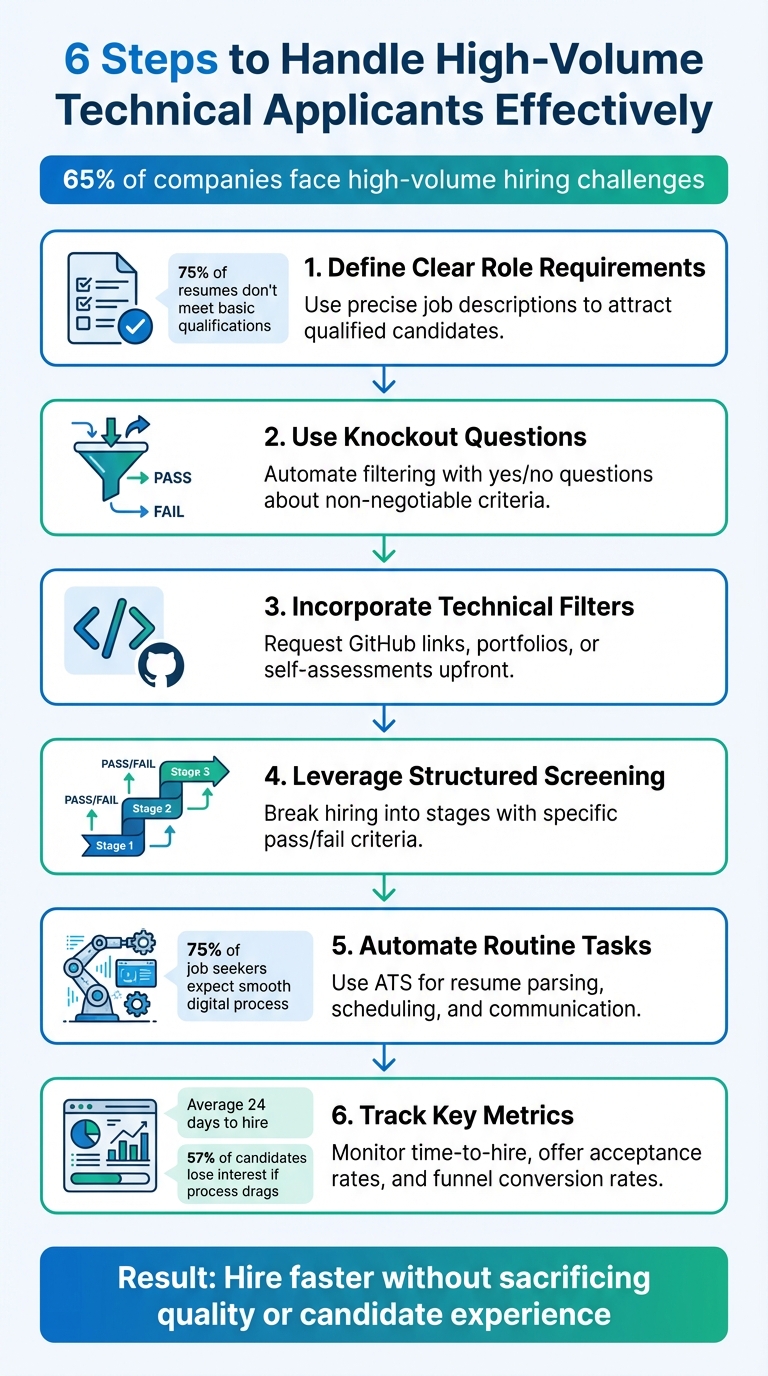 {6-Step Process for Managing High-Volume Technical Recruiting}
Define Role Requirements and Optimize Your Application Funnel
Streamline your hiring process by weeding out unqualified candidates early on. Did you know that around 75% of resumes don’t meet basic qualifications? One recruiter even shared that 90% of 300 applicants failed to address key criteria . This kind of volume can overwhelm your team and waste valuable time.
The fix? Start with crystal-clear job descriptions and smart filters at the top of your application funnel. By setting clear expectations upfront, candidates can decide for themselves if they’re a good fit before applying. This approach reduces the number of applications while increasing the quality of those you receive. Let’s break down how to refine your job descriptions and screening criteria to build a more efficient hiring process.
Write Clear Job Descriptions to Filter Out Unqualified Candidates
Vague job postings attract the wrong crowd. Think of your job description as your first line of defense - not just a way to advertise the role. Collaborate with your hiring manager to define what’s truly non-negotiable versus what’s simply nice to have. For example, can a candidate learn certain tools on the job, or do they need years of hands-on experience from day one?
"When creating job advertisements, clearly define your organization's requirements for each position. Defining job requirements helps potential candidates assess whether they have the necessary qualifications and increases the suitability of those who apply." – iprospectcheck
Be explicit about technical skills, years of experience, and specific tools or technologies that are mandatory. Separate these from "nice-to-have" qualifications so applicants know what’s essential. Including salary details is also a smart move - 91% of job seekers want this information upfront . Write the description from the candidate’s perspective, focusing on what they’ll actually do day-to-day rather than crafting an unrealistic wishlist .
Avoid buzzwords like "rockstar" or "ninja", which can alienate qualified candidates and introduce bias . And steer clear of overly generic, AI-generated descriptions - they might sound polished, but they often lack the clarity needed to attract the right talent.
Add Knockout Questions to Screen Applicants Automatically
Once your job description is dialed in, use knockout questions to further refine your applicant pool. These are straightforward, yes-or-no questions that help your applicant tracking system (ATS) automatically filter out candidates who don’t meet minimum requirements .
Focus these questions on absolute deal-breakers, such as work authorization, willingness to relocate, required hours, or specific technical experience. For instance, you might ask, "Are you legally authorized to work in the United States?" or "Do you have at least 5 years of experience with Python?" Use simple formats like multiple choice or rating scales to make the screening process seamless .
Work closely with your hiring manager to identify these must-haves - they’ll know which gaps can’t be bridged with training . And always ensure your questions are job-related and compliant with employment laws to avoid any legal issues .
Add Technical Filters Early in the Process
Incorporate technical filters to quickly gauge candidates’ skills. Ask applicants to self-rate their proficiency in programming languages, frameworks, or tools using a standardized scale. While self-reported data isn’t perfect, it helps you identify candidates worth a closer look.
Request links to GitHub profiles, portfolios, or code samples directly in the application. These provide an immediate glimpse into their work and coding style. For senior roles, consider asking about specific technical achievements - for example, "Describe a system you designed that handles over 10,000 requests per second." This often reveals more about a candidate’s expertise than simply listing years of experience.
You can also include optional short-answer technical questions. Strong candidates will likely put thought into their responses, while less qualified applicants might skip them or provide weak answers. These early filters help you focus your time on candidates who’ve already demonstrated they meet your baseline requirements.
Build a Scalable Screening Process
When you're dealing with hundreds of technical applications, a structured, multi-step screening process is your best friend. This approach helps you start with a broad pool of candidates and gradually narrow it down to those who meet your baseline requirements. By the time candidates reach your engineering team, they’ve already shown strong potential. This method ensures your team’s time is spent wisely, focusing on top-tier talent.
Create a Multi-Stage Technical Screening Funnel
Divide your screening process into clear, manageable stages. This might include steps like reviewing applications, administering technical assessment tools, conducting phone interviews, live coding sessions, and final evaluations. Each stage should have specific pass/fail criteria, making it easy to filter out unqualified candidates early. This structured funnel not only prevents bottlenecks but also gives you insights into where candidates tend to drop off, so you can continuously refine your process.
Use an ATS to Track Candidates and Automate Workflows
An Applicant Tracking System (ATS) can simplify your hiring process by automating repetitive tasks. From parsing resumes to tracking candidate progress and managing workflows, an ATS frees up your team to focus on more strategic efforts. Plus, it provides performance data that can help you identify weak points in your funnel and make improvements .
Use Standardized Scorecards for Consistent Evaluations
Scorecards create a level playing field. Develop evaluation criteria tailored to each role, covering both technical skills and behavioral traits. Using behavioral interview questions helps identify candidates who align with your team culture. Every interviewer should use the same scorecard with clearly defined rating scales, ensuring candidates are assessed consistently, regardless of who’s conducting the interview.
"To ensure the consistency of your hiring process, establish standardized steps for each type of role. All candidates for a specific position should undergo the same selection and assessment process. This helps to reduce the potential for unconscious bias influencing the process." – iprospectcheck
Scorecards are especially useful for early-stage filtering, allowing you to weed out underperforming applicants efficiently. When you’re under pressure to fill roles quickly, this structured approach ensures you maintain high standards without cutting corners.
Use Automation to Improve Candidate Experience
Smart automation can create a responsive and engaging experience for job seekers, even when you're managing hundreds of applications. By automating repetitive tasks, your team gains more time to focus on meaningful interactions with candidates. According to Joveo, 75% of job seekers expect a smooth digital application process, and companies that use automation in talent acquisition are twice as likely to improve candidate experience . Here’s how automation can help you streamline processes and keep candidates engaged.
Automate Routine Tasks with an ATS
The best recruiting software for tech companies can take over time-consuming administrative tasks, saving your team hours each week. For instance, you can set up your ATS to automatically tag candidates, sync calendars for interview scheduling, and send reminders. These platforms simplify scheduling and communication, cutting down on manual coordination. The result? Your team can spend less time on logistics and more time assessing top talent.
Send Personalized Communication at Scale
Automation makes it possible to deliver personalized messages at scale. By using email and SMS templates with dynamic fields - like the candidate’s name, the role they applied for, or the interviewer’s name - you can create tailored communication that feels personal. AI-powered CRMs can help you manage multi-channel communication, ensuring timely updates throughout the hiring process . Tools like AI chatbots can also handle frequently asked questions, providing instant support and leaving no query unanswered .
As Joveo puts it:
"Who says automation has to feel robotic? From personalized emails to tailored interview follow-ups, automation makes it easy to connect with candidates on a human level. In fact, automated systems make personalization at scale possible. Automation makes personalization at scale possible, and happy candidates are more likely to say 'yes' to your offer."
Prevent Candidate Fatigue in High-Volume Recruiting
High-volume recruiting can overwhelm candidates if not managed thoughtfully. Respect their time by consolidating assessments, minimizing the number of interview rounds, and clearly communicating timelines. Even a brief update - like letting them know their application is still under review - can make a big difference . Make sure your application process is mobile-friendly and easy to navigate, as this leaves a positive impression .
Additionally, automated interview scheduling via text allows candidates to pick times that work best for them, improving scheduling outcomes . By keeping candidates informed about what to expect and when, you reduce uncertainty and keep them engaged throughout the process. This approach not only enhances their experience but also strengthens their perception of your company. For more engagement tips, check out our tech recruiting cheatsheet.
Hiring engineers?
Connect with developers where they actually hang out. No cold outreach, just real conversations.
Measure Success and Improve Over Time
Tracking the right metrics can turn high-volume recruiting from a guessing game into a well-oiled, data-driven process. The key is to focus on metrics that reveal both the efficiency and quality of your hiring pipeline.
Track Key Metrics for High Volume Recruitment
Start by keeping an eye on time to hire - the number of days from when a candidate applies to when they accept your offer. This metric sheds light on both your recruitment team's effectiveness and the overall candidate experience . On average, it takes nearly 24 days to fill a role, but only 30% of companies manage to meet that benchmark. The rest take anywhere from 1 to 4 months . And here's a critical insight: 57% of candidates lose interest if the hiring process drags on too long .
Another vital metric is your offer acceptance rate - the percentage of job offers that candidates accept. A low acceptance rate could signal issues like uncompetitive compensation, poor candidate experience, or unclear communication about the role. Additionally, track conversion rates at each stage of your hiring funnel - from application to phone screen, phone screen to technical assessment, and so on. This helps pinpoint where candidates might be dropping off or losing interest.
Use Data to Optimize Your Funnel
Your ATS (Applicant Tracking System) is a goldmine of data that can help you spot bottlenecks. For instance, if candidates are stuck waiting weeks between assessment stages, it's time to streamline that part of the process. Companies using AI-powered resume screening have managed to cut their time to hire by 75% , proving that automation can significantly speed things up when used strategically.
You should also analyze your sourcing channels. Track where candidates are coming from and which sources lead to the most hires. If some channels outperform others, consider reallocating your resources to maximize results. Similarly, if your interview-to-hire ratio is low - meaning many candidates are interviewed but few are hired - it may be worth tightening your screening process or adding more effective knockout questions earlier in the funnel.
These insights don't just help you improve day-to-day operations - they also prepare you for when hiring volumes surge.
Prepare for Volume Spikes
Look at historical data to anticipate patterns like seasonal hiring surges, company expansions, or spikes following major industry events. For example, you might notice an uptick in applications after a product launch or a big conference.
When you know a surge is coming, plan ahead. This could mean bringing in temporary contract recruiters, setting up additional automated workflows in your ATS, or opening more interview slots. Your ATS can be a powerful ally in managing increased volumes - just make sure it’s regularly updated to handle peak performance demands.
Conclusion
Managing high-volume technical recruiting doesn’t mean compromising on quality or candidate experience. By adopting the right strategies, you can streamline your process and achieve impressive results.
Key Takeaways
Start with clear criteria. Defining non-negotiable qualifications upfront helps filter out unsuitable candidates early on, saving time for everyone involved. Using knockout questions and technical filters at the beginning of your hiring funnel ensures your team focuses only on those who meet the baseline requirements .
Leverage scalable tools and automation. An applicant tracking system (ATS) combined with standardized scorecards ensures consistent and efficient evaluations across all candidates. Automation can handle repetitive tasks like scheduling interviews and sending status updates, allowing your team to dedicate more attention to engaging with top candidates .
Rely on data to optimize. Metrics like reducing time-to-hire, offer acceptance rates, and funnel conversion rates can highlight inefficiencies and guide improvements. Monitoring drop-off points and sourcing data helps refine your approach, while historical data equips you to handle sudden increases in hiring demands without missing a beat.
FAQs
How does automation enhance the candidate experience in high-volume tech recruiting?
Automation transforms the hiring process by speeding things up, improving efficiency, and simplifying every step for candidates. It takes care of tasks like screening resumes, scheduling interviews, and sending follow-ups, cutting down delays and ensuring smoother communication. Tools like chatbots are a game-changer - they can instantly update candidates, answer frequently asked questions, and keep them in the loop from start to finish.
By handling repetitive tasks, automation frees up recruiters to focus on what really matters: building genuine, personalized connections with candidates. This approach not only saves time but also ensures applicants feel appreciated, even when dealing with a high volume of applications.
What are the best ways to screen technical applicants during the initial application stage?
To screen technical applicants effectively, consider using pre-employment assessment tools that feature coding tests and clear evaluation standards. These tools can simplify the hiring process by automatically sorting candidates based on set criteria, helping you save time while maintaining precision.
You can also incorporate automated screening systems to identify top candidates more efficiently and cut down on manual workload. This method lets you concentrate on the most qualified individuals without negatively impacting their experience during the hiring process.
What are the benefits of tracking key metrics in high-volume technical recruiting?
Tracking key metrics in high-volume technical recruiting plays a crucial role in making the hiring process more efficient. It helps pinpoint the sourcing channels that deliver the best results, shortens the time needed to fill positions, and boosts the overall quality of hires. By diving into these metrics, recruiters can make smarter, data-backed decisions and focus their energy where it counts.
Keeping an eye on these numbers also leads to a smoother candidate experience. It helps uncover bottlenecks, cut down on delays, and ensure communication stays consistent. This doesn’t just build trust with applicants - it also strengthens the company’s reputation as a great place to work over time.
.png)