Hiring senior backend engineers is harder than ever in 2026. Despite 80% of developers being open to new opportunities, 43% mute or ignore recruiter outreach. Why? Overwhelming noise from generic, AI-generated messages and a lack of trust in recruiters. Only 15% of developers believe recruiters understand the technical roles they’re hiring for, and 69% want salary details upfront, yet many outreach efforts fail to deliver on these expectations.
Here’s the core issue: high demand meets low engagement. Recruiters rely too heavily on platforms like LinkedIn, where 64.5% of developers feel their skills are poorly represented. Meanwhile, senior engineers, focused on complex system design and architecture, are inundated with irrelevant messages and impersonal communication. This leads to low response rates, high dropout rates, and a hiring process bogged down by inefficiencies.
To fix this, recruiters must shift from volume-based outreach to targeted, trust-building strategies:
- Use warm introductions via trusted networks or platforms engineers already value.
- Craft job descriptions that highlight specific technical challenges, tools, and salary details upfront.
- Replace abstract puzzles with practical screening exercises that reflect actual job requirements.
::: @figure 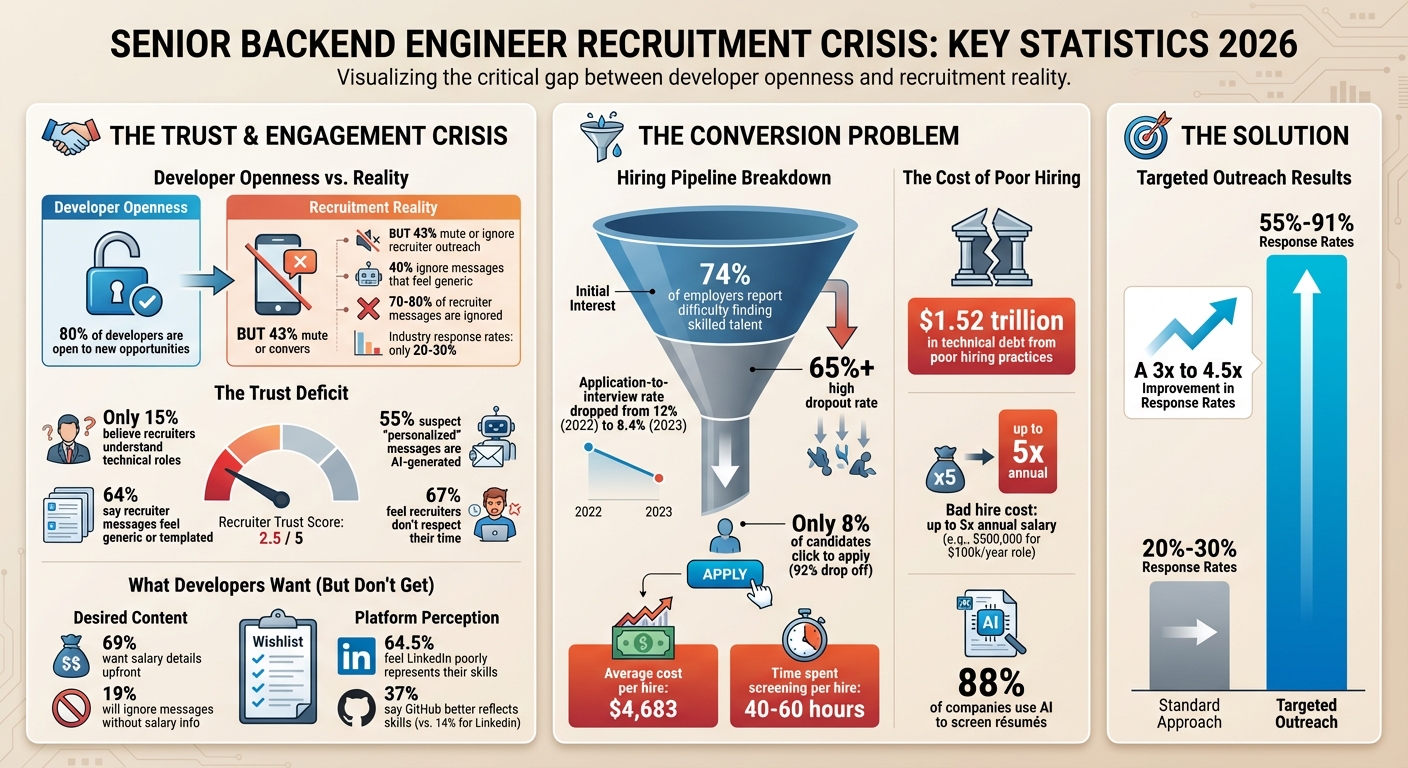 {Senior Backend Engineer Recruitment Statistics: Trust Gap and Engagement Crisis in 2026}
Why Senior Backend Engineer Searches Fail to Convert
High Demand Meets Low Engagement
The numbers paint a challenging picture. While 74% of employers worldwide report difficulty finding skilled talent, the irony is that the talent pool is actively seeking opportunities. Yet, there's a disconnect: 43% of developers have muted recruiter outreach altogether, 40% ignore messages that feel generic, and over 65% of companies face high dropout rates during the hiring process. Despite reaching out to countless candidates, most companies struggle to make meaningful connections. This disconnect is exacerbated by outdated recruitment practices that fail to resonate with senior engineers.
When Recruitment Methods Miss the Mark
The engagement problem deepens when we look at how recruitment methods often alienate senior engineers. Only 15% of developers feel recruiters truly understand the technical roles they're hiring for. Mistakes like mixing up technologies or misjudging seniority levels can quickly damage trust and credibility.
Another issue is platform choice. Recruiters heavily rely on LinkedIn, but 64.5% of developers feel the platform doesn't accurately represent their career paths or potential. In contrast, 37% say GitHub better reflects their skills, compared to just 14% who prefer LinkedIn. This mismatch makes it harder for recruiters to connect with candidates where they are most comfortable showcasing their abilities.
Then there's the issue of transparency - or lack thereof. Sixty-nine percent of developers want salary information upfront, and 19% will ignore messages that omit this detail. On top of that, 55% of developers suspect that even so-called "personalized" messages are generated by AI. These missteps amplify the noise, eroding trust and making it even harder to engage senior engineers in meaningful conversations.
The Hidden Problem: Too Much Noise, Not Enough Signal
The real challenge in hiring senior backend engineers isn't just a shortage of talent - it’s the overwhelming flood of irrelevant applications and messages that drowns out genuine opportunities. With the rise of AI-generated résumés and mass outreach, the recruitment process has hit a breaking point. In 2026, the signal-to-noise ratio in hiring has plummeted, making it harder than ever to identify top-tier candidates. Recruiters are left sifting through applications that may look promising but lack depth, while highly skilled engineers with expertise in distributed systems, cloud infrastructure, and reliability engineering often go unnoticed.
How Recruitment Noise Pushes Away Top Talent
Senior backend engineers are inundated with irrelevant messages daily. The numbers tell a clear story: 70-80% of recruiter messages are ignored, with industry response rates hovering between 20-30%. Worse, application-to-interview rates have dropped from 12% in 2022 to just 8.4% in 2023, highlighting how the sheer volume of noise is clogging the recruitment pipeline.
Adding to the problem, 64% of developers say recruiter messages feel generic or templated. This lack of personalization signals to candidates that they’re just another name on a list. Engineers with specialized skills - like cloud-native architecture, database optimization, and observability - aren’t actively browsing job boards. They’re passive candidates who might entertain the right opportunity, but those opportunities are buried under irrelevant outreach. With only 8% of candidates clicking to apply, a staggering 92% drop off due to application friction. This overload of irrelevant communication not only disengages candidates but also erodes their trust in the hiring process.
The Trust Problem: Why Signal Quality Matters
The damage from poor signal quality goes beyond low response rates. It actively undermines trust. When developers feel that most outreach is impersonal or AI-generated, skepticism becomes their default response. Many don’t believe recruiters understand the technical roles they’re hiring for, creating a trust deficit from the very first interaction.
"This isn't a sourcing problem. It's a trust problem." - Nimrod Kramer, CEO, daily.dev
This erosion of trust has tangible costs. On average, companies spend $4,683 per hire, but inefficiencies caused by recruitment noise inflate that figure dramatically. The process also consumes 40 to 60 hours of screening time per hire, pulling senior engineers away from critical projects. With tighter budgets and shorter timelines in 2026, these delays are unsustainable. Every sprint without the right talent slows delivery and widens the gap between companies and their competitors. This inefficiency is a direct result of low conversion rates for senior backend engineers - and it’s a problem that businesses can no longer afford to ignore.
What Makes Senior Backend Engineers Different
Senior backend engineers approach their work with a mindset centered on systems thinking, not just writing lines of code. Their focus lies in designing distributed systems, weighing performance trade-offs, and preparing for potential failure scenarios - not simply handling CRUD operations. If your outreach doesn't reflect this reality, it sends a clear message: you may not fully understand the complexity of their role. This gap highlights why it's so important to grasp the unique perspective that senior backend engineers bring to the table.
Technical Credibility Matters More Than a Sales Pitch
When it comes to trust, recruiters start at a disadvantage. Senior engineers give recruiters an average trust score of just 2.5 out of 5. Making mistakes like confusing Java with JavaScript or listing unrealistic job requirements can instantly destroy any credibility. What these engineers value most is an honest, technically informed conversation about the role’s challenges and scope - not a flashy sales pitch. Demonstrating technical understanding, whether through references to their GitHub work or thoughtful questions about their experience, goes a long way. On the other hand, generic templates don’t just miss the mark - they actively push top talent away. In fact, 40% of developers ignore messages that feel like generic spam.
Losing technical credibility doesn’t just erode trust - it also adds to the burnout engineers face as they deal with a flood of low-quality outreach.
Burnout and Message Overload in 2026
By 2026, the problem isn’t a lack of skilled talent - it’s a lack of attention. Senior backend engineers are bombarded with so many low-quality messages that they’ve learned to tune most of them out. The numbers paint a clear picture: 67% of engineers feel recruiters don’t respect their time.
These professionals fiercely protect their focused work hours. Midday calls or constant follow-up messages don’t come across as persistence - they signal a lack of understanding about how senior engineers operate. As AI tools shift their responsibilities from routine coding to more complex system design and architectural work, their time becomes even more valuable. Transparency is key in cutting through the noise: 69% of developers want salary details in the first message, and 19% will ignore outreach entirely if that information is missing. In today’s crowded market, being upfront isn’t just polite - it’s essential to earning their attention.
How to Fix Your Conversion Problem
To cut through all the noise mentioned earlier, the key is to focus on building meaningful, high-quality connections. When it comes to addressing the trust gap, you need to shift your strategy from high-volume outreach to targeted, thoughtful engagement. Senior backend engineers aren’t going to respond to generic, impersonal messages. They’re far more likely to engage when you meet them where they already are, use their language, and focus on what truly matters to them.
Use Warm Introductions Instead of Cold Outreach
Cold outreach often fails because it doesn’t address the trust issue - it actually makes it worse. Instead, aim to connect with candidates in spaces they already trust, like technical forums, professional networks, or platforms where they go to learn and share knowledge. When you’re introduced through a trusted source or a familiar environment, you sidestep the skepticism that often accompanies cold outreach.
Be upfront and respectful of their time by sharing key details right away, such as the tech stack, salary range (in USD), and work model. Once you’ve established credibility through a warm introduction, the next step is to ensure your job descriptions resonate by focusing on the real technical challenges they care about.
Write Job Descriptions That Speak to Engineers
After earning their trust, your messaging needs to connect on a deeper level. Generic job descriptions won’t cut it - senior backend engineers want to know the actual problems they’ll be solving. Skip the buzzwords and get specific. For example, describe challenges like modernizing a legacy monolith, managing over 10,000 requests per second, or building scalable APIs for high-concurrency environments. Be transparent about your architecture, mentioning tools like Docker, Kubernetes, and cloud platforms such as AWS or GCP. Instead of vague phrases like "modern technologies", call out specifics like Python 3.11, FastAPI, PostgreSQL, or GraphQL.
Include clear details about salary ranges, equity options, and work models upfront. Engineers increasingly value companies that align with their principles, such as those that are B-Corp certified. If your company uses older systems, highlight opportunities to lead modernization efforts - this can be a major draw. Additionally, sharing details about deployment frequency, code review practices, and mentorship opportunities gives candidates a clear picture of how your team operates, not just what you hope to achieve.
Screen for Problem-Solving Skills, Not Just Résumé Keywords
Once you’ve engaged candidates authentically, your screening process should reflect the real challenges they’ll face on the job. Algorithm puzzles and whiteboard exercises often miss the mark - they don’t predict real-world performance. Consider this: developers spend 60% of their time understanding existing code, not writing new code from scratch. Your screening methods should mirror this reality.
Instead of focusing on abstract puzzles, use practical exercises. For example, ask candidates to review code snippets for vulnerabilities, identify technical debt, or improve modularity. You could also have them optimize a slow query, scale a system, or design an architecture suited to specific requirements.
"I've interviewed developers who could solve any LeetCode problem but couldn't explain basic architectural decisions or handle real-world system design challenges."
– Greg T., Technical Interviewer, Lemon.io
Pay attention to how and why candidates make decisions, not just what they know. Poor hiring practices have contributed to $1.52 trillion in technical debt, and the cost of a bad hire can be staggering - up to five times the employee’s annual salary. For example, a bad hire at $100,000 per year could cost a company $500,000. Look for candidates who demonstrate senior-level qualities, such as mentoring skills, the ability to lead architectural decisions, and strong communication with non-technical stakeholders. These traits are far more valuable than simply solving puzzles or memorizing syntax under pressure.
Conclusion
Finding the right senior backend engineer often fails due to a lack of trust, excessive noise, and irrelevant outreach. With 88% of companies using AI to screen résumés and developers bombarded with generic, impersonal messages, many experienced engineers have grown accustomed to ignoring most recruitment attempts. They approach these interactions with skepticism, dismissing anything that feels automated or insincere. In fact, 40% will ignore your message outright if it resembles spam.
To overcome these challenges, a more thoughtful approach is essential. Instead of relying on mass outreach, focus on building genuine connections. Use warm introductions through trusted networks or developer communities to establish credibility. Craft job descriptions that highlight the essentials - like the tech stack, salary range, and work model - right from the start. This is crucial, as 69% of developers want compensation details upfront, and 19% won't even consider your message without them. When it comes to assessments, prioritize real-world problem-solving skills over abstract puzzles to better reflect the actual job requirements.
These tactics directly address the trust issues and application overload discussed earlier, aligning your recruitment strategy with what top engineers expect. By emphasizing quality, technical expertise, and transparency, you can significantly improve your success rate. Targeted outreach, for example, yields response rates of 55%–91%, compared to the standard 20%–30%.
The companies successfully hiring senior backend engineers treat them as skilled professionals, not just names on a list. Build trust, offer clear and relevant information, and personalize every interaction to turn your search efforts into actual hires.
FAQs
What’s the fastest way to build trust with senior backend engineers?
The quickest way to earn trust with senior backend engineers is by crafting outreach that feels personal and genuine, showing you’ve done your homework. Developers appreciate when their time and expertise are respected. Take the time to research their technical experience and mention specific projects or interests they’ve worked on - it shows you’re paying attention. Be upfront about key details like the role, salary, and hiring process, and make sure to honor their preferred ways of communicating. This thoughtful approach can go a long way in building a strong connection.
What should I include in the first outreach message to get replies?
To improve reply rates from senior backend engineers, start by including essential details right away - like salary range, tech stack, and work model (e.g., remote or hybrid). Personalize your outreach by mentioning specific projects they’ve worked on or highlighting their areas of expertise. Keep the message short (just 2-3 sentences) and avoid using generic templates. Focusing on relevance and being upfront demonstrates respect for their time, which can help build trust and encourage a response.
How can I screen senior backend engineers without LeetCode-style puzzles?
If you're looking to evaluate senior backend engineers without resorting to LeetCode-style puzzles, focus on assessing real-world skills. Instead of artificial or timed challenges, use methods that reveal their practical expertise and decision-making abilities.
Start with technical conversations. Dive into their experience with system architecture, troubleshooting complex issues, and making key technical decisions. These discussions can provide insight into their thought process and problem-solving approach.
You can also review their portfolios. Look at past projects to understand their coding quality, design choices, and ability to deliver scalable solutions. For a more hands-on approach, consider take-home tasks or pair programming exercises. These allow candidates to demonstrate their coding skills and collaboration style in a more natural, less pressured environment.
These techniques help you identify candidates with the judgment and practical expertise needed for senior roles - without relying on puzzles that don't reflect the challenges they'll face on the job.
.png)