Job boards aren’t always the best way to hire developers. They’re crowded, inefficient, and often fail to attract the best talent - especially those not actively job hunting. Instead, focus on sourcing strategies that build relationships in spaces where developers already spend their time. Here’s how:
- Leverage referrals: Employees’ networks are a goldmine. Offer incentives like bonuses or tech gadgets to encourage participation.
- Engage in open-source communities: Platforms like GitHub showcase developers’ skills. Study their contributions and personalize your outreach.
- Join developer forums: Participate in discussions on platforms like Stack Overflow or Discord. Build trust by adding value before recruiting.
- Attend tech events: Sponsor meetups or conferences and connect face-to-face with engaged developers.
- Use platforms like daily.dev Recruiter: Access over 1,000,000 developers, with a double opt-in system ensuring mutual interest.
Instead of relying on job boards, these strategies help you connect with developers in meaningful ways, saving time and reaching talent that traditional methods often miss.
::: @figure 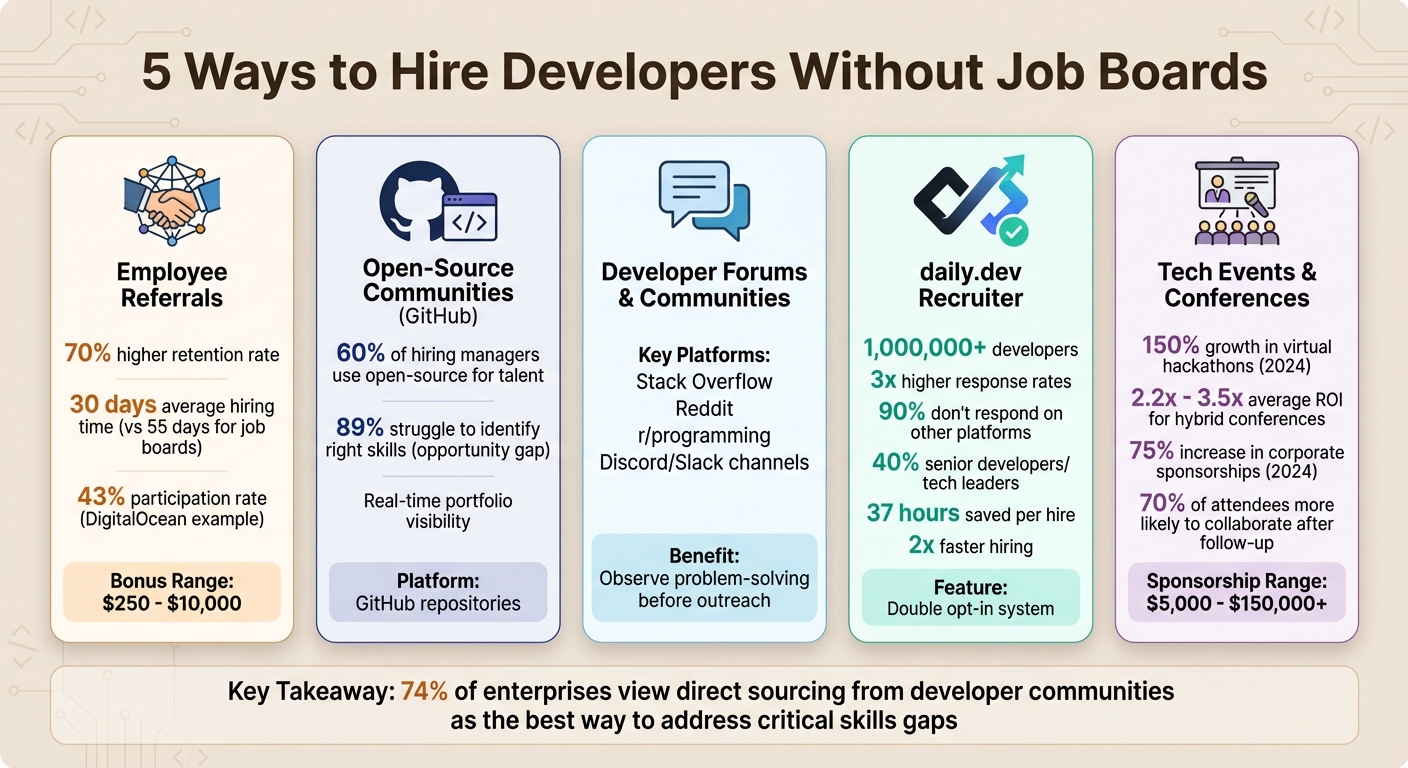 {5 Alternative Developer Hiring Strategies vs Traditional Job Boards}
Use Employee Referrals and Professional Networks
Your employees can be a goldmine for finding skilled developers. They often have connections from previous jobs, educational programs, or tech events. Plus, referred hires tend to stick around longer - showing a 70% higher retention rate - and are hired faster, averaging 30 days compared to 55 days for candidates from job boards.
Make the referral process easy and rewarding. For example, DigitalOcean's referral program combined a $3,500 bonus with a $1,500 charity donation, which led to a participation rate of 43% - four times the industry average.
Set Up Employee Referral Programs
Incentives matter. Companies like HubSpot and Atlassian offer referral bonuses as high as $10,000, while others use tech gadgets like iPhones or Apple Watches to motivate employees. Typically, referral bonuses range from $250 to $10,000, depending on the role’s seniority.
Streamline the process. A simple two-click submission via Slack can replace clunky HR systems. Introduce the program during onboarding, and consider gamifying it with leaderboards or contests to keep employees engaged.
Don’t limit yourself to internal referrals. Alumni networks and local tech groups can also help you tap into a broader pool of potential candidates.
Connect with Alumni and Local Tech Groups
Former employees and their networks are often overlooked but can be valuable sources of talent. Regularly checking in with alumni can help you find candidates who already understand your company’s values and culture.
Local meetups and user groups are another great way to connect. By sponsoring events or hosting workshops, you can build real, face-to-face relationships with regional developers - creating trust and interest beyond just posting job ads.
Hiring engineers?
Connect with developers where they actually hang out. No cold outreach, just real conversations.
Find Developers in Open-Source Communities
Open-source platforms like GitHub offer a direct window into a developer's actual skills and problem-solving style. Unlike resumes, which can sometimes exaggerate or gloss over details, GitHub activity serves as a real-time portfolio showcasing their work.
Interestingly, while 60% of hiring managers actively look for talent in open-source communities, 89% admit they struggle to pinpoint the right skills. This mismatch creates a prime opportunity for recruiters who know how to navigate these spaces effectively. GitHub, in particular, can be a goldmine for finding skilled contributors.
Search for Contributors on GitHub
To start, focus on repositories that align with your company’s tech stack. For example, if your projects involve React, Django, or Kubernetes, look for developers contributing to popular repositories in those ecosystems. Pay close attention to their pinned repositories - these are the projects they’re most proud of. Evaluate their code quality, as well as how they collaborate with others.
"A developer's work is highly visible... potential employers see their GitHub activity as a public resume." - Guy Martin, Director of Open at Autodesk
Dig deeper by reviewing commit messages for clarity, professionalism, and consistency. Analyze pull requests to see how they handle feedback and check issue discussions to understand their approach to problem-solving and communication. Once you’ve identified promising contributors, craft personalized recruiter outreach to reflect their skills and interests.
Personalize Your Outreach
When reaching out, reference specific contributions the developer has made - such as a well-executed bug fix, a new feature, or an insightful code review. This shows that you’ve taken the time to understand their work and what they value. Personalizing your message in this way helps build a connection based on mutual respect for their expertise.
Instead of focusing solely on job requirements, frame your message around the technical challenges they’ll tackle in the role. Highlighting how their skills will make an impact can be far more engaging.
"Money is important, but it functions as a representation of recognition, not value." - Jeff Osier-Mixon, Open Source Community Manager at Intel Corporation
Developers want to feel that their work is meaningful and appreciated. A well-thought-out, personalized message that acknowledges their contributions will always stand out compared to a generic pitch.
Join Developer Forums and Niche Communities
Developer forums, Slack channels, and Discord servers are buzzing with technical discussions in real time. Platforms like Stack Overflow, Reddit's r/programming, GitHub Discussions, and tech-focused Slack or Discord groups are goldmines for connecting with developers who are actively solving problems and sharing insights . These spaces are built on collaboration and trust, offering a unique chance to observe how developers think, communicate, and tackle challenges - all before initiating any outreach. Unlike traditional job boards, these communities prioritize genuine interaction over formal recruitment . To make the most of these spaces, start by engaging authentically and building relationships.
Add Value Before Recruiting
Be an active contributor to the community. Take time to answer questions about your company’s tech stack, share helpful resources, or provide insights from your own experience. When you consistently add value, you build credibility and establish yourself as a knowledgeable participant. Over time, developers will recognize your contributions, making them more open to conversations about potential opportunities .
Identify and Approach Active Members
Pay attention to developers who frequently post, provide thoughtful answers, or lead discussions in areas that align with your needs. Their detailed responses often reflect strong technical skills and clear communication. When reaching out, respect the community’s norms and keep your approach personal. Reference specific contributions they’ve made to highlight how their expertise aligns with your role. Whether you use direct messages or community-approved channels, focus on creating a mutually beneficial conversation. This relationship-driven strategy ensures your outreach feels natural and fosters positive engagement . By meeting developers where they collaborate, you can build meaningful connections that go beyond traditional recruitment methods.
Connect with Developers on daily.dev Recruiter
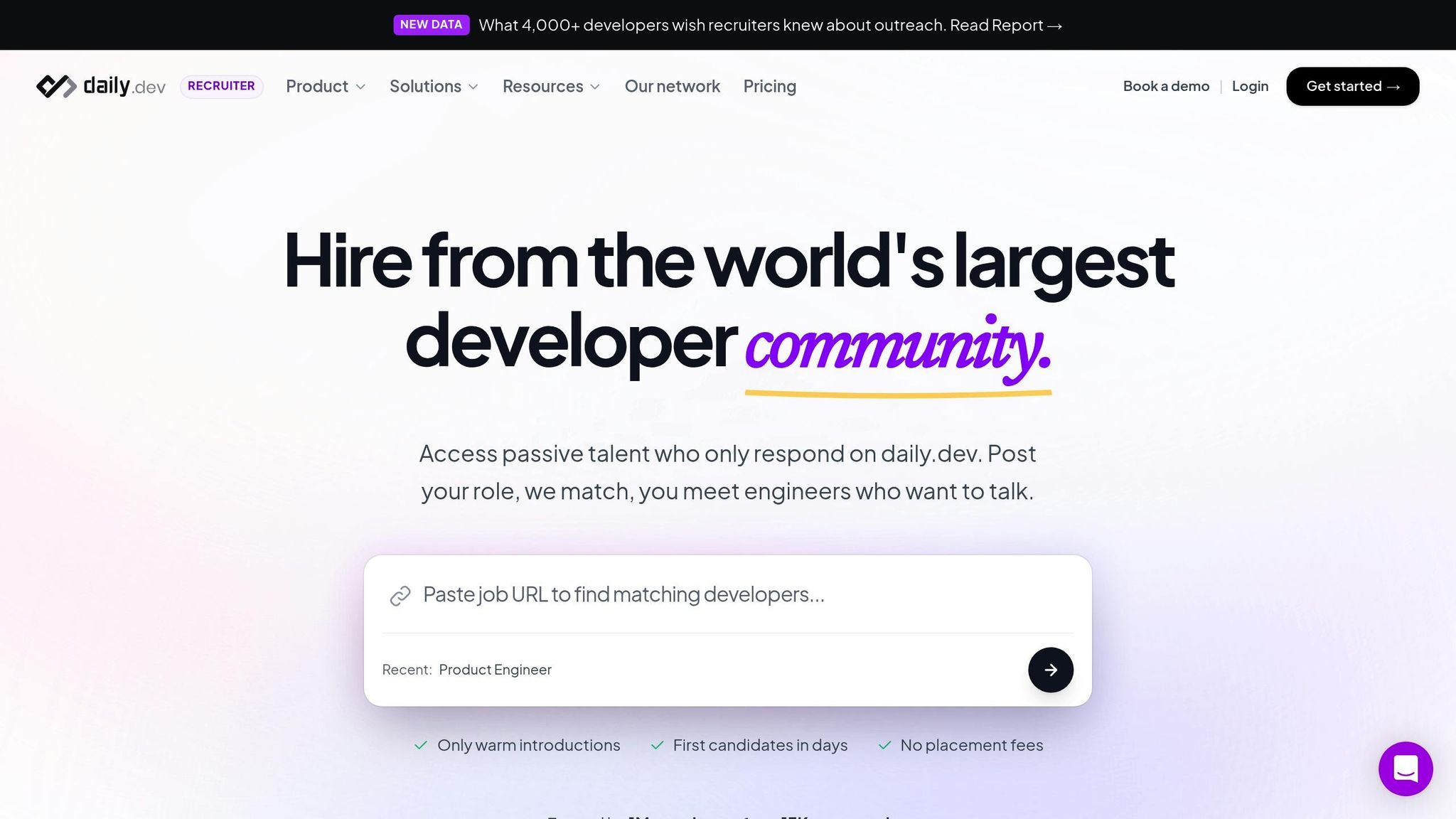
daily.dev Recruiter offers a direct way to connect with over 1,000,000 developers engaged in continuous learning, setting it apart from forums or open-source communities . Even developers who aren’t actively job hunting can be reached through this platform, thanks to its use of real-time behavioral data. By tracking what developers are reading, building, and learning, it identifies skills and intent instead of relying on outdated resumes or LinkedIn profiles . Interestingly, 90% of developers on daily.dev Recruiter don’t respond to recruiters on other platforms, making it an invaluable tool for accessing otherwise unreachable talent . Here’s how it simplifies introductions, candidate screening, and workflow integration.
Get Warm, Double Opt-In Introductions
With the "TinDev" system, both you and the developer must express interest before any interaction begins . Developers are presented with a concise overview of your role, including details like tech stack, salary, and technical challenges. They can then choose to opt in, ensuring 100% of conversations start with mutual interest. This eliminates cold outreach and achieves 3x higher response rates compared to traditional methods . Opt-ins from developers signal genuine enthusiasm.
"When your role shows up inside that flow, it doesn't feel like outreach. It feels like an opportunity. That's why it just works."
Target Roles and Screen Candidates
The platform allows you to set up to three custom screening questions to filter candidates based on specific technical needs. For instance, you could ask, "How do you handle state management in large Astro applications?" to ensure candidates have relevant experience . It also verifies seniority, tech stack expertise, and location before presenting candidates, while automatically deduplicating against your ATS database to avoid redundant efforts . With 40% of the talent pool consisting of senior developers or technical leaders, you gain access to experienced professionals who might not be visible on other platforms . These features save engineering managers an average of 37 hours per hire .
Integrate with Your Existing Tools
daily.dev Recruiter integrates directly with major ATS platforms like Greenhouse, Lever, Ashby, and Workable. When a developer accepts an introduction, their profile is automatically synced with your ATS, removing the need for manual data entry. Real-time updates ensure your pipeline remains consistent, and the "Full Visibility" dashboard helps you monitor reply and pass-through rates to identify drop-off points . This platform complements your existing workflow without requiring placement fees or long-term commitments . Companies using these integrations report 2x faster hiring compared to traditional channels .
Attend Tech Meetups and Conferences
While online platforms are great for connecting with developers, nothing beats the impact of face-to-face interactions at tech meetups and conferences. These events gather developers who are deeply invested in specific technologies like Ruby, Python, or React, making them perfect spots for focused recruiting efforts . Unlike job boards, where candidates passively browse listings, conference attendees actively dedicate their time - and often their own money - to learn and network. This level of commitment naturally creates a pool of highly engaged and motivated developers. Interestingly, virtual hackathons grew by 150% in 2024, surpassing traditional in-person events, while hybrid conferences now deliver returns on investment ranging from 2.2x to 3.5x on average . These events not only expand your brand's visibility but also help you form deeper, long-lasting connections.
Sponsor or Present at Events
Sponsoring events is a straightforward way to boost your company's visibility and show your support for the developer community. Paul McMahon, founder of TokyoDev, describes it as a "low-hanging fruit" strategy for increasing brand awareness . Sponsorship levels vary: Bronze sponsorships, typically costing between $5,000 and $15,000, often include basic perks like API access and community support. On the other hand, Platinum sponsorships, which can exceed $150,000, often come with premium benefits like keynote speaking opportunities . Notably, corporate sponsorships for open-source projects - often tied to conference participation - rose by 75% in 2024 .
Encouraging your developers to present at these events can be even more impactful. As McMahon points out:
"Having a developer present at a conference is great exposure for your company. Talented developers want to work with other passionate developers" .
However, preparing for a 30-minute technical talk isn't a small task - it typically requires about 40 hours of preparation . To support this, allow your team to work on their presentations during regular work hours and cover related expenses, such as admission fees . Move beyond handing out generic swag by organizing live coding challenges, interactive demos, or workshops that tackle actual technical problems .
Make Real Connections with Attendees
It's crucial not to approach conferences purely as recruitment opportunities. McMahon cautions:
"Developer conferences are organized by the community. Respect this and don't treat the conference as only a venue to find new talent, or else your attempts to find developers will backfire" .
The focus should be on providing real value to attendees. Share technical resources like code samples, API documentation, and implementation guides instead of relying on flashy marketing materials . JJ Kass, Head of Developer Programs at Dropbox, highlights the importance of substance:
"The emails you send, the marketing you do, the blogs you write all have to be helpful to developers and are only gonna work if you have a product that has the foundation they need to build what they're working on" .
Following up after the event is just as important as the event itself. Statistics show that 70% of attendees are more likely to collaborate with a company that takes the time to follow up, and segmented email campaigns can boost revenue by as much as 760% . Tailor your follow-up efforts: send advanced integration guides to those who visited your API booth or introductory materials to first-time attendees . To keep the connection alive, invite attendees to join Slack or Discord channels focused on specific technical topics, or schedule "office hours" with your technical team a few weeks after the event . These steps can turn casual interactions into meaningful, ongoing relationships.
Build Your Employer Brand in Developer Communities
To build your employer brand in developer communities, focus on earning trust through genuine, value-driven participation. Developers are quick to recognize superficial recruitment efforts, and these communities expect authentic engagement long before any hiring discussions begin . The effort is well worth it: 74% of enterprises now view direct sourcing from developer communities as the best way to address critical skills gaps .
This requires a shift from reactive hiring - waiting for applications - to a proactive approach centered on community building . By consistently offering valuable content and supporting tools developers rely on, you naturally attract talent who align with your technical values. This strategy not only draws in passive candidates - those skilled developers who aren't actively job hunting but are open to the right opportunity by understanding developer needs for growth and flexibility - but it also strengthens the foundation for your content and open-source initiatives, which we'll explore next .
One of the most effective ways to build trust is by sharing high-quality technical content.
Publish Technical Content
Publishing technical content allows your company to demonstrate expertise while providing practical value. For example, companies like Eightfold AI and Beamery have shared case studies on their blogs and LinkedIn, highlighting how machine learning enhances skills-based hiring. These posts not only reduced their hiring timelines but also resonated with developers who appreciated the technical depth, increasing engagement within developer communities . Similarly, Huntly used community forums to share detailed insights about their tech stack, which helped them source candidates faster and avoid paying agency fees of $20,000 to $30,000 per hire in the U.S. .
Platforms like HashNode, CodeProject, and Dzone are excellent spaces to publish this kind of content. Use social media scheduling tools to maintain a steady, engaging presence. Share insights like guides, architecture choices, debugging techniques, and lessons learned from real-world challenges. The key is to solve actual problems developers face, rather than simply promoting your company.
In addition to technical content, supporting open-source projects is another powerful way to build trust.
Support Open-Source Projects
Open-source contributions or sponsorships are a clear way to demonstrate your technical commitment. Options range from financial sponsorships through GitHub Sponsors to direct code contributions to well-known repositories like React or TensorFlow . Even small teams can make a difference by improving documentation or participating in bug bounties .
| Strategy | Hiring Benefit | Community Impact |
|---|---|---|
| Direct Code Contribution | Showcases your team's technical expertise | Enhances project stability and features |
| Documentation Support | Attracts detail-oriented developers; signals clarity | Makes projects easier for newcomers |
| Event Sponsorship | Boosts visibility in respected, non-recruitment spaces | Encourages knowledge sharing and networking |
| GitHub Sponsors | Demonstrates financial support for key tools | Provides sustainability for maintainers |
What makes open-source involvement so effective is its transparency and verifiability. Developers can assess your team's code quality, communication style, and problem-solving abilities before even considering a job opportunity. This level of openness fosters trust in a way that traditional employer branding often can't match.
Conclusion
Finding developers without relying on job boards means connecting with them in spaces where they naturally engage. The strategies highlighted here - like leveraging employee referrals, participating in open-source communities, engaging on developer forums, attending tech meetups, and strengthening employer branding - focus on building trust and fostering genuine connections, rather than casting a wide net.
This approach shifts away from traditional recruitment methods. By consistently offering value, you create a network of developers who align with your technical principles and culture.
Tools such as daily.dev Recruiter align well with this trust-first strategy. With its double opt-in process, it ensures conversations start with mutual interest. By using real-time data to gauge intent, the platform achieves response rates that are three times higher than standard outreach methods . As Nimrod Kramer, CEO & Co-Founder of daily.dev, explains:
"We built a place where engineers can turn off the noise. To enter this space, you don't need a hack. You need trust" .
Consistency plays a key role in this process. Whether you’re sponsoring a tech meetup, contributing to a GitHub repository, or sharing debugging guides, every effort adds to your reputation. Over time, these actions build up, creating a steady stream of passive developer candidates who are open to engaging when the right opportunity comes along.
FAQs
Which hiring channel works best for my role?
When choosing the right channel to reach developers, consider their skills and how engaged they are. Traditional job boards might not be the best option, as they often overlook passive talent. Instead, look to developer communities like GitHub and Stack Overflow. These platforms allow you to assess technical skills and see real contributions. Additionally, using platforms that tap into trusted developer networks can boost your credibility. This approach also enables more personalized outreach, which is crucial for connecting with passive candidates effectively.
How do I find and evaluate developers on GitHub?
To evaluate developers on GitHub, start by examining their public repositories, commits, pull requests, and interactions within the community. This gives you a clear picture of their coding abilities, technical knowledge, and how they work with others.
Pay close attention to consistent contributions, well-thought-out pull requests, and active involvement in discussions. These elements highlight their dedication and enthusiasm for coding. GitHub offers a transparent way to assess a developer’s skills and collaboration style, going beyond what a traditional resume can provide.
How can daily.dev Recruiter reduce cold outreach?
daily.dev Recruiter takes the guesswork out of hiring by focusing on trust-based, opt-in connections. Instead of relying on outdated cold outreach methods, it uses real-time behavioral data - like the articles developers read or the topics they follow - to identify potential candidates. This allows recruiters to connect with developers even before they start actively looking for new opportunities. By prioritizing genuine, meaningful interactions, this approach helps reduce ghosting, build trust, and streamline the hiring process for everyone involved.
.png)