If you need to hire 10 engineers in just 13 weeks, here’s the formula: structure, speed, and precision. This playbook outlines exactly how to scale your hiring process without sacrificing quality. Here's the breakdown:
- Pipeline Math: Start with 100–150 candidates to secure 10 hires. Expect ~30–50% to pass initial screens and ~4:1 to 6:1 interview-to-offer ratios.
- 13-Week Plan: Focus on sourcing in Weeks 1–6, run parallel interviews in Weeks 4–10, and close offers by Week 12.
- Sourcing Strategy: Balance referrals, outbound outreach, developer communities, and job boards to meet volume targets.
- Interview Process: Condense timelines to 7–10 days by overlapping interview stages and making decisions within 24–48 hours.
- Onboarding: Use cohort-based onboarding to integrate hires efficiently without burning out your team.
Key Metrics to Watch:
- Time-to-hire: Aim for 2–3 weeks per role.
- Offer acceptance rate: Target 70–80%.
- 90-day retention: Ensure 95%+ to validate hire quality.
This guide ensures you stay on track while maintaining high standards. Let’s dive into the details.
Pipeline Math: Working Backwards from 10 Hires
Start with the goal in mind. If you need 10 accepted offers, you'll have to work backward through each stage of the hiring funnel to determine how many candidates to source initially.
For 10 hires with an 80% offer acceptance rate, you’ll need to extend 13 offers. This translates to conducting 52–78 final interviews, which means sourcing 100–150 candidates . Since only 30–50% of candidates pass the recruiter screen , this volume at the top of the funnel ensures a healthy pipeline.
Interview capacity often becomes the biggest hurdle. With an interview-to-offer ratio of 4:1 to 6:1, those 13 extended offers require 52–78 final interviews. Each final-stage interview takes about 8 hours , meaning you’ll need to allocate 416–624 interview hours. Without parallel interview loops or efficient scheduling, delays can cost you top candidates. This backward-planning method helps pinpoint the necessary conversion metrics at each stage.
Recruitment Funnel Conversion Rates
Knowing your conversion rates is essential to ensure your pipeline numbers translate into actual hires. Screen pass rates should range between 30–50% . If your onsite pass rates drop below 20%, it’s a red flag that your technical screen isn’t filtering effectively. On the flip side, if your onsite pass rate exceeds 50%, you may be letting through too many unqualified candidates, wasting interview resources.
Quality trumps quantity in sourcing. For instance, employee referrals often convert to hires at 15–25%, while inbound applications only convert at 3–8% . If you rely heavily on job boards, you’ll need 3–5 times more candidates at the top of your funnel compared to referrals or targeted outreach. Developer communities, with conversion rates of 8–15% , provide a middle ground for accessing engaged, passive talent.
| Recruitment Stage | Candidates Needed | Conversion Rate | What It Means |
|---|---|---|---|
| Sourced/Contacted | 100–150 | - | Mix of referrals, outbound, and inbound sources |
| Recruiter Screen | 50–75 | ~30–50% pass | 30-minute calls to evaluate basic skills and team alignment |
| Final Interview (Technical & Onsite) | 52–78 | 4:1 to 6:1 ratio | Deep technical assessments and team interviews |
| Offers Extended | 13 | ~80% acceptance | Quick, competitive offers to secure top candidates |
| Accepted Offers | 10 | - | The ultimate hiring goal |
If your onsite pass rate is under 20%, re-evaluate your technical screen immediately . Pre-approve salary ranges before sourcing to avoid delays during the offer stage . Aim to make decisions within 24–48 hours of the final interview , as slower processes risk losing candidates to faster-moving competitors. These figures lay the groundwork for refining your sourcing and interview tactics, which will be detailed further in later sections.
The 13-Week Hiring Calendar
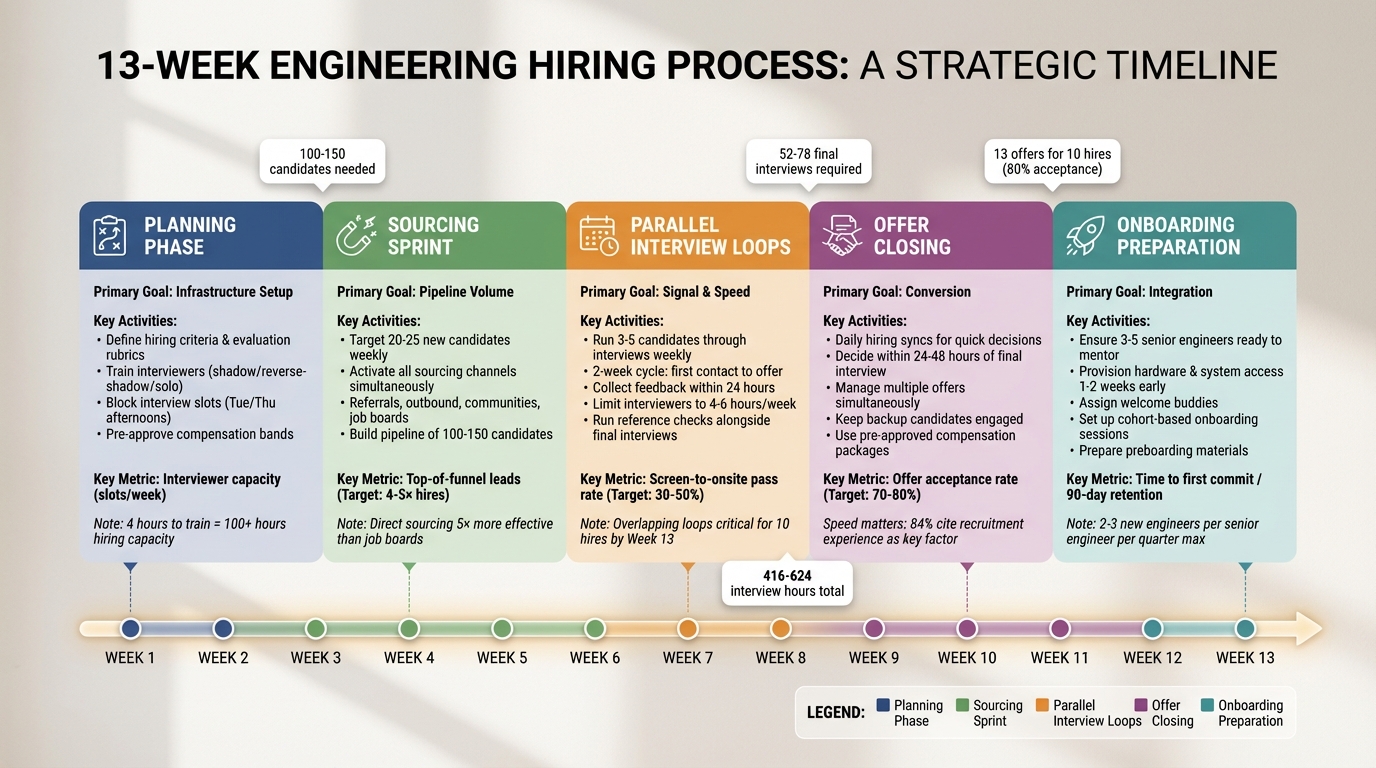
Think of this calendar as your game plan for hiring success. By following a clear, week-by-week strategy, you can avoid the chaos of disorganized sourcing, interviewing, and offer management. Overlapping stages - like sourcing new candidates while interviewing earlier ones - lets you reduce the time from first contact to offer to just 7–14 days . This speed is crucial for securing top talent before they’re snapped up by competitors.
Don’t approach recruitment step by step. Waiting until Week 6 to start interviews will make hitting 10 hires by Week 13 nearly impossible. A steady flow of candidates ensures you can handle inevitable drop-offs without falling behind schedule.
Plan for interview capacity - it’s your biggest constraint. Across your team, you’ll need up to 320 interview hours . That’s why Week 1 is all about preparing: invest 4 hours to train a new interviewer, which translates to over 100 hours of hiring capacity for the quarter . Without this preparation, your team could burn out by Week 6, leading to rushed or overly critical decisions.
Daily syncs replace weekly meetings during crunch time. Starting in Week 8, when offers and final interviews overlap, switch to daily hiring syncs to make decisions within 24–48 hours of final interviews . Assign a decision-maker to break ties and keep things moving - indecision at this stage is a failure of the process .
This calendar takes your pipeline math and turns it into a practical, day-by-day hiring strategy.
Weeks 1-2: Planning Phase
Set up your hiring infrastructure before sourcing begins. Define clear hiring criteria and structured evaluation rubrics now to avoid lowering the bar under pressure later . Resist the temptation to hire “good enough” candidates just to meet numbers - this often leads to lower standards and more management headaches down the road .
Reserve interview time early. Block out dedicated slots (e.g., Tuesday and Thursday afternoons) for interviews across your team by the end of Week 2 . Train new interviewers using a shadow/reverse-shadow/solo feedback system: observe experienced interviewers, co-interview while being observed, and then conduct solo interviews with feedback. This method builds capacity without sacrificing quality.
Pre-approve compensation bands to avoid delays. Set salary ranges in advance so you can extend offers immediately after final interviews without waiting for approvals . This simple step can save 3–5 days in your hiring timeline, which makes all the difference when competing for top candidates.
Weeks 2-6: Sourcing Sprint
Activate all sourcing channels at once. Your goal is to have 100–150 candidates in your pipeline by Week 6. To reach this, aim for 20–25 new candidates each week from referrals, outbound outreach, developer communities, and job boards .
Direct sourcing outperforms job boards. Candidates sourced directly are five times more likely to convert than those from job boards . Plus, candidates are 56% more likely to respond when contacted by a hiring manager instead of a recruiter . For senior roles, get engineering leads involved in personalized outreach.
Monitor your pipeline metrics closely. If you’re not adding 20–25 candidates weekly by Week 3, your pipeline won’t support the parallel interviews needed in Weeks 4–10. If one channel underperforms - like referrals - double down on others, such as community outreach or direct sourcing.
Once you’ve built a strong candidate pool, move into parallel interview loops in Weeks 4–10.
Weeks 4-10: Parallel Interview Loops
Run 3–5 candidates through interviews each week. With a 2-week cycle from first contact to offer , overlapping interview loops are critical to reaching 10 hires by Week 13. For example, candidates engaged in Week 4 can receive offers by Week 6, Week 5 candidates by Week 7, and so on - ensuring a steady stream of offers from Week 6 to Week 12.
Collect interview feedback within 24 hours to keep candidates engaged . Delays can make your process seem disorganized, driving top candidates to accept other offers. Also, run reference checks alongside final interviews to shave additional days off your timeline .
Limit interviewer workload to 4–6 hours per week to prevent burnout and rushed decisions . Rotate interviewers to maintain high-quality evaluations - declining pass rates or vague feedback are early signs of fatigue .
As interviews progress, prepare to manage multiple offers simultaneously in Weeks 8–12.
Weeks 8-12: Offer Closing
Daily hiring syncs ensure quick decisions. During this phase, you’ll juggle multiple offers, negotiate terms, and keep backup candidates engaged in case offers are declined. Decisions should happen within 24–48 hours of final interviews . Speed matters - 84% of candidates cite the recruitment experience as a key factor in their decision .
Keep candidates engaged until their first day. Offers can fall through due to counteroffers, company changes, or second thoughts . Keeping backup candidates warm ensures you can pivot without losing momentum.
Streamline negotiations with pre-approved packages. Use set compensation bands, signing bonuses, and equity structures to make competitive offers without lengthy back-and-forth . Aim for a 70–80% offer acceptance rate . If you’re below this range, reevaluate your competitiveness and candidate experience.
Once offers are accepted, shift your focus to onboarding preparation in Week 13.
Week 13: Onboarding Preparation
Prepare your team to absorb new hires. A team can typically onboard 2–3 new engineers per senior engineer per quarter; exceeding this can strain resources and impact quality . For 10 hires, ensure you have at least 3–5 senior engineers ready to mentor and onboard new team members.
Set up tools and access early. Provision hardware and grant system access 1–2 weeks before start dates so new hires can hit the ground running . Use a formal preboarding phase - assign a “welcome buddy” and send company swag to keep excitement high and reduce the risk of ghosting .
Group onboarding sessions for efficiency. When multiple hires start within the same timeframe, cohort-based onboarding builds camaraderie and simplifies training . This approach eases the burden on senior engineers and accelerates productivity for new team members.
| Phase | Primary Goal | Key Metrics to Track |
|---|---|---|
| Planning (W1-2) | Infrastructure Setup | Interviewer capacity (slots/week) |
| Sourcing (W2-6) | Pipeline Volume | Top-of-funnel leads (Target: 4–5× hires) |
| Interviewing (W4-10) | Signal & Speed | Screen-to-onsite pass rate (Target: 30–50%) |
| Closing (W8-12) | Conversion | Offer acceptance rate (Target: 70–80%) |
| Onboarding (W13) | Integration | Time to first commit / 90-day retention |
Multi-Channel Sourcing Plan
In this 13-week playbook, having a well-rounded multi-channel sourcing strategy is essential to complement the pipeline math and scheduling framework. Relying on a single channel puts your timeline at risk. To meet your candidate volume goals, build parallel pipelines, each tailored to different candidate profiles and conversion rates . Referrals bring high-quality candidates but in smaller numbers, outbound sourcing ensures a steady flow, and inbound applications contribute to your long-term brand-building efforts . All channels should be running simultaneously during the Weeks 2–6 sourcing sprint.
Here’s a breakdown of what you’ll need for 10 hires: approximately 40–67 referrals, 67–125 candidates from developer communities, or 125–333 inbound applicants. These numbers are based on conversion rates of 15–25%, 8–15%, and 3–8% respectively . Knowing these rates allows you to set realistic weekly targets for each sourcing channel.
Budget planning is critical. For 10 hires using internal recruiting, expect to spend $20,000–$40,000 per hire, totaling $200,000–$400,000. If you rely on agencies for hard-to-fill roles, costs can climb to $45,000–$90,000 per hire due to their standard 20–25% fee on first-year salaries . Limit agency use to critical or temporary hiring needs .
Sourcing Channel Mix
Your sourcing mix should align with conversion rates and role requirements. For 10 hires, a balanced approach might include: 30–40% from referrals (3–4 hires), 25–35% from developer communities like daily.dev Recruiter (2–3 hires), 20–30% from direct outbound on platforms like LinkedIn or GitHub (2–3 hires), and 10–15% from inbound applications (1–2 hires) . This variety ensures you’re not overly dependent on any single channel.
daily.dev Recruiter can be a game-changer for scaling quickly. It connects you with developers who are actively learning and engaged, offering warm, double opt-in introductions. These pre-qualified leads can save time at the top of the funnel, which is crucial when working within a tight 13-week timeline.
Referrals are ideal for senior or specialized roles, not volume hiring. With conversion rates of 15–25%, referrals are effective but inherently low in volume . Focus on using them for roles like senior architects or niche positions. Offering $2,000–$10,000 referral bonuses can incentivize participation, but track success based on hire quality rather than the number of referrals submitted .
Direct sourcing through platforms like GitHub or developer communities often yields better engagement than job boards. For senior roles, personalized outreach from engineering leads - referencing specific projects or contributions - can make a big difference.
| Sourcing Channel | Typical Conversion | Best For | Cost Basis |
|---|---|---|---|
| Employee Referrals | 15–25% | All levels, culture fit | $2,000–$10,000 bonus |
| Developer Communities | 8–15% | Engaged candidates | Content/community investment |
| Recruiters/Agencies | 5–12% | Speed, specialized roles | 20–25% of first-year salary |
| LinkedIn Sourcing | 5–10% | Targeted profiles | Recruiter time + tools |
| Inbound Applications | 3–8% | Volume, junior roles | Employer brand investment |
With your mix in place, focus on crafting outreach strategies that resonate with candidates.
Outreach Templates and Timing
Once you’ve established a diverse channel mix, your outreach strategy becomes key to maximizing conversions. Personalization is non-negotiable. Generic templates won’t cut it - reference specific projects, contributions, or skills to grab attention. For instance, when using daily.dev Recruiter, mention the developer’s learning interests or recent content engagement to show you’ve done your research.
Timing matters, too. Send initial outreach on Tuesday or Wednesday mornings for higher response rates. Follow up 3–4 days later with more role-specific details. If there’s no response after a second follow-up, it’s time to move on.
Avoid creating false urgency. Phrases like "this offer expires in 24 hours" can alienate candidates . Instead, tie your timeline to real milestones, such as: "We’re launching a new platform in Q2 and need this position filled by mid-April to stay on track."
Keep it brief and developer-focused. Developers want to know what they’ll build, who they’ll work with, and what they’ll learn. Lead with the tech stack, challenges, and team structure, saving broader company details for later conversations.
Budget Allocation by Channel
Distribute your budget based on efficiency and speed. For a $200,000–$400,000 recruiting budget, a sensible breakdown might be:
- 40% for internal recruiter salaries and tools: $80,000–$160,000
- 25% for referral bonuses: $50,000–$100,000 (5–10 bonuses at $5,000–$10,000 each)
- 20% for sourcing platforms like daily.dev Recruiter: $40,000–$80,000
- 15% for agencies or contract recruiters: $30,000–$60,000
daily.dev Recruiter offers unlimited recruiter seats, allowing your entire team to work simultaneously without additional per-seat costs, keeping expenses manageable.
Agencies can be expensive, typically charging 20–25% of a candidate’s first-year salary . For example, hiring a senior ML engineer with a $180,000 salary could cost $36,000–$45,000 in agency fees. Use agencies selectively for 1–2 critical roles rather than as a primary source.
Track cost-per-hire by channel for better planning in future quarters. If referrals cost $8,000 per hire (including bonus and recruiter time) and agencies cost closer to $50,000 per hire, you’ll know where to focus your efforts next time. Many companies find that developer communities and referrals provide the best balance of cost and efficiency for volume hiring .
Streamlining the Interview Process
When you're tasked with hiring 10 engineers in just 13 weeks, the typical 4–6 week hiring timeline simply won't cut it. The interview process needs to be condensed into 7–10 days without compromising candidate quality. To achieve this, every stage must be optimized - run steps in parallel, cut out unnecessary delays, and empower decision-makers to act swiftly.
Focus on running processes concurrently. Instead of dragging interviews out over weeks, schedule multiple steps on the same day or overlap technical evaluations with culture-fit discussions . For instance, a candidate could complete a recruiter screen on Day 1, tackle a technical assessment on Day 2, and participate in team interviews on Days 4–5. This approach respects everyone's time while preserving the quality of signals gathered. It also builds on the upfront planning outlined in the 13-week hiring calendar.
Pre-approval of budgets and simultaneous reference checks can save days. Ensure compensation ranges and offer approvals are ready before sourcing begins . Waiting for executive sign-offs after final interviews wastes valuable time. Similarly, reference checks and offer letter preparations should happen alongside the final interview stages . Any administrative task that can be handled concurrently should be expedited.
Compressing Interview Timelines
To hit aggressive hiring goals, interview stages must be streamlined. Combine multiple interviews into one extended session. For example, a 90–120 minute "super-session" can cover coding, system design, and behavioral fit, replacing what would traditionally take weeks .
Quick debriefs keep decisions moving. Schedule 10–15 minute debriefs immediately after interviews to make same-day decisions . During peak hiring periods (Weeks 4–10 of the calendar), daily hiring syncs can ensure decisions are finalized within 24–48 hours of the last interview .
| Process Stage | Standard Timeline | Rapid Timeline |
|---|---|---|
| Initial Screen | Week 1 | Day 1 (30 min) |
| Technical Assessment | Weeks 2–3 | Days 2–3 (2–3 hrs) |
| Team Fit / Leadership | Weeks 4–5 | Days 4–5 (60–90 min) |
| Offer and Close | Week 6 | Days 6–7 |
Empower hiring managers to make final decisions without waiting for committee reviews. Replace weekly hiring committees with "Bar Raisers" - senior engineers who ensure quality standards without the pressure of filling a specific role . This allows for faster decision-making while maintaining high standards.
Limit total interview touchpoints to 3–4 interactions. For junior roles, this could include a recruiter screen, technical assessment, team interview, and offer. For senior roles, you might add a system design round, but keep the total under five steps.
Once you've tightened up the interview process, objective evaluation becomes key to maintaining quality.
Interview Scorecards and Evaluation Criteria
Scorecards eliminate guesswork. Structured scorecards ensure consistency across interviewers and roles, reducing reliance on subjective impressions.
Use a clear recommendation scale: Strong Yes, Yes, Maybe, No, Strong No . This approach eliminates ambiguity and forces decisive conclusions. During rapid hiring, treat "Maybe" as a "No" to avoid onboarding candidates who don't excite the team .
Tailor evaluation criteria to engineering roles. Focus on key competencies like Problem Solving, Code Fluency, Autonomy, System Design, Communication, and Collaboration . For each, define what a "Strong Yes" versus a "No" looks like. For example, under Code Fluency, a "Strong Yes" might mean writing clean, idiomatic code without hesitation, while a "No" could indicate struggling to implement basic loops or using unclear variable names .
Complete scorecards immediately after interviews to avoid memory bias . Train interviewers to record observable facts - like "Candidate struggled to implement a loop" - rather than subjective opinions like "Candidate seemed uninterested" . This documentation is crucial for calibration meetings where multiple interviewers align on decisions.
Not all skills carry the same weight. Assign a priority coefficient (1–5) to each skill based on the role's needs . For instance, System Design might weigh heavily for a senior backend engineer, while Communication might be less critical. Use a weighted average to calculate a final score that reflects the most important competencies.
Using Asynchronous Assessments
Take-home projects provide clarity without wasting candidates' time. Keep assignments short - 2–4 hours maximum. Lengthy projects (8+ hours) can discourage candidates and hurt your employer brand .
Automated coding tests filter candidates early. A 30-minute automated assessment can screen out those lacking basic proficiency, saving interview time for stronger candidates . This is particularly helpful when sourcing large numbers of candidates for multiple roles.
Run assessments while scheduling interviews. Candidates can complete take-home assignments as interview logistics are being coordinated. By the time they arrive for live interviews, your team has already reviewed their work, enabling deeper discussions and better pre-interview insights.
Provide clear instructions and evaluation criteria. Candidates should know exactly what’s expected and how much time to dedicate. This transparency improves their experience and ensures consistent evaluation . It also speeds up internal reviews, as interviewers know exactly what to look for, enabling faster decisions.
Planning Role Mix and Seniority Levels
An all-senior team can lead to diminishing returns, decision-making bottlenecks, and overlooked tasks like documentation or setting up CI/CD pipelines . Striking a balance - such as a team of 3 senior, 4 mid-level, and 3 junior engineers - can speed up hiring while creating a sustainable structure for mentoring, execution, and fresh ideas. This balance ensures hiring aligns with quality goals and budget constraints.
Tailor your team mix to your current needs. Teams managing legacy systems or strict SLAs often require more senior engineers to maintain stability and efficiency. On the other hand, R&D or exploratory projects can benefit from the creativity and enthusiasm of junior engineers . However, before bringing on junior hires, make sure senior and mid-level staff have the time and willingness to mentor effectively .
"What I ask myself, at any given point, is whether I have the leadership in each of the workstreams and the infrastructure to support junior engineers properly." - Nathan Esquenazi, CTO at CodePath .
Avoid a top-heavy structure by considering a "backfill at N-1" policy. This means replacing a departing employee with someone one level below them - for instance, hiring a mid-level engineer instead of a senior. This approach helps maintain financial balance and creates room for internal promotions .
Balancing Speed and Experience
The team mix you choose directly impacts hiring timelines and early productivity. Junior engineers are less expensive but may take 3–9 months to reach full productivity . Mid-level engineers adapt faster, while senior engineers - earning $150,000–$230,000 annually - can tackle complex tasks immediately. For a 40-person engineering team in the U.S., annual costs typically range from $7.5M to $12M, with salaries accounting for about 70% of the budget .
The time to fill roles depends on seniority. Junior roles often close within 2–3 weeks due to simpler evaluations, while senior roles take 3–4 weeks, and Staff+ positions can extend to 4–6 weeks because of executive involvement and broader fit assessments . To meet a 13-week hiring deadline, focus on sourcing junior and mid-level candidates early (Weeks 2–6) while starting senior searches right from Week 1.
Set limits on the number of senior roles to keep costs manageable and avoid decision gridlock . Rapid growth - over 40% annually - can overwhelm onboarding processes and strain company culture . Aiming to onboard 1–2 engineers per manager each quarter ensures quality integration .
Salary Planning by Level and Location
Match salaries to market standards to attract top talent without overspending. High-demand markets provide access to larger talent pools, but compensation must align with local benchmarks . Decide whether to target the 50th percentile for sustainability or the 75th percentile for competitiveness .
Remote hiring in smaller markets can cut salaries by 10–20%. For instance, a Level 3 (Senior) engineer in the SF Bay Area or New York City might earn up to $220,000, while the same role in Tier 3 markets maxes out at $190,000 . Establish salary bands around your target percentile with a ±15–20% range .
| US Tier | Level 1 (Junior) | Level 3 (Senior) | Level 5 (Principal) |
|---|---|---|---|
| SF Bay Area & NYC | $135k – $165k | $180k – $220k | $225k – $275k |
| Seattle | $124k – $152k | $175k – $215k | $220k – $268k |
| Tier 2 (Austin/Boston) | $100k – $124k | $162k – $198k | $208k – $254k |
| Tier 3 (Other) | $98k – $120k | $153k – $190k | $202k – $248k |
Defining Clear Role Requirements
Clearly defined role requirements are essential for scaling without compromising quality. Avoid settling for "good enough" candidates during rapid growth. Well-defined roles ensure you hire the right talent and avoid costly mistakes . Base seniority on the complexity of challenges and level of independence, not just years of experience .
Standardize job levels around skills, ownership, and influence. For example, a Level 1 engineer might follow existing processes, while a Level 4 engineer is expected to lead system design, champion best practices, and drive technical strategy . This consistency helps with budgeting and evaluation across roles.
Use outcome-driven job descriptions with clear metrics and real-world examples. This approach sets clear expectations . Introduce "Bar Raisers" - senior engineers outside the hiring team who focus solely on maintaining quality in hiring decisions . By defining "hire" versus "no hire" criteria upfront, you can avoid delays caused by indecision . Standardized scorecards and rubrics for each candidate level ensure interviewers remain aligned , enabling faster decision-making while maintaining high standards.
Closing Multiple Offers
If you’re aiming to make 10 hires, you’ll likely need to extend 12–13 offers, as about 17–25% of candidates may decline. The best teams consistently hit an 80–90% offer acceptance rate. To achieve this, focus on crafting attractive offers, managing timelines efficiently, and keeping backup plans in place.
Building Competitive Offers
To stand out, your offers should include equity (ESOP), sign-on bonuses, and performance incentives. By 2026, base salaries are projected to range from $130,000–$170,000 for mid-level engineers, $160,000–$220,000 for senior engineers, and $190,000–$260,000 for staff engineers. Senior individual contributors may also expect 0.1–0.5% equity, typically with four-year vesting.
Flexibility matters, too. Offering remote work options and adjustable start dates can be decisive factors for candidates. Additionally, provide clear career advancement paths like "Distinguished Technologist" or "Staff Engineer" roles for those who prefer technical growth over management. Pre-approve salary bands and equity ranges before sourcing candidates to avoid delays during the closing process.
"Good engineers have choice on where to work, and if your 'talent competition' does things in a leaner and more effective fashion, that right out of the gate makes it harder for you to hire the right people." - Claus Jensen, Chief Innovation Officer, Teladoc
When closing, tailor your approach to each candidate. For those considering Big Tech, emphasize faster career growth and equity potential. Against early-stage startups, highlight your company’s stability and proven success. Respond to counter-offers swiftly to maintain momentum.
Once your offers are ready, managing multiple timelines becomes your next challenge.
Managing Batch Offers
A strong offer strategy is only effective if you can manage multiple candidates efficiently. Use a daily sync framework to decide on offers within 24–48 hours of the final interview. Extend verbal offers the same day decisions are made, followed by written offers within 24 hours. To save time, run reference checks during the final interview stages so you’re ready to deliver offers immediately.
Create a sense of urgency by aligning offer deadlines with project milestones. Aim for candidates to accept within 3–5 days, with a maximum of one week to minimize risk. During periods of rapid hiring, a daily hiring committee can prevent bottlenecks.
| Stage | Ideal | Maximum |
|---|---|---|
| Final Round to Decision | 1–2 days | 3 days |
| Decision to Offer | Same day | 2 days |
| Offer to Acceptance | 3–5 days | 1 week |
"The companies winning engineering talent have median time-to-hire under 3 weeks. In competitive markets, speed is a feature." - Alex Carter, Technical Recruiter
Handling Declined Offers
Even with a solid strategy, some candidates will decline. To prepare, maintain a secondary pipeline of "silver medalists" - qualified candidates who made it to the final stages but weren’t the first choice. Avoid sending official rejections until your primary candidate has signed or started. When reconnecting with backups, frame the outreach around new opportunities rather than positioning them as second choices. Aim to extend offers to backup candidates within 48 hours of a decline.
Feedback from declined candidates can help you refine your approach. Around 80% of declines are due to candidates finding better opportunities. If you notice recurring reasons like salary, role scope, or flexibility, adjust your offer packages before reaching out to the next candidate pool. You can also ask candidates who decline to recommend others in their network.
Finally, take steps to prevent post-acceptance dropouts. About 25% of candidates withdraw after verbally accepting, and 60% of Gen Z candidates continue job searching even after agreeing to an offer. Stay connected with future hires every 2–4 weeks through check-ins, mentorship introductions, or sneak peeks into company culture. Losing a hire at this stage can cost up to 30% of their annual salary and set back productivity by 6–12 months.
Onboarding 10 Engineers at Scale
Once you've sped up your hiring process, the next hurdle is onboarding those engineers efficiently. It's not just about filling positions; it's about making sure these new team members hit the ground running without disrupting the existing team's flow. Did you know a strong onboarding process can improve new hire retention by 82% and increase productivity by over 70%? Yet, surprisingly, 36% of companies lack structured onboarding programs, and 58% focus more on paperwork than on technical ramp-up.
To onboard 10 engineers effectively, you need a solid plan before they even start. Typically, a senior engineer can guide 2–3 new hires per quarter. Go beyond that, and you risk burning out your experienced team members as they spend more time answering questions than writing code. This is where cohort-based onboarding comes into play. It allows you to scale knowledge transfer without overwhelming your team.
Cohort-Based Onboarding
Cohort-based onboarding groups 3–5 new hires to start within a 1–2 week window. This enables you to streamline orientation, culture training, and technical walkthroughs. Between 2016 and 2018, WeWork Technology in Tel Aviv used this method to onboard 55 engineers, achieving a churn rate of just 1.8% in the first three months and an 80% retention rate after 2.5 years.
Assign 2–3 senior engineers as Onboarding Champions to lead the program. These champions ensure consistency and provide technical guidance for the new hires' success. Prepare these mentors ahead of time with a buddy training session to address challenges and set expectations.
"Software Organizations invest so much on optimizing talent sourcing and work processes, it's amazing how the link connecting the two - engineer onboarding - is often neglected." - Oded Magger, Engineering Leader
The first three weeks should focus on learning the company's tech stack before transitioning into active production work. Assign each new hire a "pet project" - a low-risk feature or tool that lets them practice using the actual tech stack without the pressure of delivering customer-facing code. Pair them with a buddy who can answer questions and help them navigate the team's culture.
Once the cohort structure is in place, the next step is ensuring everything is ready for their first day.
Day-One Readiness Checklist
Imagine a new hire showing up only to find their laptop isn't ready or they lack access to essential tools. That kind of chaos sends the wrong message. Before their start date, make sure all logistics are handled: hardware setup, software access, account creation, and automating paperwork. This preparation typically costs $3,000–$5,000 per hire, but delays can cost $10,000–$20,000 in lost productivity.
Greet new hires with a welcome email, company swag, and clear instructions for Day 1. Include details like the cohort schedule, buddy assignment, and what their first week will look like. For remote employees, offer a stipend for home office furniture and ensure all meetings have video links to keep them connected.
Track "time to first commit" as a key metric. If it takes more than a week for a new engineer to push their first code, it's a sign that your onboarding process has bottlenecks that need fixing. A standardized checklist covering environment setup, tool access, and initial project assignments can help prevent these issues.
First 30 Days Structure
Once the basics are covered, it's time to integrate new hires into the team and track their progress. The first 30 days should balance team bonding, technical training, and clear goal-setting. Week 1 should focus on culture and tools, including team lunches, buddy introductions, environment setup, and culture sessions that go beyond the company's aspirational values. Weeks 2 and 3 should shift to hands-on technical work, like completing the pet project, shadowing peers, reviewing Architecture Decision Records (ADRs), and learning the tools they’ll use daily.
Set clear 30/60/90-day milestones so new hires understand what success looks like. At the 30-day mark, hold a check-in to gather feedback on the onboarding process and adjust their growth plan as needed. This feedback loop not only helps refine the program for future cohorts but also identifies issues early, improving retention.
Spread out learning over time to avoid overwhelming new hires. Document everything - from setting up environments to understanding architecture - so new hires can ramp up independently, reducing the burden on senior staff. As your team grows, what was once informal at 10 engineers needs to be formalized by the time you reach 50.
| Phase | Focus Area | Key Activities |
|---|---|---|
| Preboarding | Logistics & Welcome | Hardware setup, welcome email, swag delivery, paperwork automation |
| Week 1 | Culture & Tools | Team lunch, buddy introduction, environment setup, culture sessions |
| Weeks 2-3 | Technical Ramp-up | Pet project, shadowing, ADR review, tool tutorials |
| Day 30-90 | Performance & Feedback | 30/60/90 day goal reviews, competency assessments, onboarding survey |
Tracking Progress with Recruitment Metrics
Once you've established your pipeline math and 13-week plan, keeping a close eye on recruitment metrics becomes critical. Ignoring these metrics could mean missing your hiring goals entirely. Regular weekly reviews help you stay on track, while daily check-ins during peak hiring periods (Weeks 4–10) ensure you maintain momentum and make timely decisions.
Start by focusing on top-of-funnel activity. To hire 10 engineers, you'll typically need 40–50 candidates entering your pipeline - roughly 4–5 times your hiring goal . Falling behind early can be a problem. For instance, if you're in Week 4 and only 15 candidates are in the funnel, you're already off pace. Keep an eye on your Screen Pass Rate (target: 30–50%) and Onsite Pass Rate (target: 30–40%) to ensure your evaluations are aligned with your hiring standards . A pass rate below 30% might indicate you're interviewing candidates who aren't ready, while a rate above 50% could mean your screening process isn't selective enough.
Interview capacity is another area to monitor closely. Hiring five engineers might require 50 interviews, which translates to about 25 interview slots per week. To avoid interview fatigue - which often leads to rushed "no" decisions or vague feedback - limit engineers to 4–6 hours of interviews per week . If you're maxed out on interview slots, consider streamlining the process or bringing in additional support. These metrics allow you to fine-tune your hiring playbook in real time.
Pipeline Health Tracking
It's not just about volume; the speed at which candidates move through your pipeline is equally important. Ideally, candidates should progress from application to screening within 2–3 days, from screening to technical rounds in 3–5 days, and from final round to decision in 1–2 days . If any stage consistently lags, you've identified a bottleneck. Keep in mind that about 60% of candidates will drop out if they don't hear back within a week of applying .
"The paradox: moving faster requires more structure, not less. Process enables speed at scale." - daily.dev
Track your weekly interview attendance (aim for over 70%) and use tools like Calendly or Cal.com to minimize scheduling delays . Also, measure your "Time to Launch", which tracks how quickly outreach begins after a role is approved. This can help you spot early pipeline delays . Once these timelines are optimized, you can shift your focus to evaluating your developer sourcing channels.
Source-of-Hire Analysis
Not all sourcing channels are equally effective, so it's essential to measure their performance. Instead of just looking at the number of candidates they bring in, evaluate their source-to-hire ratios . For example, referrals might yield just 10 candidates but could have a 40% conversion rate, while job boards might generate 100 applicants with a 5% conversion rate. Calculate the true cost per hire for each channel, factoring in recruiter time and platform fees, and allocate your budget to the most effective ones. To ensure you're hiring quality candidates, aim for a 90-day retention rate of at least 95% . If you notice new hires leaving within three months, it might be time to reassess your sourcing strategy.
Offer Acceptance and Time-to-Fill
Metrics like offer acceptance rate and time-to-fill directly reflect how efficient your hiring process is. An offer acceptance rate between 70% and 80% is ideal . If it's lower, you may need to revisit your compensation packages or speed up your process. Pre-approving salary bands and equity ranges can help you extend offers on the same day as the hiring decision . Even a 48-hour delay between a verbal "yes" and a formal offer can give competitors an opening.
Aim for a 2–3 week time-to-hire to stay competitive . With the average U.S. interview process taking about 23.7 days , delays could cost you top talent. To hit your 10-hire goal within 13 weeks, you should be closing one offer every 1–2 weeks.
| Metric | Target Benchmark | Why It Matters |
|---|---|---|
| Top of Funnel | 40–50 candidates | Ensures enough volume to meet the hiring target |
| Screen Pass Rate | 30–50% | Confirms that sourcing is targeting the right profiles |
| Onsite Pass Rate | 30–40% | Indicates proper calibration of the technical screening |
| Time to Hire | 2–3 weeks | Keeps pace with top talent and competitive hiring speeds |
| Offer Acceptance Rate | 70–80% | Reflects competitive compensation and an efficient process |
| Interview Attendance | >70% | Low rates signal scheduling issues |
| 90-Day Retention | 95%+ | Validates the long-term quality of hires |
This dashboard isn't just for tracking - it’s for taking action. If your Screen Pass Rate drops to 20%, pause sourcing and adjust your criteria. If your time-to-hire exceeds three weeks, simplify interview stages or increase capacity. These metrics are your guide for real-time adjustments, helping you optimize your sourcing and interview processes for success.
Conclusion
Hiring 10 engineers in 13 weeks isn’t about pushing harder - it’s about creating a recruiting system that runs smoothly and efficiently. This playbook gives you the tools to make it happen: pipeline math that shows you’ll need 40–50 candidates to secure 10 hires, a detailed week-by-week calendar to keep you on track, and a multi-channel sourcing strategy to avoid bottlenecks that could throw off your timeline . Stick to the plan, stay disciplined, and you’ll hit your hiring goals without compromising on quality.
Here’s the catch: scaling quickly doesn’t mean cutting corners - it means adding structure . Pre-approve salary bands so you can make same-day offers, train interviewers using a shadow-to-solo approach to maintain evaluation standards while expanding capacity, and hold daily hiring syncs during Weeks 4–10 to keep decisions moving within 24–48 hours after final interviews . These small but critical adjustments can be the difference between hitting your target of 10 hires or falling short with only six.
Quality must remain your top priority. A single bad hire can set you back 6–12 months and risk losing your best team members . Use tools like bar raisers, structured scorecards, and aim for a 30–40% onsite pass rate to ensure you’re hiring the right people, even under tight deadlines . The goal isn’t just to fill roles - it’s to build a team that delivers long-term value.
Keep an eye on your metrics every week, tweak your process if pass rates or time-to-hire start slipping, and treat recruiting as a critical, ongoing business function - not just something you do occasionally. With this playbook, you’re equipped to scale your engineering team quickly, effectively, and without sacrificing quality. Now it’s time to put it into action.
FAQs
How many recruiters do I need to hire 10 engineers?
To bring on 10 engineers within a quarter, you'll generally require 1 recruiter for every 3 to 4 active job openings. The precise number can vary based on how streamlined your hiring process is and the effectiveness of your sourcing methods.
What's a realistic timeline for hiring 10 engineers?
A practical timeline for hiring 10 engineers typically falls between 25 to 35 days, provided your hiring process is well-organized. This timeframe accounts for key steps such as technical screenings and interviews, with efficient scheduling and prompt decision-making to minimize unnecessary delays.
How much does it cost to hire 10 engineers in a quarter?
Hiring 10 engineers within three months can range from $100,000 to $200,000, factoring in salaries, benefits, recruitment fees, and onboarding expenses. Recruitment-specific costs - like fees for external recruiters or hiring platforms - typically add $2,000 to $7,000 per hire. Beyond these direct expenses, there are hidden costs to consider, such as reduced productivity during onboarding. Make sure your budget reflects these factors, as well as current market conditions.
Should I use an agency or build an internal team?
Choosing whether to work with an agency or build an internal team comes down to your hiring priorities, budget, and how quickly you need results. Internal teams are great for managing high-volume hiring since they’re deeply connected to your company’s values and long-term objectives. On the other hand, agencies excel at delivering fast results for urgent roles, though they often come with higher fees. A mix of both approaches can be a smart move - letting internal recruiters handle regular hiring while bringing in agencies during busy periods ensures you balance speed with efficiency when scaling quickly.
.png)