Hiring senior React engineers is challenging due to high demand and a competitive market. Flooding inboxes with generic messages doesn’t work. Instead, focus on these strategies to attract top talent:
- Define the Ideal Candidate: Specify technical skills like React 18+, TypeScript, and system design expertise. Include leadership and mentoring abilities.
- Targeted Sourcing: Engage with candidates in trusted developer communities like GitHub, Reactiflux, and daily.dev, where 42% specialize in Web/React technologies.
- Personalized Outreach: Craft messages referencing their work, such as GitHub contributions or conference talks, to boost reply rates.
- Evaluate Effectively: Use real-world challenges and system design interviews to assess skills. Avoid basic coding quizzes.
- Paid Trials: Offer short-term paid projects to validate technical and team fit while respecting candidates’ time.
::: @figure 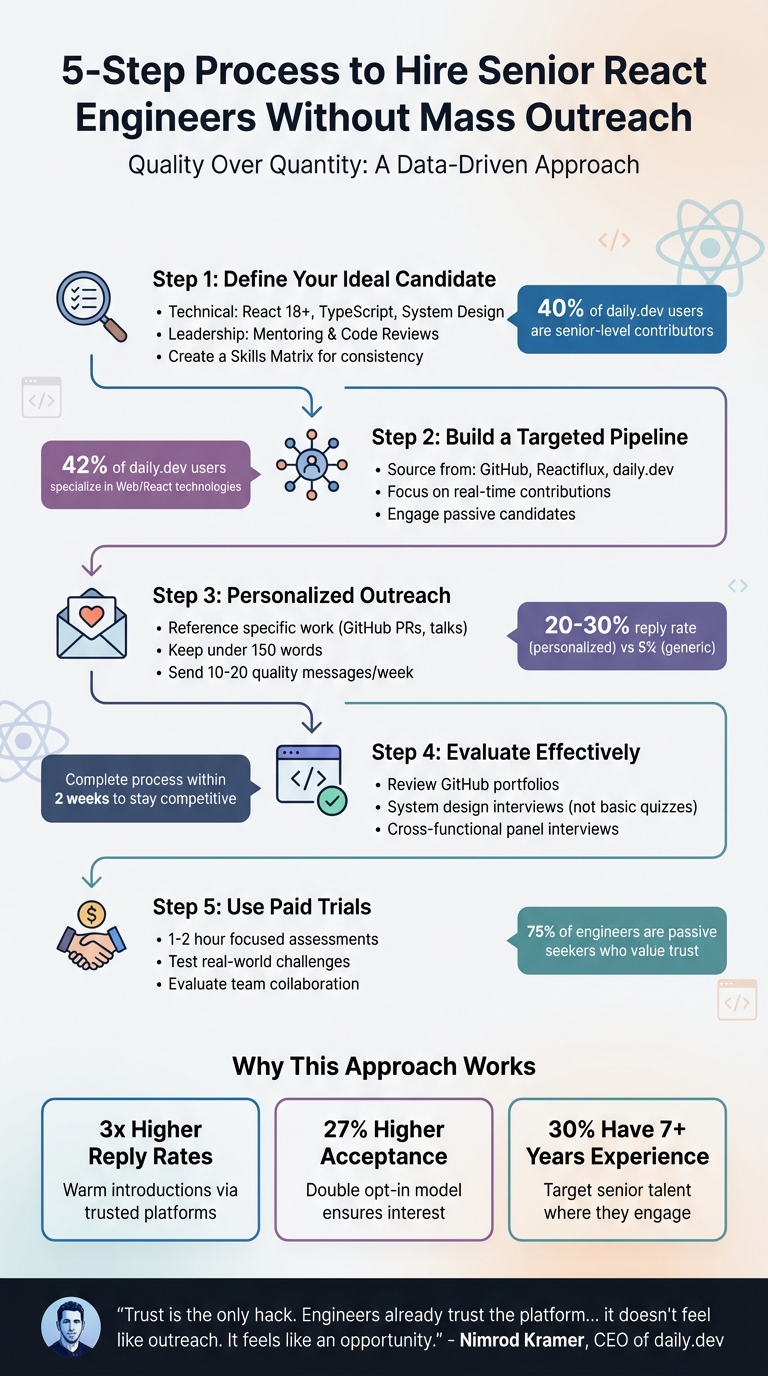 {5-Step Process to Hire Senior React Engineers Without Mass Outreach}
Define Your Ideal Senior React Engineer Profile
Before you begin reaching out to candidates, take the time to define what your ideal senior React engineer looks like. A vague job description can lead to wasted hours sifting through resumes that don’t align with your needs. By clearly outlining the profile of your ideal candidate upfront, you ensure that your outreach targets engineers who not only meet your technical requirements but also thrive in your specific work environment. This clarity is the foundation for an effective hiring process.
The definition of a "senior React engineer" can vary significantly depending on the company. For a startup, it might mean someone capable of building a product from the ground up. In contrast, at a larger organization, the role could focus on providing technical leadership, managing teams, and overseeing complex projects. Your profile should reflect your unique technical challenges, team dynamics, and business objectives - not just a generic checklist of keywords.
Technical Skills and Experience Requirements
Senior React engineers bring more to the table than just basic component development. They should have a deep understanding of React 18+, including concurrent features, server components, and modern hooks. TypeScript expertise is becoming increasingly essential, as it forms the backbone of scalable and maintainable codebases. Beyond React, senior engineers need strong system design skills to make architectural decisions that support long-term product growth.
What sets senior engineers apart is their ability to optimize performance. They should be well-versed in techniques like code splitting, lazy loading, and memoization, and they must know how to identify and resolve bottlenecks using tools like React DevTools and browser profiling. Leadership skills are equally important. A senior engineer should be comfortable mentoring junior developers, conducting thorough code reviews, and introducing new technologies - all of which require clear and effective communication.
It’s also worth considering the context in which candidates have developed their skills. Platforms like daily.dev report that 40% of their users are senior-level contributors or leaders . These platforms provide a unique opportunity to find engineers who actively engage with the latest trends and advancements in React. Unlike static resumes on traditional job boards, these platforms showcase real-time learning and activity, offering deeper insights into a candidate's expertise .
Team and Company Fit
Technical prowess alone doesn’t guarantee a successful hire. Elena Bejan, People Culture and Development Director at Index.dev, highlights the importance of alignment between a candidate’s skills and the company’s goals:
"To be successful in the long run, it is critical to match a candidate's abilities with what the company is trying to achieve and its work environment."
This alignment ensures that your new hire not only meets technical expectations but also contributes positively to your company’s culture and long-term vision.
Start by outlining your company’s mission and values. This will help you determine whether a candidate’s working style and mindset align with your strategic goals . For instance, if your team thrives on rapid experimentation, a candidate who leans toward structured, methodical processes might not be the best fit. Similarly, if you’re building a remote-first culture, prioritize traits like proactive communication and self-management , which are crucial for success in distributed teams.
Including potential team members in the interview process can also provide valuable insights. Behavioral questions about past experiences - such as leading teams, resolving conflicts, or implementing new technologies - can reveal a candidate’s leadership style and interpersonal skills . These discussions shed light on how they collaborate, navigate disagreements, and adapt to different work environments.
Create a Skills Matrix for Senior Roles
A skills matrix is a practical tool for defining what "senior" means within your organization. Without it, interviewers may have inconsistent expectations, leading to conflicting evaluations of candidates.
To build a skills matrix, start by listing key competencies along one axis - such as React fundamentals, TypeScript, testing, system design, mentorship, and communication. Then, define what proficiency looks like for each skill at different levels. For example, while a mid-level engineer might focus on writing unit tests for their own code, a senior engineer would set testing standards for the entire team and mentor others on best practices.
This matrix becomes a valuable reference during interviews, helping you pinpoint gaps in a candidate’s experience and tailor your questions to explore specific areas. More importantly, it ensures that strong candidates aren’t overlooked due to unclear or inconsistent expectations among interviewers. With these criteria in hand, you’ll be better equipped to move forward in sourcing and evaluating candidates effectively.
Build a Targeted Talent Pipeline
Once you’ve nailed down your ideal candidate profile, the next step is to focus on sourcing talent from places where experienced React engineers are already active. Forget the old-school approach of blasting generic outreach - it’s ineffective and can even damage your company’s image. Instead, aim for a more selective and thoughtful strategy by tapping into developer communities where senior engineers actively engage.
Senior React engineers aren’t spending their time scrolling through static job boards. They’re diving into open-source projects, staying up-to-date with technical trends, and contributing to discussions on advanced topics. Platforms like GitHub, React-specific communities such as Reactiflux, Reddit's r/reactjs, and developer-focused networks like daily.dev are hotspots for talent. For instance, on daily.dev, 42% of the active users specialize in Web and React technologies, and 30% have over seven years of experience . These platforms provide dynamic insights into what engineers are building, learning, and sharing - offering a goldmine of opportunities to connect with the right talent.
Source from Developer Communities
When searching for senior React engineers, focus on their real-time contributions rather than just scanning resumes. On GitHub, you can track recent activity on React or Next.js projects, evaluate meaningful pull requests that showcase architectural thinking, or review contributions to widely-used libraries like Redux or React Query . Look for engineers maintaining open-source repositories or crafting detailed READMEs that demonstrate advanced concepts like code splitting or server-side rendering optimization. These are clear indicators of expertise that go beyond just years of experience.
On daily.dev, pay attention to engineers who engage with advanced React topics or share insights on modern tools like Next.js and state management. Their activity reflects not just their past achievements but also their current interests and potential future projects . This approach is particularly useful for identifying passive candidates - those who might not be actively job hunting but are open to the right opportunity. Once you’ve identified promising talent, the next step is to make meaningful connections.
Use Warm Introductions
Building trust is essential, and warm introductions are a great way to do it. Platforms like daily.dev Recruiter use a double opt-in model where engineers signal their willingness to engage, and recruiters can request introductions based on genuine technical activity rather than just keywords .
This personalized approach delivers real results. Companies that use warm introductions see a 27% higher offer acceptance rate because candidates are already pre-vetted for interest before any conversation begins . Nimrod Kramer, CEO of daily.dev, sums it up perfectly:
"Trust is the only hack" .
Additionally, when introductions happen within communities engineers already trust, 40% report feeling more confident about the opportunity . Once trust is established, the focus shifts to crafting role descriptions that resonate with passive candidates.
Engage Passive Candidates Effectively
Senior React engineers are drawn to roles that emphasize their potential impact and autonomy, not just a laundry list of technologies. Tailor your job descriptions to highlight ownership and challenges. For example, instead of generic listings, frame the role with specifics like, “Own React architecture for a 1M+ user app” or “Scale performance 3x while mentoring junior engineers” . Include details about remote work options and the unique product challenges the candidate will tackle.
This level of specificity pays off. Job descriptions that emphasize autonomy, growth, and meaningful impact can boost candidate engagement by 40% compared to traditional postings . To refine your approach, track key metrics like open rates, response times, and interview conversions. Use A/B testing to experiment with different messaging - such as emphasizing a “product mindset” versus a “tech stack” focus - to see what resonates most with your target audience. Providing timely feedback and leveraging data insights can further increase offer acceptance rates by 27% . The goal is to make passive candidates feel genuinely understood and valued, showing them that you’ve taken the time to address what they care about most.
Write Personalized Outreach Messages
Once you've built a targeted pipeline, the next step is crafting outreach messages that feel personal and meaningful. Forget generic emails - they rarely get responses. Instead, focus on writing thoughtful messages that show genuine interest in the recipient's work. The goal isn't to blast hundreds of emails but to send a smaller number of messages tailored to spark real conversations.
Core Principles of Effective Outreach
Effective outreach hinges on three key elements: personalization, brevity, and clarity. Personalization means referencing specific details about the recipient’s work, such as their GitHub contributions, blog posts, or recent projects. For instance, you could mention how they solved a complex state management issue in a React app or highlight a particular commit that stood out to you. Keeping your message short - ideally under 150 words - makes it easy for busy professionals to read and respond. A well-crafted message should start with a strong hook (like a genuine compliment), clearly explain the opportunity, and end with a straightforward call-to-action, such as scheduling a quick call. Below are some message templates that demonstrate these principles.
Outreach Message Templates
Here are three examples of personalized outreach messages tailored to different backgrounds:
For an open-source contributor:
"Hi [Name],
I came across your recent PR optimizing state management in [Repo], and I was impressed by your use of Zustand for scalability. At [Company], we're building a high-traffic React app that deals with similar challenges in real-time data flows. Would you be open to a 15-minute chat next week?
Best,
[Your Name]"For a conference speaker or blogger:
"Hi [Name],
I really enjoyed your talk on React architecture at [Event]. Your insights on GraphQL caching strategies were incredibly relevant to some challenges we're tackling. I'd love to hear more about your perspective - how about a coffee chat?
Best,
[Your Name]"For someone with enterprise experience:
"Hi [Name],
I noticed your work on large-scale React migrations at [Previous Company], and it really stood out. We're facing similar performance challenges and are looking for senior leadership to guide us. Could we schedule a quick call?
Best,
[Your Name]"
Track and Improve Response Rates
Tracking your outreach metrics is essential for refining your approach. Monitor open rates (aim for over 40%), reply rates (personalized messages typically achieve 20–30%, compared to just 5% for generic ones), and positive responses that lead to calls . Tools like Mailchimp, HubSpot, or Lemlist can help you measure and optimize these metrics.
Experiment with A/B testing - compare messages that reference specific contributions, like a GitHub project, to those that focus only on role fit. Data shows that mentioning specific projects can boost reply rates by up to three times compared to generic outreach . Timing matters, too. Sending messages mid-week (Tuesday through Thursday) during business hours (9:00 AM to 12:00 PM EST) often results in better open rates.
If you don’t get a response, follow up after five to seven days, adding value to your message - perhaps by sharing a relevant article or documentation on React architecture. Remember, quality beats quantity. Sending 10 to 20 well-researched messages each week is far more effective than blasting out hundreds of generic emails. With this approach, you'll set the stage for meaningful conversations with candidates. Next, it's time to focus on screening and evaluating them to find the best fit.
Screen and Evaluate Senior React Engineers
After reaching out to candidates with personalized messages, the next step is to carefully evaluate their skills to identify those who truly excel in senior-level engineering. This means focusing on their ability to make architectural decisions, solve real-world problems, and collaborate effectively with teams - rather than relying on theoretical puzzles or basic coding exercises.
Review Code and Portfolio Work
Start by examining the candidate's GitHub repositories, open-source contributions, and past projects. Pay close attention to how they structure large-scale React applications, manage state effectively, and address performance challenges. Look for signs of thoughtful architectural decisions and problem-solving approaches. Reviewing their commit history can also help you gauge their individual contributions versus team efforts .
Conduct Senior-Level Technical Interviews
Once you've confirmed their expertise through their code and portfolio, move on to live technical evaluations. As Travis Lindemoen from Underdog.io aptly notes:
"Asking experienced engineers to take basic coding quizzes is inappropriate - it's like asking a professional golfer to play putt-putt" .
Instead, design interviews around system design challenges and architectural decision-making. For example, ask candidates to design a system relevant to your business, such as an e-commerce checkout flow or a real-time dashboard. Have them explain their choices for state management libraries, data-fetching strategies, and component architecture . Introduce unexpected constraints during the discussion - like a sudden change in requirements - to see how they adapt and rethink their decisions . The goal is to evaluate their problem-solving process and the trade-offs they consider, rather than expecting perfect code .
A good structure for these interviews could include a 30-minute session on advanced JavaScript patterns, followed by a deeper dive into system design and how they navigate evolving challenges .
Assess Collaboration and Cultural Alignment
Technical expertise is only part of the equation. Senior engineers must also mentor others, communicate effectively, and align with your company's values. Test their collaboration skills by having them work on a realistic problem alongside your team . This exercise can highlight how they explain their thought process, respond to feedback, and adjust their approach based on input.
To ensure they can work well across teams, involve a cross-functional panel - including product managers, designers, and QA engineers - to evaluate how they communicate with non-technical stakeholders. Marcelo Wiermann from Engineering Land emphasizes:
"The goal is not to ship software, but to serve customers. You want engineers who know how their work affects business KPIs" .
Finally, during reference checks, ask specific questions about their ability to perform under pressure and mentor junior team members. To stay competitive and secure top talent, aim to contact candidates within 48 hours of each interview and complete the evaluation process within two weeks .
Use Paid Trials to Validate Fit
Consider offering a short-term paid trial after interviews to assess both technical skills and work style in a real-world context. This method minimizes the risk of a poor hiring decision while respecting the candidate’s time and expertise. It’s a win-win: you get to evaluate the candidate's capabilities, and they get a chance to experience your team and workflow.
Keep the trial concise - aim for a focused 1–2 hour assessment rather than an unpaid, multi-day project. As highlighted in senior-level hiring practices, it's recommended to "shorten and pay for focused, 1–2 hour DevOps assessments, offer transparency and live reviews to reduce candidate drop-off and attract senior engineers" . Offering fair compensation not only values the candidate’s expertise but also sets your process apart, which is crucial since 75% of engineering professionals are passive job seekers who engage only with opportunities that build trust .
During the trial, pay close attention to how the candidate tackles real challenges your team faces. Evaluate the readability, scalability, and maintainability of their code. Key areas to assess include their understanding of the React lifecycle, effective state management, and the ability to create reusable components. Also, keep an eye on their use of tools like linters, formatters, and their approach to meaningful commit messages . These details often reflect their dedication to high-quality engineering practices .
Beyond technical skills, observe how they interact with your team. Collaboration and communication are critical, especially for senior roles. Invite product managers and designers to participate in the trial to see how the candidate explains technical concepts to non-technical team members and responds to feedback. Strong candidates will demonstrate emotional intelligence by staying open to input and knowing when to ask for help . This step helps you gauge whether their work style aligns with your company’s values .
A paid trial isn’t just an evaluation for you - it’s also an opportunity for candidates to experience your team’s culture, codebase, and processes firsthand. This mutual assessment approach - “commit only if it works” - builds trust and ensures a better fit for both sides from the very beginning.
Conclusion
Finding and hiring senior React engineers isn’t about casting the widest net - it’s about precision and meaningful engagement. The strategies covered in this guide - defining a clear candidate profile, building focused pipelines through developer communities, crafting personalized outreach, and testing fit with paid trials - are designed to save time while yielding better results. It’s a simple truth: when it comes to top-tier talent, quality beats quantity every time.
The data backs this up. For example, daily.dev’s approach to warm pitching achieves reply rates that are three times higher than traditional methods. Why? Most developers prefer connecting on platforms they already trust . Nimrod Kramer, CEO & Co-Founder of daily.dev, sums it up perfectly:
"Trust is the only hack. Engineers already come to daily.dev to grow. They already trust the platform... When your role shows up inside that flow, it doesn't feel like outreach. It feels like an opportunity."
daily.dev Recruiter taps into this trust. It connects you with senior React engineers where they’re already active - reading, learning, and contributing to developer communities. With 40% of its audience being senior-level engineers or tech leaders and 42% specializing in Web/React , you’re not chasing outdated resumes. Instead, you’re reaching passive candidates based on their real interests and activities. Plus, the platform’s double opt-in approach ensures introductions are warm and relevant, eliminating the cold spam factor entirely.
FAQs
What key skills should you look for in a senior React engineer?
A senior React engineer needs to have a solid grasp of core React concepts like JSX, hooks, and the component lifecycle. Mastery of state management tools such as Redux, Zustand, or MobX is crucial, along with a strong command of performance optimization techniques like code-splitting, memoization, and profiling.
They should also be highly skilled in modern JavaScript and TypeScript, familiar with testing frameworks like Jest or React Testing Library, and capable of designing scalable architectures. On top of that, strong debugging abilities, experience with CI/CD workflows, and the capacity to mentor and communicate clearly are key traits for thriving in this role.
What’s the best way to personalize outreach to senior React engineers?
To personalize your outreach effectively, focus on research, relevance, and clear communication. Start by digging into the candidate’s recent work - whether it’s GitHub projects, blog posts, or conference talks - and highlight specific achievements or technologies that align with your role. For instance, referencing a standout project they’ve worked on can demonstrate genuine interest and set your message apart.
Use their name and make a clear connection between their skills and the position you’re offering. Be upfront about compensation by including a salary range in U.S. dollars (e.g., $130,000–$150,000 base + equity) - this transparency helps build trust. Timing is also key: aim to send your message midweek (Tuesday–Thursday) in the early afternoon (around 1–3 PM EST) to boost your chances of a response.
If they don’t reply after a few days, follow up with something of value - perhaps a relevant article or insights about your team’s current React projects. Keep your tone professional but approachable, and tailor your message to their experience. This thoughtful approach will help you stand out and encourage engagement.
Why is offering a paid trial a smart step in the hiring process?
A paid trial offers a practical way to assess a senior React engineer's abilities in a real work environment. It gives you insight into how they tackle challenges, work with your team, and deliver results when faced with real-world tasks.
This method not only minimizes the chances of hiring mistakes but also boosts your confidence in the decision-making process. On top of that, compensating candidates for their time shows respect and professionalism, which can help you build trust and appeal to highly skilled professionals.
.png)