Relying on old methods like job boards or generic LinkedIn outreach? That approach won’t fill your engineering roles anymore. Here's why:
- 98% of tech candidates are already employed, with only 2% actively job hunting.
- Top talent is off the market in 10 days, but filling roles takes 49–82 days on average.
- Generic outreach yields 5–8% response rates, while personalized efforts can reach 30%.
- AI tools and developer-first sourcing channels (like GitHub and daily.dev) now dominate recruitment strategies.
To succeed, you need to:
- Focus on passive talent through relationship-driven methods.
- Use AI sourcing and analytics for faster, smarter candidate matching.
- Prioritize transparent, personalized communication - include salary, tech stack, and role details upfront.
- Meet engineers where they are: niche communities, open-source platforms, and technical forums.
The key is shifting from mass outreach to meaningful connections. Outdated databases, vague messages, and lengthy processes won’t cut it anymore. To hire effectively, adopt tools and strategies that align with how developers work and engage today.
How Engineer Recruitment Changed Since 2016
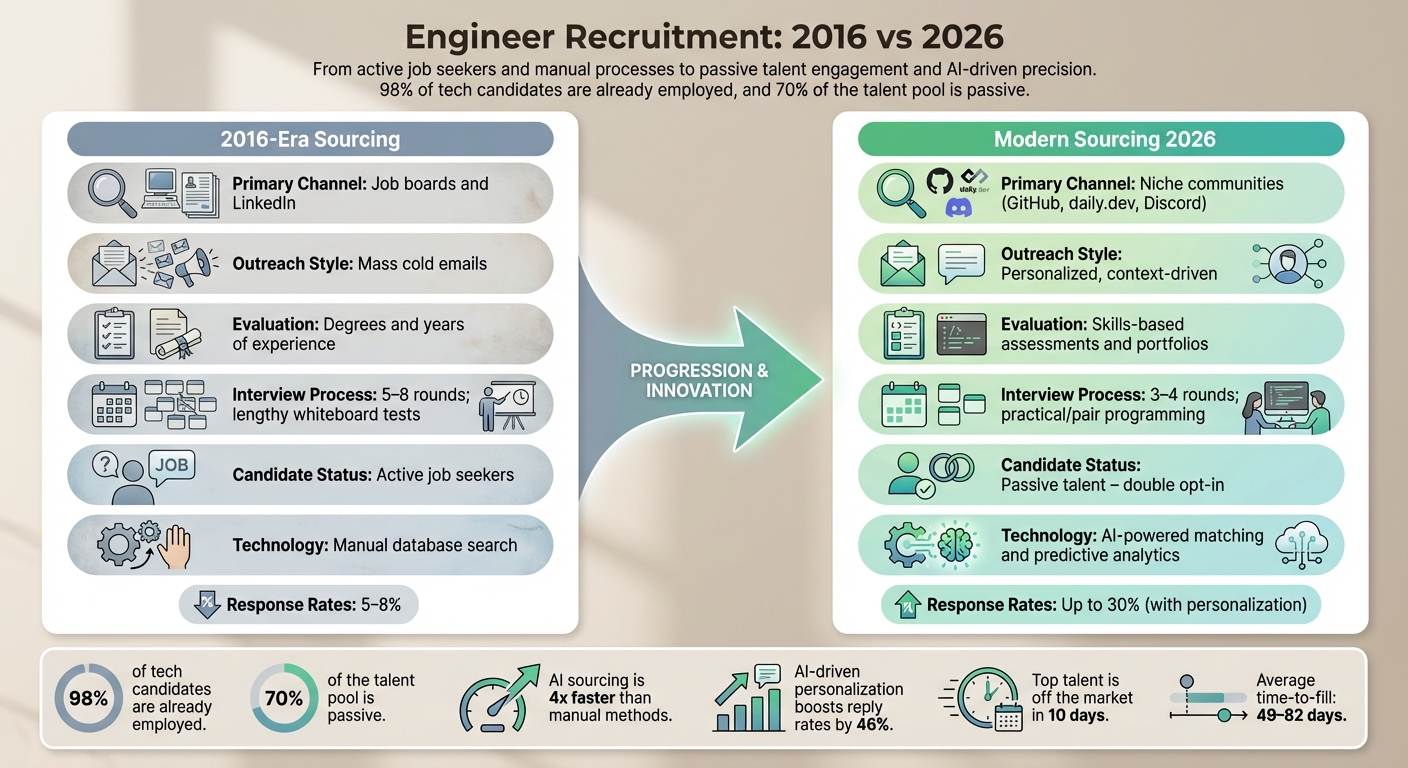
The landscape of tech hiring has undergone a major transformation since 2016. Posting jobs on boards and sending out mass emails no longer deliver the results they once did. Eighty-one percent of professional developers are employed full-time, and fewer than 2% are actively job hunting. This means most skilled engineers aren’t scrolling through job boards or updating their profiles to attract recruiters.
The data paints a clear picture: 70% of the talent pool is passive. With about three job openings for every engineer actively searching, the competition for talent has become fierce. The old strategy of casting a wide net and sifting through piles of applications has been replaced by more focused, relationship-based methods that connect with engineers where they already spend their time. Today’s new candidate sourcing tactics must align with this new reality.
The Shift to Passive Talent and Developer-First Recruiting
Top engineers aren’t waiting around for recruiters to send them InMails. They’re busy working on meaningful projects, contributing to open-source code, and sharpening their skills. Ninety-two percent of developers would consider leaving their current job if approached by a company with a strong brand and reputation. But the way they’re approached makes all the difference.
Developer-first recruiting flips the script. Instead of bombarding engineers with generic outreach, this approach focuses on building trust and offering value right from the start. That means sharing clear role details upfront - transparent salary ranges, the specific tech stack they’ll be working with, and a clear explanation of the challenges they’d tackle - all before even asking for a conversation. Candidate Relationship Management (CRM) now emphasizes long-term engagement over quick, transactional hires. As technical sourcer Anastasia Dontova puts it:
"You can't out-spend Big Tech, but you can out-nurture them".
The double opt-in model has become the go-to strategy. Developers first review the role details and then decide if they want to engage. This eliminates the spammy nature of the mass email campaigns that defined recruitment in 2016, ensuring every conversation begins with genuine interest from both sides. Modern tools have further supercharged this relationship-driven approach, as we’ll explore next.
Technology That Changed How We Hire
The shift in recruitment has been propelled by advances in technology. Automated candidate sourcing using AI is now four times faster than manual methods, and it’s no longer limited to basic keyword searches. Today’s AI tools analyze the context of a developer’s work, such as their side projects, open-source contributions, and ongoing learning efforts, instead of simply scanning for buzzwords on a résumé.
The results speak for themselves. AI-driven personalization boosts reply rates by 46% (35.3% compared to 24.1%) and increases the likelihood of hiring high-quality candidates by 9%. These enhancements can mean the difference between filling a position in weeks instead of months.
Automation has also taken over many time-consuming tasks. AI tools can now parse résumés for specific tech skills like Kubernetes or AWS, manage interview scheduling, and maintain detailed candidate engagement histories that integrate seamlessly with Applicant Tracking Systems. Predictive analytics adds another layer, identifying passive candidates who might be open to new opportunities based on their engagement with technical content or professional activity. This allows recruiters to reach out at just the right moment.
| Feature | 2016-Era Sourcing | Modern Sourcing (2026) |
|---|---|---|
| Primary Channel | Job boards and LinkedIn | Niche communities (GitHub, daily.dev, Discord) |
| Outreach Style | Mass cold emails | Personalized, context-driven |
| Evaluation | Degrees and years of experience | Skills-based assessments and portfolios |
| Interview Process | 5–8 rounds; lengthy whiteboard tests | 3–4 rounds; practical/pair programming |
| Candidate Status | Active job seekers | Passive talent – double opt-in |
| Technology | Manual database search | AI-powered matching and predictive analytics |
Recruitment platforms have also shifted dramatically. Instead of relying on generic job boards, hiring efforts now focus on developer-first communities like GitHub, Stack Overflow, and daily.dev. These spaces encourage authentic interactions and warm introductions, a far cry from the cold, impersonal outreach methods of the past.
Why 2016 Sourcing Methods Fail Today
Recruiting strategies that worked in 2016 no longer cut it. The numbers speak for themselves: generic cold emails now yield response rates of just 5% to 8% , and 65% of recruiters say they struggle to find qualified candidates with traditional methods . What once seemed like an efficient way to connect now feels like spam to developers, who’ve grown adept at filtering out low-effort outreach.
Generic Outreach Gets Ignored
Developers are quick to spot impersonal, mass-produced emails . They can recognize a template in seconds - and delete it just as fast. These generic messages not only fail to engage but also damage your brand's credibility. When engineers repeatedly see the same tired pitches about "exciting opportunities" and "competitive salaries", they simply tune out.
In contrast, personalized outreach can make a huge difference, with response rates climbing to 30% when recruiters take the time to tailor their messages to highly matched candidates . Kiera Cox, a technical recruiter at Liveflow, highlights the impact:
"I get candidates all the time - in emails and on calls - say things like 'I've never gotten such a personalized recruiter outreach message before'"
. Despite this clear advantage, many recruiters still fall short. And with top technical talent often off the market in just 10 days , relying on generic outreach isn’t just ineffective - it wastes your limited window to make a connection. This outdated approach often goes hand in hand with another major issue: relying on obsolete candidate databases.
Outdated Databases Don't Deliver Results
Traditional candidate databases come with a glaring flaw: they’re outdated almost as soon as they’re created. Vicky Liu of Juicebox doesn’t mince words:
"The data is old the second you type it in"
. In fact, around 30% of candidate information becomes irrelevant within a year . This means the résumés and contact details you’re using may already be inaccurate.
Even worse, these systems often miss out on the majority of top talent. Research shows that up to 87% of skilled engineers are passive candidates who don’t frequent traditional job boards . Instead, they’re contributing to open-source projects and developer communities on GitHub, daily.dev, or Discord. Joel Spolsky, co-founder of Stack Overflow, summed it up well:
"The great software developers... are quite simply never on the market"
. If your sourcing strategy relies solely on scraping databases or running keyword searches, you’re likely overlooking the best candidates. Beyond outdated data, recruiters also need to address another expectation: clear and honest communication.
Developers Expect Personalized, Transparent Communication
Developers today expect more than a well-crafted email - they want transparency from the very first interaction. Vague phrases like "competitive compensation" or unclear details about the tech stack send the wrong message. Engineers want to know exactly what they’re signing up for, and they won’t waste time on recruiters who fail to provide upfront details.
It’s worth noting that 54% of developers are open to new opportunities , but they’re selective about who they engage with. They want to see salary ranges in USD, understand the technologies they’ll work with, and know the challenges they’ll tackle - all before agreeing to a conversation. Companies that fail to offer this level of clarity risk harming their reputation as an employer. Sonya Yeonas, Technical Recruiting Manager at Ramp, explains:
"When we send out our sequences, most sourcers here at Ramp have three or four stages with data showing we get the most response on the second or third outreach versus that first one"
. Following up is crucial, but it only works if your initial message shows respect for the developer’s time and demonstrates a genuine understanding of their needs.
A Modern Playbook for Sourcing Engineers
The old ways of recruiting engineers just don’t cut it anymore. Cold emails, outdated databases, and cookie-cutter templates? Those belong in the past. Today, it’s all about using smarter strategies that tap into modern platforms and data insights. To connect with developers effectively, you need to meet them where they are, build trust before asking for their time, and rely on data to screen candidates. Here’s how you can make it happen.
Go Where Developers Are Active
Most skilled tech professionals aren’t scrolling through job boards - they’re already employed and busy contributing to open-source projects on GitHub, reading technical articles on daily.dev, or engaging in niche communities like Discord and Stack Overflow. If you’re still relying on job boards, you’re fishing in the wrong pond.
Instead, focus on platforms where developers are actually spending their time. For example:
- GitHub: Look for recent contributions to open-source projects.
- daily.dev: Engage with developers reading and sharing technical content.
- Discord and Stack Overflow: Participate in niche communities.
To maximize response rates, target developers who’ve recently updated their profiles or added new skills - this group is 4x more likely to respond . Timing matters too: outreach sent between 12 PM and 6 PM local time tends to perform best . By using "recent activity" filters, you can zero in on passive candidates who are actively sharpening their skills, making your outreach far more effective.
Build Relationships, Not Interruptions
Cold emails? They’re a thing of the past. Today’s developers respond better to double opt-in introductions - where they choose to engage with you after reviewing the role’s full context. This shifts recruiting from being an interruption to becoming an invitation.
Start by building a pipeline of passive talent through nurturing, not pitching. Share technical insights, invite developers to private Slack groups, or highlight their open-source work. Keep the focus on adding value rather than immediately pushing a job opening. Use your CRM to segment developers by their tech stack (e.g., "Rust enthusiasts") and their availability (immediate vs. 6–12 months down the line). When a role opens up, you’ll already have a pool of pre-qualified engineers who trust your brand and are open to conversations. This approach replaces the transactional methods that just don’t resonate with today’s passive candidates.
Once you’ve built these warm connections, you can take things a step further with data-driven evaluation.
Let Data Lead Your Screening Process
Relying solely on résumés is outdated. Instead, assess candidates based on real-world skills, their GitHub portfolios, and hands-on work samples. Boolean search strings like "software engineer" AND (Python OR Java) AND "machine learning" -junior can help you narrow down your search effectively . Focus on candidates who are actively contributing to projects rather than those with stagnant profiles.
Using AI in tech recruiting for personalization can also make a big difference. For example, AI-driven outreach has been shown to boost reply rates from 24.1% to 35.3% - a 46% increase . Use automation to follow up when candidates engage with your content, but don’t forget the human touch. Reference their specific work or contributions to show you’ve done your homework. This ensures you’re evaluating candidates based on their current skills and not outdated credentials.
Write Outreach That Developers Actually Want to Read
Developers can spot a generic template a mile away. To stand out, reference their specific projects, technical talks, or open-source contributions. Be transparent about salary by providing exact ranges in USD, and clearly outline your tech stack - don’t just say "fullstack", but specify tools like "React 18, Node, AWS."
Here’s a quick comparison of outdated vs. modern outreach:
| Feature | Traditional Outreach (2016 Style) | Modern Developer Outreach (Today) |
|---|---|---|
| Personalization | Name-only templates | References to specific code/projects |
| Salary | "Competitive" (Hidden) | Transparent range in USD |
| Tech Stack | Vague (e.g., "Fullstack") | Precise (e.g., "React 18, Node, AWS") |
| Focus | Company milestones/funding | Technical challenges and impact |
| Channel | LinkedIn/Cold Email | Niche communities/Double opt-in |
Developers care about solving meaningful problems, growing their careers, and working with great teams - not just perks or company milestones. With 66% of candidates now expecting upfront transparency and sourcing emails achieving an 86% average open rate , clarity isn’t just a nice-to-have - it’s essential. Tailoring your message to focus on technical challenges and career growth is the key to breaking through the noise.
Tools You Need for Modern Engineer Recruitment
Having a solid sourcing strategy is just the beginning - success hinges on using the right tools to bring that strategy to life. Gone are the days of manual searches and endless spreadsheets. Today’s recruitment landscape demands platforms that can automate repetitive tasks, highlight top candidates, and provide real-time insights.
Developer-Focused Recruitment Platforms
Traditional job boards and LinkedIn scraping often fall short because they aren’t designed with developers in mind. Instead, focus on platforms that connect with engineers in the spaces they frequent. For example, daily.dev Recruiter reaches developers within their active communities, where they engage with technical content and expand their knowledge. What sets it apart? Every candidate introduction is warm and double opt-in, ensuring you only interact with individuals who are genuinely interested.
AI and Automation for Smarter Screening
Did you know recruiters spend an average of just 7.4 seconds on a resume ? That’s hardly enough time to assess technical fit. AI-powered tools are transforming this process by automating repetitive tasks like screening candidates, matching them to roles, and even crafting personalized outreach at scale. Take Ashby, for instance - it uses AI tokens to generate tailored email content based on a candidate’s work history, which has been shown to increase reply rates from 24.1% to 35.3% .
Other tools, like Fetcher.ai and Paradox Olivia, streamline personalized outreach sequences , while platforms such as Beamery and Greenhouse CRM help build pools of pre-qualified passive candidates through long-term nurture campaigns . These AI-driven solutions can cut manual sourcing time by up to 80% , letting your team focus on building relationships rather than sifting through profiles. With predictions showing that 75% of organizations will adopt AI-based talent solutions by 2026 , this shift is already well underway. Beyond speed, these tools also generate valuable data to continuously refine your recruitment strategy.
Analytics for Smarter Recruitment Decisions
Automated outreach is just one piece of the puzzle - data analytics now play a central role in guiding recruitment strategies. Modern tools provide real-time insights into performance, helping you make informed decisions. For example, Ashby offers dashboards that track key metrics like reply rates, passthrough rates, weekly outreach sequences, time-to-fill, and conversion rates .
In 2023, Ramp’s talent team doubled its sourcing efforts and used Ashby’s analytics to fine-tune their outreach strategy. Similarly, PeopleGPT provides talent insights dashboards that help map competitive landscapes, compare salary expectations across locations, and monitor metrics like "Time to Shortlist" . In 2025, Ramp leveraged PeopleGPT to identify a larger talent pool in a city with lower salary expectations, enabling them to fill a senior engineering role 30% faster than anticipated .
Shifting focus to quality metrics - such as qualification rates and long-term retention - is crucial, as these are three times more predictive of success than volume-based metrics . With average campaign reply rates at 19.6% and email open rates hovering around 86% , tracking these numbers allows you to fine-tune your approach and maximize your return on investment.
How to Measure Sourcing Success
If you want to improve your sourcing strategy, you need to measure the right things. Metrics aren't just numbers - they're the story of how well your efforts are translating into quality hires and efficient processes. Forget vanity stats like how many emails you sent; instead, focus on data that reflects hiring quality and speed. These insights will guide you in ensuring strong candidates move seamlessly through your pipeline.
Response and Engagement Rates
Understanding response and engagement rates is crucial. Response rates tell you how many people opened your message, while interest rates reveal how many are genuinely interested in the role. These are not the same thing. On average, reply rates sit at 19.4% , but not all replies are positive - some are just polite declines. The real focus should be on interest rates, which average 37.7% for sourcing campaigns .
High open rates (around 86% ) paired with low replies? That’s a messaging problem. Personalization can make all the difference. For example, in March 2024, Kiera Cox, a Technical Recruiter at Liveflow, used AI to craft outreach messages tailored to candidates' work histories. The result? A noticeable boost in response rates. As Kiera explained:
"Using Ashby's AI helps us source more quickly while still sending out way higher quality emails."
The numbers back her up. AI-driven personalization can increase reply rates by 46%, jumping from 24.1% to 35.3% .
Keep your outreach sequences concise. Data shows reply rates level off after three emails , so don’t waste time with overly long campaigns. Timing also plays a role - sending messages between 12 PM and 6 PM in the candidate's local time zone can significantly improve responses .
Pipeline Candidate Quality
A pipeline full of poorly matched candidates is a red flag. The application-to-interview conversion rate is a great way to measure the quality of your sourcing efforts. High-performing teams typically see 30–50% of sourced candidates advancing to interviews , a much stronger outcome than inbound applications. In fact, sourced candidates are hired at more than double the rate of inbound applicants .
To maintain quality, track how candidates progress through each screening stage. Metrics tied to candidate quality are three times more predictive of recruitment success than volume-based metrics . This means focusing on whether candidates meet the role’s technical requirements, have the right experience, and align with your team’s values - not just how many profiles you’ve reviewed. Using standardized scorecards can help ensure your evaluations are consistent and fair.
Time-to-Fill and Retention Rates
Once you’ve confirmed candidate quality, it’s time to measure how quickly and effectively you’re filling roles. Time-to-fill tracks the days from role approval to when an offer is accepted. For technical engineering roles, the median time-to-fill is 49 days . Top teams, however, speed things up by focusing on "time to launch", which measures how quickly outreach begins after a role is approved . Delays at the start of the process often lead to bottlenecks later.
Retention rates offer a long-term view of hiring success. Track retention at 30, 90, 180 days, and one year to identify trends. High-performing teams aim for 90% or higher retention after 12 months . If sourced hires are leaving early, use exit interviews to uncover the reasons - whether it’s mismatched expectations, poor alignment with company values, or flaws in your screening process. Additionally, keep an eye on your offer acceptance rates. Teams that close 85–90% of their offers demonstrate a competitive compensation strategy and a strong candidate experience .
Conclusion: Moving to Developer-First Hiring
Hiring engineers in 2026 requires more than just sending out mass emails or relying on outdated databases. It’s about trust, transparency, and a personal touch. While 80% of developers are open to new opportunities, a staggering 43% completely ignore recruiter outreach . Why? The disconnect is clear: 69% of developers expect salary details upfront, and 19% will dismiss your message outright if that information is missing . Transparency isn’t just a nice-to-have - it’s the key to turning ignored messages into meaningful conversations.
Focus on the essentials in your first message: include the tech stack, salary range, and work model. These aren’t optional details - they’re the baseline for developer-first recruiting. This approach lays the groundwork for building genuine, long-lasting relationships with the best talent in the field.
Platforms like daily.dev Recruiter are already leading the way, offering warm introductions that fit seamlessly into this modern hiring strategy. Instead of sending cold outreach to developers who may not even be looking, you’re connecting with pre-qualified candidates who are actively engaged and open to new opportunities. It’s a smarter, more respectful way to recruit.
"This isn't a sourcing problem. It's a trust problem." - daily.dev State of Trust Report
To succeed, embrace these developer-first principles. If your recruiting methods still feel like they belong in 2016, you’re not just outdated - you’re invisible. Developers are moving away from traditional hiring tools, and only recruiters who provide real value and respect their time will stand out. By prioritizing transparency, leveraging the right tools, and focusing on quality over quantity, you’ll be equipped to hire top engineers in 2026. It’s not about doing more - it’s about doing it better.
FAQs
How can AI tools improve hiring engineers in today’s tech landscape?
AI tools are reshaping the way recruiters discover and hire engineers, making the process smoother and more insightful. By analyzing code repositories, developer forums, and project contributions, these tools help pinpoint candidates with the right skills - focusing on actual expertise rather than just keyword-stuffed resumes. This not only saves valuable time but also opens the door to finding diverse talent that might otherwise go unnoticed.
These tools also improve outreach efforts by generating personalized messages tailored to a candidate’s work, which can significantly increase response rates while still feeling authentic. On top of that, AI takes over repetitive tasks like screening resumes, reviewing code samples, and ensuring evaluations are free from bias. This speeds up the hiring process and makes it fairer for everyone involved. When combined with applicant-tracking systems, AI creates a streamlined hiring pipeline that enhances the candidate experience and helps you secure top engineering talent more effectively.
How can I improve response rates when recruiting engineers?
To increase response rates, focus on making your outreach personal. Mention specific projects, technologies, or contributions that align with the engineer's work. This demonstrates genuine interest and helps establish trust. Avoid sending generic messages - engineers are far more likely to engage when they feel recognized and appreciated.
Leverage data-driven tools to track real-time developer activity, such as open-source contributions or GitHub commits, and craft messages that highlight these accomplishments. Combine this with a clear and detailed job description that includes the role's responsibilities, the tech stack, and perks like remote work options or transparent salary details. Engineers are more inclined to respond when the opportunity feels relevant and straightforward.
Keep the conversation going with thoughtful follow-ups. For example, share a useful article, a relevant code snippet, or a short video showcasing your team culture. Tap into employee referrals and use a CRM system to manage interactions and automate follow-up reminders, ensuring you stay on top of promising leads.
Why is it essential to focus on passive candidates when hiring engineers today?
When it comes to hiring skilled engineers, focusing on passive candidates can make a big difference. Why? Because around 70% of the tech workforce isn’t actively job hunting. These individuals are often seasoned professionals with sought-after expertise, making them great assets for any team.
Targeting passive talent not only broadens your hiring options but also boosts your chances of connecting with standout candidates. To succeed, it’s all about building trust and tailoring your outreach. By doing so, you can capture the interest of these high-caliber developers and maintain a competitive edge in the fast-paced tech hiring world.
.png)