Hiring backend engineers in 2026 is challenging due to the difficulty of identifying production-level expertise during traditional interviews. A junior developer using modern frameworks can produce code that looks similar to that of a senior engineer, but lacks the depth needed for scalable, reliable systems. This gap often results in technical debt or costly fixes, with backend errors like N+1 queries or poor session management leading to significant performance issues or security risks.
Key takeaways for hiring backend engineers:
- Core Skills: Proficiency in server-side programming (e.g., Python, Go, Rust), database optimization, API development, scalability, and debugging.
- Assessment Methods: Use task-based evaluations like coding challenges, system design interviews, debugging scenarios, and code reviews to simulate production needs.
- Sourcing Talent: Explore platforms like GitHub for open-source contributors and daily.dev Recruiter for warm introductions to skilled candidates.
- Structured Frameworks: Define role-specific competencies and use standardized rubrics to ensure fair and effective evaluations.
Core Skills Required for Backend Engineers
Backend engineering in 2026 goes far beyond just writing functional code. The real challenge lies in creating systems that can thrive under real-world production demands without faltering. With around 62% of developers identifying as backend or full-stack engineers , the competition for advanced skills is fierce. The global software development market, projected to reach $0.64 trillion in 2026 with an 11.74% annual growth rate , underscores the rising demand for highly skilled professionals.
Server-Side Programming and Frameworks
Mastery of server-side programming languages is at the heart of backend engineering. Engineers should be proficient in Python (FastAPI, Django), Java (Spring Boot), Node.js (Express, NestJS), Go, or Rust, particularly for high-performance applications . However, true expertise goes beyond familiarity. For instance, understanding how Django or Rails generates SQL queries when using an ORM's .where() method can reveal a deeper grasp of database interactions .
A practical example: Kellton revamped a high-frequency trading platform by switching from Node.js to Go's Gin framework. This change reduced their AWS Fargate usage by 50% while maintaining sub-10ms p99 latency . It highlights why choosing the right language for the workload is critical. Go is now a go-to for high-throughput infrastructure, while FastAPI leads in AI-integrated applications due to its asyncio capabilities .
While JavaScript remains the most commonly used language at 65.85% , Rust earns the title of "most loved", with 87% of developers eager to continue using it . Java, with its strong enterprise presence, is still utilized by 48% of developers . The key takeaway? Match the language to the task - Go and Rust for low-latency systems, Python or Ruby for quick prototyping . Beyond programming languages, engineers must also excel in database management to build reliable systems.
Database Management and Optimization
A well-designed database is the backbone of any scalable system. Poor database practices can cripple performance and lead to system failures under heavy traffic. Candidates should demonstrate how they address issues like the N+1 query problem, showing that they view database schemas as critical architectural components rather than just storage solutions .
Strong candidates are skilled in both relational databases (PostgreSQL, MySQL) and NoSQL systems (MongoDB, Redis, Cassandra) . But technical know-how isn't enough. Ask candidates to recount a real-world database issue they've resolved, detailing tools like EXPLAIN ANALYZE or slow query logs and explaining the root causes at the execution plan level .
For senior roles, understanding distributed systems is essential. Can they discuss the CAP theorem and its implications for database design? Do they know how to implement sharding, replication, and quorum-based systems to ensure consistency ? These skills are critical for scaling systems effectively. After all, inefficient database queries can directly impact revenue - slow checkout processes, for instance, lead to abandoned carts and lost sales . Fixing database-related technical debt can also incur significant costs, sometimes three to five times a developer's annual salary .
API Development and Integration
Building robust APIs is another cornerstone of backend engineering. Engineers need expertise in RESTful architecture, GraphQL, and gRPC, alongside secure authentication protocols like OAuth2 and JWT . However, API development isn't just about functionality - it's about creating interfaces that are reliable and developer-friendly. The best engineers ensure every endpoint is instrumented for observability before deployment. As Nurullin puts it:
Observability is not a feature you add after the fact - it is the mechanism by which you know whether the feature you just shipped is behaving correctly in production .
This proactive approach reflects a senior-level mindset, focusing on maintainability and system reliability from the outset.
Scalability and Performance Optimization
Designing systems that scale effectively is a hallmark of experienced backend engineers. This involves expertise in distributed systems, microservices, serverless computing (e.g., AWS Lambda), and event-driven architectures like Kafka or RabbitMQ . By 2026, 75% of backend roles will require proficiency in major cloud platforms .
Scalability isn't just about adding servers; it's about anticipating and addressing potential failure points. For example, how does the system handle duplicate webhooks or cache stampedes? The best engineers design with these edge cases in mind rather than treating them as afterthoughts . Once scalable designs are in place, strong debugging practices ensure the system remains resilient under pressure.
Debugging and Observability
Monitoring and profiling skills using tools like Prometheus, Grafana, and Jaeger are now essential . Top engineers don't wait for problems to escalate - they build systems that detect issues before users are affected. Whether it's spotting N+1 queries or addressing connection pool saturation, these engineers proactively identify bottlenecks. Familiarity with Docker, Kubernetes, Terraform, and CI/CD pipelines further solidifies their ability to deploy and iterate efficiently .
How to Assess Backend Engineering Skills
Finding the right backend engineer means going beyond resumes to uncover real-world skills. Task-based assessments have proven to be effective in reducing candidate drop-off rates . By designing evaluations that test reasoning, debugging, and communication, you can align your hiring process with the demands of backend engineering.
Coding Challenges
Good coding challenges mimic the tasks engineers handle daily. Focus on areas like REST API development, database migrations, or CI/CD troubleshooting . Keep challenges concise - 60 to 90 minutes - and provide pre-configured repositories with frameworks, database settings, and linting tools. Including unit-test harnesses is a great way to give candidates instant feedback .
For senior-level candidates, add complexity. Scenarios involving duplicate handling or partial failures can reveal deeper problem-solving skills . Code review exercises are also valuable for spotting subtle architectural issues .
Here’s an example: Between April 2019 and October 2020, Slack's backend engineering team replaced open-ended take-home assignments with a two-hour GitHub-hosted code review exercise. They even built a custom Electron app, "Slack Engineering Recruiting Tools", to automate candidate-specific repositories. This, paired with onsite "no-whiteboard" coding sessions, cut their average time-to-hire from 200 days to just 83 .
System Design Interviews
Tailor system design challenges to your product. For example, you might ask candidates to design multi-tenant permission systems, high-concurrency e-commerce APIs, or analytics platforms handling 50 million rows . Introduce real-world constraints, like achieving sub-5ms p99 latency or managing large data sets, to push candidates to think critically.
The best candidates will ask clarifying questions about scale, consistency, and failure modes before diving into their designs . Look for their ability to weigh trade-offs, such as eventual versus strong consistency or strategies for avoiding cache stampedes . Encourage them to explain their decisions as if writing an Architecture Decision Record, detailing why they chose one approach over others .
You can also simulate production issues during the interview. For example, ask, "What happens if the database write succeeds, but the downstream email service is unavailable?" This tests their understanding of idempotency and retry logic . As Almaz Nurullin from EXZEV puts it:
The difference [between a junior and senior] is invisible until the system is under load, until the edge case hits production, or until the team has to extend the architecture in a direction the original author never anticipated .
Debugging Scenarios
Debugging exercises reveal how candidates handle pressure. Present a scenario like an endpoint with 800ms p95 latency and connection pool metrics, then observe their diagnostic process . Strong engineers approach problems systematically, reading error messages, forming hypotheses, and testing solutions instead of panicking .
Provide slow-running queries with execution plans (such as EXPLAIN ANALYZE) to see if candidates can identify bottlenecks like sequential scans or missing composite indexes . You can also test their ability to address N+1 query issues, which can lead to thousands of unnecessary database calls per minute without proper eager loading . Finally, review their open-source contributions and portfolio for deeper insights into their skills.
Portfolio and Open-Source Contributions
A candidate's GitHub or open-source work can reveal a lot about their practical experience. Look for projects that showcase scalable systems, robust authentication, and optimized databases . Assess code quality by checking for readability, modularity, consistent naming, and well-organized files .
Strong portfolios often demonstrate clear architectural separation and effective error handling . Dive into their commit history and pull request discussions to evaluate how they collaborate, respond to feedback, and justify their technical decisions. These insights can help you identify engineers with the depth of thinking needed for production environments.
Where to Find Backend Engineers
Finding top backend engineers can be challenging since many of them engage more with development communities than traditional job boards.
Using GitHub to Screen Developers
GitHub is more than just a platform for hosting code; it’s a treasure trove of insights into developers' skills, interests, and contributions. Raj Patel from Reczee explains:
GitHub isn't just a code hosting platform. It's a live, open record of what developers care about, contribute to, and improve.
To find backend engineers, start by exploring the Contributors tab of open-source projects relevant to your tech stack - like Django, Flask, or FastAPI for Python roles. Repositories with stars and forks often indicate developers who are actively learning and contributing.
For a more targeted search, use Google X-Ray techniques, such as:site:github.com "backend engineer" "Go" "New York".
This can help you locate profiles that GitHub's native search might overlook. Alternatively, GitHub’s advanced search allows you to filter by programming language, location, and follower count, helping you identify candidates who are active in the developer community.
When evaluating profiles, focus on the quality of contributions rather than just activity levels. Look for pinned repositories with clear READMEs, strong test coverage, and meaningful commit messages. Developers with repositories earning 20 or more stars or those with a modest follower base often show strong engagement. You can also review their pull request comments to assess how well they communicate and collaborate.
Personalized outreach is key. Instead of sending generic messages, mention specific contributions. For example, you might say, "I came across your Python library for rate limiting and was impressed by how you implemented distributed locks." To gain a fuller professional picture, supplement GitHub insights by checking candidates' LinkedIn profiles.
Advanced Talent Search on LinkedIn
LinkedIn continues to be a go-to platform for professional sourcing, but finding backend engineers requires more than simple keyword searches. LinkedIn Recruiter offers over 40 filters, including company history, years of experience, and "Open to Work" indicators. As of 2026, AI-powered Hiring Assistants further refine searches with natural language queries.
While many backend engineers showcase their technical work on GitHub, LinkedIn is still useful for gathering professional details and contact information. Use it to complement GitHub research and confirm candidates' technical expertise.
LinkedIn Recruiter provides tiered subscription plans, allowing you to choose the level of access that fits your needs . Pairing LinkedIn with platforms like daily.dev Recruiter can help you make more meaningful connections.
daily.dev Recruiter: Warm Introductions to Pre-Qualified Candidates
Unlike platforms that rely on static profiles and cold outreach, daily.dev Recruiter connects you with developers in spaces where they’re already active - engaging with technical content and staying informed. The platform identifies backend engineers based on their current interests, such as reading about Kubernetes, database optimization, or the latest frameworks.
What sets daily.dev apart is its warm, double opt-in introductions. Developers only engage if they’re genuinely interested in the opportunity, which often results in higher response rates. Nimrod Kramer from daily.dev highlights this approach:
The sourcing tools that actually work are the ones that find devs where they already spend time, not where they go to job hunt... passive talent tends to be better.
This strategy is especially effective for finding passive developer candidates - those who aren’t actively job hunting but are open to the right role. Instead of competing with numerous recruiters, you’ll engage with someone who has already shown interest. The platform also integrates seamlessly with ATS tools and offers transparent pricing, simplifying the hiring process.
For backend roles requiring specialized skills - like distributed systems, event-driven architectures, or performance tuning - targeting candidates based on their learning habits ensures you’re reaching engineers who are passionate about their craft and committed to staying current in their field.
Creating a Technical Assessment Framework
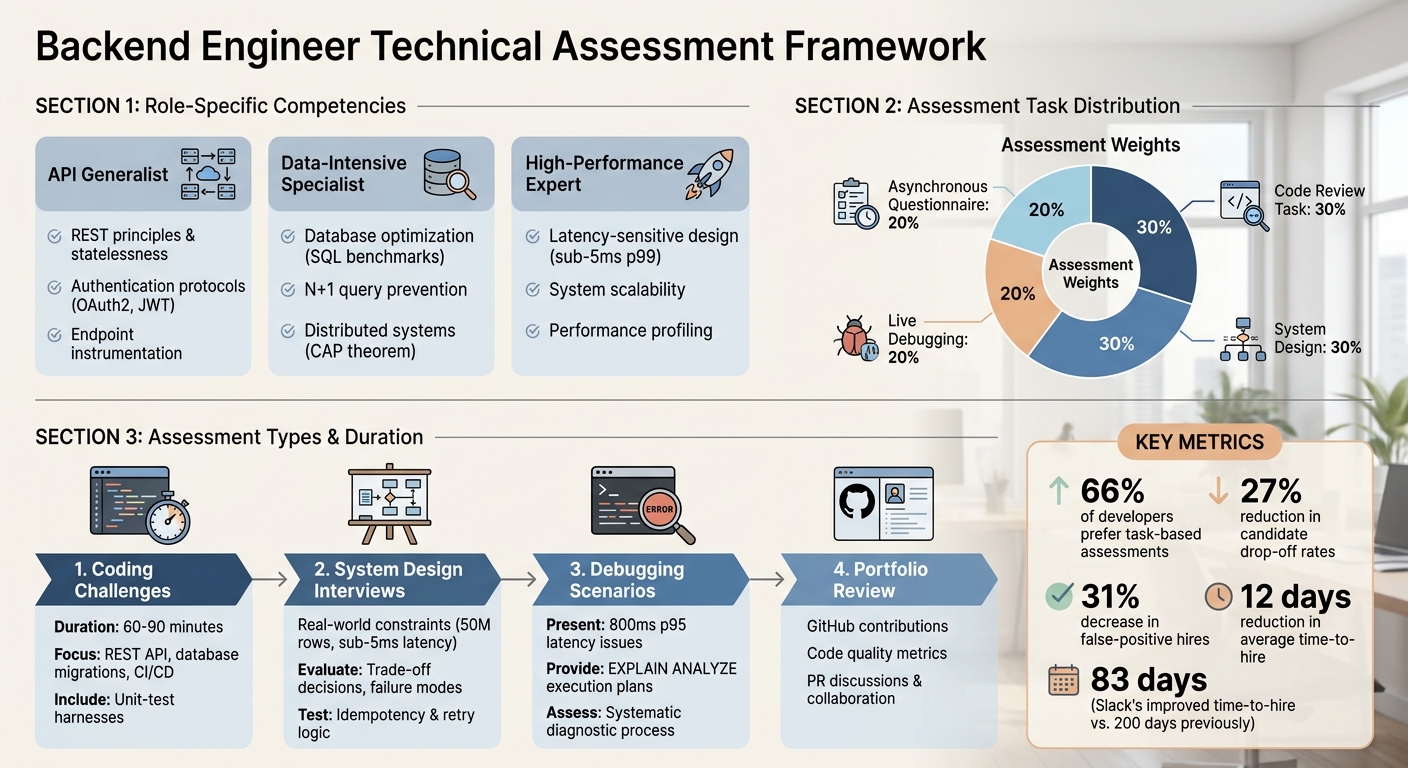
When it comes to evaluating backend engineers, a structured technical framework ensures your assessments align directly with the role's requirements. This approach not only promotes fairness but also helps streamline the hiring process. The key? Focus on practical, job-related tasks instead of abstract puzzles.
Defining Success Metrics and Competencies
The first step is to define what success looks like for the backend role you're hiring for. Set clear six-month goals for new hires - like increasing test coverage to 80% or solving specific performance challenges . These objectives will guide the entire assessment process.
Backend engineering spans various specializations. As Almaz Nurullin from EXZEV aptly explains:
Backend is not a monolith. Before writing the JD, define whether you need an API generalist, a data-intensive backend specialist, or a systems performance expert.
Tailor your competencies to reflect these distinctions. For example, an API Engineer should demonstrate expertise in REST principles and statelessness, while a High-Performance Specialist should excel in designing latency-sensitive systems. Map these competencies to specific evaluation criteria, such as testing database performance using SQL benchmarks or assessing security awareness through scenarios like SQL injection prevention and authentication protocols.
Observability is another crucial skill. Evaluate candidates on their ability to instrument endpoints and leverage telemetry effectively. As Nurullin points out:
Observability is not a feature you add after the fact - it is the mechanism by which you know whether the feature you just shipped is behaving correctly in production.
Balancing Task Types and Scoring Weights
To create a well-rounded assessment, combine different task types with carefully considered weights. For instance, Slack revamped its backend hiring process between 2019 and 2020, replacing a lengthy take-home exercise with a standardized code review task and an onsite "no-whiteboard" coding session. This change, led by engineers Chase Rutherford-Jenkins and Duretti Hirpa, cut their time-to-hire from 200 days to under 83 days while improving candidate feedback on the process .
Keep take-home exercises short - around two hours - to avoid overburdening candidates and ensure you retain a diverse talent pool . Design these tasks with a required MVP component, such as basic CRUD operations, and optional stretch goals. This allows you to differentiate between average and standout candidates without overwhelming them .
Standardized rubrics are essential for subjective tasks like code reviews or system design exercises. They ensure consistency across interviewers and help reduce bias in technical hiring . For example, you might allocate scoring as follows:
- 20% for an asynchronous questionnaire
- 30% for a code review task
- 30% for system design
- 20% for live debugging
Adjust these weights based on the role. A High-Performance Backend position might place more emphasis on system design than an API-focused role .
Travis Lindemoen, Founder of Nexus IT Group, highlights the importance of realistic challenges:
While strong coding skills are essential, the ability to design scalable, maintainable systems is paramount. Look for candidates who can discuss trade-offs.
This underscores the need to avoid "gotcha" questions. Instead, focus on practical system design challenges, like creating a multi-tenant permission system . These structured scoring methods naturally integrate into assessments that reflect the real-world demands of backend engineering.
Backend Assessment Examples
To evaluate candidates effectively, use real-world scenarios that showcase their problem-solving and communication skills. For example, present a Pull Request with 2–3 significant issues. This allows you to assess whether candidates can identify bugs and provide constructive, empathetic feedback . This mirrors the actual work environment more closely than traditional whiteboard exercises.
For database optimization, test candidates with an N+1 query scenario. Ask them to identify and fix the issue using eager loading or other optimization methods.
Security assessments should focus on production-level risks. Provide code with a vulnerability, such as a non-expiring session token, and evaluate how candidates implement proper token expiration and refresh protocols.
Additionally, challenge candidates to explain the execution path of tools they use - like what an ORM does during a query. This helps gauge their technical depth. Watch for red flags, such as a lack of accountability. For instance, candidates who describe incidents passively ("the database went down") instead of taking ownership ("I introduced a lock") may signal potential issues .
To stay competitive, aim for a streamlined interview process lasting 2–3 weeks . A focused, realistic framework not only saves time but also provides the insights needed to make confident hiring decisions. By incorporating these practical examples into your process, you can evaluate candidates thoroughly and efficiently.
Conclusion
Hiring backend engineers in 2026 requires a shift toward practical, production-oriented evaluations. Traditional whiteboard interviews are falling out of favor - 66% of developers now prefer task-based assessments over abstract algorithmic challenges. Companies that adopted this approach saw a 27% reduction in candidate drop-off rates . To truly assess a candidate's capabilities, focus on real-world scenarios like database optimization, identifying security vulnerabilities, and conducting code reviews that reflect the actual demands of the role.
Start by clearly defining your needs. Do you require an API generalist, a specialist in data-intensive systems, or someone skilled in performance optimization? This clarity will guide everything from sourcing candidates to structuring evaluations . For instance, production challenges like N+1 queries, which can lead to thousands of unnecessary database calls, reveal the difference between those who simply operate within frameworks and those who think critically about platform design.
This approach to evaluation also shapes better sourcing strategies. A standardized assessment framework - including rubrics for functionality, code quality, and problem-solving - can significantly enhance hiring outcomes. Companies using structured evaluations reported a 31% decrease in false-positive hires and reduced their average time-to-hire by 12 days .
When it comes to sourcing, look beyond generic job boards. High-signal channels like GitHub are excellent for finding open-source contributors, while stack-specific communities offer access to highly skilled developers. Platforms like daily.dev Recruiter streamline the process by providing warm introductions to pre-qualified developers, eliminating the need for cold outreach. These tools connect you with professionals who are actively engaged and open to the right opportunities.
The cost of a poor backend hire can be staggering - up to five times their annual salary when factoring in technical debt, security breaches (which average $4.45M per incident), and expensive rewrites . By combining targeted sourcing with practical, standardized evaluations, you can identify engineers who don't just deliver functional systems in demos but also build solutions that scale, perform, and endure in production.
FAQs
How do I tell a senior backend engineer from a junior one?
Distinguishing between a senior backend engineer and a junior one comes down to experience, technical expertise, and problem-solving skills. Senior engineers usually bring several years of working with complex systems under their belt. They have a solid grasp of architecture, scalability, and managing edge cases. Their roles often involve leading projects, improving performance, and mentoring team members. On the other hand, junior engineers are more focused on learning, completing assigned tasks, and tackling simpler coding challenges as they build their skills.
What’s the best backend take-home task length?
The sweet spot for a backend take-home task is around 5 hours. This timeframe strikes a balance - it's enough to challenge candidates and assess their skills thoroughly, while also respecting their time. The key is to keep the task laser-focused on evaluating essential backend abilities without making it unnecessarily time-consuming or overwhelming.
How do I source passive backend engineers fast?
To find passive backend engineers efficiently, start by exploring platforms like GitHub and LinkedIn, where professionals often display their work and expertise. Pay attention to candidates with portfolios that demonstrate experience in scalable systems, security, and performance optimization - key skills for backend roles.
Another effective approach is to engage in technical communities or participate in industry discussions. These spaces not only help you identify skilled professionals but also allow you to connect on a more personal level. When reaching out, craft personalized messages that emphasize your company’s unique technical challenges and highlight opportunities for the candidate to take ownership of impactful projects. This tailored approach can make your outreach more appealing to top-tier talent.
.png)