Engineering leaders face a critical challenge: finding top technical talent in a crowded, fragmented recruiting landscape. With 75% of developers not actively job hunting on LinkedIn, relying on traditional platforms can waste resources and miss out on skilled candidates. The solution? A structured, multi-channel approach to evaluate and optimize recruiting efforts.
Key takeaways include:
- Avoid over-relying on LinkedIn: Many successful companies source over 80% of hires from niche platforms or referrals.
- Focus on skill validation: Use platforms that assess actual coding contributions or project history.
- Track performance metrics: Monitor application-to-interview rates, interview-to-hire ratios, and retention data.
- Engage passive talent: Use personalized outreach and avoid duplicate or generic messages.
- Integrate tools: Connect recruiting channels with your ATS to streamline processes and avoid redundancies.
How to Evaluate Recruiting Channels
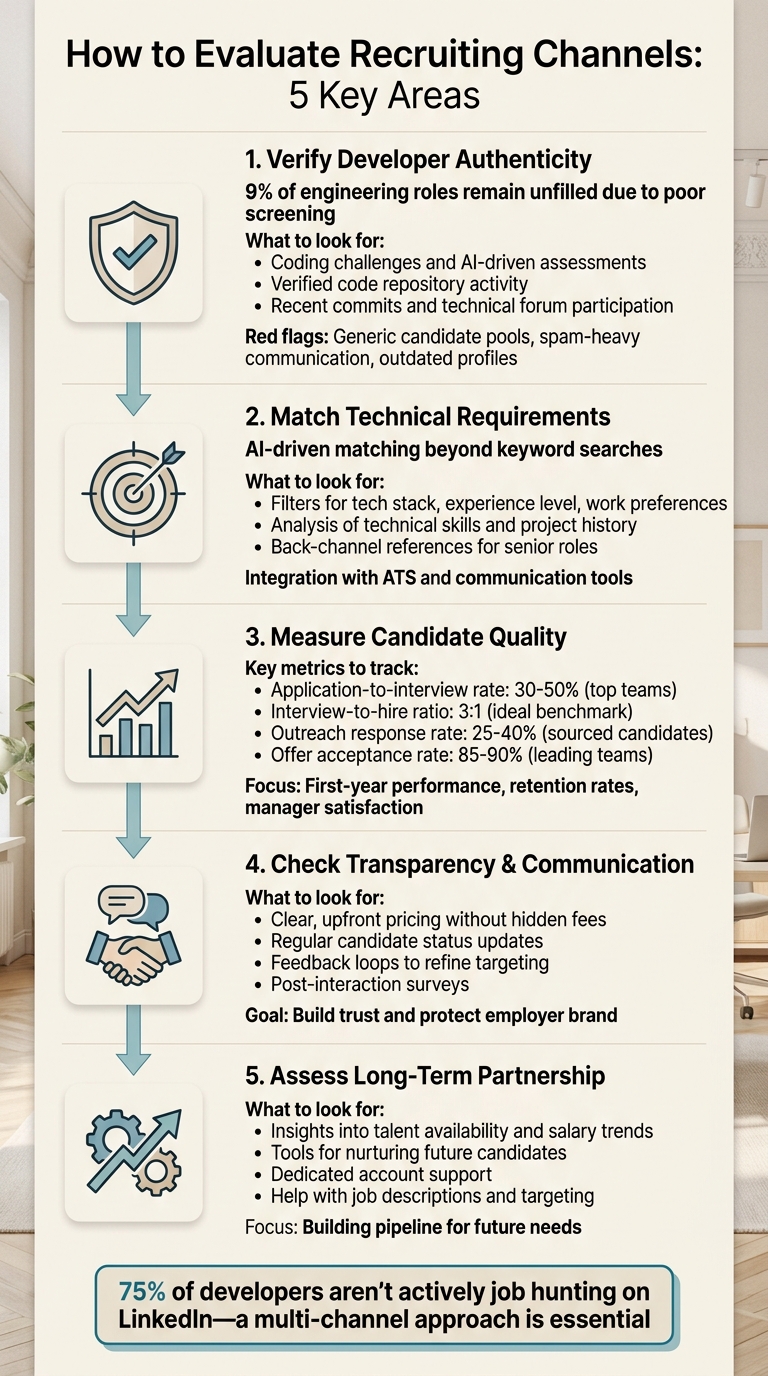
When evaluating recruiting channels, it’s important to focus on their ability to deliver real results across five key areas: authenticity, targeting, candidate quality, communication, and long-term value. Let’s break each of these down.
Verifying Developer Authenticity
One of the biggest challenges in hiring developers is ensuring the candidates you’re connecting with are genuine and active. Many platforms rely on outdated resumes or scraped profiles, which can lead to hiring decisions based on irrelevant or inflated qualifications. Beware of what’s often called the "Buzzword Mirage" - profiles filled with impressive-sounding jargon but lacking real-world coding skills .
To avoid this, prioritize channels that validate candidates’ skills through practical assessments, such as coding challenges, AI-driven evaluations of actual project contributions, or verified code repository activity. These methods paint a much clearer picture of a developer's actual capabilities. This is particularly important given that 9% of engineering roles remain unfilled due to poor screening processes .
Red flags to look out for include generic candidate pools, spam-heavy communication, and outdated profiles. Authentic developers often leave traces of their activity, such as recent commits, participation in technical forums, or engagement with industry content. If a channel can’t demonstrate this level of authenticity, it’s likely not worth your time. Next, ensure the channel aligns with your specific technical needs.
Matching Technical and Hiring Requirements
A large database of candidates is meaningless if it doesn’t align with your specific hiring needs. The most effective platforms allow you to filter candidates by tech stack, experience level, and even work preferences like time zones and authorization status.
Look for platforms that use AI-driven matching to go beyond keyword searches. These tools analyze technical skills, project history, and career goals to find candidates who truly fit your requirements . For senior-level roles, consider platforms that offer back-channel references from previous managers or colleagues to provide a well-rounded view of the candidate’s abilities and compatibility . As Raghavendra Prabhu, former CTO at Thumbtack, wisely said:
Strong engineering cultures are built by engineers who are good at managing people, not people managers who might dabble in engineering .
Also, ensure the channel integrates well with your ATS and other communication tools to streamline the hiring process.
Measuring Candidate Quality and Passive Talent Access
Data doesn’t lie. To gauge the effectiveness of a recruiting channel, track metrics like your application-to-interview conversion rate (top teams often hit 30–50% for sourced candidates) and your interview-to-hire ratio (an ideal benchmark is 3:1) .
When it comes to passive talent, outreach response rates are a key indicator. Traditional cold emails often have trust rates below 1%, but warm introductions with double opt-ins can see nearly 100% success . For sourced candidates, a solid response rate typically falls between 25–40% .
Don’t stop measuring after the hire. Assess the quality of hire by reviewing first-year performance, retention rates, and manager satisfaction. Leading recruitment teams maintain offer acceptance rates of 85–90% by keeping candidates engaged and informed throughout the process . This makes communication and transparency essential for evaluating a channel’s overall effectiveness.
Checking Transparency and Communication
Transparency is the foundation of trust. Recruiting channels should provide clear and upfront pricing without hidden fees. Look for platforms that offer flexible pricing tiers to accommodate your hiring needs, especially during busy periods.
Beyond pricing, evaluate how the channel handles communication. Do they provide regular updates on candidate status? Do they offer feedback loops to refine your targeting? Channels that conduct post-interaction surveys can help you understand how candidates perceive your brand. Negative experiences, such as feeling spammed or ignored, can damage your reputation and hurt future hiring efforts.
Assessing Long-Term Partnership Potential
The best recruiting channels don’t just help you fill immediate openings - they help you build a pipeline for the future. Seek out platforms that act as strategic partners, offering insights into talent availability, salary trends, and emerging technical demands .
Consider whether the channel enables you to maintain relationships with developers who aren’t ready to move right now but could be perfect for future roles. Tools for nurturing long-term connections, sharing company updates, or re-engaging candidates for new opportunities are especially valuable in specialized fields with limited talent pools.
Lastly, evaluate the channel’s commitment to your success. Do they provide dedicated account support? Are they willing to help you refine job descriptions or improve targeting? A true partner invests in your hiring outcomes, which becomes especially evident during tough searches or periods of rapid growth.
Creating a Multi-Channel Sourcing Strategy
Once you've assessed the effectiveness of individual sourcing channels, the next step is combining them into a cohesive strategy. This means leveraging role-specific platforms - like GitHub and open-source communities for technical experts, or Hacker News for leadership roles - and complementing them with AI-driven tools that compile profiles from multiple sources. Why is this important? Because relying on a single channel means missing out on a large pool of qualified candidates. AI-powered platforms streamline the process by scanning over 850 million profiles across various platforms, cutting down manual research time from hours to just minutes .
But here’s the catch: outreach needs to be carefully managed to avoid overwhelming candidates.
Preventing Duplicate Outreach and Candidate Fatigue
Repeated outreach to the same candidates can harm your employer brand. Many senior engineers frequently report feeling inundated with recruiter messages, leading to "inbox fatigue" and lower response rates industry-wide . To avoid this, use a centralized tool or shared platform that tracks every interaction with a candidate across all channels.
For internal alignment, set up dedicated Slack channels for each open role. This keeps communication between hiring managers and recruiters streamlined, avoiding fragmented conversations and ensuring everyone is on the same page regarding candidate status . If your team is still relying on spreadsheets to track outreach and prevent duplicates, it’s time to adopt an integrated ATS or AI sourcing platform that automates these checks .
When reaching out, personalization is a must. Mention specific details about a candidate’s work - like a GitHub project they contributed to or a Stack Overflow solution they provided - to show genuine interest. Sending generic messages like "I saw your profile" won’t cut it anymore . Thoughtful, multi-channel outreach using email, LinkedIn, and SMS can achieve a 48% response rate, far outperforming single-channel efforts .
Tracking Performance by Role and Specialty
Different roles and specialties require different sourcing strategies, and not all channels will perform equally. After making 10–15 hires, evaluate the effectiveness of each channel by looking at metrics like interview-to-offer ratios and time-to-fill . Don’t just track application volume - focus on metrics that matter, such as quality of hire, 12-month retention rates, and hiring manager satisfaction .
A helpful tool here is a monthly "Source Scorecard." This report compares key metrics like the number of applicants, the percentage of qualified candidates, interview rates, and the cost per hire across all active channels . The insights can be eye-opening. For example, roles sourced through talent relationships may require just 4 applications per hire, while job boards might need 74 applications per hire - resulting in 73 rejected candidates and potential damage to your employer brand .
Channel performance also varies by specialty. For software engineering positions, platforms like GitHub, Stack Overflow, Discord, and Hacker News often yield better results. On the other hand, finance and executive roles might benefit more from alumni networks and targeted outreach . Regular feedback loops are crucial - after every screening, recruiters should share insights to refine sourcing criteria. For instance, if a candidate is passed over for lacking experience in unstructured environments, adjust the sourcing approach to target candidates with that background . Once you’ve established clear performance metrics, integrate these insights with your ATS for smoother management.
Connecting Channels with Your ATS and Tools
To ensure all your sourcing efforts work seamlessly together, integration is key. Connecting your sourcing channels to your ATS is not just a nice-to-have - it’s essential for managing your pipeline and maintaining accurate reporting. With this integration, you can automate multi-channel outreach and consolidate reporting into a single platform, ensuring candidates aren’t contacted multiple times for the same role .
Integration also simplifies other tasks like contact enrichment, interview scheduling, and syncing calendars, saving your team countless hours of manual work . When exploring new sourcing channels, always ask about their API capabilities and whether they integrate smoothly with your existing tools. Platforms that don’t integrate well can create data silos, making it harder to track which channels are delivering results. And without that clarity, you risk wasting time and resources on ineffective strategies.
Setting Up a Channel Evaluation Process
A solid evaluation process is essential to measure hire quality, technical compatibility, and long-term retention. This process completes the structured framework for assessing recruiting channels discussed earlier. Without it, sourcing decisions often rely on intuition rather than data.
Reviewing Your Current Recruiting Channels
After evaluating the initial effectiveness of your recruiting channels, it's time to assess their long-term impact. Focus on how each channel contributes to hire quality over time. For example, track whether referrals, niche platforms, or agencies consistently produce employees who excel in their roles - not just candidates with impressive resumes . A critical metric here is the technical passthrough rate, which measures the percentage of candidates from each channel who successfully clear technical assessments. If a specific channel regularly delivers candidates who fail coding or system design evaluations, it signals a mismatch .
Additionally, use candidate surveys to gauge their hiring experience. High drop-off rates or poor satisfaction scores can indicate that a channel's process is overly complex or unprofessional . Channels that rely heavily on keyword matching rather than showcasing technical contributions should also raise red flags. These often result in candidates who can articulate concepts but struggle with hands-on problem-solving .
Scheduling Regular Performance Reviews
For most engineering teams, monthly reviews strike the right balance. Use a standardized scorecard to compare key metrics across all active channels, such as the number of applicants, percentage of qualified candidates, interview rates, and hires . However, avoid focusing on vanity metrics like total application volume. What truly matters are metrics like offer acceptance rates, 12-month retention, and cost per quality hire - including reducing time to hire during screening .
A low interview-to-offer ratio suggests that a channel is misaligned, leading to wasted time for your engineering team . With roughly 9% of engineering positions currently unfilled and 75% of companies planning to ramp up hiring, you can't afford inefficiencies . Replacing an experienced engineer is costly - between 1.5 and 4 times their annual salary - when factoring in lost productivity and onboarding time . Document these findings in a centralized repository to refine your strategy over time.
Documenting Results and Collecting Feedback
Centralizing performance data and manager feedback is crucial for capturing both quantitative metrics and qualitative insights. When candidates are rejected, document the reasons - whether it's a lack of distributed systems expertise, poor communication, or cultural misalignment. Use this data to fine-tune the criteria for each recruiting channel.
Establish feedback loops with your recruiting team after every interview cycle. If candidates from a specific channel consistently fail at the same stage, that's actionable information. For instance, a channel might attract mid-level engineers when you're seeking senior architects, or it may excel at sourcing backend developers but fall short for frontend roles. AI-driven platforms can help consolidate data from various sources into unified profiles, reducing manual effort . However, team discussions and honest evaluations remain essential for understanding why certain channels work better for specific roles.
Red Flags and Mistakes to Avoid
When evaluating hiring channels, it's crucial to spot warning signs that could derail your efforts. Even with a well-structured evaluation process, engineering leaders can fall into common traps that hinder hiring success. Recognizing these red flags early can help you avoid wasting resources or damaging your employer brand.
Channels That Don't Align with Your Needs
One major issue is working with channels where recruiters lack the technical knowledge to understand your team's requirements. For instance, if a recruiter pitches a "full-stack engineer with React experience" for a senior distributed systems role, it’s a clear sign they don’t grasp the nuances of your needs. This disconnect can result in candidates who look good on paper but falter in technical discussions . As Blake Stockman, a technical recruiting leader, explains:
Trust is something you really have to build with these engineering leaders because they've almost certainly been burned by recruiters in the past .
Inconsistent performance across platforms is another red flag. If a channel has stellar reviews on one site but poor feedback on another, it signals a lack of reliability . Similarly, beware of channels that push unrealistic "wish list" job descriptions - those that focus on ideal resumes over real-world potential. This approach often shows a misunderstanding of how engineering teams actually function .
Beyond mismatched channels, relying only on inbound applications introduces its own set of challenges.
The Problem with Solely Relying on Inbound Applications
Focusing exclusively on inbound applications limits your reach to active job seekers, who represent only a small slice of the engineering talent pool. Many top engineers are already employed and not actively browsing job boards . This narrow approach can cause you to miss out on highly skilled passive candidates. Considering that a poor hiring decision in engineering can cost up to 30% of the employee’s first-year salary , it’s clear that diversifying your sourcing strategies is essential.
But channel selection isn’t the only factor - candidate experience plays a critical role too.
Spotting Issues in Candidate Experience
Candidate experience problems are often overlooked by hiring teams but are glaringly obvious to developers. Channels with long application processes or delayed feedback can alienate candidates . Remember, 78% of candidates believe the recruitment experience reflects how a company values its employees .
Cold outreach is another area to approach carefully. As Travis Lindemoen from Underdog.io points out:
asking experienced engineers to take basic coding quizzes is inappropriate - it's like asking a professional golfer to play putt-putt .
Channels that rely on generic messaging or one-size-fits-all assessments fail to respect developers' time and expertise. Additionally, unprepared interviewers who show up late or haven’t reviewed a candidate’s profile leave a poor impression. If a channel doesn’t ensure recruiters provide thoughtful "no-hire" recommendations, it’s likely prioritizing volume over quality .
Key Takeaways
Finding the best recruiting channels for tech talent requires more than just gut feelings - it calls for a modern framework for engineering talent acquisition. Engineering leaders who emphasize qualities like credibility, alignment with team values, and open communication are better positioned to build strong teams and minimize hiring missteps.
Verify developer authenticity. Use platforms that assess skills through coding challenges and actual contributions. Prioritize channels with engaged developer communities, as these often provide access to active, high-quality candidates rather than outdated profiles.
Transparency is just as important as verification. Platforms that facilitate warm connections and maintain clear communication throughout the hiring process make a big difference. Integration with your ATS can also simplify tracking key hiring metrics. As Raghavendra Prabhu, former CTO at Thumbtack, explains:
Strong engineering cultures are built by engineers who are good at managing people, not people managers who might dabble in engineering .
Avoid over-relying on inbound applications, as this can limit your reach to passive candidates who might be a perfect fit. For senior roles, it’s critical to prioritize alignment with team values and culture over rigid technical assessments. Peer references can also provide valuable insights into a candidate’s suitability .
Lastly, establish a routine for reviewing the performance of your recruiting channels based on the role and specialty. Document your findings, gather input from hiring managers and candidates, and adjust your strategy based on real-world data. This kind of ongoing evaluation ensures your recruiting efforts stay effective and responsive to changing needs, while also maintaining a positive experience for candidates.
FAQs
What metrics prove a recruiting channel actually works?
When analyzing a recruiting channel's performance, focus on metrics like reply rates, candidate interest levels, and conversion rates. These figures give you a clear picture of how well the channel engages potential candidates.
Beyond the numbers, take a closer look at the quality of candidates and their engagement levels. Are the candidates aligning with your hiring needs? Are they actively involved in the process? These insights are just as important as the raw data.
By consistently tracking these metrics, you'll get a better sense of how effective a channel is at sourcing top tech talent.
How can I verify a developer’s real skills before interviews?
To get a clear picture of a developer's skills before the interview, start by reviewing their portfolio or GitHub profile. This will give you insight into their coding abilities and the types of projects they've worked on. Next, consider using technical assessments or coding tests that align with the job's requirements to gauge their practical skills. Finally, ask targeted technical questions about their past experience and the tools or technologies relevant to the role to ensure they have the expertise you're looking for.
How do I prevent duplicate outreach across channels?
To keep outreach efforts efficient and avoid duplicating work, use AI-powered tools that gather and consolidate candidate profiles from platforms like GitHub and Stack Overflow. A centralized candidate database or CRM can also be a game-changer, allowing you to track outreach history and avoid contacting the same person multiple times. Regular team updates and open communication about which candidates have already been approached can further streamline your process and reduce unnecessary overlap.
.png)