Want to excel in technical recruiting? Here's a snapshot of the career path, skills, and salaries you need to know:
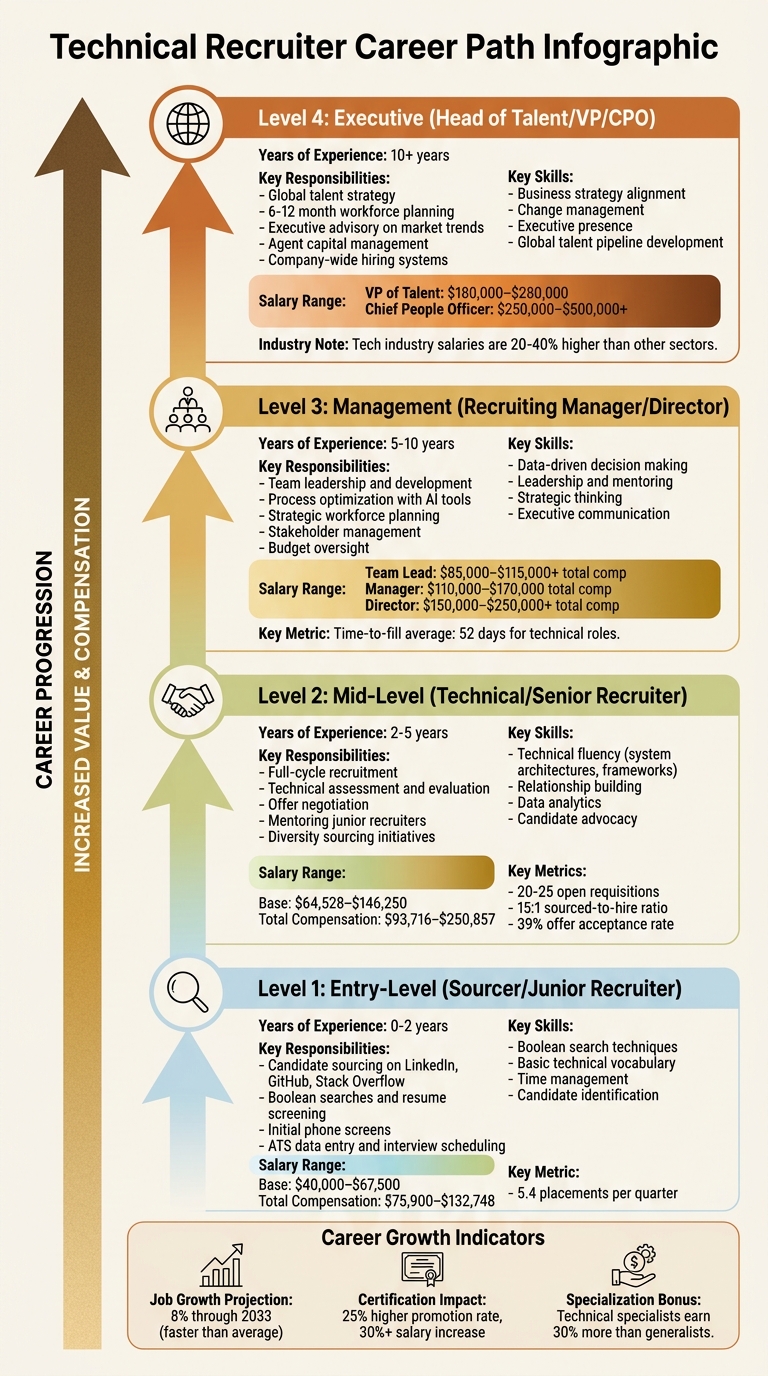
- Entry-Level Roles (Sourcer/Junior Recruiter): Focus on finding candidates using tools like LinkedIn and GitHub. Learn Boolean searches and basic technical terms. Average salary: $40,000–$67,500, with total compensation up to $132,748.
- Mid-Level (Technical/Senior Recruiter): Handle full-cycle recruitment, negotiate offers, and deepen technical knowledge. Average salary: $64,528–$146,250; total compensation up to $250,857.
- Management (Recruiting Manager/Director): Oversee teams, refine processes, and align hiring with business goals. Salaries range from $85,000 to $200,000+.
- Executive (Head of Talent): Shape global hiring strategies, manage budgets, and advise leadership. Salaries often exceed $250,000.
Key Skills: Technical fluency, relationship-building, and data-driven decision-making evolve at every stage. Tools like ATS platforms, CRM systems, and analytics dashboards are essential.
Certifications: Boost your career with programs like the Certified Technical Recruiter (CTR) or SHRM-CP/SCP.
Start small, grow your expertise, and aim for leadership roles by combining technical understanding with strong communication and strategic thinking.
Entry-Level Roles: Sourcer and Junior Technical Recruiter
Main Duties and Required Skills
If you're stepping into an entry-level role like a sourcer or junior recruiter, your primary focus will be on finding and engaging potential candidates. This involves building talent pipelines by identifying promising profiles through various developer sourcing channels like LinkedIn, GitHub, and Stack Overflow. To do this effectively, you'll need to use Boolean search strings (e.g., AND, OR, NOT) to narrow down your search results. Personalization is key - generic messages often get ignored, so referencing a candidate's specific projects or contributions can make all the difference.
You'll also handle administrative tasks like screening resumes, scheduling interviews using tools like Calendly, and keeping candidate data updated in applicant tracking systems (ATS) such as Greenhouse, Lever, or iCIMS. These efforts help streamline the hiring process for engineering teams. Additionally, you'll conduct initial phone screens using prepared scripts to gauge both technical skills and compatibility with the company culture before passing candidates along to senior recruiters. The ultimate goal? Save time for engineering teams by ensuring only the most relevant candidates move forward.
While you don't need to know how to code, having a basic understanding of technical roles is a must. For example, you should know the difference between a frontend developer who uses React and a backend engineer who works with Python to build APIs. To build this "conversational fluency", you can explore engineering blogs, attend tech meetups, or use free resources like freeCodeCamp. As Careery explains:
"Engineers will lose respect for you immediately if you try to fake technical knowledge. It's far better to say 'I'm not technical, can you explain what you mean by that?'"
By mastering these core skills, you'll lay a solid foundation for your career in technical recruiting.
Career Growth Benchmarks
Within two years, most entry-level recruiters are responsible for sourcing talent for 20–50 developer roles per quarter, with an average of 5.4 successful placements . Achieving this level of performance requires proficiency with your ATS, creating efficient sourcing workflows, and developing enough technical vocabulary to communicate effectively with hiring managers. Typically, six months of experience working on technical roles is enough to build the credibility needed to collaborate confidently with engineering leaders .
Entry-Level Salary Range
In the United States, entry-level technical recruiters earn between $40,000 and $67,500 annually, with an average base salary of approximately $48,846 . When factoring in bonuses and commissions, total compensation can range from $75,900 to $132,748. These figures vary based on factors like location, company size, and individual performance.
Mid-Level Positions: Technical Recruiter and Senior Technical Recruiter
Main Duties and Skill Growth
After spending two to five years in recruitment, you’ll likely transition into full-cycle recruitment. This means taking the lead on intake calls, defining role requirements, assessing technical stacks, and determining trade-offs for candidates .
Your technical expertise will also deepen. Expect to evaluate system architectures and frameworks more thoroughly. Shadowing technical interviews and collaborating with engineers on identifying key candidate qualities will help you develop conversational fluency in technical discussions .
As you grow, you’ll handle complex offers, including negotiating compensation, addressing counteroffers, and explaining equity structures . With technical roles averaging 21% more interview hours per hire in 2024 compared to 2021 , keeping candidates engaged throughout these longer processes becomes a critical part of your role.
At the senior level, your responsibilities expand further. You’ll mentor junior recruiters, lead diversity sourcing initiatives, and advise on workforce planning . Tackling hard-to-fill positions, such as Principal Engineers or VP of Engineering, will be a key focus. Tools like daily.dev Recruiter can help you connect with pre-qualified candidates, reducing the need for cold outreach.
These responsibilities not only broaden your expertise but also set the foundation for achieving strong performance metrics, which are essential for mid-career success.
Performance Metrics and Career Benchmarks
As your responsibilities grow, so do the metrics used to evaluate your success. For mid-level recruiters, a solid sourced-to-hire ratio is around 15:1, while a ratio above 30:1 could indicate inefficiencies in outreach . Weekly conversion rates - such as sourced-to-screen, screen-to-interview, and interview-to-offer - are also key metrics to monitor .
Quality of hire takes precedence over sheer volume. In fact, 42% of tech teams prioritize this metric, often measured by six-month productivity or retention rates . With an average offer acceptance rate of 39% in the tech sector , your ability to close candidates through relationship-building and clear communication about compensation will play a significant role in your performance evaluations.
Mid-level recruiters typically juggle 20–25 open requisitions at a time and average 5.4 placements per quarter . Over three to five years, you’ll refine your strategic thinking to influence hiring plans, analyze labor market trends, and collaborate with executive stakeholders. Personalized outreach remains vital - messages under 400 characters receive 22% higher response rates from developers, and tailored messages outperform bulk campaigns by about 15% .
Mid-Level Salary Range
The increased responsibilities and expertise required at this level are reflected in competitive salaries. Mid-level technical recruiters earn between $64,528 and $125,000 annually in base salary, with total compensation (including bonuses and equity) ranging from $93,716 to $162,042 . Senior technical recruiters see higher earnings, with base salaries between $87,813 and $146,250 and total compensation ranging from $141,275 to $250,857 .
Location plays a major role in salary variations. For instance, senior recruiters in San Francisco average $159,668, while their counterparts in Chicago average $66,834 . Specialization also impacts earnings - recruiters who can effectively communicate with engineers earn about 30% more than generalist recruiters . Developing expertise in specialized areas like machine learning or distributed systems can further boost your market value.
Management Roles: Technical Recruiting Manager and Director
Management Duties and Business Impact
Once you've established yourself as a mid-level recruiter, the next step is leading teams and building systems to scale hiring efforts. In management, your success hinges on team performance, process efficiency, and the quality of hires you deliver . Instead of focusing on individual placements, your role shifts toward creating strategies and structures to meet broader talent needs.
This includes working closely with senior leaders to anticipate hiring demands, refine recruiting processes (often incorporating AI-driven sourcing tools), and manage partnerships to address challenging roles . Strategic workforce planning becomes essential as you oversee hiring across multiple teams and departments.
Operationally, you'll need to balance stakeholder expectations, which may involve addressing unrealistic demands - like below-market compensation - and advocating for the resources your team needs to succeed .
Developing your team becomes a top priority. You'll mentor junior recruiters on complex searches, guide calibration sessions to align interview feedback, and monitor team performance . Since technical hiring often requires more time and effort, keeping both your team and candidates engaged is critical to achieving successful outcomes.
Leadership Skills Needed
Moving into management requires a new focus on data-driven decision-making and strategic thinking. Taylor Rupe, Education Researcher & Data Analyst at Human Resources Degree, highlights this:
"The TA Managers who use data to continuously improve their operation outperform those who manage by gut" .
Key metrics like time-to-fill (an average of 52 days for technical roles ), cost-per-hire, and offer acceptance rates will guide your decisions. Understanding conversion ratios is equally important. For instance, a strong sourced-to-hire ratio for senior engineers is about 15:1, while anything above 30:1 may indicate issues with targeting or outreach . Tracking weekly conversion rates - such as sourced-to-screen, screen-to-interview, and interview-to-offer - helps you identify where the hiring process is stalling .
Clear, data-backed communication is essential for managing stakeholders. You'll need to explain delays in hiring with evidence that highlights the challenges. Ben Chung, Director of TA at Dialogue, stresses the importance of accountability:
"Tell them what you'll do. Do it. Then report back. Most people skip the last step - that's how trust erodes" .
In your first 90 days as a leader, building trust is more important than achieving quick wins. Chung advises:
"Your first 90 days as a Head of Talent Acquisition aren't about big wins. They're about building trust" .
Start by scheduling one-on-one meetings with different teams to understand their unique hiring challenges before implementing major changes.
Management-Level Salary Range
Salaries for management roles reflect the broader responsibilities and impact on the business. Entry-level TA Team Leads typically earn base salaries between $85,000 and $100,000, with total compensation ranging from $100,000 to $115,000+ . Mid-level TA Managers can expect base pay of $110,000 to $140,000, with total compensation falling between $130,000 and $170,000 .
Directors of Talent Acquisition earn even more, with base salaries ranging from $150,000 to $200,000 and total compensation between $186,270 and $250,000+ . In the tech industry, salaries for Talent Acquisition leaders are often 20% to 40% higher than in other sectors, reflecting the competitive landscape and the strategic importance of these roles .
Factors like company size and location also influence pay. Larger organizations with complex hiring needs and widespread operations tend to offer salaries at the higher end of the spectrum, while smaller companies or those in less expensive areas may offer less. These insights pave the way for understanding the executive responsibilities of a Head of Talent Acquisition, which will be explored next.
Executive Level: Head of Talent Acquisition
Executive-Level Duties
At this stage, your focus shifts from hands-on hiring to crafting long-term strategies. Taylor Rupe, an Education Researcher & Data Analyst at Human Resources Degree, describes this transition perfectly:
"You stop filling individual roles and start building the system that fills them all" .
This means diving into strategic workforce planning - predicting talent needs for the next 6–12 months, analyzing turnover rates, and aligning recruitment efforts with the company’s growth goals . You’ll collaborate closely with VPs and executives to develop hiring strategies, deliver market insights, and create global talent pipelines for critical areas like Engineering, Product, Design, and Data .
Another key responsibility is designing systems that improve hiring efficiency, maintain quality, and manage costs sustainably across the organization . You’ll also tackle emerging challenges like integrating and managing AI agents as part of the workforce, a concept now known as "agent capital management" . Leveraging platforms like daily.dev Recruiter can help you connect with developers in trusted spaces where they engage frequently - up to 200 times a month .
Even at this level, data remains a cornerstone of your role. However, your analysis now drives company-wide strategies. This requires a leadership approach that blends industry expertise with a clear vision for the future.
Required Skills and Experience
Executive roles build on the skills developed in earlier stages, but they demand a deeper understanding of business strategy. You’ll need to grasp how talent density contributes to competitive advantages, especially in areas like AI. Advising executives on securing top-tier talent becomes part of ensuring the organization stays relevant . This also involves managing expectations, pushing back on unrealistic demands, and advocating for the necessary resources and budgets to support your team .
Your data fluency will be crucial. Metrics like quality of hire, offer acceptance rates, and recruitment funnel conversion rates will help justify decisions around resource allocation . Typically, you’ll need over 10 years of recruiting experience, progressing through roles from recruiter to manager, and eventually into Director or VP positions . This career path ensures you’ve mastered both the tactical and strategic aspects of talent acquisition at an organizational level.
Executive Salary Range
The increased scope and strategic importance of these roles come with higher compensation. VPs of Talent typically earn between $180,000 and $280,000 annually . Directors working in major tech hubs often see salaries around $200,000 per year . Meanwhile, Chief People Officers at large organizations can command salaries ranging from $250,000 to over $500,000 .
As of May 2024, the median salary for HR Managers, which includes Talent Acquisition leadership roles, was $140,030. Job growth in this field is expected to rise by 8% through 2033, outpacing the average for other occupations .
Skills and Tools for Each Career Stage
How Skills Develop Over Time
As you move through your recruiting career, your skill set grows and adapts to new challenges. At the entry level, the focus is on mastering the basics: Boolean searches, identifying candidates on platforms like GitHub and Stack Overflow, and managing your time effectively to handle outreach efficiently.
When you step into mid-level roles, your responsibilities broaden. Beyond sourcing candidates, you’ll assess their suitability for roles, negotiate offers, and rely on data to improve your processes. Building strong, lasting relationships becomes a priority, as does tracking metrics like response rates and time-to-fill. These skills help you demonstrate your impact and refine your approach.
At the management stage, the focus shifts to leading teams, improving recruitment processes, and ensuring hiring strategies align with overall business objectives. By the time you reach the executive level, your role centers on global talent strategies, workforce planning, and advising senior leadership on market trends. At every stage, the key is continuous learning and adapting.
These evolving skills also call for different tools, tailored to each stage of your career.
Tools for Each Career Level
The tools you rely on change as your responsibilities grow. For entry-level recruiters, the focus is on sourcing and coordination. Basic applicant tracking systems (ATS), Slack, and scheduling tools like Calendly are essential.
As a mid-level recruiter, your toolbox expands to include more advanced systems. Full-featured ATS platforms like Lever, CRM tools such as Gem or Beamery for managing talent pipelines, and technical assessment platforms like HackerRank become invaluable. This is also the stage where platforms like daily.dev Recruiter shine, helping you connect with developers who are already engaged in their field.
For senior and executive roles, the tools become more strategic. Analytics platforms like Tableau or Power BI help you make data-driven decisions, while enterprise systems like Workday support workforce planning. Recruitment marketing tools and operational dashboards also play a critical role in guiding company-wide strategies.
Skills and Tools Comparison Table
| Career Level | Primary Technical Skills | Interpersonal Skills | Recommended Tools |
|---|---|---|---|
| Entry (Sourcer) | Boolean search, candidate identification, ATS data entry | Persistence, outreach, time management | LinkedIn Recruiter, GitHub, Stack Overflow, Greenhouse |
| Mid (Recruiter) | Full-cycle recruiting, market research, technical screening | Negotiation, relationship building, candidate advocacy | Dice, AngelList, HackerRank, Lever, daily.dev Recruiter |
| Senior/Lead | Data analytics, strategic sourcing, market mapping | Consultative partnership, mentoring, influence | Tableau, Beamery (CRM), Power BI, Avature |
| Management/Exec | Workforce planning, budget management, global strategy | Leadership, executive presence, change management | Recruitment Ops dashboards, Slack, Calendly, Zoom |
Certifications and Continuing Education
As you move through your career, from sourcer to Head of Talent, staying current with education and expanding your network will be just as important as the hands-on experience you gain along the way.
Recommended Certifications
Certifications can significantly enhance your professional profile. Research indicates they can boost your chances of promotion by 25% and increase your salary by over 30% .
For those starting out, the Certified Internet Recruiter (CIR) at $795 and the Certified People Sourcing Professional (CPSP) at $399 are excellent options. These certifications focus on advanced Boolean searches and candidate sourcing techniques, helping you build a strong foundation .
Mid-level recruiters should consider the AIRS Certified Technical Recruiter (CTR), costing between $795 and $995, which is widely regarded as a top-tier credential. The Tech Recruiter Certification 2.0 at $595 is another great choice for refining technical assessment skills .
For senior-level professionals, certifications like the Strategic Talent Acquisition Certificate from AIHR (rated 4.76/5) can help align recruitment strategies with broader business objectives. Additionally, the SHRM-CP/SCP certification ($1,830 for members) is ideal for solidifying HR expertise. With AI becoming more integral, the AIRS AI, Sourcing & Recruiting (CASR) certification at $895 can help you stand out as a tech-savvy leader .
"Technical recruiters who can't speak engineer don't survive. The ones who can? They earn 30% more than generalists." - Careery Editorial Team
These certifications not only validate your skills but also give you a competitive edge at every stage of your career.
Building Your Professional Network
Networking is a cornerstone of career growth. Joining professional organizations like SHRM and NAPS provides access to resources, training, and connections that can elevate your career .
To deepen your understanding of the tech world, immerse yourself in developer communities like GitHub and Stack Overflow. These platforms are invaluable for learning the challenges and language of developers . Following engineering blogs from companies such as Stripe, Uber, and Netflix can also keep you up-to-date on evolving tech trends and tools.
Local tech meetups, found on platforms like Meetup.com and Luma, are great for building in-person relationships . Online forums, such as niche Discord servers or Reddit communities like r/experienceddevs, offer insights into developer frustrations and goals, which can inform your outreach approach. Shadowing engineering interviews is another practical way to quickly improve your conversational fluency .
"The point isn't to spam these platforms with job posts. It's to listen, contribute, and build credibility before you ever send a DM." - Rose Calvert, Senior Technical Recruiting Strategist
For more formal learning opportunities, events like the Tech Recruitment Conference (TRC) in Amsterdam bring together experts and practitioners to share the latest strategies. Remember, technical literacy isn’t a one-and-done task - it’s an ongoing journey.
Conclusion
Climbing the career ladder from sourcer to Head of Talent is an evolving journey that hinges on technical expertise, relationship-building, and ongoing learning. Successful recruiters know their stuff - like the difference between Java and JavaScript - and can confidently discuss topics like microservices versus monoliths. They also understand that engineers are partners, not just candidates. This guide underscores that staying curious about technology and fostering genuine connections are key to thriving at every stage of your career.
While career growth often brings financial rewards, true success lies in demonstrating measurable impact with a tech candidate fit analyzer. Metrics that showcase your contributions to business outcomes carry far more weight than compensation alone.
Stay sharp by improving your technical knowledge with resources like Codecademy and freeCodeCamp. Tools like daily.dev Recruiter can help you stay in tune with what developers care about, while platforms like GitHub and Stack Overflow are perfect for building meaningful connections. Don’t wait until you have a role to fill - get involved in local tech meetups and start networking early. As Careery puts it:
"Engineers can smell a fake - authenticity matters. It's far better to say 'I'm not technical, can you explain what you mean by that?' than to nod along cluelessly."
Consider earning certifications like the AIRS Certified Technical Recruiter (CTR) to validate your skills, and seek guidance from experienced talent leaders to shift from tactical tasks to strategic decision-making.
The recruiting landscape is evolving, with skills-based hiring and AI-driven workflows becoming the norm. In fact, 81% of employers are heading in this direction for 2024 . Recruiters who balance AI tools with human insight and prioritize trust-based relationships will be best equipped to lead talent teams into the future.
FAQs
How do I build technical credibility without coding?
To establish technical credibility without writing a single line of code, focus on grasping the core concepts, systems, and terminology related to the roles you're recruiting for. Dive into how different technologies function at a high level, get acquainted with the basics of software architecture, and stay informed about the latest industry trends. This knowledge lays the groundwork for evaluating candidates effectively and having meaningful conversations with technical professionals, all without needing direct coding experience.
What metrics matter most at each recruiting level?
Recruiting metrics shift as professionals advance in their careers. For those starting out, time-to-fill and candidate quality are the primary focus, highlighting efficiency and the ability to identify strong candidates. As recruiters move into mid-level positions, the emphasis shifts to candidate engagement rates and sourcing channel effectiveness, showcasing their ability to build and maintain a talent pipeline.
At senior and leadership levels, the focus broadens to strategic outcomes like quality-of-hire, retention rates, and hiring manager satisfaction, demonstrating how recruitment efforts align with broader organizational objectives. Additionally, metrics such as diversity hiring and candidate experience become increasingly vital, reflecting a deeper commitment to inclusive and positive hiring practices.
When should I move from recruiter to management?
To transition into management, it's wise to first spend 2–5 years gaining hands-on experience, fine-tuning your recruitment strategies, and guiding junior recruiters. This step usually comes after you've solidified your role as a senior recruiter or specialist. During this time, concentrate on strengthening your leadership abilities, expanding your industry expertise, and honing your skills in strategic planning. These areas will be crucial when it comes to managing recruitment operations and leading teams with confidence.
.png)