Ghosting during the hiring process is a growing challenge in tech recruitment. Developers often stop responding due to long hiring cycles, poor communication, unclear job details, or impersonal recruitment methods. This disrupts hiring timelines and costs companies thousands of dollars in productivity and hiring expenses. Here’s how to address the issue:
- Shorten hiring timelines: Long processes (average 41 days) lead candidates to accept other offers. Aim to make decisions within a week.
- Communicate consistently: Respond to applications within 48 hours and provide feedback after interviews within 72 hours.
- Be transparent: Share salary ranges, job details, and expectations upfront to build trust.
- Personalize interactions: Treat candidates as partners, not just resources, by tailoring communication and providing clear updates.
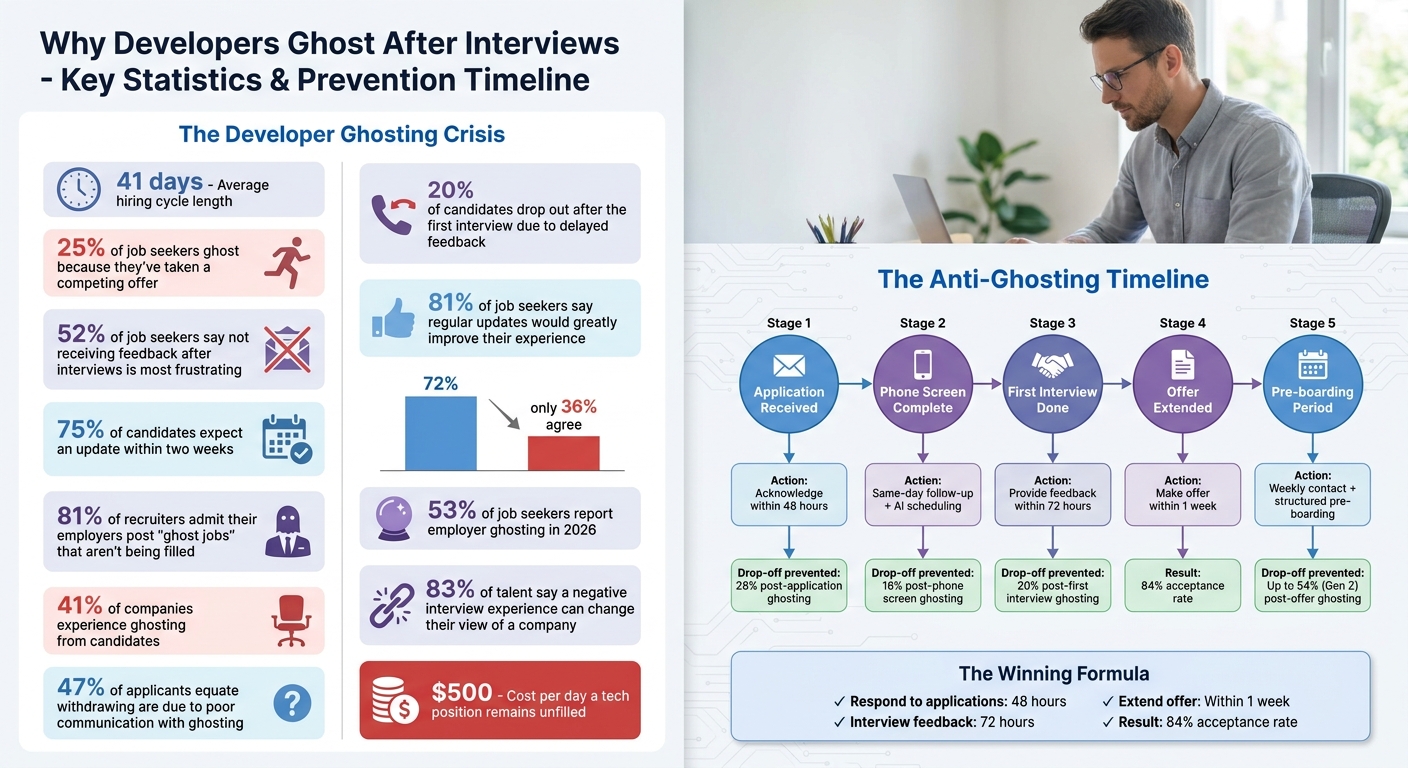
Why Developers Stop Responding After Interviews
To understand why developers sometimes go silent after interviews, it's important to examine common hiring missteps. These patterns often stem from processes that don't align with candidates' expectations or respect their time.
Long and Inefficient Hiring Processes
One major issue is the length of time it takes to complete the hiring process, leading to drop-offs in developer hiring pipelines. Developers often disengage when things drag on too long. With the average hiring cycle lasting 41 days , many candidates accept other offers before your process wraps up. In fact, 25% of job seekers who ghost do so because they’ve taken a competing offer . Prolonged timelines - caused by excessive interview rounds or slow decision-making - give candidates more opportunities to explore and commit to other roles.
Poor Communication and Missing Feedback
A lack of communication is a major turnoff. When candidates don’t hear back after interviews, they often assume they’ve been rejected and move on. The statistics are clear: 52% of job seekers say the most frustrating part of the hiring process is not receiving feedback after interviews . Meanwhile, 75% of candidates expect an update within two weeks . This disconnect between expectations and reality creates frustration and drives candidates away.
The impact is significant. Research shows that 20% of candidates drop out after the first interview due to delayed feedback or indecision . Moreover, 47% of applicants equate withdrawing due to poor communication with ghosting . In essence, when employers fail to communicate, they unintentionally signal that ghosting is acceptable behavior.
As CareerBuilder found:
81% of job seekers say regular updates from employers would greatly improve their experience .
Unclear Expectations and Job Details
Another common reason developers disengage is the mismatch between the job description and the actual role. Ambiguity around key details - such as the tech stack, team structure, or day-to-day responsibilities - can frustrate candidates who have plenty of other options. This issue often begins with the job posting: while 72% of hiring managers believe their descriptions are clear, only 36% of candidates agree .
The problem intensifies when interview discussions reveal discrepancies between the advertised role and reality. Developers are quick to shift their focus to employers who are more upfront and transparent. Adding to this distrust is the rise of "ghost jobs", with 81% of recruiters admitting their employers post roles that aren’t actually being filled . This practice has made candidates skeptical from the start, further damaging trust.
One-Sided Recruiting Methods
Finally, impersonal and one-sided recruiting approaches contribute to disengagement. When recruiters send unsolicited messages about roles that candidates haven’t expressed interest in, it creates a transactional dynamic that lacks mutual respect. This imbalance makes it harder to build the trust needed to keep developers engaged throughout a lengthy hiring process. Unpersonalized outreach often feels like a numbers game, and candidates are less likely to invest their energy in such interactions.
How to Prevent Developers from Ghosting
If you want to keep developers engaged throughout the hiring process, you need to address the core reasons they disappear. That means speeding up your process, staying consistent in your communication, being upfront from the start, and showing genuine respect for candidates.
Shorten and Simplify Your Hiring Process
A lengthy hiring timeline is one of the biggest reasons candidates drop out. With an average hiring process taking 41 days , you're giving developers plenty of time to accept other offers. The solution? Streamline and simplify.
Start by cutting down on unnecessary interview rounds. Before you even begin interviewing, get your team aligned on the role's requirements to avoid changing expectations midway. Then, map out the entire process - technical tests, interviews, team meetings - and share it with candidates upfront .
Stick to clear deadlines. Aim to make offers within a week, as doing so leads to an 84% acceptance rate . If a candidate mentions another offer, condense remaining interviews into a single day to stay competitive.
The time between offer and start date is another risky period. To prevent post-offer ghosting, introduce candidates to their future teammates right away and outline the onboarding process. Research shows that up to 54% of Gen Z candidates may ghost between accepting an offer and their first day if they feel ignored during pre-boarding .
Of course, none of this works if communication isn’t consistent.
Maintain Clear and Consistent Communication
Silence is a dealbreaker. When candidates don’t hear from you, they often assume the worst and move on. The fix? Set clear communication guidelines and stick to them.
Respond to applications within 48 hours - far faster than the median 6.7-day response time . After each interview stage, provide feedback within 72 hours, even if it’s just to let candidates know you’re still deciding . As Mark A. Herschberg, CTO and author, explains:
Ideally a company should reach out and say, 'We haven't forgotten about you, we just need to sort some things out.' Unfortunately, that's not a standard part of the process .
Establish service level agreements (SLAs) for communication and share them with candidates so they know when to expect updates. While speed matters, predictability is even more important - candidates are more patient when they know what’s coming .
Using personal email addresses instead of generic ones can make your communication feel more personal . If internal issues like budget delays arise, send an update rather than going silent. You can also use multiple channels - email, LinkedIn, or even SMS - to keep the conversation going .
| Funnel Stage | Drop-off Rate | Recommended Fix |
|---|---|---|
| Post-application | 28% | Auto-acknowledge within 48 hours |
| Post-phone screen | 16% | AI scheduling; same-day follow-up |
| Post-first interview | 20% | 72-hour feedback SLA |
| Post-offer / Day-one | Up to 54% (Gen Z) | Weekly contact; structured pre-boarding |
Once your process and communication are on track, focus on being upfront about the job itself.
Share Job Details and Compensation Upfront
Transparency builds trust. With 81% of recruiters admitting their companies post "ghost jobs" that aren’t actually being filled , you need to show candidates your role is legitimate by being honest about the details.
Start with salary ranges and specifics about the team structure and growth opportunities. Be clear about the tech stack, whether you use open-source or proprietary tools, and how the role fits into the bigger picture . Developers value learning opportunities - 68% say it’s the most important part of a job - so highlight these early.
There’s often a gap between what hiring managers think they’re communicating and what candidates actually understand. While 72% of hiring managers believe their job descriptions are clear, only 36% of candidates agree . Avoid vague, aspirational language and focus on the actual day-to-day responsibilities.
Also, steer clear of the "bait-and-switch" trap. 72% of applicants report that the job they applied for ended up being different from the one offered . When candidates notice these discrepancies, they’re far more likely to ghost. Set accurate expectations from the start.
Put Candidates First
The traditional recruiting model often treats candidates as just another resource to evaluate. This approach can make developers disengage. Instead, create a process where candidates feel like equal partners.
Personalize your interactions. Reference specific details from interviews in your follow-ups, and tailor your offer letter to align with the candidate’s career goals and technical interests rather than sending a generic template.
Empower candidates to have control over their experience. Use automated scheduling tools to let them pick interview times that suit their schedule, reducing back-and-forth delays. Always provide feedback, even to rejected candidates. It matters - 83% of talent say a negative interview experience can change their view of a company or role .
Building Trust with Developer-First Recruitment
Once you've streamlined your processes and refined communication, the next step to reducing ghosting is building trust. To truly connect with developers, you need to rethink your approach. Traditional recruiting methods - cold outreach, mass messaging, and trawling public profiles - often leave developers feeling like they're just another name on a list. A developer-first strategy flips the script by engaging developers in their own spaces and fostering genuine, two-way trust. This shift from impersonal tactics to a more thoughtful approach emphasizes transparency and respect, creating a hiring process that minimizes ghosting.
Double Opt-In Engagement
Cold emails and LinkedIn blasts rarely work because trust can't be built without mutual interest. A double opt-in model changes that. This approach ensures both you and the developer express interest before any interaction begins. Developers only engage with roles they find appealing, and you focus your efforts on candidates who actually want to hear from you.
Tools like daily.dev Recruiter make this process seamless. Instead of relying on scraped profiles or sending out hundreds of messages hoping for a small response rate, this platform connects recruiters with developers already active in professional communities. These developers have signaled they’re open to the right opportunity, leading to warm introductions. The results speak for themselves: response rates soar to 85–90%, a stark contrast to the typical 10% from cold outreach. This mutual interest lays the groundwork for meaningful conversations that align with developers' goals and aspirations.
Developer-Focused Job Descriptions
Developers approach job searches differently from most candidates. Knowing how to write developer job descriptions that are well-crafted makes all the difference. Be clear about the programming languages and tools they’ll use daily, whether the projects are open-source or proprietary, and how their role fits into the larger team. Highlight opportunities for technical decision-making and growth rather than generic requirements. When developers can visualize their day-to-day responsibilities and see potential for learning and advancement, they’re much more likely to stay engaged.
Warm Introductions and Real-Time Matching
The best developers aren’t actively job hunting - they’re passively open to better opportunities. To connect with them, you need to meet them where they already spend their time learning and collaborating, not disrupt them with cold messages on platforms like LinkedIn.
daily.dev Recruiter bridges this gap by connecting recruiters with developers in real time through a professional network where over a million developers engage daily. Instead of wading through outdated profiles or sending mass messages, you’re introduced to active developers who already trust the platform. These introductions feel natural, not intrusive, which leads to higher engagement and eliminates the "spam" stigma that often drives developers to ghost traditional recruiters.
Tracking Your Progress: Metrics to Monitor
Measuring progress is essential for improving any process. When it comes to recruitment, tracking key metrics ensures you're staying on top of potential issues and maintaining a candidate-first approach. Once you've addressed ghosting, these metrics help pinpoint what's working and what still needs attention. They reveal trends you might otherwise overlook - like candidates dropping off after technical rounds or delays in follow-up communication. These insights align perfectly with earlier process improvements, giving you clear benchmarks for further refinements.
Response Rates and Engagement Metrics
Start by monitoring how quickly candidates respond to your outreach and how promptly your team follows up after each stage of the process. Delayed feedback often leads to disengagement and ghosting. Set clear internal deadlines for follow-ups and track candidate response times to catch early signs of waning interest. For instance, if you promise to update candidates by Friday but consistently miss that deadline, you're inadvertently encouraging disengagement .
Changes in response times can signal trouble, making it easier to step in before candidates lose interest completely. Generally, a recruitment process is considered "cold" after three follow-ups over a 14–21 day period with no response .
Interview No-Show Rates
The rate at which candidates skip scheduled interviews is a direct indicator of potential issues in your process. High no-show rates typically stem from two problems: a scheduling system that's too complex or a loss of interest between stages. Track no-shows by interview type to identify where the breakdown occurs using a developer hiring checklist. For example, if ghosting spikes after coding assignments, it may be time to reconsider whether whiteboard exercises are deterring strong candidates .
Candidate Feedback and Satisfaction
Beyond behavioral data, direct feedback from candidates provides valuable insights into gaps that internal metrics can't capture. Brief surveys asking about communication, speed, and overall experience can uncover pain points. The stats back it up: 81% of job seekers say regular status updates improve their experience, while 83% say a poor interview process can change their opinion of a company .
Pay attention to recurring complaints. If candidates frequently mention unclear next steps or frustration with long waits, you've identified a friction point. And don’t forget the financial impact: every day a tech position remains unfilled costs $500 . optimizing the candidate experience not only reduces ghosting but also saves your company money in the long run.
Conclusion
This article has shed light on common missteps in tech recruitment and offered practical ways to improve how companies engage with candidates. Developer ghosting isn’t just a one-sided issue - it's a breakdown in the system. With 53% of job seekers reporting employer ghosting in 2026 and 41% of companies experiencing ghosting from candidates, it’s clear both sides are contributing to the problem . The key to fixing this lies in rebuilding trust through faster processes, clear communication, and genuine interactions.
Simple steps can make a big difference: acknowledge applications within 48 hours, provide feedback within 72 hours, and aim to extend offers within a week. Companies that stick to this timeline see offer acceptance rates soar to 84% . Efficiency isn't just about improving the candidate experience - it directly impacts the bottom line.
Building real connections is essential. Eliminating ghost jobs, crafting honest job descriptions, and communicating like an actual person instead of a recruitment bot can help break the cycle of mutual distrust that fuels ghosting.
The strategies discussed here can give you an edge in a hiring market where the average time-to-hire has stretched to 41 days . Adopting a developer-first mindset requires more than just policy changes - it demands a shift in how candidates are treated, prioritizing respect and fairness.
Start tracking metrics like response rates, no-shows, and candidate feedback today. The companies succeeding in the talent race aren’t necessarily the ones with the deepest pockets - they’re the ones that value developers’ time and create hiring experiences that people want to engage with. Aligning your process and communication with developers’ expectations is the foundation for building trust and, ultimately, lasting success.
FAQs
How do I tell if a candidate is about to ghost?
Changes in a candidate's communication can often signal potential ghosting. Look out for these warning signs:
- Sudden silence: If a candidate stops responding altogether, it’s a red flag.
- Vague or infrequent replies: Responses that are unclear or come less often than usual may indicate a loss of interest.
- Unexplained delays: Long pauses in communication without any reason can signal disengagement.
- Failure to confirm next steps: If a candidate doesn't follow up after interviews or avoids discussing future steps, it’s worth noting.
By identifying these patterns early, you can step in to address any issues and work on keeping the communication on track.
What should I say in a follow-up message after an interview?
After an interview, it's important to send a concise and professional follow-up message. This not only shows appreciation for the candidate's time but also keeps the lines of communication open. A message like: "Thank you for interviewing with us. We appreciate your interest and will reach out soon with details about the next steps." works well.
Clear communication like this builds trust, enhances the candidate's experience, and reduces the chances of miscommunication or "ghosting." It’s a simple but effective way to leave a positive impression.
Which hiring metrics best predict developer ghosting?
Several factors can signal the likelihood of developer ghosting during the hiring process. These include:
- Lengthy hiring processes: When the process drags on, candidates may lose interest or accept other offers.
- Unclear or unappealing offers: Generic or vague offers fail to capture attention or convey value.
- Poor communication after the offer: A lack of follow-up or engagement can leave candidates feeling undervalued or ignored.
To minimize ghosting, focus on streamlining your hiring process, crafting clear and engaging offers, and ensuring consistent communication throughout the entire journey. These steps help keep candidates interested and invested.
.png)