Developers often ignore recruiter messages due to generic outreach, lack of personalization, and unclear job details. With over 4 million developer roles globally but only 1.5 million active candidates, recruiters face a tough challenge. Here's what you need to know:
- Why Outreach Fails: Generic messages, irrelevant perks, and vague job descriptions erode trust. Developers value transparency, meaningful work, and clear communication.
- Key Fixes: Personalize messages, highlight specific skills or projects, and include essential details like salary and tech stack. Keep messages concise and relevant.
- Better Platforms: Instead of LinkedIn strategies for passive candidates, use developer-focused platforms with double opt-in systems to connect with engaged candidates.
Recruiters must shift from mass outreach to focused, respectful communication. Building trust and using smarter tools can dramatically improve response rates.
Why Developers Ignore Recruiter Messages
Cold outreach to developers has a dismal response rate - just 4–8% . That statistic alone should make it clear: something isn’t working. To fix it, recruiters need to understand why their messages are being ignored. Let’s break down the common missteps.
Generic Messages That Miss the Mark
Developers can spot a copy-paste job a mile away. When recruiters send templated messages that only swap out names, they fail to answer the one question every candidate asks: "What's in it for me?" If the pitch doesn’t mention the tech stack, explain the role, or provide details about compensation, it’s unlikely to grab attention.
As one developer bluntly put it:
"I have no idea why I'd want to work for you. You haven't announced a salary or described the tasks." - Maksym, Developer
Keep It Short
Length matters, too. Long-winded messages, especially when viewed on mobile, are a turnoff. In fact, LinkedIn InMail messages under 400 characters get a 22% higher response rate . By focusing on brevity, specificity, and relevance, recruiters can improve their chances of standing out.
No Sign of Personal Research
A generic message doesn’t just feel impersonal - it shows a lack of effort. Developers invest years mastering specific programming languages, frameworks, and domains. When a recruiter only references a job title from LinkedIn, it’s clear they haven’t done their homework.
This disconnect is reflected in the numbers: only 15% of software engineers believe recruiters understand their technical work . Developers don’t need flattery - they need proof that the recruiter has taken time to understand their skills. Mentioning specific projects on GitHub or other contributions can go a long way in building credibility.
Wrong Assumptions About What Developers Want
Too often, recruiters lead with perks like office snacks, company culture, or vague mission statements. While those details might interest some, they’re not what most developers prioritize. Developers care about meaningful technical work, autonomy, opportunities to grow, and a realistic understanding of the job’s challenges.
Focusing on surface-level perks over technical depth sends the wrong message. Recruiters who align their pitch with what developers actually value will have a much better chance of getting a response.
Overloaded Channels With Too Much Noise
LinkedIn and email inboxes are drowning in recruiter messages, and the rise of AI-generated outreach has only made things worse. Quantity has gone up, but quality? Not so much.
"Most cold recruiting to developers fails because it's built around sending more, not writing better." - Riem.ai
This constant flood of messages has made developers less likely to engage. In fact, 67% of engineers rate recruiters’ respect for their time at two out of five or lower . To stand out, recruiters need to choose the right platform - one where developers are already active - and focus on writing thoughtful, well-crafted messages.
Lack of Trust and Transparency
Trust is another major hurdle. Vague job descriptions, missing salary ranges, and unclear expectations make developers wary. When key details are left out, developers often assume there’s something to hide. A job post without a defined compensation range or a clear tech stack isn’t an opportunity - it’s a red flag.
Ghosting during the interview process only makes things worse. Developers are quick to lose patience with recruiters who disappear without explanation.
"Silence is the fastest way to turn a neutral candidate into a detractor. Even a two-line 'no and why' beats the black hole." - Nimrod Kramer, CEO of daily.dev
Breaking this cycle of skepticism requires transparency and respect. Recruiters who provide clear, honest information and follow through on communication can transform a skeptical audience into an engaged one.
How to Get More Developers to Respond
Getting developers to engage with your outreach requires a mix of thoughtful messaging and strategic actions. Here’s how you can improve your approach.
Write Messages That Are Specific and Relevant
The easiest way to catch a developer's attention is by showing you’ve done your homework. Instead of relying on their job title, reference something specific - like a GitHub project they’ve worked on, a blog post they’ve written, or a framework they use. Think of it like writing detailed code documentation: specifics always beat generic language.
Keep your message short and to the point (under 400 characters). Include 2–3 bullet points that highlight the essentials: the role, key technologies, remote options, and salary range. Using a 3-stage email sequence can dramatically improve your response rates - from around 15% initially to nearly 50% with follow-ups .
Once you’ve got the message right, the next step is picking the right platform to deliver it.
Use Platforms Built for Developers
After personalizing your message, you’ll need to engage developers where they’re already active. Traditional messaging channels are often overcrowded, making cold outreach easy to ignore. Platforms like daily.dev Recruiter offer a smarter alternative. They connect recruiters with developers who are already engaging with technical content on daily.dev - reading, learning, and staying active in their field. Every introduction is warm, double opt-in, and based on mutual interest. This approach can boost response rates to an impressive 85–90%, compared to the typical 10% seen with conventional methods.
By shifting from generic outreach to targeted, intentional connections, recruiters can focus on candidates who are genuinely interested in new opportunities instead of wasting time on those who aren’t.
Be Upfront and Honest From the Start
Transparency makes a huge difference when it comes to earning a developer's trust. Provide a clear job description, outline the team’s challenges, and be upfront about the salary range. This shows respect for their time and helps build trust. Also, let candidates know what to expect in the recruitment process - share who they’ll meet and the topics that will be covered. Adding a simple, low-pressure call to action, like a link to schedule a 15-minute chat, can make it easier for them to respond without feeling overwhelmed.
Nimrod Kramer, CEO of daily.dev, sums it up perfectly:
"Trust is our moat. We protect it at all costs. Most recruiting tools burn trust to scale - we'll scale because we protect it."
For recruiters, this means that building a reputation for honest and respectful communication can go a long way in earning goodwill within the developer community.
Traditional Recruitment vs. Developer-First Platforms
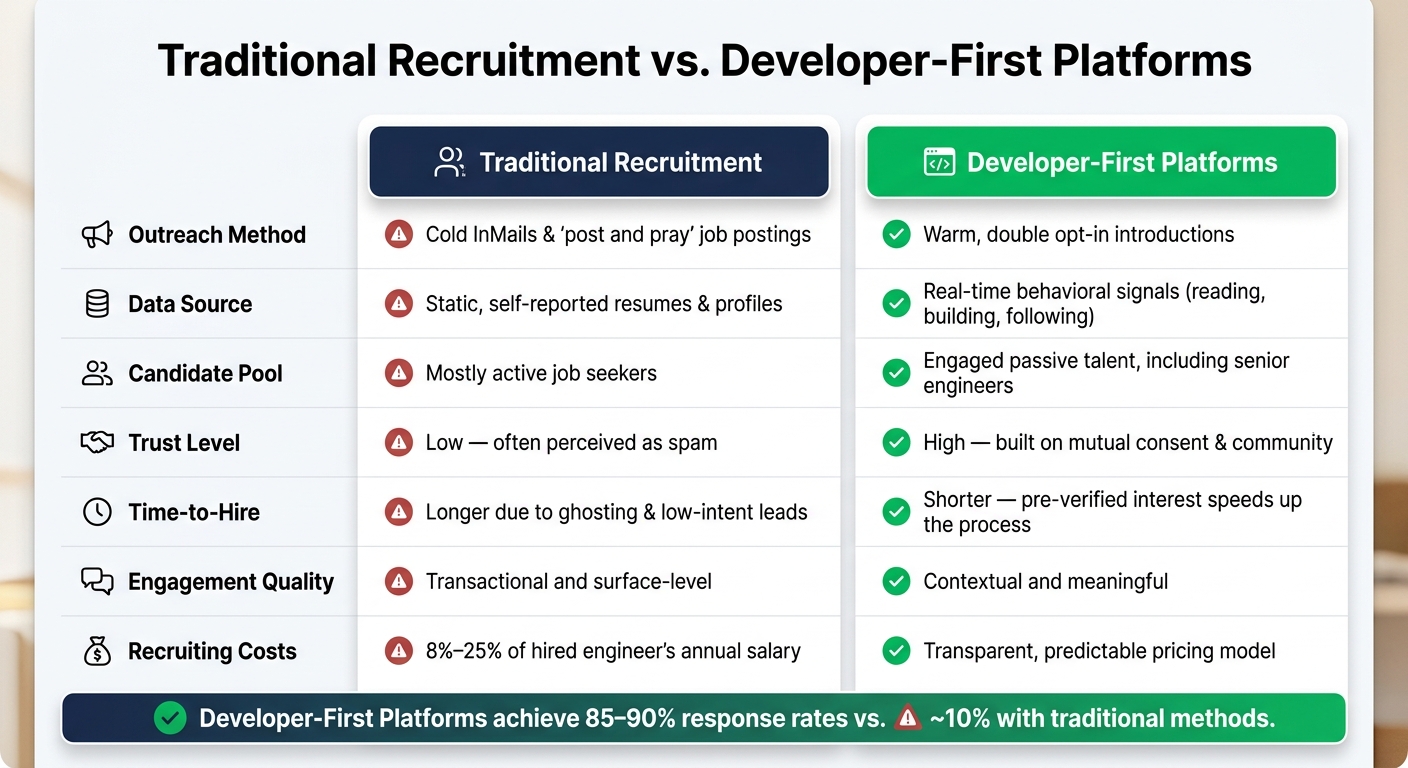
Fine-tuning your messaging can improve response rates, but sometimes, the entire approach to recruitment needs a rethink.
Most traditional recruitment tools are built with active job seekers in mind. But here’s the catch: the best developers aren’t usually looking. They’re already employed, deeply focused on solving challenging problems, and rarely browsing job boards. This disconnect is why conventional methods often fall flat when it comes to hiring technical talent.
The issue lies in how traditional recruitment operates. Job boards and cold InMail campaigns depend on either waiting for candidates to come to you or sending unsolicited messages to people who didn’t ask for them. This approach doesn’t address the imbalance between open roles and actively searching candidates. And sending more messages won’t fix it. What’s needed is a complete shift in strategy.
Developer-first platforms take a different approach. Instead of relying on outdated profiles, these platforms use real-time behavioral signals - what developers are currently reading, building, or following - to identify and understand the needs of passive talent who are truly relevant. They also replace cold outreach with double opt-in introductions, meaning developers have already reviewed the role and agreed to connect before recruiters even reach out . This change drastically reduces ghosting and low-quality interactions, saving time and effort for everyone involved.
Side-by-Side Comparison Table
Here’s how traditional recruitment stacks up against developer-first platforms when it comes to hiring developers:
| Factor | Traditional Recruitment | Developer-First Platforms |
|---|---|---|
| Outreach Method | Cold InMails, job postings ("post and pray") | Warm, double opt-in introductions |
| Data Source | Static, self-reported resumes and profiles | Real-time behavioral signals (reading, building, following) |
| Candidate Pool | Mostly active job seekers | Engaged passive talent, including senior engineers |
| Trust Level | Low; often perceived as spam | High; built on mutual consent and community |
| Time-to-Hire | Longer due to ghosting and low-intent leads | Shorter; pre-verified interest speeds up the process |
| Engagement Quality | Transactional and surface-level | Contextual and meaningful |
| Recruiting Costs | 8%–25% of the hired engineer's annual salary | Transparent, predictable pricing model |
The comparison makes it clear: a recruitment model based on mutual consent and real-time engagement leads to better results.
The double opt-in model is especially worth highlighting. By the time a developer agrees to an introduction, they’ve already reviewed the role and expressed interest. This eliminates the need to spend the first call gauging mutual interest - it’s already been established . That’s a huge time-saver for both recruiters and candidates.
While traditional recruitment methods still have their place, they often hit a ceiling when it comes to hiring developers. The most sought-after candidates are the least likely to respond to cold outreach. To connect with them, you need to meet them where they’re already engaged and respect their time from the very first interaction.
Conclusion: How to Actually Connect With Developers
The challenge in hiring developers isn't about a lack of talent - it's about failing to understand how developers think and make decisions. Most outreach strategies miss the mark. Generic messages are ignored, hidden salary details erode trust before a conversation even begins, and cold, irrelevant InMails rarely achieve anything meaningful.
The solution? It's not about sending more messages; it's about sending better ones. Hyper-personalized outreach that references a developer's specific technical work can boost response rates by 50% compared to generic templates . Keeping messages concise - under 150 words - while being transparent about compensation and offering a clear, low-pressure call to action helps reduce the barriers that often lead to disengagement .
"Recruiting should be built on context, not spam. Developers shouldn't have to sift through irrelevant offers from strangers who don't understand their work." - Nimrod Kramer, daily.dev
But it's not just about the content of your message - the platform you use to connect with developers is just as important. Developers aren't spending their time on typical job boards. They're engaged in spaces where they can learn, build, and collaborate. Reaching them in these environments, with respect for their time and interests, can turn a cold introduction into a meaningful conversation.
daily.dev Recruiter is designed with this philosophy in mind. It uses a double opt-in system, real-time behavioral matching, and connects recruiters with over 1 million active developers. By replacing cold outreach with warm, consent-based introductions, it ensures that when you finally speak with a candidate, the interest is mutual. This approach reflects the respectful, efficient process we've been advocating all along .
FAQs
What should I include in the first message to a developer?
Your initial message to a developer should be short and to the point, but also personal and thoughtful. Highlight something specific about their skills or experience that caught your eye - maybe a project they've worked on or a technology they specialize in. Avoid sounding like you're copying and pasting a generic note; instead, approach them as you would a future collaborator. Clearly explain how connecting could be mutually beneficial, whether it’s an exciting project, a shared interest, or a career opportunity. This personal touch can make all the difference in getting a response.
How do I personalize outreach without sounding creepy?
To make outreach more personal, take the time to dig into the candidate’s skills, experience, and interests. Mention specific details, such as recent projects they’ve worked on or standout qualifications, to demonstrate sincere interest and relevance. Steer clear of generic messages - tailor your communication to connect their background with the role you’re offering. Maintaining a professional tone, being upfront, and focusing on what’s valuable to them helps build trust and ensures your approach feels genuine rather than pushy.
How do double opt-in introductions work on daily.dev Recruiter?
Double opt-in introductions on daily.dev Recruiter ensure that developers give clear, explicit consent before recruiters reach out to them. This method focuses on creating trust by making communication both transparent and personalized. The result? Better response rates and a smoother interaction for everyone involved.
.png)