Building a developer talent pipeline ensures you're ready to hire skilled engineers when needed - without rushing. Instead of waiting for job openings, this approach focuses on building relationships with potential candidates early. Here's the key takeaway:
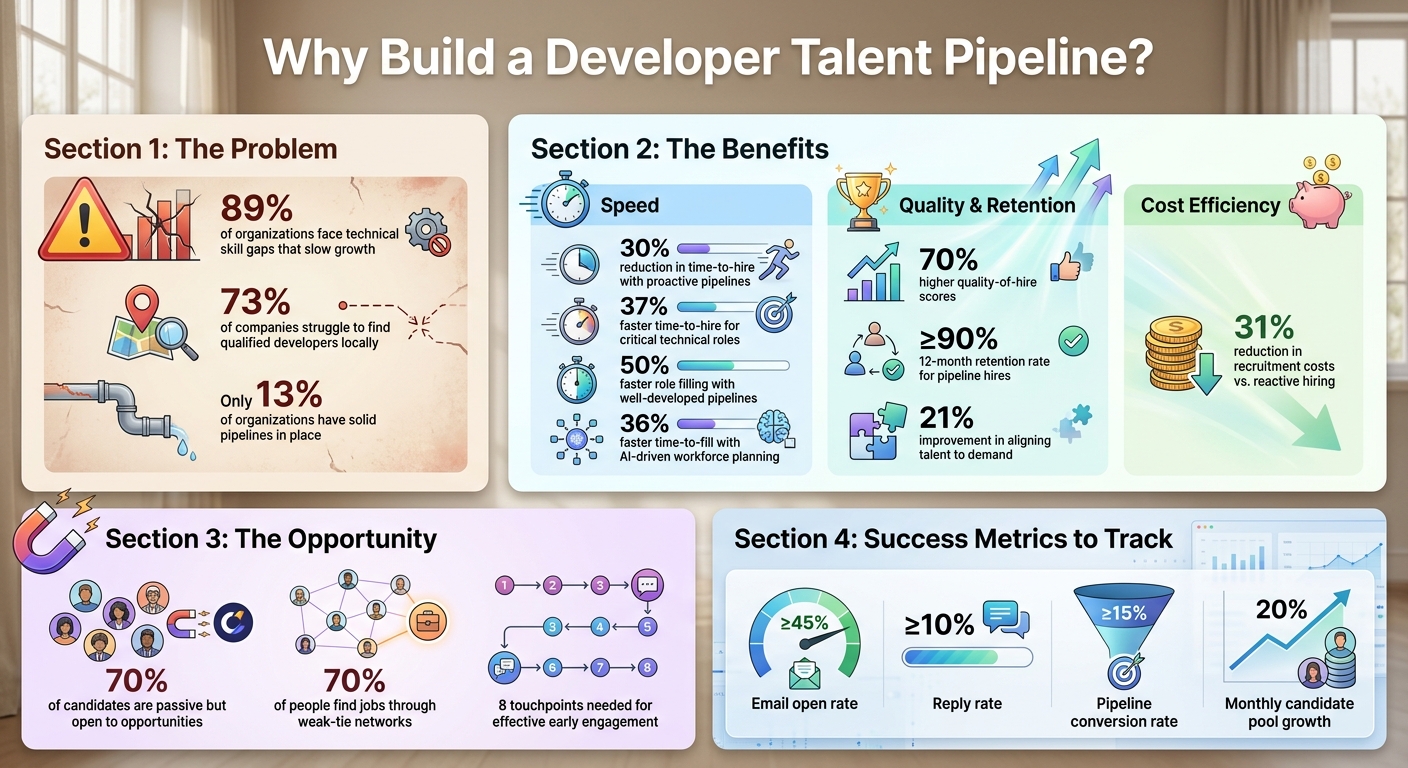
- Faster Hiring: Companies with pipelines reduce time-to-hire by 30% by tapping into pre-qualified candidates.
- Access Passive Talent: Most developers aren’t actively job hunting but are open to the right opportunity. Early engagement (up to 8 touchpoints) makes a difference.
- Strategic Planning: Align hiring plans with your product roadmap to anticipate skill needs (e.g., AI, DevOps).
- Organized Database: Use tools like ATS or CRM to centralize candidate data and track readiness levels.
- Engagement Matters: Regular, personalized outreach (e.g., sharing insights, hosting events) builds trust and keeps candidates interested.
Forecast Your Developer Hiring Needs
To align your workforce with your business goals, start by reviewing your 6–12 month product roadmap. This will help you identify the technical skills your team will need. For example, if you're planning to launch an AI feature, you'll need machine learning engineers. Expanding your cloud infrastructure? DevOps specialists should be on your radar.
The urgency of this planning is backed by numbers. Research shows that 89% of organizations face technical skill gaps that slow their growth. Meanwhile, 73% of companies struggle to find qualified developers locally. The good news? Companies with proactive recruitment strategies report a 37% faster time-to-hire for critical technical roles.
Connect Business Goals to Hiring Plans
Use your roadmap to guide hiring decisions. Collaborate with department heads by asking, "Which three roles are critical to achieving next year’s goals, and what specific skills should these roles bring?". This approach helps pinpoint gaps before they become critical. Work closely with engineering leaders to distinguish between your "core technologies" (proprietary systems that need deep expertise) and "context technologies" (like APIs, UI frameworks, or security tools) that can be staffed more flexibly.
Leverage talent intelligence tools like LinkedIn Talent Insights or other developer sourcing tools to analyze hiring trends, attrition rates, and the local availability of specific skills. Companies using AI-driven workforce planning have seen a 36% faster time-to-fill and a 21% improvement in aligning talent to demand. These insights can guide decisions on adjusting job requirements, widening your geographic search, or starting earlier for hard-to-fill roles.
Identify High-Priority Developer Skills
Not all roles require the same level of attention. Focus on positions that are historically harder to fill or those you hire for frequently. Conduct a skills audit by categorizing roles based on frameworks (e.g., React, Angular), programming languages (e.g., Python, Go, Rust), and seniority levels.
Set measurable goals to streamline your efforts. For example:
- Aim for 20% monthly growth in your candidate pool for high-priority skills.
- Target a 15% conversion rate from initial contact to "ready-to-hire" status.
- Reduce your time-to-hire by 30% compared to reactive hiring methods.
Segmenting candidates by technical stack and seniority helps create what Anastasia Dontova, Technical Sourcer at Index.dev, calls a "living map" of the talent landscape. This approach ensures your proactive sourcing strategy is both targeted and effective.
Source Developer Talent Before You Need It
The best developers aren’t scrolling through job boards - they’re busy working, learning, and contributing to their communities. To connect with them, you need to meet them where they already are.
Moving from reactive hiring to proactive sourcing requires more than just posting "we're hiring" announcements. Instead, focus on authentic engagement. Share technical insights, organize knowledge-sharing events, or highlight your team's open-source work. The aim is to build trust and visibility long before you have open positions to fill.
Why does this matter? Companies with well-developed talent pipelines fill roles 50% faster and report 70% higher quality-of-hire scores. The secret? They’ve cultivated relationships with candidates who already understand their mission and technical challenges. Tools like daily.dev Recruiter can help make these connections even easier.
Use daily.dev Recruiter to Connect with Developers
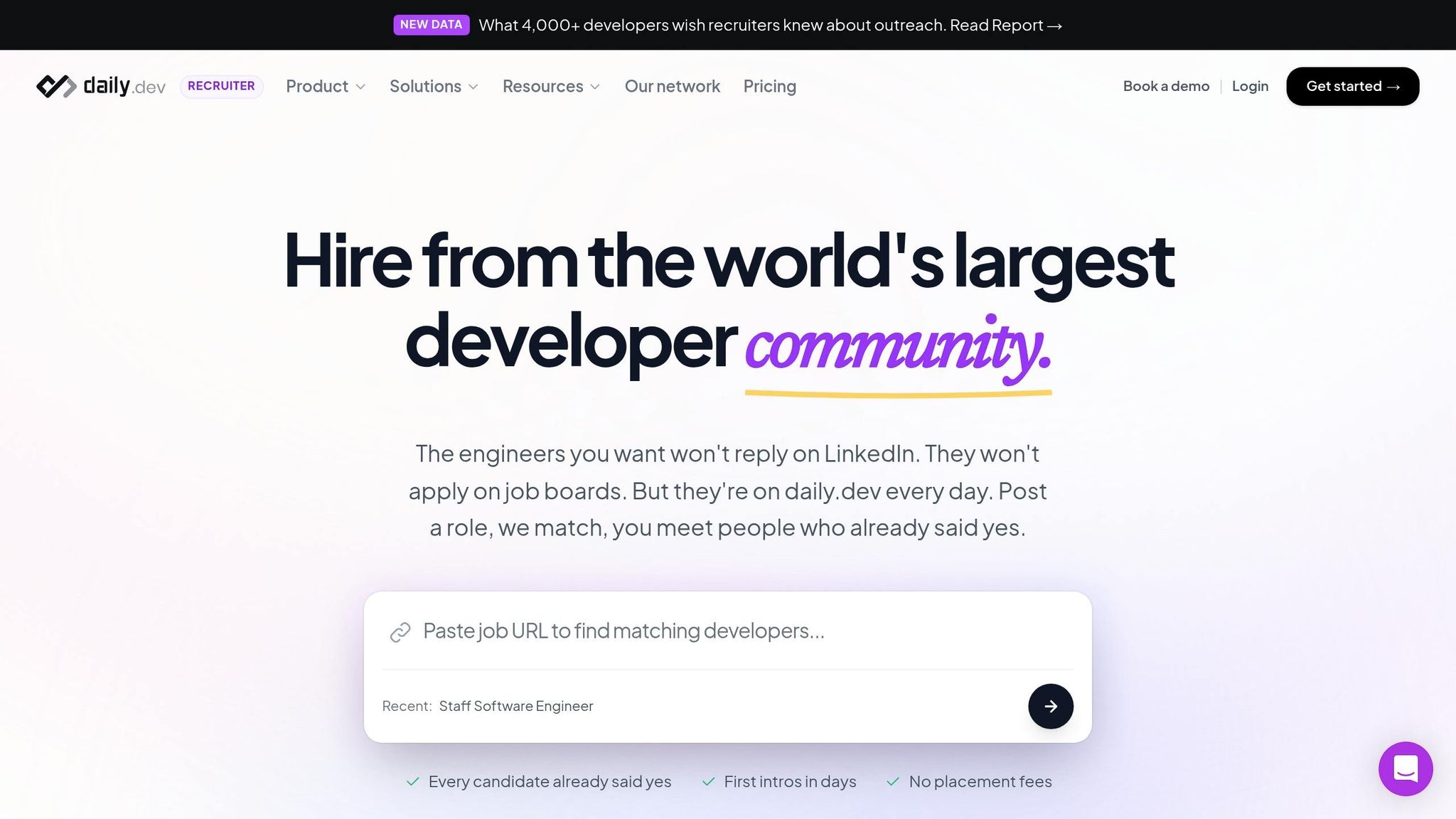
daily.dev Recruiter takes a different approach to sourcing, connecting you with developers based on real-time behavior - what they’re reading, building, and learning right now. Forget outdated, impersonal outreach methods.
The platform uses a double opt-in system, known internally as "TinDev", ensuring both you and the developer express interest before starting a conversation. This approach keeps interactions genuine and avoids the spammy nature of cold emails. The results speak for themselves: this method achieves a trust score of 100%, compared to less than 1% for cold emails and 5% for InMail.
Here’s how it works: daily.dev automatically verifies details like a developer’s tech stack, seniority, time zone, and location, matching them to your specific needs. When a candidate opts in, their profile integrates directly with your ATS (Greenhouse, Lever, Ashby, or Workable), eliminating manual data entry. Instead of chasing resumes, you’re connecting with professionals who are already engaged and open to opportunities. Expanding these proactive methods to educational and event-based channels can take your talent sourcing even further.
Connect with Universities, Bootcamps, and Events
In line with a proactive sourcing strategy, educational institutions and industry events provide direct access to both up-and-coming and experienced talent. Establish partnerships with coding bootcamps and university computer science programs to build internship pipelines. These connections give you early access to promising developers before they enter the broader job market.
Participate in or sponsor hackathons and tech conferences like JSWorld to engage with developers in action. These environments let you observe their problem-solving skills and how they might fit within your team, all without the pressure of formal interviews. Hosting your own technical meetups or virtual roundtables - on topics like "Future of API Design" or "Scaling Kafka Infrastructure" - can also boost your brand while offering meaningful value to the community.
Don’t overlook weak-tie networks - alumni groups, former coworkers, and professional acquaintances. Research shows that 70% of people find jobs through weak ties rather than close connections. Tap into your company’s alumni network for referrals or consider "boomerang" hires - former employees who already understand your culture and systems. These connections can be a goldmine for building a strong talent pipeline.
Build and Organize Your Developer Talent Database
You’ve found promising candidates - so what’s next? Without a proper system to organize them, all that hard work can quickly go to waste. Companies with established global developer recruitment programs report hiring for critical technical roles 37% faster while cutting recruitment costs by 31% compared to reactive hiring approaches . A centralized database turns scattered candidate data into a powerful resource.
Think of your talent database as a dynamic system, not just a static spreadsheet. It should capture everything - skills, experience, engagement history, and readiness - within a single platform. This is where an Applicant Tracking System (ATS) or Candidate Relationship Management (CRM) platform becomes key, serving as your go-to source for all candidate information . Start by importing historical data, such as profiles of past applicants who didn’t fit earlier roles but may now have the qualifications you need . For example, in 2024, a mid-sized FinTech firm with 200 employees implemented a global talent mapping strategy. The results? They slashed their average hiring time from 97 days to 31 days - a 68% improvement - and onboarded 27 developers across three regions in just four months . Once your data is centralized, you’ll have a solid foundation to manage and nurture these valuable relationships.
Create a Centralized Talent Database
Don’t let candidate information sit scattered across emails, LinkedIn messages, and spreadsheets. Use your ATS or CRM to consolidate all data into one central hub. Introduce a tagging system to make it easier to find niche skills. For example, tags like "Rust enthusiasts", "Open-source maintainers", or "Bench Q3 2026: Senior Backend" can help you quickly locate candidates with specific expertise . Direct integration with your ATS ensures that candidate profiles stay updated automatically.
Track interactions like email opens, link clicks, replies, and event attendance to measure engagement levels . This data helps you figure out who’s genuinely interested and who’s just passively browsing. As Anastasia Dontova, Technical Sourcer at Index.dev, explains:
"A CRM without a communication plan is just a sophisticated contact database" .
The goal is to build a "warm bench" - a curated group of pre-qualified engineers who’ve already engaged with your company and shown interest in future opportunities.
Segment Candidates by Readiness Level
Not every candidate is ready to interview right now. That’s why segmentation is critical. Group candidates by timing, technical skills, and engagement levels. For timing, categories like "Immediate", "6-12 months out", or "Long-term potentials" can help you prioritize outreach and craft personalized messages . For example, someone in the "Immediate" category might get a direct message about an open position, while a "Long-term potential" might receive quarterly updates, technical content, or webinar invites.
Engagement scores can also guide your focus. Candidates with at least two meaningful interactions - such as replies or event attendance - within six months are likely ready for a conversation . Add another layer of segmentation based on factors like seniority (junior, mid-level, senior, lead), skillset (React, Go, Kafka, DevOps), or special interests (diversity advocates, conference speakers).
For a high-performing talent pipeline, aim for an email open rate of 45% or higher and a reply rate of at least 10% . If your numbers fall short, it might be time to fine-tune your segmentation or messaging. By structuring your database this way, you’ll be ready for targeted, effective outreach to keep developers engaged and interested.
Engage and Nurture Developer Relationships
Once you've centralized your candidate data, the real challenge begins: building authentic, long-term connections with developers. A talent database is just the starting point. To truly stand out, you need to engage developers in a way that feels personal and meaningful. Developers can quickly spot generic outreach, and if your messages feel impersonal or salesy, they’ll simply tune out.
To keep engagement alive without overwhelming candidates, aim for outreach every 3–4 weeks. But don’t just send generic updates - each interaction should provide something of real value. Share technical insights, invite them to community events, or simply ask about their latest projects. This kind of consistent, thoughtful communication ensures candidates are already engaged when the right opportunity arises. As Anastasia Dontova, Technical Sourcer at Index.dev, explains:
"Cold outreach can't be cold-hearted. Generic messages... can no longer be an ice-breaker" .
Personalization is key. Use insights like a candidate’s GitHub activity, blog posts, or preferred tech stack to craft messages that resonate.
Use Personalized Outreach Campaigns
A personalized approach shows candidates you’re genuinely interested in their work. Reference their recent contributions - whether it’s open-source projects, conference talks, or blog posts - to make your outreach feel relevant. Avoid blasting the same message to everyone; instead, tailor your campaigns to reflect your research.
For example, instead of just pitching a job, share technical stories or community updates. You might highlight how your team scaled Kafka to handle 5 billion messages daily or invite them to review a pull request for a CNCF project your company worked on. Incorporate updates about your own open-source contributions or ask about their ongoing projects. A good benchmark? Aim for email open rates of 45% or higher. If you’re not hitting that mark, it’s time to rethink your messaging strategy.
Also, ask candidates how often they’d like to hear from you and through which platform - email, LinkedIn, or even Slack. While some developers may prefer quarterly updates, others might welcome monthly check-ins. Respecting these preferences builds trust and ensures your outreach feels thoughtful, not intrusive.
Host Webinars and Knowledge-Sharing Events
Events are a great way to position your company as more than just a recruiter. Developers are often drawn to learning opportunities and peer collaboration, sometimes valuing these more than salary discussions. Hosting webinars, live coding sessions, or technical roundtables creates a space where candidates can engage with your team without the pressure of a hiring pitch.
Focus on topics that resonate with experienced developers. Think sessions like "Scaling Kafka at 5B messages/day" or "Redesigning CI/CD pipelines." Instead of leading the discussion yourself, invite senior developers to join as panelists or contributors. This shifts the tone from “we’re recruiting you” to “we value your expertise.” Samantha McLaren from LinkedIn sums it up well:
"Meeting a candidate in person [or virtually] is a fast way to start building a relationship that can pay off down the line" .
After the event, follow up via LinkedIn or email to keep the relationship alive. Encourage hiring managers to attend these sessions too - they can connect directly with potential candidates and start building rapport. You can also create private Slack or Discord channels for niche communities, like Go or Rust enthusiasts. These spaces foster ongoing conversations and keep your talent pipeline warm for future opportunities.
Measure and Improve Your Developer Talent Pipeline
Once your developer pipeline is up and running, the next step is to measure its performance. This ensures it consistently delivers qualified talent when needed. Success here involves more than just tracking activity like the number of emails sent - it’s about assessing the impact. Are you building a pool of skilled developers ready to step into open roles? This phase transforms engagement into measurable hiring outcomes, completing your proactive approach.
Define Key Metrics for Success
Focus on metrics that reflect the health of your pipeline, not just its activity levels. For outreach, aim for an email open rate of at least 45% and a reply rate of 10% or more . Your pipeline should convert at least 15% of initial contacts into a “ready bench” of developers . Also, track the growth of your candidate pool - ideally, it should expand by about 20% month-over-month .
Remember, quality beats quantity. Monitor the 12-month retention rate for hires sourced from your pipeline, targeting 90% or higher . Additionally, compare the time-to-hire for pipeline candidates versus those sourced cold. Proactive pipelines can cut time-to-hire by around 30% .
Adjust Based on Data Insights
Let the data guide your strategy. For instance, if your applicant-to-interview conversion rate is low, it might mean recruiters and hiring managers aren’t aligned on candidate profiles . In this case, schedule calibration sessions to clarify expectations before investing more time in misaligned outreach. If reply rates drop below 10%, revisit your messaging - emphasize technical value, such as inviting candidates to coding sessions. Also, review time-in-stage metrics to identify bottlenecks .
If candidates linger too long in the "initial contact" phase, your follow-up cadence might need a boost. Set up CRM triggers to remind you to follow up after three email opens or clicks on technical content . Additionally, analyze your offer acceptance rates by source. If certain channels consistently attract candidates who decline offers, it could signal a mismatch between the talent’s expectations and your company’s mission or tech stack .
As Kelly Robinson, Leadership & LinkedIn Coach, explains:
"Real recruiting success is measured by quality and fit. It's about building strong teams, improving retention, and ensuring long-term success for both the candidate and the company" .
Approach your pipeline like a product - review performance quarterly, experiment with new outreach methods, and refine based on what delivers results. By continuously fine-tuning your metrics, you enhance the talent pipeline you’ve worked hard to build. These ongoing adjustments ensure your earlier engagement and segmentation efforts pay off in the long run.
Conclusion
Switching to a proactive developer talent pipeline can transform the chaos of last-minute hiring into a seamless process with quick access to skilled professionals. By adopting Talent Architecture, you’re not just filling roles - you’re cultivating relationships well before positions even open, giving your team a distinct edge in hiring speed and quality .
Right now, only 13% of organizations have solid pipelines in place . That leaves a huge opportunity for companies ready to prioritize proactive sourcing, meaningful engagement with developers, and consistent relationship-building.
Consider this: 70% of candidates are passive but open to opportunities. Platforms like daily.dev Recruiter can help you connect through genuine, opt-in interactions . Instead of cold outreach, focus on community-driven efforts. Host technical discussions, share valuable insights, and establish trust long before mentioning specific job openings . These steps - predicting hiring needs, engaging early, and nurturing talent - are the cornerstone of a reliable, efficient hiring system.
To keep your pipeline effective, aim to deliver value within the first three months, maintain consistent engagement every quarter, and reevaluate career alignment every three years . Organize your talent pool by skills, experience levels, and availability, rather than relying on outdated, static lists . Track meaningful metrics like ≥ 45% email open rates, ≥ 10% response rates, and ≥ 15% pipeline conversion rates .
Think of your pipeline as a living, evolving product. Review it quarterly, experiment with new approaches, and make adjustments as needed. When you build relationships ahead of demand, you’re not just hiring faster - you’re creating stronger, more resilient teams with ≥ 90% retention rates . In doing so, you gain a lasting advantage in the competitive landscape of developer recruitment.
FAQs
How far ahead should I start building a developer pipeline?
Starting to build a developer talent pipeline at least 12 months before you expect to hire is a smart move. This approach gives you enough time to map out roles effectively, establish connections with potential candidates, and nurture those relationships. By planning ahead, you’ll have a steady stream of qualified talent ready when you need them, cutting down on hiring delays and keeping your pipeline strong over the long term.
What should I send developers so outreach doesn’t feel spammy?
To steer clear of spammy outreach, focus on sending personalized, value-focused messages rather than relying on generic templates. Make it clear what the recipient stands to gain by presenting a strong value proposition and maintaining open, honest communication. Skip the mass-sending of cookie-cutter templates - take the time to craft concise, relevant, and respectful messages that align with the preferences of developers. This tailored approach can lead to much higher response rates compared to more traditional outreach tactics.
How do I know when someone in my pipeline is ready to interview?
A candidate is prepared for an interview when they exhibit clear signs of engagement and meet the qualifications you're seeking. Indicators include positive feedback, effective communication, genuine interest, and alignment with the required skills and workplace values. Keeping track of their journey through the hiring process - such as progressing from initial contact to active participation - can help you determine when they're ready to take the next step.
.png)