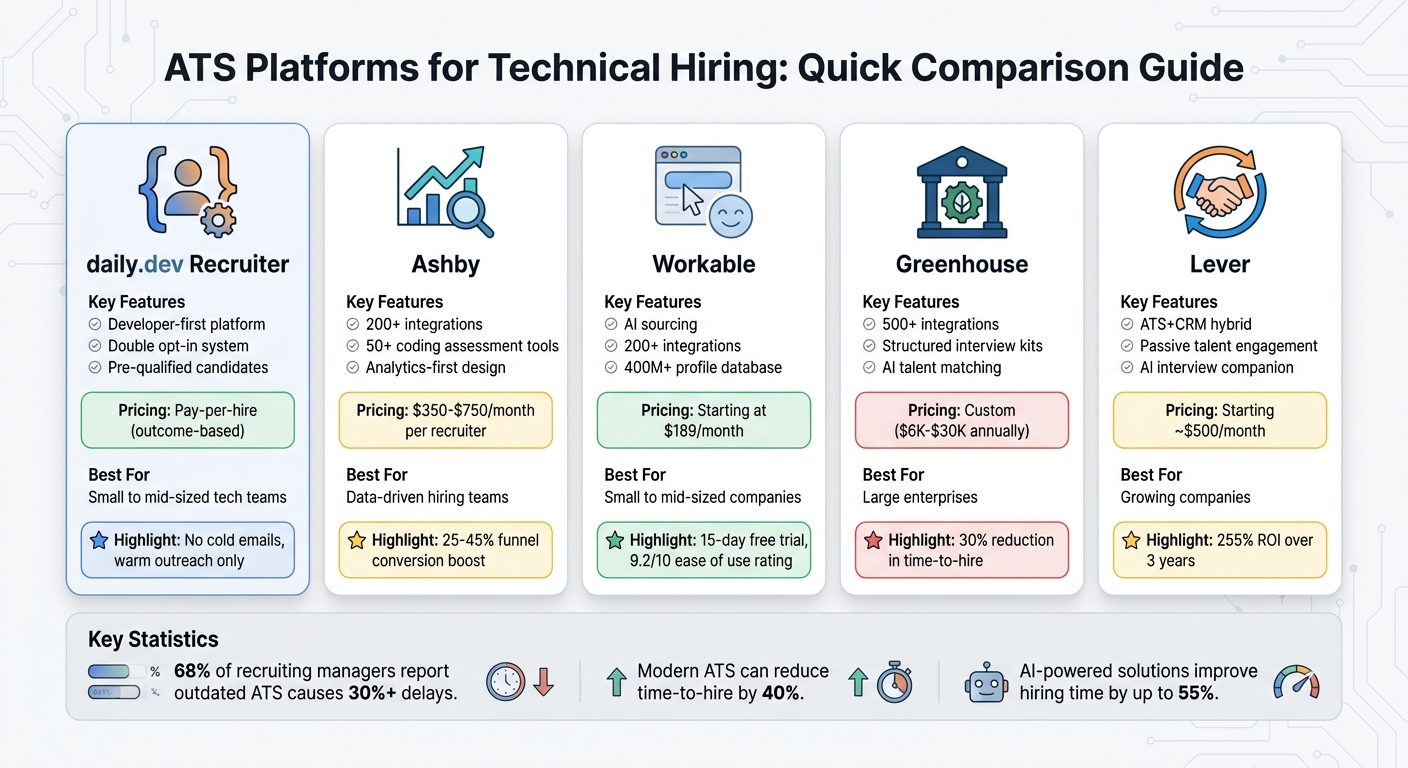
Recruiting developers in 2026 is challenging due to high application volumes, passive candidates, and complex technical evaluations. Using modern sourcing tactics is essential to reach these developers. The right Applicant Tracking System (ATS) can save time, improve candidate quality, and simplify hiring. Here's a quick guide to five leading ATS platforms for technical hiring:
- daily.dev Recruiter: Developer-focused, integrates with technical tools, and offers pay-per-hire pricing.
- Ashby: Analytics-driven with developer assessment tool integrations; starts at $350/month per recruiter.
- Workable: User-friendly with AI sourcing and over 200 integrations; pricing starts at $189/month.
- Greenhouse: Enterprise-level ATS with structured processes and 500+ integrations; custom pricing.
- Lever: Combines ATS and CRM, ideal for passive candidate engagement; pricing starts around $500/month.
Quick Comparison
| Platform | Key Features | Pricing | Best For |
|---|---|---|---|
| daily.dev Recruiter | Developer-first, pay-per-hire model | Outcome-based pricing | Small to mid-sized tech teams |
| Ashby | Analytics, 50+ coding tools | $350+/month per recruiter | Data-driven hiring teams |
| Workable | AI sourcing, 200+ integrations | $189+/month | Small to mid-sized companies |
| Greenhouse | Structured processes, 500+ integrations | Custom pricing | Large enterprises |
| Lever | ATS+CRM, passive talent engagement | $500+/month | Growing companies |
Your ATS choice should align with your hiring needs, team size, and budget. A modern, AI-driven system can reduce manual tasks, speed up hiring, and attract top developers.
1. daily.dev Recruiter
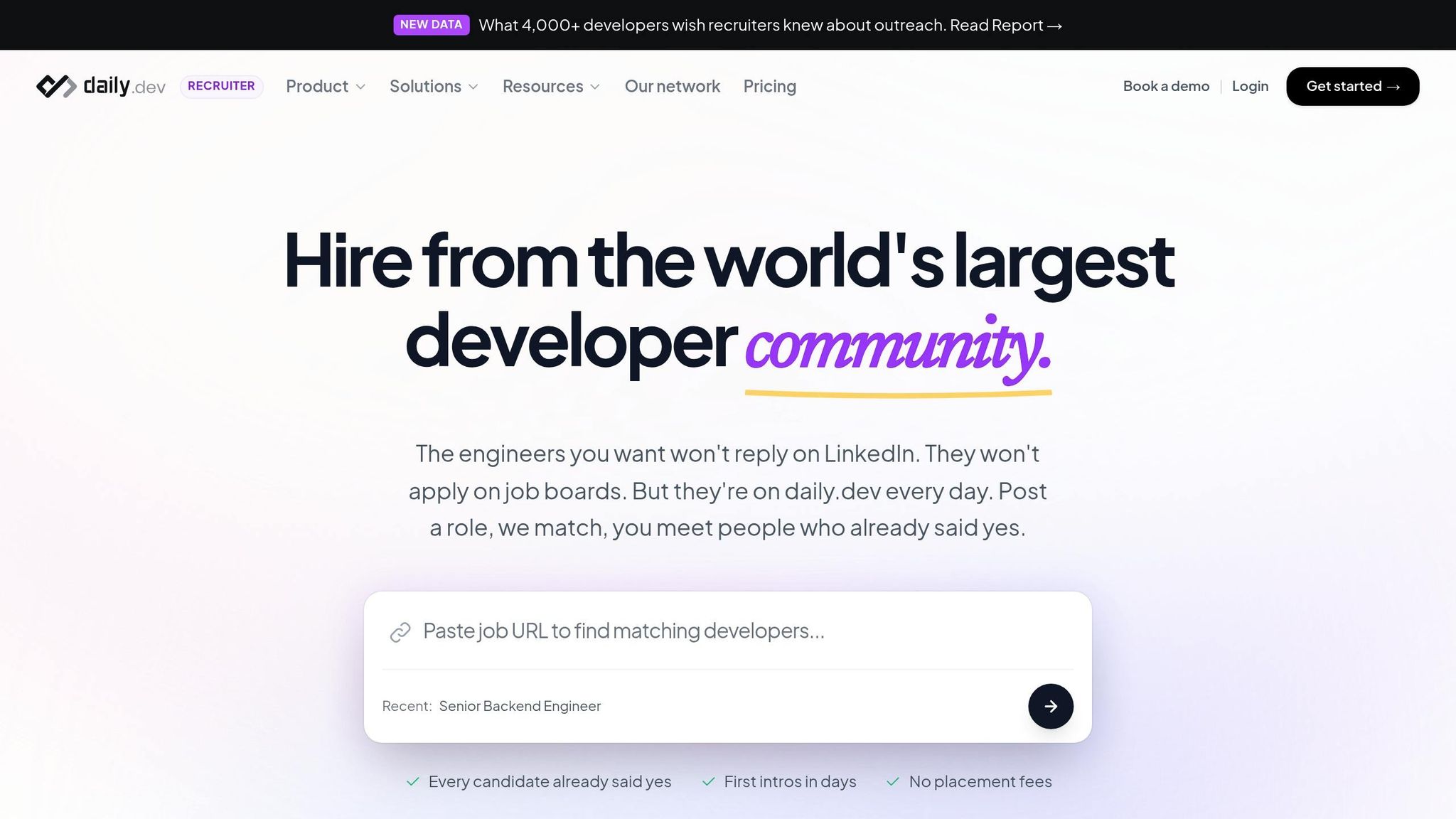
daily.dev Recruiter changes the game for technical hiring by offering a developer-first platform. It’s built within a network where software engineers actively engage with technical content, creating a fresh way to connect with talent. This approach is powered by strong technical integrations that make the process seamless.
Developer-Friendly Integrations
The platform works smoothly with your current recruitment tools, integrating with popular ATS platforms, Slack, Microsoft Teams, and scheduling software. It also provides customizable API endpoints to simplify data entry and sync candidate details across your HR systems. Security is prioritized with Single Sign-On (SSO) and OAuth 2.0 authentication, ensuring enterprise-grade protection without disrupting your workflow.
Candidate Experience
daily.dev Recruiter uses a double opt-in system, meaning developers only hear from you if they’ve shown interest in opportunities. No cold emails here - every outreach is warm and informed. You’ll have insights into a developer’s technical interests, learning habits, and engagement patterns. Plus, candidates are pre-qualified through their activity in the community. By the time you connect, you’ll already know they’re engaged with relevant technologies and open to a conversation.
Pricing Model
The platform uses an outcome-based, pay-per-hire pricing model with no hidden fees. It scales effortlessly, whether you’re a startup hiring your first developer or a large company looking to fill multiple engineering roles. This approach ensures you’re making the most of your budget while bringing in top-tier talent.
2. Ashby
Ashby provides an analytics-focused platform built by experienced engineers from Box, Dropbox, and Robinhood. It combines your entire recruiting toolkit - ATS, CRM, scheduling, and analytics - into a single system. Below, we’ll break down how its integrations, support for coding assessments, scalability, and pricing structure enhance technical hiring.
Developer-Friendly Integrations
Ashby supports over 200 integrations, ranging from coding assessments to job boards and post-hire tools. Its open API allows for custom workflows and automations, making it a favorite for technical hiring teams. It integrates seamlessly with platforms like CodeSignal, HackerRank, CoderPad, CodeSubmit, and Hatchways, offering a streamlined experience.
Between 2025 and 2026, Coder - a remote infrastructure platform - replaced four separate recruiting tools with Ashby. Under the leadership of Director of People Camilla Lever, the team saved more than 10 hours each week and reduced sourcing time by over 5 hours per job listing. This efficiency contributed to a 12% headcount increase during that time .
"I found Ashby to be the missing link between sourcing and staying on top of candidates. It's helped me streamline a lot of things, and it's definitely helped me stay more organized." - Camilla Lever, Director of People, Coder
Coding Assessment Tools
Ashby integrates with more than 50 coding assessment platforms, enabling teams to conduct tailored evaluations. Whether it’s take-home challenges, short screening tests, or live coding sessions, Ashby ensures fast result processing and includes built-in fraud detection for candidate assessments .
Scalability
Ashby’s analytics-first design tracks every step of the hiring process, delivering insights comparable to business intelligence tools. This can boost hiring funnel conversion rates by 25%-45% . Features like the Recruiting Planner help forecast staffing needs, while AI-driven reviews and feedback summaries make managing large candidate pools more efficient.
Pricing Model
Ashby’s comprehensive features come with a straightforward pricing structure tailored to teams of different sizes. It uses a per-recruiter pricing model with three tiers:
- Growth: $350/month (minimum of 3 seats)
- Scale: $500/month (minimum of 5 seats)
- Enterprise: $750/month (minimum of 10 seats)
For smaller teams, some reports suggest entry-level pricing starts at $149/month . Implementation typically takes 6 to 8 weeks, and the platform boasts a 95% implementation success rate .
3. Workable
Workable is an all-in-one Applicant Tracking System (ATS) designed for small to mid-sized companies. It combines AI-powered sourcing, built-in assessments, and over 200 integrations. With more than 75 million candidates processed and 1 million hires facilitated, Workable serves 20,000+ customers across 100+ countries .
Developer-Friendly Integrations
Workable offers an open API, enabling teams to create API Access Tokens for custom workflows and third-party integrations . It connects with specialized tech tools like HackerRank, Coderbyte, CoderPad, TestGorilla, and Codility . Automated workflows simplify processes - for instance, when a candidate is moved to the "Screening" stage, a Coderbyte challenge can be sent automatically .
In 2026, HireTruffle, a recruitment firm, used Workable to make 15 engineering hires in just six weeks. By integrating Hirevire with Workable, candidates submitted GitHub repositories, architecture diagrams, and video responses. This approach saved senior engineers several days of review time per role through asynchronous evaluations . Such integrations streamline technical hiring and improve efficiency.
"Workable is easy to set up and use. Setting it up took just a couple of hours, and I can fully recommend it." - Anna Hoffmann, COO, dltHub
Coding Assessment Tools
Workable integrates technical assessment tools directly into candidate profiles. For example, the HackerRank integration displays invite statuses, scores, and detailed reports right within the platform . Additionally, the platform supports one-way video interviews, allowing hiring teams to evaluate candidates’ communication and problem-solving skills at scale .
Scalability
Workable is built to handle high-volume hiring needs. Its AI-powered screening generates match scores and checklists while offering access to a searchable database of over 400 million profiles. Job postings are auto-distributed to 200+ boards . For larger teams, features like SSO, SCIM provisioning, audit logging, and a BI-data link help connect hiring metrics to external business intelligence tools, ensuring a secure and data-driven hiring process .
"The AI features within sourcing is excellent, and also the AI screening has saved hours in searching through candidates." - Mark Dolman, Director - Talent Acquisition, EnerMech
Pricing Model
Workable’s pricing is straightforward, based on active job openings or headcount. Plans range from Starter to Enterprise, and every plan includes a 15-day free trial with full access to the platform . On G2, Workable earned a 9.2/10 rating for Ease of Use, outperforming competitors in its category .
Candidate Experience
Workable enhances the candidate experience with mobile-friendly forms, one-click apply options, and self-scheduling tools that eliminate back-and-forth communication delays. The platform supports multi-language job posts and offers in six languages . Integrated SMS messaging achieves a 98% response rate and delivers replies 60 times faster than traditional email .
4. Greenhouse
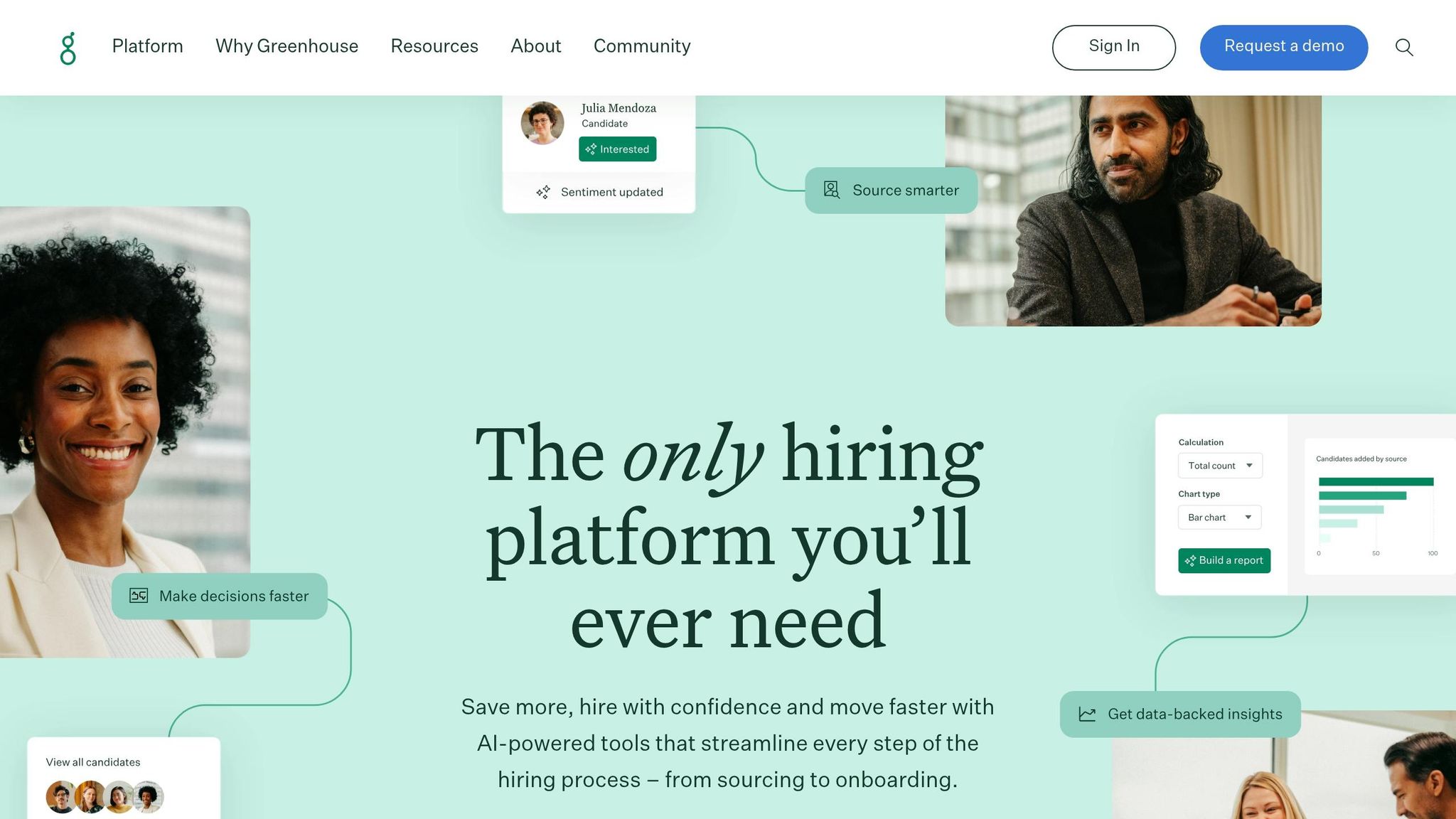
Greenhouse is designed to adapt to the evolving demands of technical hiring by offering data-focused integrations and standardized assessments. Serving over 4,000 customers, this enterprise ATS streamlines technical evaluations with its structured kits and scorecards. For instance, Ocado Group reduced its time-to-hire by nearly 30% using Greenhouse .
"Greenhouse has made a real difference to how we hire at Ocado Group. It's helped us simplify our recruitment processes, cutting our time‐to‐hire by nearly 30%."
– Peter Tam, Talent Acquisition Enablement Manager, Ocado Group
Developer-Friendly Integrations
Greenhouse boasts over 500 native integrations spanning various HR tech categories, making it one of the most connected platforms for technical recruitment . This connectivity is essential when you audit your tech hiring stack to ensure tool compatibility. Its Harvest API enables seamless data sharing with tools like HackerRank and CodeSignal, allowing detailed candidate information, notes, and custom fields to flow directly into the ATS. It also auto-generates live pair-coding links for interview invitations . Between 2019 and 2020, Greenhouse's engineering team, under Tim Johnson's leadership, improved their technical pass-through rates by using the CodeSignal Interview integration. This live, collaborative coding setup provided deeper insights into candidates' problem-solving approaches, resulting in more effective onsite interviews .
"The live experience gives us an ability to assess a person's style. It lets us understand how they work. How do they approach a problem? How do they pick apart the requirements?"
– Tim Johnson, Director of Engineering, Greenhouse
Coding Assessment Tools
Greenhouse enhances technical hiring by integrating with third-party coding assessment platforms, rather than offering its own native coding environment . Structured Interview Kits and Scorecards ensure consistent evaluations by aligning candidate assessments with predefined competencies . Its AI-powered Talent Matching feature (available in Plus and Pro tiers) analyzes resumes against weighted criteria to highlight top technical talent . Additionally, the platform provides scorecard summaries and suggests interview questions, helping teams consolidate feedback and craft relevant technical queries .
Scalability
The platform is built to handle high-volume hiring and complex compliance needs, making it ideal for enterprises experiencing rapid growth . AI tools within Greenhouse create instant candidate summaries and automate interview plans, easing the workload on recruiters . Advanced funnel analytics track metrics to measure success by stage, recruiter, and source, helping to identify bottlenecks in the hiring process . For candidates, the MyGreenhouse portal offers real-time updates, fostering better engagement during lengthy evaluations . To ensure authenticity, Greenhouse Real Talent includes fraud detection and identity verification features for technical assessments .
Pricing Model
Greenhouse follows a custom pricing model with rates that are not publicly disclosed . Contracts typically range from $6,000 to $30,000 annually, depending on company size and features selected . Annual renewal rates often increase by 8–15% . Companies should plan for additional costs like integration setup, team training, and premium licenses for advanced analytics .
5. Lever
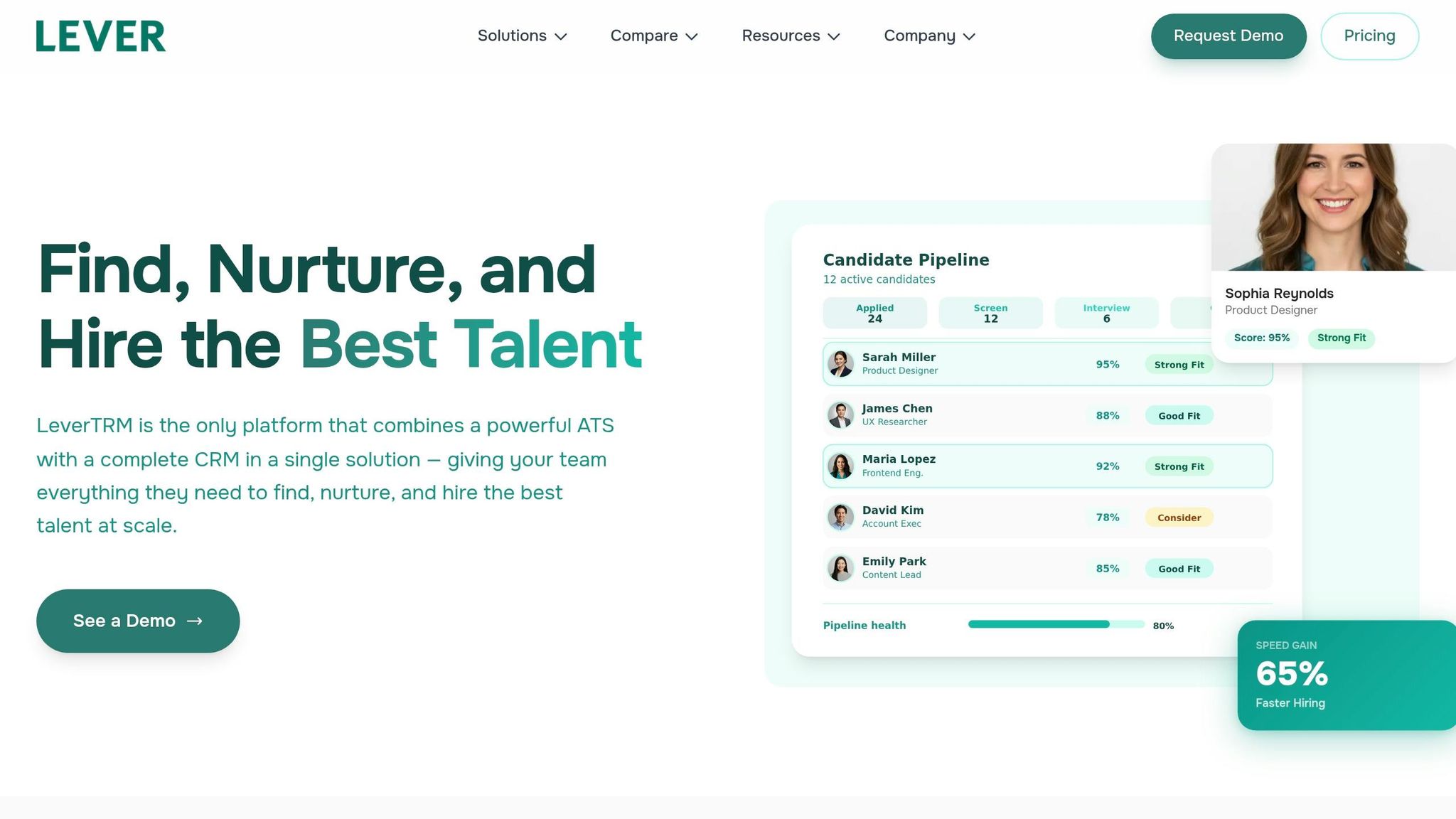
Lever's hybrid ATS and CRM, known as LeverTRM, allows companies to manage both active and passive candidates seamlessly. This dual functionality played a key role in helping Coupa grow its team by 40% in just six months. The secret? Structured pipeline management paired with automated nurture sequences . This setup makes it easier to engage passive talent while staying efficient with active applicants.
"I use Lever to simplify candidate evaluation from multiple sources, making it easier. The user-friendly UI and UX save time and are accessible for team members with varying technical skills."
– Chris Mills, Director of Recruiting, NextGen Federal Systems
Developer-Friendly Integrations
Lever connects with essential developer tools like GitHub, AngelList, and Stack Overflow, making it easier to source technical talent. It also integrates with Slack for real-time team collaboration . A notable update in May 2026 enabled CodeSignal Professional Plan users to link both platforms with a single toggle. This integration automatically adds test results and detailed reports to each candidate's profile . Additionally, Lever's "Easy Book" feature syncs directly with Google Calendar or Office 365, cutting out the usual back-and-forth when scheduling interviews .
Coding Assessment Tools
Instead of offering its own coding environment, Lever integrates with popular platforms like Codility, HackerRank, and CodeSubmit . Recruiters can automate coding tests by moving candidates to specific trigger stages, with results syncing directly into the system. For live technical interviews, the HackerRank CodePair integration adds interview links automatically. Plus, the Spring 2026 AI Interview Companion provides transcriptions and summaries, improving scorecard completion rates by over 90% and saving recruiters about 12 minutes per interview .
Scalability
Lever is designed to handle recruitment needs for companies ranging from 100 to over 10,000 employees. Its AI-powered tools, such as "Fast Resume Review" and "Talent Fit AI", streamline the process by automatically identifying top candidates . Companies using Lever report a 255% ROI over three years, with hiring teams posting jobs 34% faster and making offers 22% quicker . For example, EnableComp used Lever to create a data-driven recruiting system that facilitated over 300 hires annually by early 2026 .
Pricing Model
Lever offers custom pricing tailored to a company's size and hiring volume, with no standard rates published . For growth-stage teams (100–500 employees), pricing often starts around $500 per month. Mid-market organizations typically see annual costs ranging from $4,000 to $20,000, depending on CRM features and automation needs . Additional options like Advanced Analytics, Lever Nurture sequences, and premium support are available as paid add-ons beyond the base subscription .
Pros and Cons
Examining the strengths and challenges of these systems reveals trade-offs that directly influence technical hiring outcomes. Each platform caters to different hiring priorities, making the choice highly dependent on specific organizational needs.
Greenhouse stands out for its structured and consistent hiring processes, particularly suited for mid-to-large enterprises. Its role-specific interview kits and scorecards ensure uniformity across global teams. However, it demands a significant upfront investment and comes with a steep learning curve .
For data-driven, fast-growing teams, Ashby offers real-time analytics to identify pipeline bottlenecks. With pricing around $300 per month, scaling annually to $6,000–$15,000, it provides faster implementation - usually within 2–4 weeks - and clear pricing .
Lever combines ATS and CRM capabilities, making it a strong option for teams emphasizing proactive sourcing and long-term candidate relationships. For example, Coupa used Lever to grow its team by 40% in just six months through structured pipeline management and automated nurture sequences . However, its pricing model and scalability limitations may pose challenges for large-scale, high-volume hiring .
Workable offers tiered pricing starting at $189 per month, a 15-day free trial, and quick setup. While it’s user-friendly, its CRM and reporting tools are less advanced compared to Greenhouse or Lever .
Choosing the right ATS depends on balancing cost, efficiency, and scalability in today’s competitive tech hiring landscape. Research shows that 68% of recruiting managers report outdated ATS systems cause delays of over 30%. In contrast, modern platforms can cut time-to-hire by an average of 40% . For startups focused on speed and affordability, Ashby and Workable offer quicker implementation and transparent pricing. On the other hand, enterprises handling high-volume hiring often turn to Greenhouse for its structured processes and compliance features, despite its complexity and cost .
"The ATS you choose in 2026 is no longer just an admin tool. It is the operating system of your entire talent acquisition function." – The Undercover Recruiter
Conclusion
Choosing the right ATS depends entirely on your hiring needs. The platform you go with should match your team size, technical demands, and growth plans - not just what’s trending or familiar. The real goal? Finding an ATS that aligns perfectly with your technical hiring goals.
For teams prioritizing diversity, platforms with bias-reduction tools and anonymized screening can help ensure fairer evaluations . On top of that, companies leveraging AI-powered ATS solutions have seen hiring times improve by as much as 55% . That’s a clear example of how modern recruitment tools can make a difference.
The numbers don’t lie: 68% of recruiting managers say outdated ATS systems cause hiring delays of over 30% . Your choice of ATS can be the difference between landing top developers or losing them to faster-moving competitors. A developer-focused platform that integrates smoothly with technical tools, offers meaningful insights, and simplifies the hiring workflow is crucial for staying ahead in today’s talent-driven tech market.
FAQs
What ATS features matter most for hiring developers?
When hiring developers, certain tools and features can make the process much smoother and more efficient. These include coding assessments to evaluate technical skills accurately, as well as integrations with developer platforms like GitHub, Jira, and Slack. Such integrations help create a seamless workflow, allowing teams to collaborate effectively.
Scalability is another important factor, especially when managing a large pool of technical candidates. Features like AI-driven automation and customizable workflows are invaluable for handling high volumes of applicants while maintaining compliance with hiring standards. These tools not only simplify technical evaluations but also save time, making tech recruitment more efficient overall.
How can an ATS reduce time-to-hire for technical roles?
An ATS helps speed up hiring for technical roles by automating essential recruitment tasks. With AI-powered tools, it can screen applicants, highlight the most suitable candidates, and even handle interview scheduling automatically. By connecting with coding assessment platforms, it simplifies candidate evaluations, while real-time analytics provide insights to make quicker decisions. This combination reduces delays, cuts down on administrative work, and lets recruiters concentrate on connecting with top talent - all while maintaining high hiring standards.
What should I check before switching ATS platforms?
Before moving to a new ATS platform, it's important to weigh several critical factors to make the transition as smooth as possible and keep your hiring process effective. Start by assessing whether the platform aligns with your hiring needs - think about features like technical assessments or integration with other tools you use. Ensure it meets compliance standards, such as EEOC and GDPR, to avoid regulatory issues.
You'll also want to consider its ability to grow with your company. Can it handle an increase in hiring volume as your business expands? Finally, prioritize platforms that improve the candidate experience by streamlining the hiring process and reducing time-to-hire. Look for seamless integration with your existing tools to maintain efficiency throughout recruitment.
.png)