Hiring a VP of Engineering or CTO is a pivotal decision for any growing tech company. These roles go beyond managing teams - they directly impact product delivery, engineer retention, and scalability. However, a poor hire can cost over $500,000, including recruiting fees, severance, and lost time. Here's what you need to know:
- VP of Engineering vs. CTO: VPs focus on internal team management and project execution, while CTOs handle long-term strategy, innovation, and external relationships.
- Key Skills: Leadership hires require expertise in team building, technical strategy, and aligning engineering with business goals.
- Hiring Process: Evaluate candidates through role-specific problem-solving exercises, stakeholder interviews, and thorough reference checks.
- Compensation: Median salaries range from $300,000 (VP) to $350,000 (CTO), with equity and bonuses varying by company stage.
The stakes are high, but with the right process, you can find a leader who drives growth and ensures technical excellence.
Why Leadership Hires Are Different from Individual Contributor Recruiting
Leadership hiring takes a different approach compared to recruiting individual contributors, primarily due to the unique risks and responsibilities involved.
When hiring individual contributors, the focus is on tangible skills like coding, problem-solving, and delivering features. But for roles like VP of Engineering or CTO, the emphasis shifts dramatically. Instead of technical execution, the priority becomes building and leading high-impact teams .
Dan DeMeyere, VP of Engineering at thredUp, captures this transition perfectly:
"I was no longer measured by individual contributor heroics or by how successful a string of projects were. I was measured by my ability to build high-performing development teams and consistently deliver results for the business" .
This shift highlights the importance of what some call the "people arts" - skills like recruiting, mentoring, coaching, and navigating relationships with stakeholders. These are areas rarely explored in interviews for individual contributors but are essential for leadership roles.
The challenge grows when you're hiring to fill a gap in expertise your team doesn’t currently have . For example, if your team lacks experience scaling an engineering organization, how do you confidently assess a candidate’s ability to achieve that? This creates what’s known as the "missing skillset paradox" - you need expertise in an area where your team is inexperienced . Beyond the financial burden, this paradox complicates the evaluation process.
Here’s a side-by-side look at the key differences between individual contributors and engineering leaders:
| Feature | Individual Contributor (IC) | Engineering Leader (VP/CTO) |
|---|---|---|
| Primary Focus | Technical execution and code quality | Team health, velocity, and business impact |
| Key Skills | Language proficiency, architecture, debugging | Recruiting, budgeting, conflict mediation, people arts |
| Success Metric | Individual output and task completion | Team success, retention, and business alignment |
| Decision Scope | Tactical (how to implement a feature) | Strategic (headcount, budgets, roadmaps) |
| Evaluation Method | Coding challenges and technical interviews | Presentations, case studies, roleplays |
The stakes are also much higher. While a poor individual contributor hire might slow down a project, a bad leadership hire can cost upwards of $500,000 . Leaders don’t just integrate into your culture - they shape it. This means traditional "culture fit" evaluations often fall short. Instead, you need someone who can influence and evolve your organization, not just conform to its current state.
Up next, let’s break down the differences between the VP of Engineering and CTO roles to help you determine which is right for your company’s stage.
VP of Engineering vs CTO: Understanding the Roles
Before diving into interviews for engineering leadership, it’s essential to clearly define the role you’re hiring for. While the VP of Engineering (VPE) and Chief Technology Officer (CTO) both sit at the top of the engineering hierarchy, their responsibilities and focus areas are distinct.
What Each Role Does
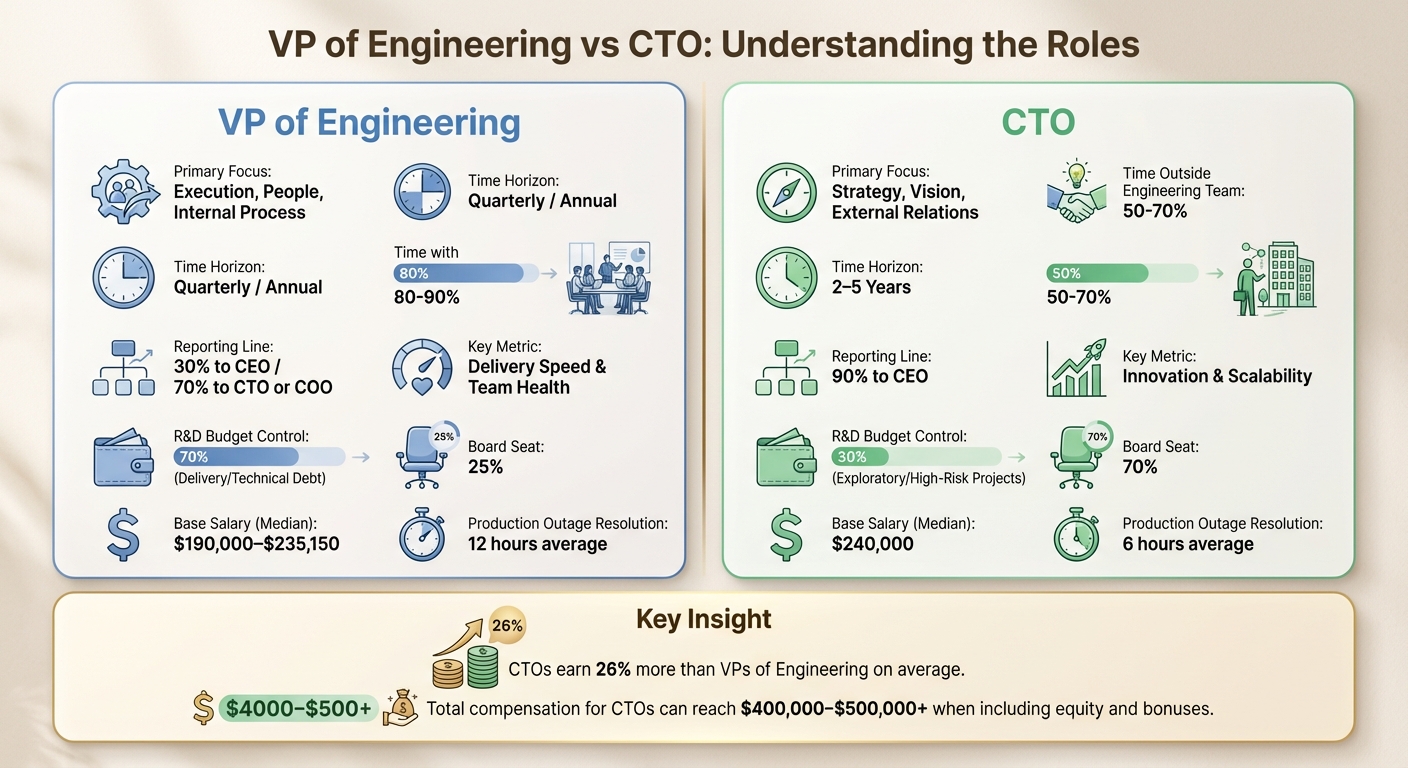
The CTO operates with an external and strategic focus, spending around 50-70% of their time outside the engineering team . Their primary responsibilities include setting the company’s technology vision, making long-term architectural decisions, and driving innovation. They think in terms of 2-5 year horizons, keeping an eye on emerging tech trends to maintain the company’s competitive edge. Roughly 30% of R&D funds are allocated by CTOs toward exploratory, high-risk projects .
On the other hand, the VPE has an internal and operational focus, dedicating 80-90% of their time to the engineering team . Their role revolves around building strong teams, ensuring smooth execution of projects, and optimizing processes. VPEs typically think in quarterly cycles, overseeing sprint planning and managing OKRs. They are responsible for 70% of the R&D budget, which is primarily directed toward product delivery and addressing technical debt .
These differences also show up in their reporting structures. 90% of CTOs report directly to the CEO, while only 30% of VPEs do - most VPEs report to the CTO or COO instead . Additionally, 70% of CTOs hold board seats, compared to just 25% of VPEs .
Understanding these distinctions is crucial when deciding which role is the right fit for your company’s current stage.
Which Role Fits Your Company Stage
The size and maturity of your company play a big role in determining whether you need a CTO, a VPE, or both.
In the early stages (seed through Series A), a single person - usually a CTO - often wears both hats . At this point, the CTO is hands-on, writing code, making architectural decisions, and managing a small team. A VPE is usually unnecessary until the company achieves product-market fit .
At Series B or during the growth stage, the need for a separate VPE becomes more apparent as the engineering team grows to 10-20+ members . If the CTO is spending more than 50-70% of their time on people management rather than focusing on technical strategy, it’s time to hire a VPE . The VPE takes over team management, process creation, and delivery execution, allowing the CTO to concentrate on innovation and external relationships .
At the enterprise level, both roles are essential, each with distinct responsibilities. The CTO focuses on high-level innovation, R&D, and enterprise-wide technology strategy, while the VPE oversees global teams and ensures the smooth delivery of large-scale projects .
VP of Engineering vs CTO Comparison
| Feature | Chief Technology Officer (CTO) | VP of Engineering (VPE) |
|---|---|---|
| Primary Focus | Strategy, Vision, External Relations | Execution, People, Internal Process |
| Time Horizon | 2–5 Years | Quarterly / Annual |
| Reporting Line | 90% to CEO | 30% to CEO / 70% to CTO or COO |
| Key Metric | Innovation & Scalability | Delivery Speed & Team Health |
| R&D Budget | 30% (Exploratory) | 70% (Delivery/Debt) |
| Board Seat | 70% | 25% |
| Base Salary (Median) | $240,000 | $190,000–$235,150 |
One notable difference between the two roles is how they handle production outages. A CTO, with their broader authority and cross-functional expertise, can resolve such issues in an average of 6 hours, while a VPE typically takes 12 hours .
Choosing the right leadership role for your company is critical to aligning with your strategic goals and avoiding costly hiring mistakes.
What to Assess in Engineering Leadership Candidates
Hiring the right engineering leader requires looking at a mix of skills - technical expertise, team management, business alignment, and how well they fit within your organization.
Technical Knowledge and Vision
Even at the executive level, technical skills remain essential. Without a solid grasp of technical concepts, leaders may struggle to gain their team's respect or attract top talent . The depth of expertise depends on the role. For instance:
- CTOs should have a strong understanding of technologies like AI/ML and blockchain and must be capable of making long-term architectural decisions to maintain the company's competitive edge .
- VPs of Engineering, on the other hand, need to focus on system scalability, ensuring delivery excellence, and maintaining high-quality standards .
To assess these abilities, go beyond theoretical discussions. Incorporate system design exercises and code reviews. As Aditya Agarwal, former CTO of Dropbox, said:
"It's hard to take your leader seriously if you feel they could not perform your job if needed" .
Key areas to evaluate include software development, system architecture, cybersecurity, data management, and cloud computing .
A great engineering leader also knows when to prioritize long-term stability over short-term gains. At Dropbox, for example, leadership paused feature development for 6–9 months to rebuild a codebase that was causing a surge in bugs. This decision, though initially unpopular, was critical to maintaining trust in their product . Look for candidates who can share similar examples of balancing speed with quality or managing technical debt .
But technical skills alone don’t make a leader. Strong people management is just as important.
People Management and Team Building
For a VP of Engineering, managing people is a core part of the role. This involves recruiting, mentoring, coaching, and retaining talent while building high-performing teams . In contrast, CTOs often focus more on fostering innovation and supporting technical leads .
Instead of just asking about management philosophies, test candidates through role-playing or feedback scenarios. Look for evidence of their ability to recruit and retain top talent, as well as their track record of building strong teams .
One effective indicator is the "follower test": do former colleagues or direct reports follow them to new organizations? If not, it could be a warning sign . Great leaders take pride in their team's success, and this often shows in their willingness to delegate, hold regular one-on-ones, and support their team members' growth - even if it means helping them leave for better opportunities .
Of course, leadership isn’t just about managing people; it’s also about aligning technical efforts with business goals.
Business Thinking and Alignment
Engineering leaders need to connect their technical decisions with the company's broader business objectives. This means understanding tradeoffs, such as balancing speed with quality or deciding between new features and managing technical debt . They should also have operational skills like budgeting, vendor management, and aligning the technical roadmap with revenue goals .
To assess this, ask candidates how they would approach key organizational metrics or present them with hypothetical scenarios to gauge their strategic thinking . Requesting a 90-day plan can also reveal how they prioritize and align with your company’s immediate needs .
Take Facebook’s engineering leadership as an example. They defined quality as "lightning-fast page/app loads" globally. If performance metrics dropped, they paused all other work to address the issue, ensuring quality remained a top priority even under pressure . Look for candidates who can describe similar frameworks for aligning technical decisions with business outcomes.
Culture and Organizational Fit
At the executive level, leadership style and values play a significant role. Assess whether candidates value transparency, accountability, and diversity, and whether they can effectively represent your company to investors, stakeholders, and high-profile clients .
Pay attention to the kinds of questions they ask about your organization. A lack of curiosity about company values, team dynamics, or challenges might be a red flag . Also, ask them to share examples of improving challenging systems or processes.
Farhan Thawar, VP of Engineering at Shopify, offers a useful analogy:
"Good process is like a traffic light. It may slow down the commute for a single driver, but it optimizes the system for everyone on the road" .
Seek out candidates who experiment with processes to reduce inefficiencies and improve team satisfaction. This alignment with your company’s culture is just as critical as their technical and managerial skills.
| Competency Area | CTO Primary Focus | VP Engineering Primary Focus |
|---|---|---|
| Technical | Emerging tech, R&D, Architecture | Execution, Delivery, Scalability |
| People | Culture of Innovation | Recruiting, Mentoring, Retention |
| Business | Market Edge, Patents, Strategy | Budgeting, Roadmaps, Operations |
| External | Public Face, Customer Strategy | Vendor Relations, Talent Brand |
How to Source Engineering Leadership Candidates
Finding engineering leadership talent requires a different approach from standard technical recruiting frameworks. Why? Because most high-caliber executive candidates aren't actively job hunting - 85% of them are considered passive . To connect with this talent, you need to meet them where they are and build trust before diving into recruitment conversations.
Executive Networks and Board Referrals
Referrals and warm introductions are, by far, the most effective way to source engineering leaders. In fact, they account for 40% to 60% of successful CTO placements at venture-backed startups . Introductions from board members or investors come with built-in credibility and often involve candidates who’ve already been vetted.
Start by engaging your investors. They can tap into their networks and connect you with experienced engineering leaders they've worked with in the past. Likewise, board members and fellow founders in your circle can provide referrals to executives who’ve successfully scaled teams at similar stages. Communities like CTO Craft and Rands Leadership Slack are also excellent spaces to connect with seasoned leaders .
The biggest advantage of network-based sourcing? Trust. This method skips the noise of traditional recruiting and gets you in front of leaders who may not be actively seeking a role but are open to meaningful conversations.
Still, there are times when personal networks may not yield enough candidates. That’s when alternative strategies come into play. These often involve leveraging specialized candidate sourcing tools to identify high-potential talent.
Retained Search Firms vs. In-House Recruiting
When personal and professional networks don’t deliver, companies often turn to retained executive search firms. These firms specialize in targeting passive candidates through exclusive databases and direct outreach. They typically provide a vetted shortlist of candidates within 6 to 12 weeks . However, this speed and specialization come at a price - retained search firms charge 25% to 35% of the candidate's first-year total compensation. For example, for a VP of Engineering earning $300,000 annually, fees could range from $75,000 to $105,000 .
In-house recruiting, on the other hand, has lower upfront costs but usually takes longer. It often relies on active applicants and existing referral networks. On average, a successful CTO search takes 3 to 6 months with in-house teams . The downside? Over 40% of executive searches fail without professional help, and a mis-hire at this level can cost anywhere from 5 to 27 times the executive's annual salary, factoring in lost momentum, severance, and restarting the search process .
| Feature | Retained Search Firms | In-House Recruiting |
|---|---|---|
| Cost | 25–35% of first-year salary | Internal costs only |
| Timeline | 6–12 weeks for shortlist | 3–6 months median |
| Candidate Pool | Passive talent, exclusive databases | Referrals, active applicants |
| Primary Benefit | Structured screening; reduced failure risk | High credibility via warm intros |
Source:
For the best results, consider a hybrid approach: combine retained search firms, investor networks, and specialized developer communities . Tailor your strategy to match your company’s growth stage and leadership needs. Before you start working with any recruiter, create a role scorecard with 3 to 5 specific deliverables for the first 12 months. This clarity can cut down the time-to-hire by up to 40% .
Designing the Interview Process for Leadership Roles
Interviewing for engineering leadership positions demands a different approach than standard technical hiring. Here, the focus shifts from coding abilities to evaluating traits like executive presence, strategic insight, and team-building expertise. A typical interview process for leadership roles often includes several stages: an initial recruiter screening, a discussion with the CEO, 2–3 interviews with peer executives, a presentation and Q&A session, and 2–3 interviews with the engineering team . This process usually spans 8–12 weeks .
Having too many untrained interviewers or unclear evaluation criteria can lead to mixed feedback and missed opportunities . To avoid this, focus on four key areas: executive skills (e.g., communication and financial understanding), role-specific problem-solving, engineering expertise, and a track record of past performance . Before starting the search, consult 3–5 seasoned engineering leaders to establish a clear picture of what "great" looks like for your role and company stage . With this foundation, you can create a more focused and effective evaluation process.
Stakeholder Panels and Cross-Functional Interviews
Incorporate 2–3 executive peers - such as heads of Product, Finance, or Sales - into the interview process. Use a written rubric to evaluate how well the candidate aligns with the business and collaborates across functions . These interviews can reveal the candidate’s understanding of the broader business landscape and their ability to build relationships outside of engineering.
A 30-minute presentation, followed by an equal-length Q&A session, is an excellent way to assess candidates. Ask them to present their understanding of the role and their proposed first 90 days, then allow stakeholders to ask questions . This format helps evaluate their executive presence, listening skills, and strategic thinking without overloading the process with too many participants. Additionally, conduct 2–3 interviews with engineering managers and senior individual contributors to gauge their technical credibility and build internal support. However, the final hiring decision should rest with the CEO or hiring manager, not be based on a group consensus .
Case Studies and Problem-Solving Exercises
Instead of relying solely on descriptions of past experiences, include live demonstrations of problem-solving skills. For instance, present suboptimal team goals and ask for feedback, or share a dataset on organizational health and have the candidate identify the top three issues they’d address . Roleplay scenarios can also be illuminating, showing how a leader provides constructive, empathetic feedback in challenging situations .
Another useful exercise involves walking candidates through a hypothetical 2 AM platform outage. This tests their ability to manage technical triage while maintaining clear executive communication . You could also ask them to explain the business impact of technical debt - like reduced velocity or increased incidents - to non-technical stakeholders . These exercises provide deeper insights into a candidate’s leadership style and decision-making under pressure than hypothetical questions ever could.
Reference Checks That Matter
Practical assessments should be complemented by thorough reference checks to uncover hidden insights. This step is especially critical for engineering leadership roles, as impressive interviews can sometimes mask issues like poor management style or lack of technical credibility . Speak with 3–4 people who have worked closely with the candidate over an extended period. Prioritize former direct reports to understand how the candidate managed daily responsibilities .
"Executive candidates are, with some exception, far more privileged than the folks they'll soon be responsible for, and you owe it to the team to ensure that the person you're entrusting them to hasn't left a trail of ethical concerns behind them." - Will Larson, Author and Engineering Executive
Backchannel references - reaching out to individuals not on the candidate’s provided list - can help verify claims and flag potential red flags . If someone gives the candidate a numerical rating (e.g., 8 out of 10), follow up by asking what stopped them from giving a 10. This often uncovers areas for improvement . Additionally, ask for names of individuals the candidate mentored who later advanced in their careers to assess their ability to develop talent . Considering the replacement cost of a failed VP of Engineering hire - often exceeding $500,000 when factoring in recruiting fees and organizational disruption - thorough reference checks are a necessary investment.
Compensation for Engineering Leaders
When it comes to engineering leadership roles like CTOs and VPs of Engineering, compensation packages can differ significantly. These packages are designed to balance immediate cash payouts with incentives tied to long-term company success. As of 2026, the median base salary for a CTO is approximately $350,000, while VPs of Engineering earn around $300,000 . Beyond base salaries, these roles often include equity, bonuses, board memberships, and severance agreements.
On average, CTOs earn 26% more than VPs of Engineering . When equity and other long-term incentives are factored in, total compensation for CTOs can climb to $400,000–$500,000 or more . On the other hand, VPs of Engineering often see bonuses tied to operational goals like code quality, release timelines, and cost management .
Additionally, 70% of CTOs hold board seats, compared to just 25% of VPs of Engineering . Between 2021 and 2024, 70% of digital-first companies added their CTO to the board, highlighting the growing strategic importance of this role . Board participation not only increases compensation but also adds governance responsibilities that go beyond day-to-day technical operations. Together, these factors highlight the unique value each role brings to a company.
Compensation by Company Stage
Compensation structures evolve as companies grow. Early-stage startups often provide lower base salaries but make up for it with larger equity grants, offering a trade-off for the risk of joining a younger company . For instance, a Series A startup might pay a CTO between $200,000 and $280,000 in base salary, while CTOs at public companies can earn $400,000–$500,000+ .
| Company Stage | CTO Base Salary | VP of Engineering Base | Equity & Key Benefits |
|---|---|---|---|
| Seed | $150,000 – $200,000 | $140,000 – $180,000 | High equity (0.5%–3%+); basic health/wellness benefits |
| Series A | $200,000 – $280,000 | $180,000 – $230,000 | Significant equity; standard benefits; performance bonuses |
| Series B+ | $280,000 – $400,000 | $230,000 – $350,000 | Moderate equity; comprehensive benefits; potential for board roles |
| Public/Large | $400,000 – $500,000+ | $350,000 – $450,000 | RSUs/stock grants; high cash bonuses; full executive perks |
Geography also continues to influence pay, even in an era of remote work. Cities like San Francisco, New York, and Seattle offer salaries that are 20–40% higher than the national median . However, many companies now use location-independent pay structures or adjust salaries based on an employee's metro area without requiring relocation .
Equity, Board Seats, and Severance Packages
As companies mature, the structure of equity and other benefits shifts to reflect greater responsibilities. For startups, offering larger equity grants is a key way to attract top talent, especially when they can’t match the high base salaries of public companies . CTOs often receive more equity than VPs of Engineering because of their long-term strategic responsibilities, including overseeing platform scalability and intellectual property .
Board seats or observer roles are another critical component, giving engineering leaders a say in company strategy and governance. This is particularly valuable for CTOs, who provide expertise in areas like generative AI, data security, and software supply chain resilience - topics that boards increasingly prioritize .
Severance packages are also a vital part of leadership compensation. These terms should be negotiated and clearly defined during the final stages of hiring to avoid ambiguity .
Red Flags in Engineering Leadership Candidates
Spotting warning signs early when evaluating leadership candidates in engineering is crucial. While strong technical expertise, people skills, and strategic thinking are essential, certain behaviors or traits can indicate deeper issues. A poor leadership hire can cost a company over $500,000 .
One major concern is insufficient technical credibility. As Caroline Horn, Charles Hubbard, and Jenna Zucker explain, businesses sometimes hire leaders from large companies who excel at managing schedules but lack a deep understanding of the product or the engineering process . Leaders who have abandoned technical work purely to avoid it often struggle to earn their team's respect . While engineering leaders don't need to write code every day, they must be capable of asking sharp, technical questions that demonstrate their understanding .
Another red flag is poor people management skills. This can manifest in multiple ways. For instance, candidates who have never had to dismiss underperforming team members may lack the decisiveness needed to maintain a healthy team environment . Similarly, a leader who can articulate abstract management theories but fails to provide examples of tough conversations with struggling engineers raises concerns. Zaharo Tsekouras from Resonance Search points out:
"The VP of Engineering who can articulate a performance management philosophy but can't tell you about a hard conversation they had with a struggling engineer is a yellow flag" .
A lack of followership is another telling sign. Exceptional leaders often inspire loyalty, with former colleagues choosing to join them at new organizations. If a candidate has never had this happen, it’s worth digging deeper .
Arrogance and a blame culture should be immediate deal-breakers. Candidates who claim they can "fix everything" often lack the humility to adapt to new environments . Likewise, those who blame others for past failures expose a mindset that can harm team cohesion and repeat past mistakes . Sandra Lopez, Talent Acquisition Manager at Horizon Global, remarks:
"Arrogance is usually a mask for insecurity. I look for candidates who are confident yet humble because those are the team players we need" .
Finally, disconnection from business strategy is a critical issue. Leaders who can’t connect technical decisions - like infrastructure choices or build-vs-buy considerations - to broader business goals lack an essential skillset . Candidates who fail to ask about company culture, team dynamics, or business objectives during interviews may lack the curiosity and engagement required for the role . Top engineering leaders bridge the gap between technical realities and the language of boards and investors; those who can’t do this effectively will likely falter at the executive level .
These red flags highlight the importance of thorough evaluation during the hiring process, as they can significantly impact team morale and overall company success.
The First 100 Days for New Engineering Leaders
The first 100 days can make or break a new engineering leader's success. A chaotic onboarding process often hints at deeper organizational issues, and a poorly executed leadership transition can be costly . This period builds on the rigorous hiring process and lays the groundwork for long-term impact. Both the company and the leader need to approach this transition with careful planning.
Setting Clear Goals and Expectations
Before diving into changes, a new engineering leader must have a clear understanding of what success looks like. The CEO or hiring manager should outline specific expectations for the first 3–6 months. During the initial 10–14 days, the focus should be on listening, not implementing. This means holding 30+ one-on-one meetings with key team members and stakeholders. These conversations should include diagnostic questions like, "What vital information am I missing?" and "If you were in my position, what would be your first move?" - questions that can uncover the organization’s true state.
Between days 15–30, the leader should aim for small but impactful wins by addressing 2–3 obvious pain points that everyone agrees on but no one has resolved. For example, this could involve fixing slow deployment pipelines or creating missing documentation. These quick wins help establish credibility without creating disruption. As Ben, Head of Data Strategy, puts it:
"The first 100 days are about earning the right to lead, not proving you're the smartest person in the room" .
By day 60, the leader should introduce structured communication patterns to establish a predictable rhythm within the team. From days 61–90, the focus should shift to crafting a technology roadmap. This roadmap should clarify what systems to maintain, what tech debt to address, and what new capabilities to build. Around day 100, the leader should present a formal assessment to the CEO and board, highlighting 3–5 major initiatives for the first year.
| Phase | Primary Focus | Key Deliverables |
|---|---|---|
| Days 1-14 | Listening & Mapping | 30+ one-on-ones; tech/organization map |
| Days 15-30 | Credibility & Quick Wins | Fix 2–3 pain points; remove key blockers |
| Days 31-60 | Team & Rhythms | Leadership assessment; establish cadence |
| Days 61-90 | Strategy & Alignment | Technology roadmap; business strategy alignment |
| Days 91-100 | Commitment | Year One priorities; one bold move |
Building Relationships with Team and Stakeholders
Once goals are set, the next priority is building strong relationships within the team and with stakeholders. Trust is built by understanding the context and showing empathy. Leaders should verify claims rather than accepting them at face value. For instance, if a team claims their CI/CD pipeline is robust, testing it with a simple build and deployment can reveal the actual developer experience. Similarly, shadowing support tickets or attending customer success meetings can provide insights into product performance.
Michelle Salvado, COO at Embed Security, highlights the importance of context:
"Context matters. A key skill for any engineering leader is to have the awareness of yourself and of others and the environment that you're in" .
Understanding a team's dynamics is just as important as strategic planning. This includes identifying informal influencers within the engineering team - typically 3–5 senior engineers who shape the team's thinking. Running ideas by this "kitchen cabinet" before sharing them broadly can help refine strategies and gain early buy-in.
Managing upward is equally important. Proactively sharing team updates with the CEO, such as using concise weekly "5-15" emails (which take 15 minutes to write and 5 minutes to read), can help secure the resources and support the team needs.
Finally, avoid over-referencing practices from past companies. Constantly comparing to previous workplaces can alienate the current team and overlook the unique context of the new organization. Instead, take time to understand the origins of existing processes. Many "bad" decisions were originally made for good reasons in a different context. Amy Carillo Cotten, Director of Client Transformation at Uplevel, warns:
"The biggest mistake a new leader can make is disrupting current systems of execution before having a working alternative" .
How daily.dev Recruiter Connects You with Engineering Leaders
Sourcing passive engineering leaders requires a fresh approach. Finding a VP of Engineering or CTO who combines technical expertise with active community engagement isn't easy. These senior leaders aren't browsing job boards or updating LinkedIn - they're busy managing teams and delivering products. daily.dev Recruiter steps in by connecting with these leaders where they already spend their time: learning, reading, and staying updated on tech trends. Here's how daily.dev's developer-first strategy and warm introductions are reshaping leadership hiring.
Developer-First Recruiting
daily.dev Recruiter leverages a professional network that tracks over 1 billion developer sessions . It identifies candidates based on their real-time interests - what they’re reading, building, and following. For example, if a VP of Engineering is exploring topics like "Frontend Architects" or distributed systems, their current technical focus becomes clear, offering insights that a traditional resume cannot.
Interestingly, 40% of daily.dev’s network consists of senior contributors and leaders - Engineering Managers, Staff Engineers, VPs of Engineering, and CTOs - who engage with the platform to stay sharp. On average, they log 200 sessions a month, which is more than six times per day . Unlike active vs passive developer recruitment dynamics where candidates are actively looking, they use daily.dev mainly for professional growth, making them more open to discussing career opportunities and salary expectations. As Nimrod Kramer, CEO & Co-Founder of daily.dev, puts it:
"We built a place where engineers can turn off the noise. To enter this space, you don't need a hack. You need trust."
Warm Introductions to Qualified Candidates
daily.dev Recruiter takes this engagement further by offering seamless candidate connections. It stands out with a double opt-in model: leadership roles are shown privately on candidates' daily.dev homepages, blending into their routines. Candidates only appear to recruiters after reviewing a role and explicitly agreeing to connect. This eliminates cold outreach and significantly reduces non-responses .
Recruiters can also refine their searches using custom screening questions and verified platform activity to ensure a strong match. For example, you could ask a candidate about their experience scaling teams from 10 to 50 engineers and cross-check their answers with their recent technical activity. This targeted approach explains why daily.dev is a go-to for passive leadership talent - 85–90% of its users are currently employed, compared to the 90% of engineers who typically ignore recruiters on platforms like LinkedIn .
The pricing is simple: $350 per role, per month. There are no placement fees, no annual contracts, and unlimited introductions. You can post a role in about 10 minutes and often receive your first introductions within one to two weeks .
Conclusion
Hiring a VP of Engineering or CTO is a completely different ballgame compared to bringing on individual contributors. It starts with defining the role around specific outcomes for the next 6–12 months, aligning expectations using insights from seasoned leaders, and crafting an interview process that evaluates technical vision, people management skills, and alignment with business goals . With the cost of replacing a failed leadership hire often exceeding $500,000, getting it right the first time is not just important - it’s essential .
Once the right leader is on board, the real work begins. The first 90 days are critical for setting the foundation. This period should focus on listening, building support networks, and diving deep into the business through activities like reviewing support tickets and meeting with customers - before implementing any major system changes . As Will Larson, author of The Engineering Executive's Primer, wisely notes:
"If you skip understanding, you can emulate success in the short-term, but you'll be back to working on the same problems a few months later with less trust and feedback from the team" .
This thoughtful onboarding process highlights the importance of sourcing candidates through reliable channels. However, connecting with top-tier engineering talent can be tricky - 90% of engineers on daily.dev report ignoring recruiters on LinkedIn or traditional job boards . That’s where daily.dev Recruiter comes in. By linking you with passive senior talent based on their actual reading habits and technical interests, it matches roles with candidates already immersed in the developer community. At $350 per role, per month, with no placement fees or long-term contracts, it offers a straightforward, trust-based alternative to traditional executive search methods .
Ultimately, engineering leadership hires shape how your business operates and executes its roadmap over the next 12 to 18 months . A well-structured hiring process - from defining the role to onboarding - turns engineering leadership into a driving force for growth and long-term success.
FAQs
Do I need a VP of Engineering, a CTO, or both right now?
Deciding whether to hire a VP of Engineering, a CTO, or both hinges on your company’s current stage and priorities.
A CTO focuses on shaping the technical vision, defining the architecture, and leading innovation efforts. On the other hand, a VP of Engineering is more about execution - managing operations, scaling the team, and ensuring that projects are delivered efficiently.
For early-stage startups, a CTO might be the better choice, as innovation and product direction are often the primary focus. As your company grows and the need for operational excellence increases, bringing on a VP of Engineering can help streamline processes and scale the engineering team. In larger organizations, having both roles ensures a healthy balance between long-term strategy and day-to-day execution.
What’s the best way to vet leadership skills if my team lacks that expertise?
To assess leadership skills when lacking in-house expertise, it's essential to use structured evaluations that focus on four key areas: technical expertise, people management, strategic thinking, and building team dynamics. Incorporate tools like stakeholder panels, case studies, and thorough reference checks to ensure a well-rounded evaluation of candidates. If additional support is necessary, consider tapping into external networks, executive referrals, or hiring retained search firms to identify and evaluate potential leaders effectively.
How can I make the interview process feel organized to top engineering leaders?
To design a well-structured interview process for top engineering leaders, start by clearly defining the role's expectations and the criteria you'll use for evaluation. Incorporate structured methods such as stakeholder panels, case studies, and in-depth reference checks to assess candidates thoroughly. Additionally, provide a detailed timeline and outline the next steps in the process. This not only reflects professionalism but also shows your company’s dedication to an organized and thoughtful hiring approach.
.png)