Engineering managers prioritize quality over quantity when evaluating hiring channels. Unlike recruiters who focus on metrics like application volume, managers aim to optimize for high-quality hires that align with team needs and minimize wasted time. Here’s what matters most to them:
- Key Metrics: Managers track metrics like Source of Hire, Quality of Hire, Time to Fill, and Candidate Engagement to assess channel effectiveness.
- Referrals Are Preferred: Internal referrals are trusted for their pre-screened quality, but they’re limited in scalability.
- Job Boards' Weakness: Job boards often overwhelm managers with unqualified candidates, requiring significant time to sift through applications.
- Direct Sourcing Challenges: Cold outreach struggles with credibility due to generic communication and lack of technical understanding.
- Time Costs: Each hire can require up to 36 interviews, consuming 26 hours of interviewer time, making efficiency critical.
To align with engineering managers’ expectations, recruiters should focus on high-performing channels, track relevant metrics using developer sourcing tools, and refine processes based on feedback. Platforms like daily.dev Recruiter address these priorities with double opt-in introductions, behavior-driven matching, and tools to streamline hiring, reducing wasted effort and improving outcomes.
Metrics Engineering Managers Use to Measure Hiring Channels
Engineering managers rely on five key metrics to evaluate the effectiveness of hiring channels. As Lena Reinhard, VP Engineering & Leadership Coach, wisely points out:
"Metrics are a tool to solve a problem; they're not the solution. The metrics you use will only be as useful as your clarity on the problem you're trying to solve with them" .
By understanding these metrics, recruiters can better align with the priorities of the managers they support. Let’s take a closer look at these metrics and how they reveal the strengths and weaknesses of different hiring channels.
Source of Hire
Source of Hire (SoH) tracks the percentage of successful hires from each channel, whether it’s referrals, job boards, direct sourcing, or other methods . This metric answers a critical question: Where are the best engineers coming from? With SoH data, engineering managers can direct recruiting budgets toward the most productive channels and reduce spending on those that yield poor results .
To ensure the data is actionable, standardizing source categories is essential. Pairing SoH with retention data also helps identify channels that bring in long-term contributors rather than short-term hires .
Quality of Hire
Quality of Hire measures the effectiveness of a channel in delivering high-performing, long-lasting employees. It’s typically assessed through performance ratings, retention rates, and time to productivity . For example, performance ratings often use a 1–5 scale, while retention rates are tracked at intervals like 90 days or one year. Time to productivity measures how quickly a new hire contributes meaningfully, such as shipping their first feature.
Industry benchmarks highlight the differences between channels: referrals often yield a performance rating of 4.5 out of 5 and a 92% one-year retention rate, compared to job boards, which average 3.8 out of 5 with 70% retention . These numbers explain why referrals are frequently prioritized.
Engineering managers also consider how quickly new hires start making meaningful contributions. While this depends on onboarding and managerial support, it’s a crucial piece of the hiring puzzle .
Time to Fill and Time to Hire
Time to Fill and Time to Hire are metrics that focus on speed. Time to Fill measures the number of days from posting a job to offer acceptance, offering insights into how quickly a company can meet its growth needs . Time to Hire, on the other hand, looks at the days from initial candidate engagement (like responding to outreach) to offer acceptance, highlighting the efficiency of the interview and negotiation process .
Vacant positions can stall product timelines, so these metrics help managers identify delays in the hiring process. For instance, automating interview scheduling can help close gaps between resume screening and initial interviews, a common bottleneck .
| Metric | What It Measures | Primary Use |
|---|---|---|
| Time to Fill | Days from job posting to offer acceptance | Budgeting and headcount planning |
| Time to Hire | Days from candidate engagement to offer acceptance | Assessing interview process efficiency |
Candidate Engagement and Response Rates
Response rates shed light on how well different channels connect with passive candidates - those who aren’t actively job hunting but might be open to the right opportunity. Industry data shows that the average sourcing email has an open rate of 86% but a reply rate of just 19.6% .
Personalization can make a big difference here. In 2023, Liveflow’s recruiting team, led by Kiera Cox, used AI-generated personalization tokens in their outreach. This allowed each recruiter to contact 150 people weekly while improving response rates . Similarly, Blacksmith Agency reported a 46% increase in reply rates (35.3% vs. 24.1%) after adopting AI-driven personalization .
However, adding more than three emails to a sourcing sequence doesn’t significantly improve reply rates, which tend to plateau around 23% . These insights help recruiters fine-tune their outreach and sourcing strategies to better resonate with engineering candidates.
Hiring Manager Satisfaction
Hiring Manager Satisfaction captures feedback from engineering leaders about the hiring process. Through surveys or interviews, recruiters gauge whether candidates meet technical requirements and align with team dynamics . This qualitative metric complements the data-driven ones.
To gather useful feedback, recruiters often ask engineering managers questions like: Did the candidates demonstrate the necessary technical skills? Did they fit the team’s communication style? Would you hire from this channel again? This information not only validates candidate quality but also helps refine recruitment strategies. Additionally, offering realistic job previews that highlight both the benefits and challenges of a role can improve candidate satisfaction and reduce early attrition .
Hiring engineers?
Connect with developers where they actually hang out. No cold outreach, just real conversations.
How Engineering Managers View Common Hiring Channels
::: @figure 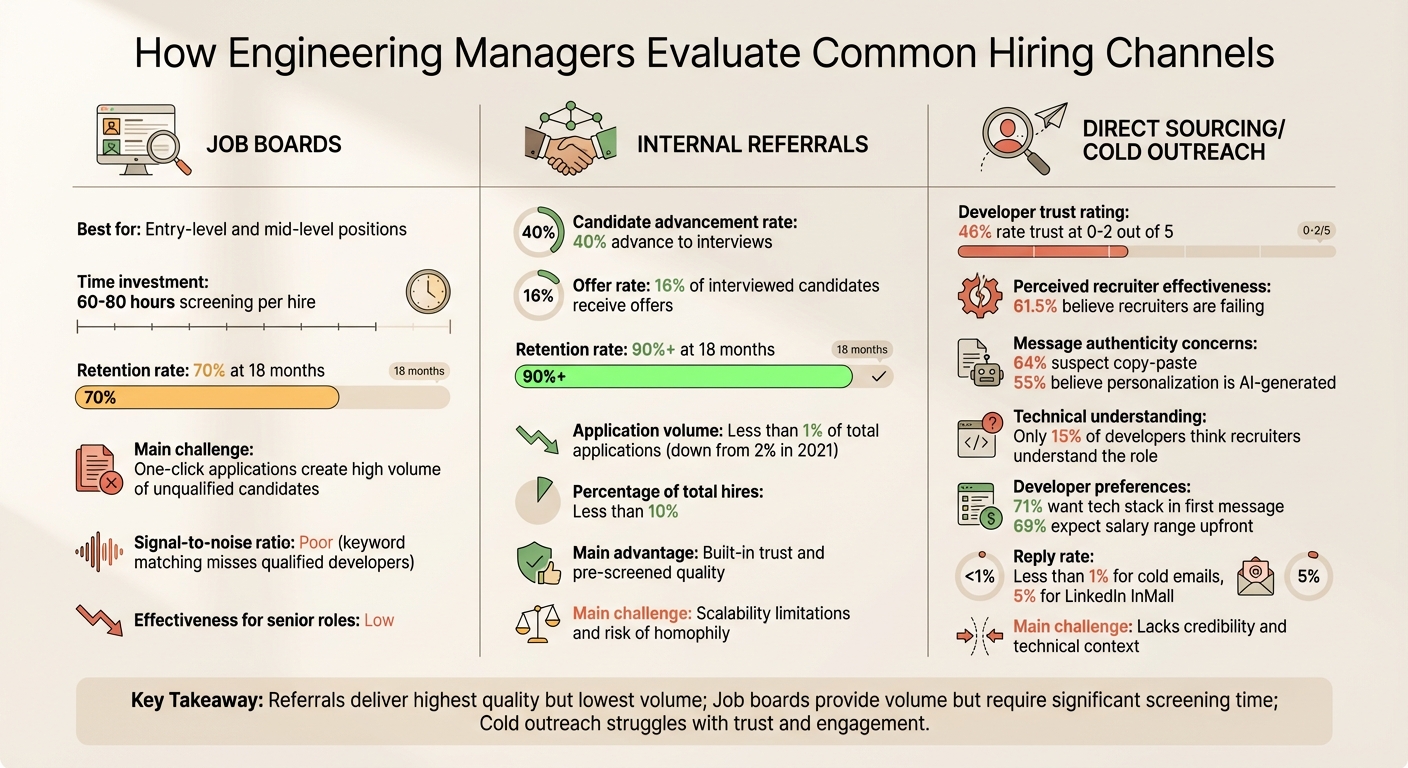 {Engineering Manager Hiring Channel Comparison: Metrics and Performance}
Engineering managers rely on data and experience to evaluate hiring channels, steering clear of decisions based solely on intuition. Here's a breakdown of how they perceive the three most common hiring methods.
Job Boards
Job boards work reasonably well for entry-level and mid-level positions, but engineering managers often voice frustration over one-click applications that overwhelm them with unqualified candidates. On average, managers spend 60–80 hours screening for each hire sourced from job boards.
The main issue? The signal-to-noise ratio. Keyword matching systems frequently overlook qualified developers who use different terminology, while generic algorithms surface candidates who don’t meet the job's basic requirements. For senior or niche roles - like Machine Learning Engineers - job boards are seen as ineffective. Retention data backs this up: hires from job boards show a 70% retention rate at 18 months, compared to over 90% for referrals or direct sourcing.
Scott Woody, former Director of Engineering at Dropbox, offers a telling insight:
"A well-formed resume is like a map of where someone can dig later in the interview process".
Unfortunately, job boards often generate too many poorly crafted "maps", forcing managers to sift through a flood of irrelevant applications. This highlights the need for better filtering to reduce wasted time and effort.
Next, let’s look at why internal referrals remain a favorite among engineering managers.
Internal Referrals
Internal referrals stand out for their built-in trust and pre-screened quality. Engineering managers consistently prefer this channel, with 40% of referred candidates advancing to interviews, and 16% of those interviewed receiving offers. As Joel Westmark from Ashby explains:
"Referred and internal candidates are often seen as lower risk as they come 'validated' from employees".
This trust factor is key. Employees are unlikely to jeopardize their reputation by recommending someone unqualified, and they also help assess whether a candidate aligns with the team’s dynamics. However, referrals face a scaling challenge: they make up less than 1% of total applications as of early 2024, down from 2% in 2021. Even with incentives like bonuses and gamified referral programs, referrals typically account for less than 10% of total hires.
Joel Spolsky, co-founder of Stack Overflow, underscores the challenge of recruiting top talent through traditional means:
"Top developers barely ever apply for jobs at all. That's because they already have jobs".
Another drawback of over-relying on referrals is the risk of "homophily", where teams become less diverse due to employees recommending people similar to themselves. While referrals are effective, they need to be part of a broader strategy to meet the high standards of engineering managers.
Direct Sourcing and Cold Outreach
Direct sourcing, while widely used, often struggles to establish credibility. Cold outreach, in particular, frustrates both developers and engineering managers. Data reveals that 46% of developers rate their trust in cold recruiter outreach at 0–2 out of 5, and 61.5% believe recruiters are failing at their job. Many developers feel recruiter messages lack authenticity, with 64% suspecting messages are copy-pasted and **55% believing even "personalized" messages are AI-generated.
Technical understanding is crucial here. Only 15% of developers think recruiters grasp the roles they’re hiring for. Messages that omit key details - like the tech stack or salary - are often ignored. In fact, 71% of developers want to see the tech stack in the first message, and **69% expect the salary range upfront.
Generic outreach doesn’t just fail to engage candidates - it can actively harm a company’s brand reputation within the engineering community, making future hiring even harder. Increasingly, developers prefer to hear directly from hiring managers, trusting them to provide an accurate picture of the role. As Joel Spolsky puts it:
"The great software developers, indeed, the best people in every field, are quite simply never on the market".
Cold outreach often falls short because it lacks the context and trust needed to spark meaningful conversations. Recruiters need to shift their approach, focusing on credibility and a genuine understanding of technical roles to stand out.
How daily.dev Recruiter Addresses Engineering Manager Priorities
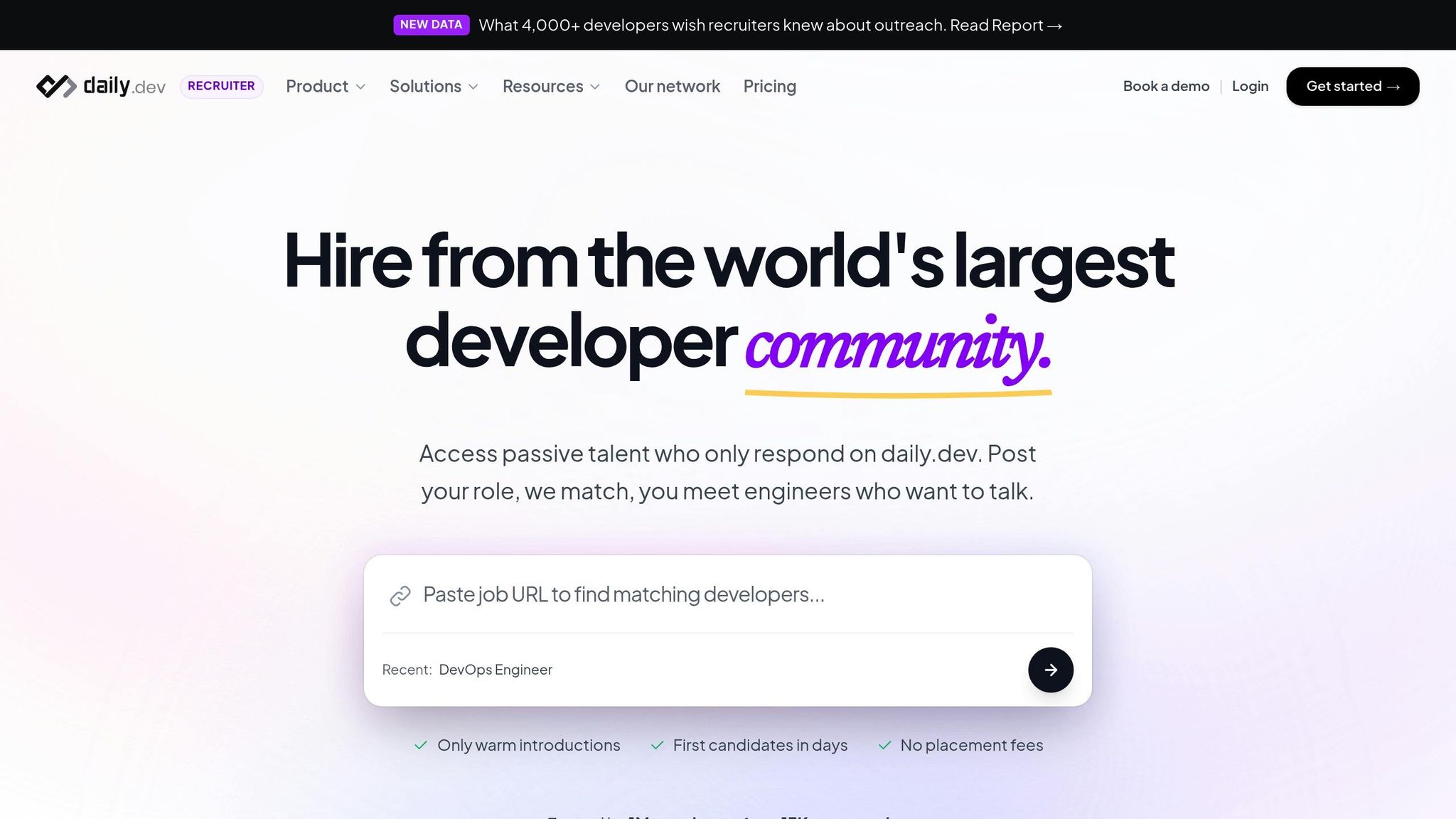
daily.dev Recruiter tackles engineering managers' key concerns by providing pre-qualified candidates through a thoughtful and behavior-driven approach. Instead of relying on outdated cold outreach methods, the platform focuses on building trust and delivering candidates who are technically aligned with the role.
Warm, Double Opt-In Introductions
One standout feature is the platform's "Tindev" mechanic, where both the recruiter and the developer must actively express interest before any interaction begins. Job roles are privately pitched to pre-screened developers within the daily.dev community. A warm introduction only happens if the developer reviews the role and opts in, eliminating the common issue of ghosting. To streamline the process, daily.dev automatically verifies key candidate details like timezone, location, tech stack expertise, and seniority level. Once a candidate agrees, their profile integrates smoothly with popular ATS tools like Greenhouse, Lever, Ashby, and Workable.
"The hiring mechanic where both developers and recruiters must say 'yes' before a conversation starts. Result: Zero Ghosting."
Higher Reply Rates from Passive Talent
The platform boasts a 100% trust score for developer opt-ins, a stark contrast to the underwhelming results of cold outreach - less than 1% for cold emails and just 5% for LinkedIn InMail. daily.dev reports reply rates that are three times higher than traditional methods. By engaging developers where they already spend time for professional growth, the platform effectively reaches passive talent. This is achieved by analyzing real-time data on what developers are reading, learning, and building.
As daily.dev puts it:
"Resumes lie. Behavior doesn't. Our AI matches based on what developers are actually learning and building right now."
This approach is particularly impactful because 70% of developers fall into the passive talent category, and passive hires are known to have 20–30% higher retention rates than active job seekers. For engineering managers, this means access to candidates who may not be actively job hunting but are open to the right opportunity, creating a better fit for long-term team success.
Matching Candidates to Engineering Team Requirements
daily.dev Recruiter takes job descriptions and turns them into developer-friendly briefs that focus on what engineers care about most - like tech stacks, technical challenges, and the role's architectural impact. Instead of relying on keyword matching, the platform uses real-time behavioral data to identify candidates who are actively engaged with relevant technologies. Recruiters can also include up to three custom screening questions to evaluate technical skills and cultural alignment. Candidates are ranked based on intent signals, ensuring that engineering managers only interact with those who truly fit their team's needs.
This targeted approach saves time and ensures that every candidate presented is a strong match, both technically and culturally, for the engineering team.
How Recruiters Can Align with Engineering Manager Expectations
Show engineering managers that your hiring strategies deliver results by tracking key metrics, focusing on high-quality channels, and refining your process based on their feedback.
Track and Compare Channel Performance
To understand which hiring channels work best, assess them on cost, efficiency, and quality. Compare outcomes like candidate quality and speed of hire against the total expense of each channel. Weigh certain metrics more heavily - like giving more importance to the Recruitment Completion Rate than the Offer Rate .
Here’s why this matters: 71% of companies consider people analytics a priority, but only 9% know which talent factors impact performance. Businesses that use HR analytics report an 82% higher average profit over three years . To get this level of insight, use unique links and UTM parameters for every job posting to track where candidates come from. Export your ATS data into tools like Tableau, Excel, or Google Sheets to visualize trends, such as "Time to Fill" across various engineering roles . Remember, the best candidates are often off the market within 10 days .
Once you’ve gathered the data, focus on the channels that consistently deliver top results.
Focus on High-Quality Channels Like daily.dev Recruiter
Engineering managers value recruiters who respect developers’ time. To meet this expectation, prioritize platforms with double opt-in systems, where both parties express interest before connecting. Instead of relying on traditional job boards, consider platforms that help you reach active vs passive developer recruitment channels to find talent open to the right opportunity.
Make your job postings stand out by converting them into developer-friendly briefs. Highlight key details like the tech stack, architectural challenges, and growth opportunities. Add targeted screening questions to weed out unqualified candidates early in the process.
After identifying high-performing channels, the next step is to refine your approach with input from engineering managers.
Use Hiring Manager Feedback to Improve
Hold weekly 30-minute syncs with engineering managers to review progress and tweak your hiring strategy . After each candidate screen, ask for detailed feedback. For instance, if a candidate lacked experience in unstructured environments, adjust your screening process to focus on that skill moving forward . Setting up dedicated communication channels for each role can also help ensure updates and details don’t get overlooked .
"The best recruiters I've worked with can own parts of the process for you, and have a good mind for improving that process continually." – Rubick
Conduct debrief sessions after interviews to pinpoint gaps in your initial screening. If technical weaknesses are being uncovered late in the process, revise your early-stage questions to catch those issues sooner . Align with managers early on to define what success looks like for a new hire at the 6-month and 12-month marks, ensuring your job brief reflects these expectations .
Lastly, help new recruiters get up to speed by having them shadow experienced interviewers. Then, reverse the roles - let them lead interviews while receiving feedback. This approach ensures everyone stays aligned on quality standards .
Conclusion
Engineering managers rely on metrics like quality of hire, time to fill (typically 45–60 days), and candidate response rates to identify channels that consistently deliver candidates who match the team’s technical needs, show genuine interest, and align well with the company culture. For recruiters, understanding these benchmarks is essential to proving their value and earning the trust of hiring managers.
Successful recruiters focus on tracking cost, efficiency, and quality. For example, using warm, double opt-in introductions can boost reply rates by 30–50% and cut time-to-fill by 20–30%. In contrast, traditional job boards often struggle with response rates below 5%, making them less effective for sourcing top talent.
To strengthen your role as a strategic hiring partner, maintain open communication with engineering managers. Regularly share feedback and performance metrics to ensure alignment and demonstrate your commitment to delivering results.
Finally, it’s crucial to tailor your recruitment strategies based on data-driven insights. Developers often feel misunderstood by recruiters - 57% state that recruiters don’t grasp their tech stack or role . By prioritizing the right metrics, leveraging effective developer networks, and continually refining your approach, you can close that gap and achieve better hiring outcomes.
FAQs
Which hiring metrics matter most to engineering managers?
Engineering managers focus on metrics that shed light on the efficiency and quality of the hiring process. Among the top metrics is time-to-hire, which measures how quickly candidates move through the recruitment pipeline. Another critical metric is candidate quality, which evaluates both their technical skills and how well they align with the team.
Other key indicators include offer acceptance rates, which reveal how competitive and appealing offers are, source effectiveness, which identifies the most productive recruitment channels, and cost per hire, which helps keep hiring expenses in check. Tracking these metrics allows managers to fine-tune hiring strategies, shorten recruitment timelines, and better meet the organization’s goals.
How can I measure quality of hire by channel?
To gauge the quality of hire by channel, focus on key metrics like technical assessment pass rates, performance reviews, and retention rates for employees sourced from each recruitment channel. Dive deeper into conversion rates throughout the hiring funnel - for instance, tracking how many candidates move from application to onboarding.
Post-hire metrics are equally important. Keep an eye on factors like onboarding success, job performance, and employee turnover. Pair this quantitative data with direct feedback from hiring managers to get a well-rounded picture of how effective each channel is at bringing in top-notch talent.
How do I improve response rates without spamming developers?
To improve response rates while steering clear of spamming, focus on making your outreach personal and upfront. Highlight specific skills, achievements, or projects relevant to the recipient. Clearly include important details, such as the salary range and tech stack, to set expectations. Timing matters too - mid-week messages often perform better.
Steer clear of generic templates that feel impersonal. Keep follow-ups minimal to avoid overwhelming your audience, and stick to opt-in communication channels to ensure you're reaching people who are genuinely interested. Engaging with communities or seeking referrals can also go a long way in building trust and fostering real connections without coming across as spammy.
.png)