Attracting top developers in 2026 means more than just offering competitive salaries. Developers prioritize autonomy, challenging work, growth opportunities, and transparent communication over superficial perks. Here’s what matters most:
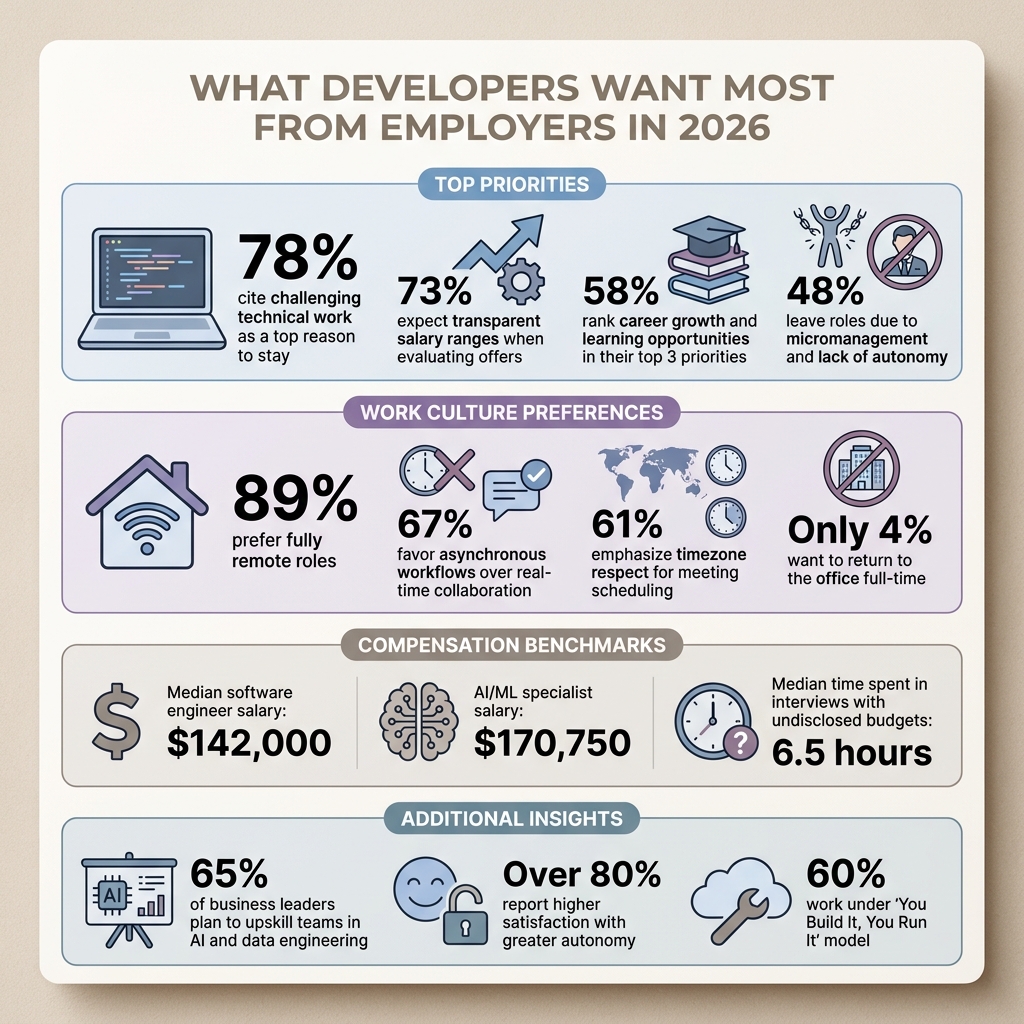
- Challenging Work: 78% of developers stay for roles that push their skills, like AI systems or scaling infrastructure.
- Autonomy: Micromanagement drives away 48% of developers. This is a key reason why many developers ignore recruiters who fail to highlight autonomy. They value decision-making freedom.
- Growth: 58% rank career development as a top priority, including mentorship and learning budgets.
- Transparency: 73% expect clear salary ranges. Median pay for engineers is $142,000; AI/ML specialists earn $170,750.
- Work Culture: Async communication, remote flexibility, and fewer meetings matter to 89% of developers.
Developers research companies through tech blogs, GitHub, Glassdoor reviews, and tech stack transparency. To stand out, maintain an active engineering blog, showcase challenges without revealing secrets, and offer clear career paths. Salary transparency and respect for developers’ time build trust and improve hiring outcomes.
What Developers Look for in an Employer
When developers evaluate potential employers, they focus on what truly impacts their work and career progression. Flashy perks like ping-pong tables or catered lunches? Those don’t hold much weight. Instead, developers zero in on aspects that shape their daily responsibilities and long-term growth. If you want to attract top talent in 2026, understanding these priorities is crucial.
Recent surveys reveal that autonomy and trust to manage their own tasks is the #1 factor driving job satisfaction . Developers want the freedom to tackle problems their way, without being micromanaged. Close behind is competitive pay and benefits, which ranks as the second most important factor . Additionally, 78% of developers consider interesting and challenging technical work a top reason to stay in a role, while 73% highlight rate transparency as a key factor when evaluating job offers .
The bottom line? Developers’ priorities shift depending on whether they’re evaluating a new role or already part of a team. Transparent compensation is critical during recruitment, but once hired, they stay for engaging work and the ability to make decisions. Let’s break down these priorities further.
Challenging Technical Problems
Developers want to work on projects that push their skills and keep them learning. 78% of developers cite interesting and challenging technical work as one of their top three reasons for staying in a position . They’re not looking to spend years maintaining outdated systems or building yet another routine CRUD app. Instead, they want opportunities to work on impactful projects - whether it’s scaling infrastructure, implementing AI-driven features, or designing systems for massive user bases. Roles that focus too heavily on maintenance without offering stimulating challenges are likely to drive talented developers away.
Autonomy and Decision-Making Power
While engaging work is essential, developers also value the freedom to decide how to approach their tasks. They want to be trusted to use their expertise without constant oversight. In fact, 48% of developers leave roles due to micromanagement and a lack of autonomy . This means giving engineers the ability to choose tools, design architectures, and participate in product planning. Companies that treat developers as mere executors of instructions risk losing them to organizations that encourage independent thinking.
Career Growth and Learning Opportunities
The tech world evolves quickly, and developers know they need to keep their skills sharp. 58% of developers rank career growth and learning opportunities among their top three priorities . Meanwhile, 65% of business leaders plan to upskill their teams, particularly in areas like AI and data engineering . Career growth isn’t just about promotions - it’s also about mentorship, access to courses or conferences, and time for open-source contributions. These efforts not only enhance developers’ skills but also strengthen their connection to the broader tech community. Without a clear path for growth or a learning budget, companies risk signaling that personal development isn’t a priority.
Transparent and Competitive Compensation
Pay transparency and market-aligned salaries are non-negotiable for developers. Competitive pay and benefits are top factors for job satisfaction , and 73% of developers say that rate transparency is critical when considering job offers . Yet many companies still withhold salary ranges, leading to frustration and wasted time - developers report spending a median of 6.5 hours in interviews for roles with undisclosed budgets . In 2026, median salaries for software engineers are around $142,000, while AI/ML engineers earn approximately $170,750 . Companies that fail to disclose or align compensation with these benchmarks risk losing candidates who assume they’re being undervalued.
Developer-Friendly Work Culture
A great work culture isn’t about free snacks or team-building events - it’s about how work gets done. Developers prefer async-first communication, with 67% favoring asynchronous workflows over real-time collaboration . They want fewer meetings, strong documentation, and code review practices focused on quality. Remote work is also a major factor: 89% of developers prefer fully remote roles, while only 4% want to return to the office full-time . Timezone respect is another key issue, with 61% emphasizing the importance of meetings being scheduled during their regular working hours . Companies that insist on mandatory office attendance or disruptive scheduling risk alienating developers who value their time and flexibility.
5 Things Developers Check Before Responding to Recruiters
When developers receive outreach from recruiters, they don’t jump in blindly. Instead, they do their research to determine if engaging is worth their time. It’s not just about the job description - they're analyzing whether your company aligns with their values and career goals. Elements like innovation, autonomy, and growth opportunities are key. Here’s what developers typically investigate before deciding why to respond.
Company Tech Blog
A well-maintained engineering blog can reveal more about your company than a careers page ever could. Developers look for regular posts that showcase how your team tackles real-world challenges and shares knowledge. This kind of content signals a culture of transparency and technical excellence. Interestingly, one in four candidates checks employee profiles immediately after learning about a job opportunity .
The most effective tech blogs feature a mix of content, including employee spotlights, interviews, and guest articles from team members. Posts that highlight big ideas, product innovation, and company milestones - like event photos or side project stories - add depth. Developer-written articles, in particular, boost your credibility while giving contributors a chance to build their personal brands. If you don’t have a dedicated blog yet, platforms like Medium or LinkedIn can serve as an alternative for distributing content. Just ensure consistent updates with a content calendar.
GitHub Activity and Open Source Contributions
Developers often turn to GitHub to see what your engineering team is working on. They’re not just looking for a presence - they want to assess your technical expertise and problem-solving approach. Open source contributions, for example, highlight a commitment to learning and innovation. When recruiters mention specific GitHub projects in their outreach, it builds trust and demonstrates genuine technical alignment.
Highlighting your GitHub activity is a great way to validate your engineering practices. Offering paid time for open source work is another strong signal that your company values developer growth beyond short-term business goals.
Engineering Reviews on Glassdoor
When developers check Glassdoor, they focus on reviews from other engineers. They’re looking for unfiltered feedback about the work environment, leadership quality, work-life balance, and whether technical challenges are taken seriously.
Recurring themes in these reviews carry weight. If engineers frequently mention micromanagement, outdated tools, or limited growth opportunities, developers take notice. Conversely, consistent praise for autonomy, challenging projects, and supportive leadership can make a strong impression. Authentic reviews are far more influential than polished employer branding efforts. Additionally, showcasing a modern tech stack reinforces that your engineering practices meet industry expectations.
Tech Stack and Development Tools
Your tech stack sends a clear message to developers. They want to know if the tools and frameworks you use align with their skills and career aspirations. If your stack relies on outdated technologies or doesn’t match their expertise, they may move on - even if your outreach is otherwise compelling.
Be upfront about your tech stack in job descriptions and on your engineering blog. Developers are drawn to roles that let them work with modern tools, keeping their skills sharp and relevant. Transparency here can make all the difference.
Engineering Team Structure and Leadership
Developers value transparency when it comes to team dynamics. They want to understand who they’ll be working with, who they’ll report to, and how decisions are made. Whether your team is small or large, sharing details like team size, reporting lines, and leadership involvement in technical discussions can help.
This kind of insight allows developers to evaluate whether there’s a clear path for growth - whether that’s moving into technical leadership or thriving as an individual contributor. Including team charts in your materials and highlighting engaged leadership in your outreach can make your company more appealing. Addressing these priorities effectively sets the stage for showcasing your technical challenges in a way that resonates with top talent.
How to Showcase Technical Challenges Without Revealing Secrets
Developers want to know what kind of challenges they’ll face in a role. The problem? Companies often share so little that the position feels generic - or they worry that revealing technical details might expose sensitive information. The key is to strike a balance: focus on how and why decisions are made without disclosing confidential business logic.
By showcasing your engineering approach - problem-solving methods, tools, and design rationale - you can highlight your team's expertise while keeping proprietary information secure. This approach provides transparency while maintaining confidentiality, giving candidates a glimpse into your technical environment.
Share Anonymized Case Studies
Case studies are a great way to demonstrate how your team tackles tough problems. The trick is to break down complex challenges into smaller, digestible parts that protect sensitive details while still showing technical depth. Instead of revealing your entire product architecture, focus on specific hurdles. For example, highlight challenges like "optimizing a DataGrid scrolling feature" or "managing cross-origin resource sharing across platforms."
Here’s a real-world example: In early 2021, Senior Engineer Jennifer Mak at Unqork shared a case study about solving a DataGrid scrolling issue. The team was using AG Grid, but a design change disrupted the HTML structure, causing text editing states to malfunction. Their solution? They wrapped the cell editor in a custom Position component that injected a portal at the bottom of the page. This preserved both functionality and a seamless UI - all without exposing any proprietary business details.
Connecting technical achievements to business outcomes can also make your case studies more impactful. Between late 2020 and early 2021, Director of Engineering DJ Seo and his team at Rokt reduced loading times by 30% in three months. They used preloading strategies and distributed tracing to optimize microservice communication. Their case study noted that high drop rates caused by poor performance could cut revenue by 7% . Highlighting these connections shows how engineering directly supports business success.
Write Technical Blog Posts
Technical blog posts are another effective way to attract developers who thrive on solving complex problems. The best posts dive into how your team overcame specific challenges, such as navigating cross-platform policy conflicts, dealing with third-party library limitations, or addressing performance issues.
Take this example: In 2021, Lead DevOps Engineer Jason Meredith at Caesars Digital faced inconsistent CORS policy interpretations across iOS, Android, and Chrome. He detailed how he leveraged AWS CloudFront to trigger a Viewer Response Lambda, using custom Python to transform header data. Once the variables were identified, the solution was implemented in just one day . His advice?
Break one large problem into manageable parts and solve them sequentially.
When writing these posts, don’t shy away from mentioning the tools and services used - whether that’s AWS Lambda, Python, Webpack, or AG Grid. This helps attract developers who are passionate about those technologies and eager to work on similar problems.
It’s also okay to admit when projects take longer than expected. For instance, if a rollout spanned from September to January, it highlights that your company prioritizes quality over rushing to meet deadlines. This kind of honesty fosters a culture where engineers feel empowered to focus on doing things right, rather than cutting corners.
Why Autonomy Matters More Than Free Lunch
Developers aren’t swayed by flashy perks like free lunches or ping-pong tables - they crave freedom in their work. This means having the authority to make technical decisions, choose their tools, shape architecture, and weigh trade-offs based on technical needs rather than red tape. In fact, over 80% of developers report feeling more satisfied at work when they have greater autonomy, even if it adds complexity to their roles . Why? Because autonomy fuels their natural drive to solve problems, take ownership, and keep learning. On the other hand, micromanaging the "how" of their work stifles growth and creativity. This need for independence is reshaping how the industry approaches work.
Take the "You build it, you run it" (YBIYRI) approach as an example - nearly 60% of developers now work under this model, and over 65% believe they should have a more significant role throughout the product lifecycle . This isn’t about rejecting teamwork; it’s about taking ownership.
"Greater autonomy is the future of software development. This means more freedom to decide which tools developers use, what they work on, and how that work gets done." - Robert Krohn, Atlassian
For senior-level developers, autonomy isn’t just a nice-to-have - it’s a must-have for their growth. They don’t want to simply execute tasks; they want to expand their impact. Leading companies understand this - they hire skilled developers, set clear goals and deadlines, and then trust their teams to determine the best way to achieve those goals.
If your strategy involves micromanaging technical decisions while investing in superficial office perks, you’re missing the point. Developers value the freedom to make meaningful decisions far more than conventional perks. By giving them control over their work, you’ll attract engineers who are passionate about building something impactful - not just collecting a paycheck. Highlighting autonomy in your hiring efforts shows developers that you respect their expertise and aligns with the direction the industry is heading. Understanding what developers want is the first step toward building a culture they'll never want to leave.
Creating Real Growth Opportunities
Developers won't stick around if they feel stuck. They want to see a clear path forward, opportunities to sharpen their skills, and the chance to make an impact beyond just writing code. If your approach to growth is limited to saying "we promote from within", you're at risk of losing talent to companies that treat professional development as a business priority, not just an HR formality.
Clear Engineering Career Ladders
The most effective engineering career ladders offer two distinct paths: one for individual contributors and another for management. These ladders include detailed milestones that evaluate progress in areas like technical expertise, impact, and leadership. For instance, Camille Fournier, an engineering leader at Rent the Runway, developed a framework built on four key pillars: Technical Skill, Get Stuff Done, Impact, and Communication & Leadership. This model has been widely adopted because it allows senior engineers to grow without being pushed into management roles .
Other companies, like OpenSesame, use skill categories such as Implementation, Design, and Operations, which are rated on a four-point scale: None, Learning, Proficient, and Fluent . Medium has taken this concept further with its "Snowflake" tool - a dynamic, interactive way for developers to track their progress and explore various paths to seniority .
Tying career progression to transparent salary bands can also build trust and improve diversity. Wise, for example, publishes clear career maps to align growth with compensation . When paired with strong learning programs, clear career paths can make a big difference in employee satisfaction and retention.
Conference and Course Budgets
Leading companies set aside a specific annual budget for each employee's professional development - and they make these policies clear . These budgets cover a wide range of resources, from conferences and certifications to online courses and even wellness programs like mental health support. This approach not only helps reduce burnout but also keeps employees focused and engaged .
Interestingly, some developers find that using these budgets for therapy is more beneficial than attending another tech conference . Additionally, forward-thinking companies are now including access to premium AI tools and programs to ensure their teams stay ahead of industry trends . Offering diverse learning opportunities shows employees that their growth is a priority.
Paid Time for Open Source Contributions
Open source contributions are another way to broaden skills and enhance visibility. Allowing developers to work on open source projects during company time is a smart move for talent development. Since 2005, over 13,500 developers from more than 1,300 companies have contributed to the Linux kernel .
"Support from leadership and acknowledgement that open source is a business critical part of your strategy is so important. You should really understand the company's objectives and how to enable them in your open source strategy."
- Nithya Ruff, Senior Director, Open Source Practice, Comcast
Encourage contributions to projects that align with your business needs, such as infrastructure or tools critical to operations. These efforts not only strengthen internal capabilities but also reduce risks of downtime . Keep in mind, 28% of open source contributions are non-code tasks like documentation, translations, or event planning . Supporting these activities helps employees develop a range of skills while boosting your company’s reputation within the developer community.
How Salary Transparency Builds Trust
Salary clarity is a key element in building trust with potential hires. While challenging projects and autonomy are appealing, transparent pay signals that a company is serious about meeting developer expectations.
When companies are upfront about compensation, they demonstrate a commitment to fairness and open communication. Without this transparency, developers may assume the role is undervalued or that the company is unsure of its worth. In fact, 68% of workers say they would switch employers for better pay transparency - even if the salary itself remained the same . This goes beyond just money - it's about respect and trust.
Clear salary ranges do more than build trust - they help streamline the hiring process. They attract candidates who are already aligned with your compensation structure and filter out mismatches, saving time for everyone involved. For example, job listings with salary ranges cost about 67 cents less per click than those without . Additionally, companies like Buffer saw a doubling of job applications after posting all employee salaries online . Transparency simplifies the process and sets the stage for meaningful conversations about compensation.
Developers also want a complete financial picture, not just a base salary. Details about equity, bonuses, and benefits are essential for understanding total compensation over time . Companies such as Microsoft and Meta now offer dashboards that let candidates model long-term wealth, including RSUs and vesting schedules . By providing this level of detail, companies can align expectations early, reducing the chances of offer resistance later in the process .
"When people feel that their employers are open and honest about pay, they are much more likely to trust that the employer is making fair and unbiased decisions." - WorkTango
It's important to avoid posting overly broad salary ranges like $300,000 to $900,000. While Netflix and a few others have made headlines with such wide spreads, most companies post ranges in good faith - typically within +/- 21% of the midpoint . Narrow ranges show you've done your research and understand the role's value. This level of clarity reinforces a culture of openness, making salary transparency a cornerstone of your developer value proposition and recruitment efforts.
Culture Signals That Actually Matter to Developers
Developers are quick to spot the difference between empty culture slogans and real, day-to-day practices. What truly resonates with them are the tangible workflows and communication habits that reflect how a company operates. These are the signals developers discuss in Slack channels and industry blogs, revealing the authentic culture of your organization.
Async Communication and Limited Meetings
For developers tackling complex technical challenges, uninterrupted focus time is non-negotiable. Asynchronous workflows make this possible by allowing engineers to work deeply without constant interruptions. They can share updates at natural stopping points, reducing the need for endless coordination and avoiding the productivity drain caused by excessive meetings.
Companies that adopt practices like "No-Meeting Fridays" or similar focus periods send a clear message: results matter more than clocking hours in meetings. This shift from tracking time to measuring outcomes builds trust within the engineering team. Nicolas Pamart from RedactAI highlights this shift perfectly:
"Flexibility isn't a perk anymore; it's a core expectation. Companies that build their culture around trust and autonomy will win" .
GitLab exemplifies this principle. By 2025, they fully transitioned to a remote-first model with no physical offices. Their public Handbook meticulously outlines async workflows and documentation standards, ensuring their culture is consistent and transparent across the entire organization.
To support these practices, consider implementing a weekly review of async updates. This ensures focus blocks remain undisturbed and creates a rhythm for teams to stay aligned. Respecting focus time also extends naturally to documentation and code review practices, reinforcing a culture of precision and excellence.
Documentation Standards and Code Review Practices
A strong documentation culture is one of the clearest signs of an organized and thoughtful engineering team. When managers actively contribute to design documents and technical specs are treated with the same care as production code, it signals a commitment to knowledge sharing over individual heroics.
Structured code reviews also play a big role in creating an environment where learning and collaboration thrive. By establishing a regular review cadence for design documents, teams can ensure that technical decisions are well-documented and accessible to everyone.
Salesforce's "Success from Anywhere" model is a great example of this approach in action. Using digital tools, they maintain high documentation standards across both hybrid and remote teams. This focus on written communication ensures that vital technical context is preserved, no matter the time zone or location.
These practices aren’t just about improving workflows - they send a clear message to developers. They show that your company values transparency, collaboration, and technical excellence, making you stand out in the eyes of the technical community.
How daily.dev Recruiter Connects You with Developers
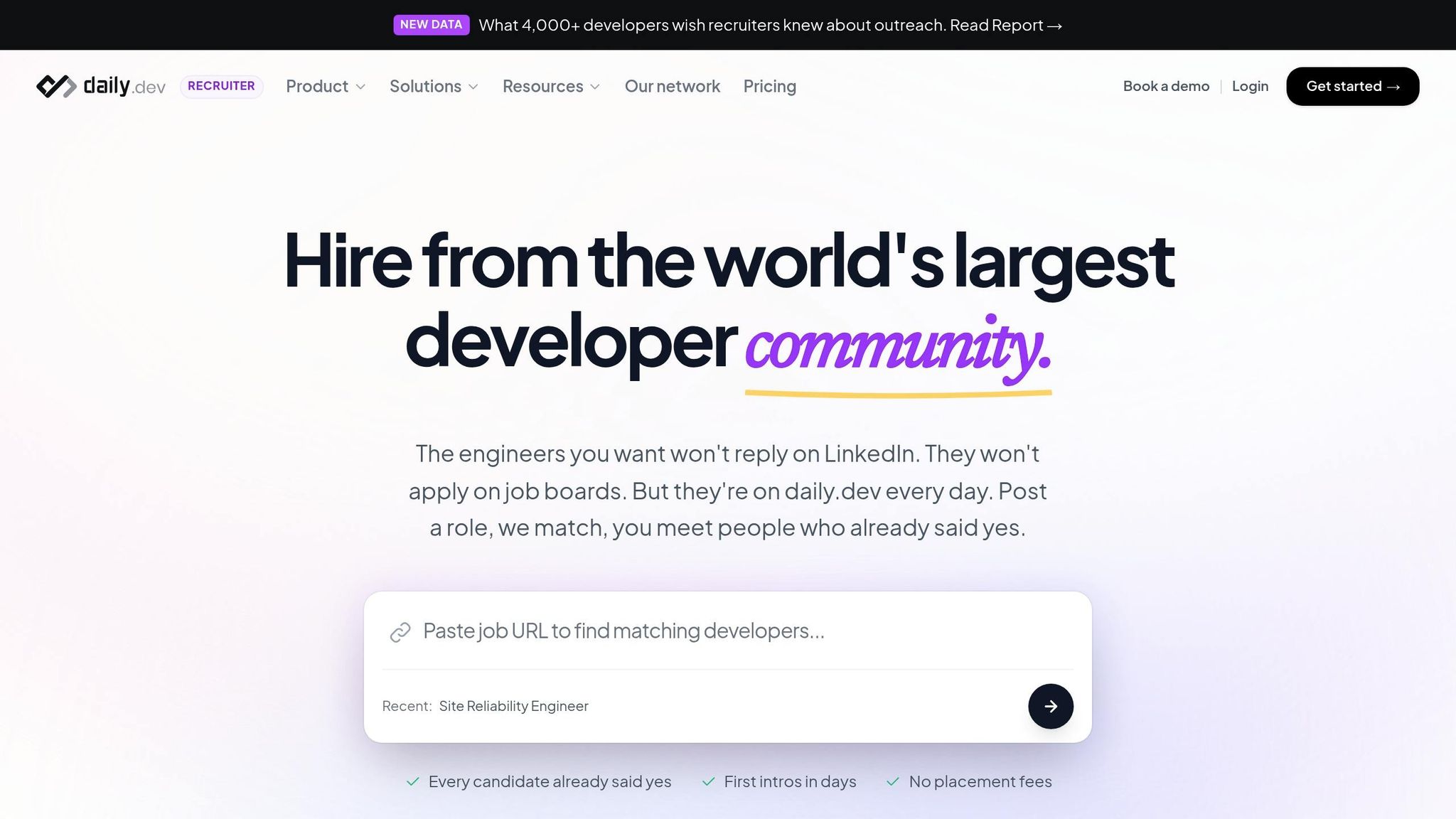
daily.dev Recruiter offers a fresh way to connect with developers by addressing the challenges of traditional recruiting. Old-school methods like scraped databases, cold LinkedIn messages, and mass email blasts have created a trust gap between developers and recruiters. Many developers, especially senior engineers and technical leaders, have grown adept at tuning out this noise. Instead of following this outdated path, daily.dev Recruiter focuses on where developers naturally spend their time - exploring industry news and learning about new technologies.
By leveraging developers' existing attention rather than relying on search tools, the platform engages them through the content they already consume. This approach avoids intrusive interruptions, creating warm introductions based on mutual interest. It replaces the impersonal, spam-like tactics of traditional recruiting with a trust-based system.
Double Opt-In Introductions
At the heart of daily.dev Recruiter’s approach is its double opt-in model. Developers must first show genuine interest in a role before any interaction begins. This ensures that recruiters only connect with candidates who are eager to engage, saving time for everyone involved. Every introduction starts with mutual intent, which aligns with the transparency and trust developers expect.
This method is especially effective for reaching the 90% of passive developers who typically ignore job boards and recruiter outreach. It’s a particularly valuable way to connect with senior developers who aren’t actively job hunting.
Content-Based Engagement Strategy
Instead of relying on outdated profiles or scraped data, daily.dev Recruiter uses real-time content engagement to create meaningful introductions. As developers interact with specific technologies, industry trends, or technical topics on the platform, they organically build a profile of their skills and interests.
This approach allows recruiters to present opportunities that are highly relevant, reaching developers at the right moment - when they’re already focused on similar technologies or challenges. With a network of over 1,000,000 developers, the platform offers access to a global talent pool that’s actively engaged, not just sitting in a database. This strategy naturally results in more meaningful connections.
Higher Response Rates Through Targeted Visibility
Because daily.dev Recruiter relies on developer opt-in for every connection, response rates are far better than those seen with traditional cold outreach. Developers only see opportunities that match their interests and can review role details, team dynamics, and technical challenges upfront before deciding to engage.
This level of transparency empowers developers to evaluate opportunities on their own terms. The process prioritizes precision and trust over high-volume, low-quality messaging, addressing what developers have been asking for all along. By aligning with developers’ habits and expectations, daily.dev Recruiter not only boosts response rates but also reinforces a content-driven, trustworthy approach that resonates with modern developers.
Conclusion
Top developers prioritize meaningful challenges, autonomy, fair pay, and a culture rooted in respect - far more than perks like free lunches or ping-pong tables.
Your true employer brand isn’t shaped by the claims on your website. Instead, it’s reflected in the candid feedback shared on platforms like Glassdoor. Research shows that 82% of job seekers assess a company’s reputation before applying, and 41% of developers rely on company reviews to learn about potential employers. If your company’s reality doesn’t match its marketing, developers will notice - and they won’t hesitate to share their experiences. This disconnect is a primary reason why developers ignore recruiters during initial outreach.
"We want to attract people with the Coca-Cola HBC mindset. Finding people that share that mindset is the key to success."
- Maya Tsankova, Group Employer Branding Communications Manager, Coca-Cola HBC
Building trust with developers not only strengthens your reputation but also delivers measurable results. Companies that embrace transparency and provide clear career pathways see real benefits: a 50% reduction in cost-per-hire and a 28% decrease in employee turnover. Trust, backed by action, is what sets successful employers apart.
FAQs
What’s the fastest way to improve developer autonomy without losing alignment?
The fastest way to enhance developer independence without losing alignment is by setting clear goals and trusting developers to figure out the best path to achieve them. Start by defining shared objectives to ensure everyone is on the same page. Keep communication channels open and provide comprehensive documentation to guide their efforts.
To make this process smoother, rely on tried-and-tested tools and frameworks. These not only empower developers to work efficiently but also help align their work with the company’s overall priorities. Striking this balance encourages a sense of ownership among developers and speeds up progress.
How can we share real engineering challenges without exposing sensitive details?
When discussing engineering challenges in a secure manner, concentrate on the technical complexity and design considerations without exposing any proprietary information. Keep the focus on the broader problem by outlining principles, constraints, and goals, rather than delving into specifics like source code, algorithms, or detailed data. Stick to sharing general, non-sensitive, or publicly accessible information, and always handle data cautiously to avoid unintentional leaks.
What should we publish first to make our developer employer brand more credible?
To establish trust and build credibility, start by clearly defining and sharing your employer brand. Highlight your mission, team dynamics, and the technical challenges that make your company stand out. Developers appreciate honesty and clear communication, so focus on creating content that showcases your work environment, opportunities for growth, and the engineering problems your team tackles. This transparency helps developers understand what sets your company apart and why it’s an exciting place to work.
.png)