Developers with specialized skills often gather in niche communities - places like GitHub, Stack Overflow, or local meetups - to collaborate and share expertise. These spaces offer hiring managers direct access to skilled professionals who may not be reachable through job boards. However, traditional recruiting methods fail here. To succeed, you need to:
- Find active communities: Explore GitHub repos, Reddit threads, Slack groups, and meetups focused on your required technologies.
- Build trust: Engage authentically by contributing to discussions and supporting open-source and communities.
- Personalize outreach: Reference specific work or contributions in tailored messages.
- Host or sponsor events: Offer hackathons, workshops, or sponsorships to connect with developers.
- Streamline hiring processes: Focus on skills, simplify applications, and offer flexible work options.
::: @figure 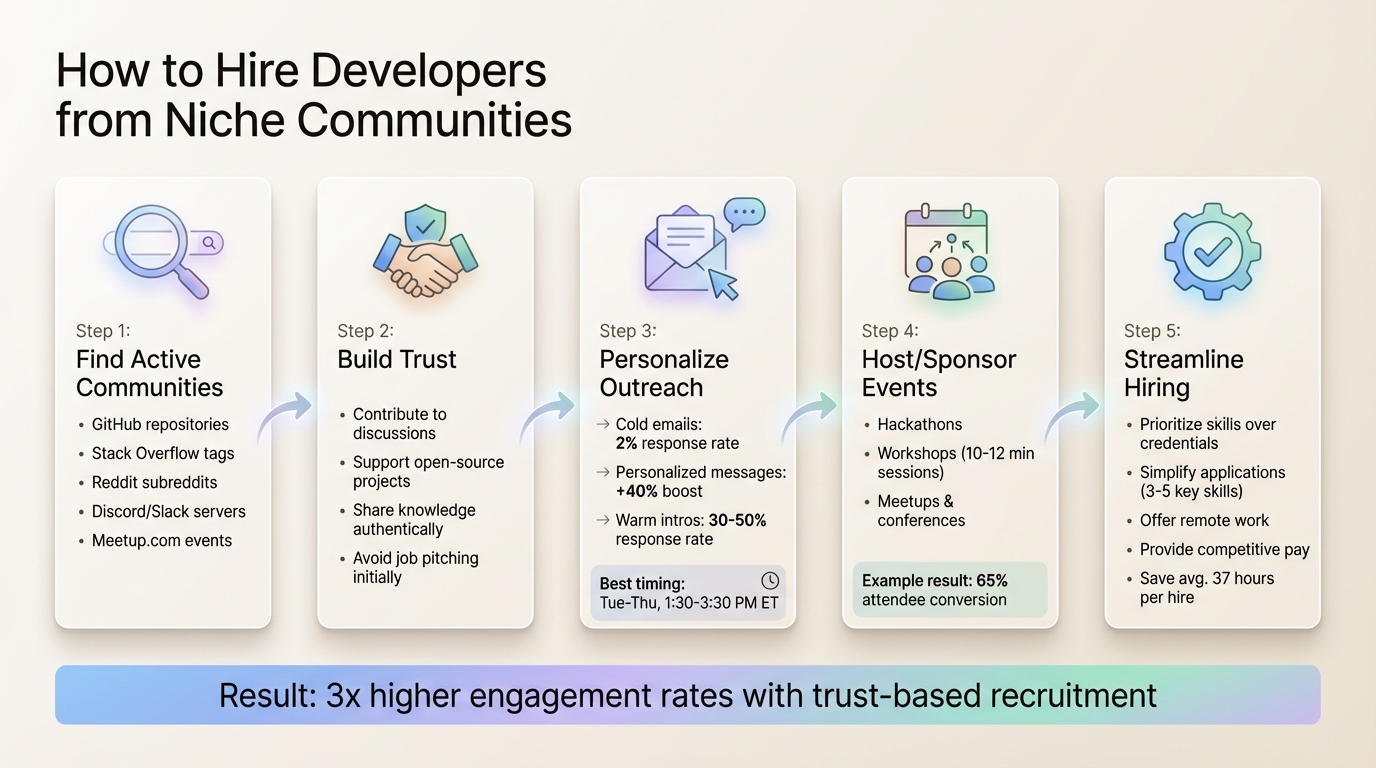 {5-Step Process for Hiring Developers from Niche Communities}
How to Find Niche Developer Communities
To locate niche developer communities, it’s essential to pinpoint where developers naturally gather to share knowledge and collaborate. These spaces can range from online forums and chat platforms to offline meetups and conferences. The goal is to focus on communities where developers are actively engaged, not just passively browsing.
Search Online Platforms and Forums
Start with popular online platforms where developers interact regularly:
- GitHub: Search repositories by programming language or framework to see who’s contributing to projects in your tech stack.
- Stack Overflow: Use tags to find experts in specific technologies. Look at reputation scores and answer histories to identify active participants.
- Reddit: Subreddits like r/rust, r/golang, and r/webdev are hubs for technical discussions and problem-solving.
Real-time chat platforms such as Discord and Slack are also valuable. Many programming languages and frameworks have official servers where members discuss issues, share resources, and more. To gauge the health of a community, check how frequently messages are posted, how quickly questions receive responses, and whether the focus remains on technical topics.
Combining these online resources with offline interactions can provide a comprehensive view of active developer communities.
Connect with Local Meetups and Events
In-person gatherings offer a chance to build stronger connections. Platforms like Meetup.com are great for finding local developer groups. For example, searching for "Python developers Boston" or "JavaScript meetup Seattle" can lead you to active groups in those areas. Certain cities even have niche specialties - Seattle is known for cloud computing and gaming, Austin for startups, and Boston for biotech and fintech.
Major conferences such as React Summit, PyCon, and KubeCon also attract highly engaged developers. Reviewing the speaker lists can help you identify thought leaders, while many of these events maintain associated Discord or Slack channels for ongoing discussions. Before attending, check how often these events occur and whether they’re still actively supported.
Use Tools to Locate Active Communities
instead of relying on outdated profiles and resumes, consider using tools that focus on behavioral intent. For example, daily.dev Recruiter connects you with developers based on their current learning habits and technical interests. This approach prioritizes active engagement over static keywords, helping you identify developers who are passionate about their craft and potentially open to new opportunities.
When assessing any community or platform, prioritize those with consistent activity. For instance, developers frequently commenting on Kubernetes articles or contributing to discussions are often more valuable than those with outdated profiles. Look for spaces where participation is dynamic and ongoing.
How to Build Trust in Developer Communities
Developers are quick to recognize recruiters, so avoid turning niche communities into job boards. To hire successfully from these spaces, you need to establish credibility first. This involves showing genuine interest in the community, contributing meaningfully, and proving that your company cares about the community’s growth - not just filling positions.
Contribute to Discussions Without Pitching Jobs
Jumping into a community and immediately posting job openings is the fastest way to lose trust. Instead, take a more thoughtful approach. Join conversations authentically by answering technical questions, sharing useful articles, or offering insights based on your company’s experience. Focus on discussions that align with your hiring needs, but avoid promoting jobs outright. Developers appreciate consistent, meaningful contributions. If your team is actively solving problems and sharing knowledge, people will naturally become curious about your organization. This kind of genuine engagement sets the stage for building trust and credibility.
Highlight Your Company’s Contributions
recruiting developers through open-source projects is a challenge for 89% of hiring managers, and 60% are actively searching for open-source talent . A great way to build trust in these communities is by contributing to the projects they care about. For example, you could fund engineers to work on open-source projects during work hours, sponsor documentation efforts, or support tools and educational initiatives that benefit the community. By investing in these areas, you send a clear message: your company values the ecosystem and wants to see it thrive. As Jeff Osier-Mixon puts it, financial support signals recognition, not just monetary value . When developers see your company backing the tools and projects they rely on, you become more than just another recruiter - you become a trusted partner.
Focus on Relationships, Not Transactions
Once you’ve established trust through authentic contributions and visible support, concentrate on building lasting relationships. Avoid the transactional approach of cold emails and generic job pitches. Instead, focus on building a tech talent pipeline through warm, personal connections. Attend meetups regularly, engage with developers on platforms like GitHub, and amplify their work by sharing blog posts or celebrating their contributions. This way, when you do reach out, you’re not just another stranger - you’re someone they already recognize and trust. This approach leads to better response rates and deeper, more meaningful conversations.
How to Reach Out to Developers Effectively
Once you've built trust within a niche community, your outreach should reflect that same level of authenticity. After all, developers value genuine connections, so your efforts to engage them should feel personal and thoughtful.
Write Messages Tailored to Each Developer
Personalization makes a world of difference. While cold emails typically see a response rate of just 2%, personalized messages can boost that number by 40% . To stand out, reference specific contributions or projects - like a GitHub repository or a forum discussion - to show you’ve done your homework. For example, instead of a generic line like, "I saw your profile and think you'd be a great fit", you could say:
"I came across your Voiceflow project in the US community group and was impressed by how you tackled user-generated content. Our team is working on similar conversational AI tools, and I’d love to discuss how your expertise could contribute."
This approach not only acknowledges their unique skills but also connects their work to the opportunity you're offering. Developers aren’t drawn in by vague promises of "exciting opportunities." They want specifics - what they’ll be working on, how it aligns with their interests, and how it benefits their career growth. By focusing on these details, you build on the trust you've already earned.
Time Your Outreach and Follow Community Rules
Timing plays a crucial role in outreach. The best window to connect with developers is Tuesday through Thursday, during US business hours (9 AM–5 PM ET), with peak visibility between 1:30 PM and 3:30 PM . This ensures your message doesn’t get buried or overlooked.
Equally important is respecting community guidelines. Each platform or forum has its own rules about recruitment. For instance, forums like r/ArtistLounge or Indie Hackers often require moderator approval before posting job opportunities. On platforms like iOS Developers Slack, use designated job channels rather than spamming general threads. And always keep your messages concise and professional - one clear, well-crafted thread is far more effective than multiple posts.
Cultural norms also matter. On platforms like Indie Hackers, transparency about your intentions goes a long way. On Dev.to, genuine contributions to discussions can help you build credibility. And above all, avoid pushy or overly aggressive pitches - developers appreciate respectful, low-pressure communication.
Get Warm Introductions Instead of Cold Emails
Nothing beats a warm introduction. When someone trusted vouches for you, developers are naturally more inclined to respond. These kinds of connections can double your conversion rates, and they often lead to better long-term outcomes. For example, Webflow has seen 3x higher retention rates for hires made through warm introductions, thanks to better alignment with team culture .
Communities like Voiceflow have had success using geo-specific subgroups to facilitate warm intros for localized AI projects. Similarly, Indie Hackers has seen founders secure developers through pod introductions, with some roles even evolving into co-founder positions.
Platforms like daily.dev Recruiter make this process even easier. Through warm, double opt-in introductions, the platform connects you with candidates who’ve already expressed interest in hearing from recruiters. These introductions can lead to response rates of 30–50% , giving you a much stronger starting point for your conversations.
Host or Sponsor Events for Developers
Hosting or sponsoring events connects you directly with niche developer communities while naturally building trust. Unlike traditional recruiting methods, events give you a chance to empower developers rather than pitch to them. As corporate.hackathon.com explains, "Instead of pitching, you're enabling. This positions your company as developer-friendly" .
The results can be impressive. For example, in September 2025, a cloud infrastructure company hosted a 200-person hackathon to showcase its new APIs. After the event, 65% of attendees signed up for long-term accounts, and the company's Discord community doubled in size within three months . These outcomes highlight how events can spark both immediate interest and lasting connections. This approach works hand-in-hand with the trust and involvement you've already built in developer communities.
Organize Events That Match Developer Interests
Hackathons give developers hands-on opportunities to create projects, test tools, and explore how your tech stack fits their needs. To make these events successful, offer the right resources - SDKs, APIs, sandbox accounts, and technical mentors who can step in when participants hit roadblocks .
Workshops and webinars should prioritize active learning over marketing fluff. Focus on practical sessions like troubleshooting, technical guides, and FAQs that solve real-world challenges developers face .
For virtual events, keep training sessions short (10–12 minutes) and follow them with interactive breakout activities (10–15 minutes) . This format works well. One Series A developer tools company saw breakout participation jump from 40% to 85% by adding structured icebreakers where attendees contributed to a shared document within the first five minutes .
Make sure your company representatives are engineers or technical leads who can hold meaningful, high-level conversations . Developers prefer learning from peers rather than sitting through polished corporate presentations . Beyond hosting your own events, joining existing meetups can further strengthen your community presence.
Sponsor Meetups and Conferences
Sponsoring established meetups and conferences is another way to connect with developers already interested in specific technologies. This approach puts your company in front of an engaged audience. Securing a speaking slot can amplify your impact far more than simply having your logo displayed . Speaking at events positions your company as a technical authority instead of just another sponsor.
Take Travis Webb, CEO of Langa, as an example. He filled a niche senior Node.js developer role for Qualcomm in San Diego thanks to a connection he made years earlier while speaking at a Los Angeles meetup . That relationship, built on technical expertise rather than a transactional approach, paid off when the right opportunity arose. This underscores the value of aligning your event strategy with genuine community involvement.
Consistency is key. Sporadic participation can come across as inauthentic. Show up regularly, contribute even when you're not hiring, and focus on building long-term relationships .
Demonstrate Your Tech and Company Culture
Events are a great way to showcase your tech stack, projects, and developer-friendly culture. Set up a lab or sandbox environment where developers can try out your product and give feedback during the event . This hands-on approach not only highlights the practical value of your tools but also offers a glimpse into your company culture.
For hackathons, conversion rates from registration to project submission typically range from 5–35% . When you recruit senior software engineers, To engage senior developers, consider offering "access" prizes like one-on-one meetings with industry leaders or tickets to exclusive tech conferences . Make sure your internal engineers or knowledgeable volunteers are available during the event to help participants avoid frustration with your tools . These efforts further strengthen your connection with the developer community.
Measure success by tracking the right recruitment metrics. Look beyond immediate engagement, like project submissions and forum activity, and monitor recruitment outcomes such as leads generated, qualified applications, and hires . Additionally, consider product-related metrics like feature adoption, developer feedback, and sandbox signups, as these reflect genuine interest in your technology .
Adapt Your Hiring Process for Niche Developers
To connect with niche developer communities, your hiring practices need to reflect their values and priorities. These developers expect processes that respect their time and expertise. Unfortunately, traditional recruitment methods often miss the mark, alienating the very talent you’re trying to attract. As Zach Hubbard puts it, "The labor market isn't broken. It's just picky... They're hiring for proof" . Companies willing to adjust their approach to align with how these developers work are more likely to succeed.
Prioritize Skills Over Formal Credentials
What matters most is what developers can do - not where they studied. Instead of focusing on formal degrees, evaluate candidates based on their portfolios, open-source contributions, and overall problem-solving abilities. A skills matrix can help you match both technical and soft skills to the role, offering a more comprehensive evaluation .
Ditch theoretical coding tests in favor of practical tasks that mirror real-world challenges. For instance, ask candidates to build a small feature, design an API, or participate in a collaborative coding session . Technical interviews should include open-ended questions that let developers showcase their thought process and problem-solving methods . Additionally, Technical hiring tools can streamline the evaluation process by analyzing technical skills and compatibility across multiple data points .
Equally important is ensuring your application process doesn’t create unnecessary hurdles for these skilled candidates.
Remove Barriers from Your Application Process
When job postings attract 1,400 applications in a single day, it’s easy for top talent to lose interest . Simplify your application process to avoid this. Instead of listing an exhaustive set of qualifications, stick to three to five essential skills. Overly ambitious "unicorn" job descriptions often discourage qualified candidates from applying .
Consider offering informal, scheduled chats with a technical recruiter or team member before candidates even apply. These sessions can help build rapport and answer technical questions upfront . Tools like AI-driven shortlisting systems can also help by pre-vetting candidates for technical proficiency, saving time on manual screening . Keep in mind that a poorly executed recruitment process can harm your reputation within tight-knit developer communities .
Once your hiring process is streamlined, focus on meeting developers’ expectations for work conditions.
Offer Remote Work and Competitive Pay
Developers with niche skills are in high demand, and they know their worth . To attract them, adopt remote-first policies that emphasize flexibility. Remote work allows developers to operate from anywhere and during their most productive hours - key factors for roles that require creativity and problem-solving .
In addition to flexible hours, offer competitive pay and perks that show you value their expertise. Consider professional development budgets for conferences, hardware stipends, or learning allowances . In close-knit communities, fairness and respect for developers' time go a long way. Lowball offers or vague compensation packages, on the other hand, can quickly damage your reputation . By aligning your approach with their expectations, you’ll build trust and attract top-tier talent.
Conclusion
Recruiting from niche developer communities calls for a relationship-focused strategy: identify the right spaces, offer meaningful contributions, tailor your outreach with warm introductions, and adjust your hiring methods. By dedicating time to building trust through active participation and respecting the norms of these communities, you can tap into a pool of talent that often goes unnoticed on traditional job boards. This trust-based approach lays the groundwork for genuine and effective recruitment.
Every tactic - whether it's finding communities or organizing events - emphasizes that developers value authenticity over generic sales pitches. Thoughtful, personalized messages that reference specific contributions, introductions through mutual connections, and hiring processes that focus on real-world skills instead of formal credentials show that you understand and respect their professional environment.
Using daily.dev Recruiter enhances this trust-driven approach with warm, behavior-based introductions. The platform identifies talent by analyzing real-time activity - what developers are building and learning - rather than relying on outdated resumes. Double opt-in introductions ensure you're connecting with pre-qualified developers who are genuinely open to hearing about new opportunities.
With engagement rates three times higher than traditional cold outreach and the potential to save an average of 37 hours per hire , daily.dev Recruiter transforms recruitment into a process rooted in trust and meaningful connections. Instead of chasing candidates, you're building relationships with the right developers at the perfect moment.
FAQs
How do I know a developer community is worth joining?
To determine if a developer community is the right fit, start by evaluating how well it aligns with your hiring objectives and the specific skills you’re seeking. Pay attention to how active the community is, whether discussions are respectful, and if moderation ensures meaningful engagement. Focus on spaces that complement your outreach approach, promote open communication, and encourage genuine connections. The best communities are those where your input is valued, and the members’ expertise directly supports your hiring needs.
What’s the best way to start contributing without sounding like a recruiter?
To make an impact without coming across as a recruiter, focus on creating meaningful connections through authentic, value-based interactions. Skip the instant job pitches. Instead, engage thoughtfully - share useful insights, join conversations, and tailor your outreach to acknowledge the other person’s expertise. Be clear about your purpose, steer clear of generic messages, and honor the community’s guidelines. Offering help or sharing resources can go a long way in building trust and credibility, ensuring your contributions resonate over time.
How can I evaluate niche developers fairly without long coding tests?
To evaluate niche developers without relying on lengthy coding tests, consider real-world assessments like short, paid projects or probationary periods. These approaches showcase a developer's practical skills and ability to adapt in real scenarios. Additionally, reviewing their open-source contributions or GitHub activity can provide insight into their coding quality and how they collaborate with others. Building genuine connections within niche communities can also foster trust and help you spot skilled developers who thrive beyond traditional testing methods.
.png)