Hiring embedded systems and IoT engineers is challenging due to high demand and a limited talent pool. By 2030, IoT devices are expected to reach 41.1 billion, with the embedded software market growing at 9.5% annually. Skilled engineers are scarce, with hiring senior roles taking 12–16 weeks on average. Here's how to navigate this process effectively:
Understand Key Roles:
- Firmware Engineers: Focus on low-level hardware interactions using C/Assembly.
- Embedded Systems Engineers: Handle system integration and RTOS environments.
- IoT Developers: Work on connectivity, cloud integration, and protocols like WiFi and MQTT.
What to Look For:
- Strong C/C++ skills, RTOS experience, and knowledge of hardware-software interfaces.
- Familiarity with debugging tools like JTAG and communication protocols (SPI, I2C, UART).
Where to Find Talent:
- Attend hardware conferences and meetups.
- Explore niche job boards and forums like GitHub or EmbeddedJobs.com.
- Use platforms like daily.dev Recruiter for pre-screened candidates.
Assessment Tips:
- Conduct role-specific technical tests (e.g., Embedded C coding challenges, RTOS tasks).
- Include debugging exercises and hardware simulation scenarios.
Compensation Insights:
- Average salaries: $115,000 for embedded engineers, $149,000 for IoT developers.
- Offshore hiring can reduce costs by up to 83%, but consider coordination challenges.
Firmware Engineers vs. Embedded Systems Engineers vs. IoT Developers
::: @figure 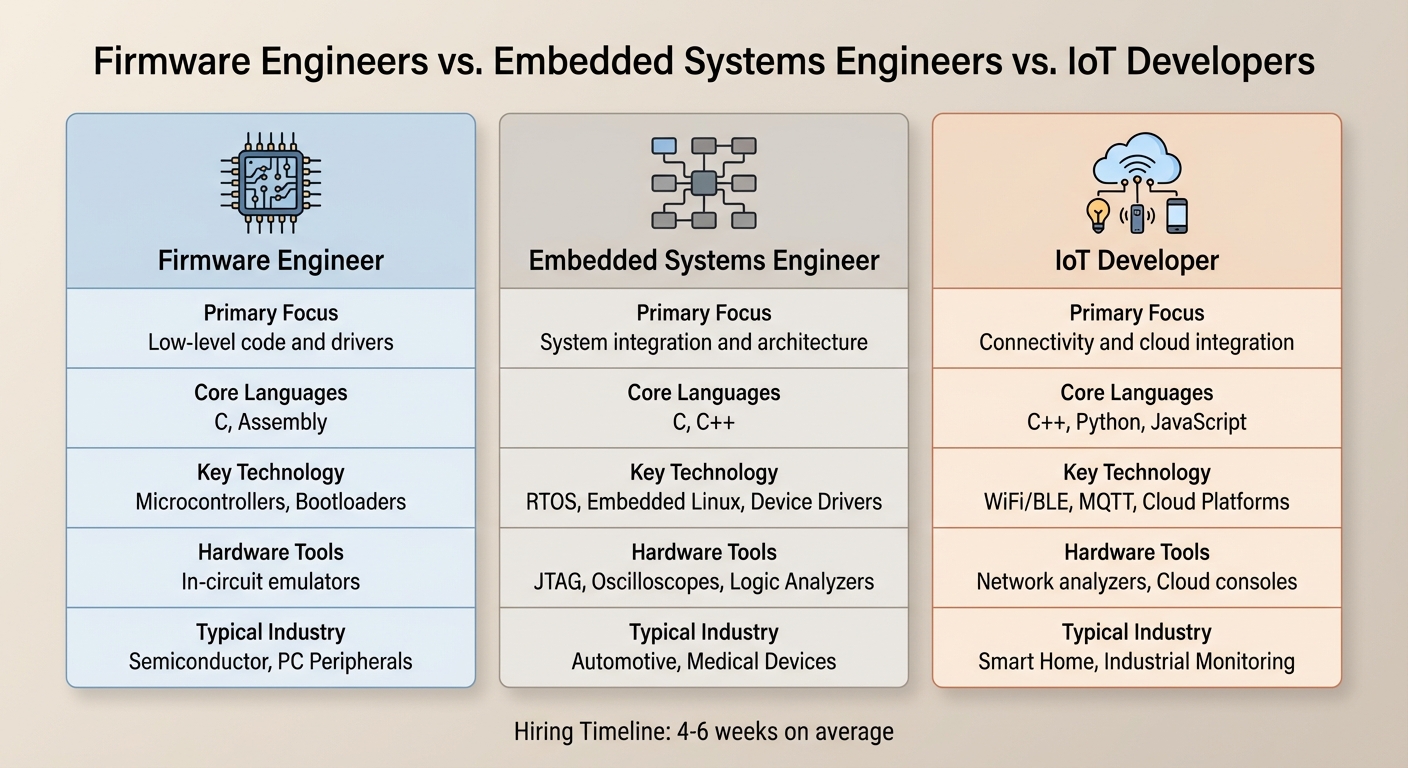 {Firmware Engineer vs Embedded Systems Engineer vs IoT Developer: Role Comparison}
Though often grouped together, these roles operate at different levels of the tech stack. Misunderstanding these distinctions can lead to hiring mismatches - sending a firmware engineer job description to an IoT developer, for instance, could derail your hiring process. Clear role definitions are key to finding the right talent for your embedded engineering needs.
Here’s a closer look at what each role entails:
Firmware engineers focus on writing low-level code that interacts directly with hardware. They handle tasks like developing drivers, managing memory constraints, and configuring I/O operations. Picture them as the ones who make a microcontroller’s LED blink or fine-tune a bootloader to reduce startup time by milliseconds. Their go-to languages are C and Assembly, and they often work with bare-metal platforms like ARM Cortex-M or AVR.
Embedded systems engineers take a broader approach, designing system architectures that integrate various hardware components. They ensure seamless interaction between peripherals and collaborate closely with hardware teams to troubleshoot integration challenges. These engineers are skilled in working with peripherals like SPI, I2C, and UART, and are familiar with RTOS environments like FreeRTOS or Zephyr. They also rely on tools like JTAG debuggers and oscilloscopes to get the job done.
IoT developers operate at the connectivity layer, focusing on how devices communicate over networks and integrate with cloud platforms. They work on APIs, data flow management, and protocols like WiFi, Bluetooth, and LoRaWAN. Their expertise often includes Embedded Linux and cloud consoles, bridging the gap between physical devices and the digital world.
| Feature | Firmware Engineer | Embedded Systems Engineer | IoT Developer |
|---|---|---|---|
| Primary Focus | Low-level code and drivers | System integration and architecture | Connectivity and cloud integration |
| Core Languages | C, Assembly | C, C++ | C++, Python, JavaScript |
| Key Technology | Microcontrollers, Bootloaders | RTOS, Embedded Linux, Device Drivers | WiFi/BLE, MQTT, Cloud Platforms |
| Hardware Tools | In-circuit emulators | JTAG, Oscilloscopes, Logic Analyzers | Network analyzers, Cloud consoles |
| Typical Industry | Semiconductor, PC Peripherals | Automotive, Medical Devices | Smart Home, Industrial Monitoring |
When it comes to screening candidates, tailor your technical tests to each role. An "Embedded C Test" is great for evaluating firmware engineers’ driver development skills. For embedded systems engineers, a "Software System Design Test" can gauge their architectural planning abilities. IoT roles, on the other hand, demand assessments that focus on protocol knowledge and cloud platform experience.
Since hiring for these specialized roles typically takes 4 to 6 weeks , defining roles clearly from the start can save valuable time. These distinctions set the foundation for effective technical evaluations and sourcing strategies in the following sections.
Hiring engineers?
Connect with developers where they actually hang out. No cold outreach, just real conversations.
Core Skills to Look for in Embedded and IoT Engineers
Once you've outlined the role, the next step is to zero in on the skills that set strong candidates apart. For embedded and IoT positions, technical expertise is key. At the heart of it all? C and C++ proficiency. As Siddhartha Gunti from Adaface explains:
"C is the backbone of embedded systems. An embedded software engineer uses C to write efficient, low-level code that directly interacts with hardware" .
However, don't just test for basic syntax. Go deeper - evaluate skills like pointers, memory management, and bit manipulation. These are the building blocks for identifying engineers who can handle the unique challenges of embedded systems.
Proficiency in C/C++
C provides the fine-grained control needed for working with resource-constrained microcontrollers. When screening candidates, include coding challenges that focus on areas like structures, dynamic memory allocation, and file systems. For embedded-specific roles, look for expertise in I/O hardware addressing, fixed-point arithmetic, and preprocessor directives - skills that aren't typically covered in standard programming tests . Avoid generic programming assessments; they won't reveal whether a candidate can optimize code under tight constraints.
Experience with RTOS and Microcontrollers
Real-time operating systems (RTOS) like FreeRTOS are crucial for managing tasks in time-sensitive applications. In industries like automotive or healthcare, where even a millisecond delay can have serious consequences, this knowledge is indispensable. Assess candidates on their ability to handle task scheduling, manage latency, and meet timing constraints through scenario-based questions.
When it comes to microcontrollers, test their understanding of architectures like ARM Cortex-M, AVR, and PIC, as well as their familiarity with cross-compiling toolchains. As Siddhartha Gunti notes:
"Understanding microcontrollers is key for embedded software engineers as they are the primary hardware component in many embedded systems" .
Knowledge of Hardware-Software Interfaces and Communication Protocols
Inter-component communication relies on protocols like I2C, SPI, UART, and CAN. These protocols ensure reliable data exchange between components. As Gunti highlights:
"Communication protocols like SPI, I2C, and UART are important as they define methods for data exchange between components in an embedded system, ensuring interoperability and reliability in communications" .
To evaluate this, ask candidates how they'd debug communication failures or solve hardware-software integration challenges. A practical "Peripheral Integration" case study can be particularly effective. This might involve demonstrating how to integrate various peripherals with a microcontroller . Also, look for experience with debugging tools like JTAG, logic analyzers, and oscilloscopes. These tools are vital for resolving the complex issues that often arise at the hardware-software boundary.
Structuring Assessments for Better Results
Specialized assessment tools tailored for embedded engineers can double the quality of your hires . Design technical tests that last about 40 minutes, combining 10 scenario-based multiple-choice questions with one hands-on coding challenge . This approach keeps candidates engaged while giving you a clear picture of their ability to navigate the constraints and trade-offs of embedded development. By focusing on these targeted evaluation methods, you'll be better equipped to identify top-tier embedded and IoT talent for your team.
Where to Find Embedded and IoT Engineers
Once you've identified the key technical skills you're looking for, the next step is figuring out where to find embedded and IoT engineers. Since many skilled professionals in this field are already employed , you'll need to go beyond standard job boards and explore diverse developer sourcing channels to connect with them.
Hardware Conferences and Meetups
Attending hardware conferences and meetups is an excellent way to meet embedded talent in person. These events attract engineers working on innovative projects, from automotive systems to medical devices. Many of these gatherings also include specialized consortia, making them a goldmine for networking. Beyond just exchanging resumes, face-to-face interactions allow for deeper technical discussions, giving you a clearer picture of a candidate's expertise.
Online Forums and Communities
Online platforms like GitHub and Stack Overflow are great for spotting passive candidates by reviewing their actual work . By analyzing code contributions and participating in technical discussions, you can gauge a candidate's problem-solving skills and technical depth. Additionally, niche job boards like EmbeddedJobs.com cater specifically to embedded systems roles, offering another avenue to find specialized talent. These forums and communities are particularly useful for uncovering candidates who aren't actively applying but are open to the right opportunity.
For a more focused strategy, consider leveraging specialized recruiting platforms that are designed to connect with this hidden talent pool.
daily.dev Recruiter

One such platform is daily.dev Recruiter, which simplifies the process of finding pre-qualified embedded engineers. With its warm, double opt-in introduction system, the platform ensures you're connecting with developers who are genuinely interested in relevant opportunities. It also screens candidates based on your specific technical needs - such as expertise in C/C++, experience with RTOS, or hardware-software integration - so you only interact with engineers who truly match your requirements.
Finding senior embedded engineers with niche protocol expertise can often take 90 to 120 days or more . By tapping into daily.dev Recruiter’s pool of professionals who are open to new opportunities but not actively job-hunting, you can access a broader range of qualified talent that traditional methods often overlook.
How to Assess Embedded and IoT Engineers
Evaluating embedded and IoT engineers requires a tailored approach that reflects the unique challenges of hardware-software integration. Unlike web developers, these engineers must excel at resource optimization, real-time problem-solving, and hardware-software collaboration. Traditional coding tests won't cut it here - your evaluation strategy needs to mirror the complexities of embedded systems, such as debugging race conditions in an RTOS or optimizing firmware for limited memory.
Resume Screening for Specialized Skills
Start by scanning resumes for keywords that demonstrate real embedded systems experience. Look for terms like RTOS, microcontrollers (e.g., ARM, AVR, RISC-V), communication protocols (I2C, SPI, UART, CAN), and Embedded Linux . These skills are the bread and butter of embedded engineering.
Be cautious of vague statements like "passionate about IoT" without concrete examples. Instead, focus on candidates who detail specific projects, such as "optimized battery management system to cut power consumption by 30%" or "developed CAN bus driver for automotive ECU." These examples showcase practical expertise and an understanding of real-world applications.
Once you've identified promising resumes, the next step is to validate their skills with targeted technical assessments.
Coding and Debugging Challenges
Your technical assessments should simulate the challenges embedded engineers face daily. For example:
- Embedded C Tests: These should focus on I/O addressing, bit operations, pointers, and driver development. A well-designed test of 30 to 40 minutes can effectively gauge low-level coding skills .
- RTOS-Specific Tasks: Include assessments on task management, scheduling, and interrupt handling. These tasks, lasting 10 to 30 minutes, are critical for engineers working in real-time environments .
Debugging exercises are equally important. Present candidates with scenarios like legacy code containing memory leaks or disrupted I2C timings. Ask them to identify and resolve the issues . Incorporate code-tracing tasks that test their understanding of preprocessor directives and fixed-point arithmetic. This approach ensures you're evaluating their analytical abilities, not just their ability to memorize syntax.
For senior positions, add a system design component. Challenge candidates to architect a scalable embedded solution, which will help you differentiate those who can design production-level systems from those who are limited to isolated tasks.
Simulation-Based Hardware Scenarios
The best way to assess an embedded engineer’s skills is through real-world hardware scenarios. Use actual target hardware or emulated environments like QEMU or Renode to test their abilities. As Nick Miller puts it:
"A HIL test is a system test that runs on real target hardware, with real peripherals, and real connections" .
These scenarios allow you to evaluate how well candidates handle the hardware-software interface, a cornerstone of embedded engineering.
Design case studies around practical challenges, such as:
- Memory Management: Efficiently working within limited RAM.
- Peripheral Integration: Connecting sensors via SPI or I2C.
- Real-Time System Design: Ensuring response times meet strict constraints .
Each task should take 2 to 10 minutes and focus on problem-solving rather than rote theoretical knowledge. By implementing these targeted strategies, you'll be able to identify the most capable candidates and move forward with offers that reflect their expertise and value to your team.
Recruiting from Adjacent Industries
If you're struggling to find talent in the embedded systems and IoT space, consider looking beyond the usual suspects. Engineers from nearby industries often bring a wealth of transferable skills and fresh perspectives to the table. The trick lies in identifying which industries align with your technical needs and knowing how to assess candidates effectively. Here's a closer look at some promising sectors and how their expertise can meet your IoT challenges.
Automotive and Aerospace
Engineers from the automotive and aerospace sectors are a great fit for mission-critical IoT systems. These industries demand precision, rigorous testing, and the ability to process real-time data under tight timing constraints . For example, professionals who have worked on Electronic Control Units (ECUs) for vehicles or avionics systems for aircraft already have firsthand experience with hardware-software integration.
These engineers shine in safety-critical and real-time environments. If you're working on projects like Vehicle-to-Home (V2H) systems or grid-interactive controls, candidates with such backgrounds are a strong match. The shift toward integrated energy management is gaining momentum - take NRG Energy's $2.8 billion acquisition of Vivint Smart Home in March 2023, which marked a pivot from home security to energy solutions. This shift spurred a 14% increase in embedded engineering job postings in Provo by 2024 . Engineers from these highly regulated fields bring exceptional precision and reliability to the table.
Medical Devices
Medical device engineers are trained to focus on accuracy, reliability, and meeting regulatory standards - qualities that align perfectly with IoT applications in regulated settings . Their expertise in preventing system failures through thorough validation makes them ideal for projects where downtime isn't an option, such as industrial monitoring systems or connected healthcare devices.
When sourcing talent from this field, prioritize candidates with experience in diagnostic equipment, wearable tech, or imaging systems. These engineers are skilled at optimizing performance within strict power and size limitations. While they bring a methodical, regulation-driven mindset, consumer electronics engineers complement them with expertise in agile design and connectivity.
Consumer Electronics
Engineers from the consumer electronics world are masters of power management, network connectivity, and miniaturization - skills that are essential for IoT products like smart home devices and wearables . Their work often involves optimizing performance for compact devices, extending battery life, and integrating wireless technologies like Bluetooth and Wi-Fi.
Seek out professionals with experience in Android-based gadgets, smart home hubs, or wearable tech. These engineers are adept at balancing performance with resource constraints and designing for mass production. As the industry moves toward universal standards like Matter 1.3 and Thread, engineers with consumer IoT expertise are well-positioned to adapt. However, be prepared for a potential training period of a few months as they adjust to new protocols .
| Industry | Transferable Skills | Best For |
|---|---|---|
| Automotive & Aerospace | ECU development, RTOS, safety-critical systems, real-time processing | Mission-critical IoT, industrial automation, smart grid integration |
| Medical Devices | Regulatory compliance, precision hardware, reliability testing | Healthcare IoT, regulated environments, high-reliability systems |
| Consumer Electronics | Power management, wireless connectivity, miniaturization | Smart home devices, wearables, battery-powered IoT |
Compensation Benchmarks for Embedded and IoT Engineers
To attract and retain top talent in embedded systems and IoT, offering competitive salaries is crucial. In the U.S., embedded systems engineers earn an average of $115,000 per year, while IoT-specific roles command a higher average of $149,000 . These numbers only reflect base salaries - when factoring in benefits, taxes, and overhead, expect to add an additional 30–40% to the total cost of hiring in-house .
Experience plays a major role in determining salary. Junior engineers (0–2 years) typically earn between $100,000 and $126,382, whereas senior engineers (6+ years) can earn between $168,000 and $184,000 or more . The highest salaries can reach $222,000, with infrastructure roles averaging $217,500 . Regional differences also matter; for instance, engineers in the District of Columbia earn an average of $145,998, slightly edging out their California counterparts at $145,444 .
Specialized skills can significantly boost compensation. Engineers with expertise in Edge AI or TinyML on microcontrollers often command rates that are 25–40% higher than generalists . Similarly, knowledge in safety-critical domains like automotive (ISO 26262) or medical devices (IEC 62304) can add a 20–40% premium due to the limited pool of professionals with compliance expertise . With a 20% global talent gap in firmware engineering, the competition for these specialists continues to grow . This highlights the importance of focused recruitment strategies in this competitive landscape. Leveraging automated candidate sourcing can help teams identify these specialized engineers more efficiently.
For companies looking to manage costs, offshore and nearshore hiring can provide significant savings. Eastern Europe offers a 68% cost reduction, with mid-level IoT developers earning around $42,480 annually compared to $132,000 in the U.S. . Latin America offers 71% savings, with salaries averaging $38,000, while Asia (excluding Singapore) provides the most savings at up to 83%, with developers earning about $22,800 . However, these savings come with considerations like time zone differences and communication challenges. Nearshore locations, while typically 10–15% more expensive than distant offshore options, can help ease coordination issues .
| Experience Level | IoT Developer Salary | Embedded Engineer Salary |
|---|---|---|
| Junior / Entry-Level | $100,000 – $126,382 | $103,500 |
| Mid-Level | $128,701 – $132,000 | $128,000 – $140,000 |
| Senior / Lead | $134,389 – $148,748 | $168,000 – $184,000+ |
Why Full-Stack Embedded Skills Are Increasingly in Demand
The role of embedded engineers has undergone a dramatic transformation. Gone are the days of simple firmware tasks. By 2026, the industry has shifted toward creating advanced, connected, and automated systems . Today’s IoT devices don’t just execute standalone code - they must interact with cloud platforms, handle secure over-the-air updates, and even run machine learning models directly on microcontrollers. This evolution calls for a broader skill set that combines deep hardware knowledge with advanced software practices.
Modern engineers need to be "Hardware Fluent", meaning they must excel in both physical electronics and networking protocols. This includes working with networking stacks like TCP/IP and IoT messaging protocols such as MQTT . Additionally, a solid understanding of electronics and power management at the physical level is essential. As Noah Bean, a computer engineer, aptly puts it:
"In 2026, the software is only as good as your understanding of the physical electrons moving beneath it" .
Security has also become non-negotiable. With legal requirements now in place for embedded devices in several regions, engineers must master Secure Boot, Chain of Trust, and cryptographic accelerators to ensure device integrity .
The complexity doesn’t stop there. Fields like Edge AI (TinyML) are growing rapidly, requiring engineers to deploy quantized machine learning models directly on microcontrollers. This bridges the gap between data science and the constraints of embedded systems . In industries like robotics and aerospace, the demand for engineers skilled in low-level hardware integration and real-time networking has surged, driven in part by companies like Amazon leveraging extensive automation .
Embedded engineers are also adopting DevOps methodologies to streamline workflows. Tools like Docker are now used for reproducible builds, while CI/CD pipelines automate testing processes . Mastery of both wired (UART, I2C, SPI, CAN-FD) and wireless protocols (Bluetooth LE, Wi-Fi, LoRaWAN) is crucial, alongside proficiency with tools such as CMake, linker scripts, and JTAG/SWD debugging . These full-stack capabilities allow companies to speed up development cycles and maintain field-deployed devices securely, including OTA updates with anti-rollback protection.
The demand for these expanded skill sets spans across industries like robotics, aerospace, data infrastructure, and renewable energy. As highlighted by a recruiting analysis:
"That kind of diversification typically supports healthier, more resilient hiring cycles" .
Organizations that hire engineers capable of working across the entire stack - from firmware to cloud integration - gain an edge in accelerating product development, improving system reliability, and driving ongoing innovation.
Conclusion
Finding the right embedded systems and IoT engineers requires a specialized approach. These roles demand a clear understanding of the technical requirements, precise sourcing strategies, and assessments that mirror actual hardware-software challenges. As Siddhartha Gunti from Adaface explains:
"Hiring embedded software engineers is a unique challenge for recruiters and hiring managers. These specialized professionals bridge the gap between hardware and software, requiring a distinct skill set that combines deep technical knowledge with practical application" .
The stakes are high - making the wrong hire can cost anywhere from $75,000 to $150,000 . To avoid this, job descriptions must clearly outline essential skills like C/C++ proficiency, experience with RTOS, and familiarity with protocols such as SPI, I2C, and UART. Without these details, there's a risk of attracting candidates who lack the necessary qualifications.
Connecting with top talent often means going beyond traditional job boards. Explore hardware conferences, niche forums, and developer communities to meet professionals where they’re already engaged. Platforms like daily.dev Recruiter can simplify this process by connecting you with pre-screened developers who are actively pursuing professional growth. This ensures you’re targeting candidates who are both skilled and genuinely interested in the role.
Once you’ve identified potential hires, focus on technical assessments that reflect real-world scenarios. Tasks like debugging memory leaks, managing resource constraints, and integrating peripherals test the practical skills that matter most. Keep the hiring process efficient - limit it to four rounds if possible. With only 37% of tech recruiters filling senior engineering roles within 60 days , speed and accuracy are essential in a market growing at a 4.77% CAGR .
FAQs
How do I choose between a firmware engineer, embedded systems engineer, and IoT developer?
To find the right fit for your needs, it’s essential to understand the key responsibilities of each role:
Firmware engineers focus on creating low-level software that directly interacts with hardware components like microcontrollers. Their work often involves programming languages such as C or C++.
Embedded systems engineers specialize in blending hardware and software seamlessly. They typically work with real-time operating systems (RTOS) and ensure smooth communication between hardware and software components.
IoT developers center their efforts on connecting devices to the internet. Their expertise lies in areas like network connectivity, data handling, and ensuring secure communication.
Your choice should align with the goals of your project - whether it’s developing device-level software, integrating hardware and software, or building connected, internet-enabled solutions.
What interview tasks best predict real embedded debugging skills?
The most effective interview tasks for assessing embedded debugging skills mimic hardware-specific challenges and demand hands-on problem-solving. Examples include troubleshooting hardware issues and simulation-based problem-solving, both of which evaluate a candidate's ability to tackle practical issues in embedded systems. These types of tasks provide valuable insight into their real-world debugging capabilities in embedded environments.
When does offshore embedded hiring stop being worth the coordination cost?
When the hurdles of coordination, management overhead, or communication barriers start to overshadow the cost savings, offshore embedded hiring might lose its appeal. This often happens with highly specialized roles or when working across significant time zone and cultural differences. Such challenges can lead to delays, quality concerns, and added complexity, making it harder to manage offshore teams effectively for some projects.
.png)