Mass messaging software engineers is ineffective - it’s noisy, impersonal, and often ignored. Instead, focus on personalized and targeted strategies to connect with the right candidates. Here's how:
- Define the Role Clearly: Specify required technical and soft skills. Avoid vague terms like "rockstar" or "ninja."
- Use Niche Platforms: Platforms like daily.dev Recruiter leverage real-time insights and a double opt-in system to connect you with interested engineers.
- Write Personalized Messages: Reference specific work or projects to show genuine interest. Keep messages concise and include key details like salary and tech stack.
- Focus on Value: Share resources or insights relevant to the candidate’s interests before pitching a role.
- Track Metrics: Monitor response rates, time-to-hire, and quality of hire to refine your process.
Define Your Ideal Software Engineer Profile
Before reaching out to candidates, take the time to clearly define the kind of engineer you're looking for. A vague or poorly defined role will only lead to mismatched hires - developers can quickly spot when a role lacks clarity.
Start by outlining the technical foundation of the role. Go beyond just listing programming languages and specify the core computer science principles the position demands. For instance, does the role require deep knowledge of data structures and algorithms, or is it more focused on system design and architecture? For senior positions, you might need engineers skilled in areas like cloud architecture, AI/ML, or Kubernetes, along with strong system design capabilities.
While technical skills are critical, soft skills play an equally important role. In fact, 92% of talent professionals consider soft skills just as important - or even more important - than technical expertise. Look for engineers who can communicate complex ideas clearly, collaborate effectively, and manage their time well. These qualities often set apart a great hire from someone who simply writes clean code in isolation.
Additionally, use inclusive language in your job descriptions to attract a more diverse pool of candidates. Avoid terms like "rockstar" or "ninja", which can alienate some applicants, and focus on clear, concise requirements. Research shows that women are more likely to apply only when they meet 100% of the listed criteria, whereas men often apply when they meet about 60%. By keeping your requirements realistic and focused, you encourage a broader range of qualified candidates to apply.
A well-defined profile not only helps you identify the right talent but also sets the stage for effective and personalized outreach.
Identify Key Role Requirements
Be specific about the technical stack and tools the role involves. For example, if your team works with cloud platforms, specify whether you're using AWS, Azure, or Google Cloud. Similarly, if the position involves developing AI features, mention frameworks like TensorFlow. Transparency about the tools and challenges helps attract engineers who are genuinely excited about the work.
Think about the problem-solving mindset required for the role. Entry-level candidates should demonstrate basic programming and logical abilities, while senior candidates must excel in system design, scalability, and making architectural tradeoffs. Many companies are moving away from traditional whiteboard interviews and trivia-based questions, instead favoring hands-on evaluations like pair programming or take-home assignments that reflect real-world tasks.
Beyond technical expertise, consider how well a candidate will match your team’s working style and values.
Understand Cultural and Team Fit
Cultural fit doesn’t mean hiring people who all think the same - it’s about finding engineers whose work habits align with your team’s dynamics and your company’s values. For example, does your team operate with a flat hierarchy, or is it more structured? Do you prioritize autonomy or prefer closer collaboration? These factors significantly influence a candidate’s day-to-day experience.
When assessing candidates, think about what matters most to them. Engineers often value things like the scale and complexity of technical challenges, the team’s collaboration style, transparent compensation (including clear salary ranges and benefits), and opportunities for growth, such as learning budgets or well-defined career paths. One effective way to assess cultural fit is to connect candidates with current employees in similar roles. These conversations can give candidates a candid look at workplace dynamics and management styles, building trust and providing a realistic preview of the environment.
Your ideal profile should balance technical qualifications with the human qualities that contribute to success on your team. This thoughtful approach lays the foundation for meaningful and effective recruitment efforts in the next stages.
Use Niche Developer Platforms for Targeted Sourcing
Finding engineers who align with your ideal candidate profile can be tricky, especially if you're relying on outdated methods like scraping LinkedIn profiles or sending generic emails. These approaches often depend on static resumes and keyword searches, which don’t always reflect a candidate’s current skills or interests. Niche developer platforms offer a smarter alternative by connecting you with engineers in spaces where they’re actively learning and growing.
These platforms focus on real-time behavioral insights - tracking what developers are reading, building, or exploring - rather than relying on resumes that may no longer be accurate. This lets you identify candidates based on their current engagement, guiding you to specialized networks filled with active, engaged developers.
Access Relevant Developer Networks
Platforms like daily.dev Recruiter are designed for sourcing developers who are actively staying up-to-date in their field. These platforms showcase profiles of engineers engaging with the latest trends and technologies, making your outreach feel like a natural extension of their professional journey rather than an interruption.
The standout feature here is behavioral matching. Instead of relying on static keywords, you can target engineers based on their recent activities. For instance, if a developer has been diving deep into Kubernetes and cloud architecture, that’s a much stronger indicator of their expertise than a line on their resume.
"We built a place where engineers can turn off the noise. To enter this space, you don't need a hack. You need trust." - Nimrod Kramer, CEO & Co-Founder, daily.dev
By tapping into these networks, you’re not just finding candidates - you’re engaging with professionals who are already invested in their craft.
How daily.dev Recruiter's Double Opt-In Process Works
One of the game-changing features of daily.dev Recruiter is its "TinDev" mechanic, a double opt-in process that ensures mutual interest before any conversation begins. Here’s how it works: your job opportunity is presented as a "Verified Opportunity", not just another cold message. Developers who are interested can opt in, and only then are you introduced. This means every conversation starts with a developer who is genuinely interested in your role.
This process eliminates the guesswork and low response rates that often come with traditional outreach. While cold emails typically yield response rates below 1% and LinkedIn InMails hover around 5%, daily.dev Recruiter achieves a 100% trust score because every interaction is mutual . You’re only engaging with developers who want to connect.
The platform also integrates seamlessly with major Applicant Tracking Systems like Greenhouse, Lever, and Ashby. Once a developer opts in, their profile is automatically added to your ATS, streamlining your workflow .
To make the process even more efficient, you can set up to three custom technical screening questions. For example, you could ask, "How do you handle state management in large Astro applications?" This ensures that candidates meet your technical requirements before an introduction is made . This streamlined approach helps you identify qualified technical candidates in minutes without manual screening. By combining behavioral targeting, mutual interest, and pre-qualification, you’re able to connect with the right talent at the right time - without sending a single cold message.
Write Personalized Outreach Messages and Job Briefs
When reaching out to developers, your messages and job briefs play a crucial role in building trust. Once you've identified your target audience, take the time to craft communications that feel relevant and purposeful.
Write Context-Specific Messages
Personalization isn’t just about using someone’s first name - it’s about showing genuine interest in their work. Mention something specific, like a recent GitHub commit, a blog post they wrote, or a project they contributed to. For instance, instead of saying, "I came across your profile and was impressed", try something like, "I saw your recent work on [Library] - great attention to detail on..." This approach makes it clear you’re reaching out for a reason, not just sending mass emails to a list of engineers.
Keep your messages concise - aim for 80–125 words or 3–5 sentences. Start with what developers care about most: the tech stack, salary range, and work model. Use subject lines that are short (under seven words) and specific, such as "Question about your [Project Name] on GitHub" instead of the generic "Exciting Opportunity at [Company]." Timing matters, too - send your emails midweek (Tuesday–Thursday) between 1:30 PM and 3:30 PM local time to avoid busy morning standups or end-of-day tasks.
Wrap up with a low-pressure call to action, like "Would you be open to a quick chat about this next week?" This makes it easy for them to respond without feeling overwhelmed or rushed.
Pair your personalized outreach with developer hiring strategies and job briefs that focus on what developers value most.
Create Developer-Friendly Job Briefs
Developers value clarity and honesty, so cut out corporate jargon and get straight to the point. Start with a TLDR section that highlights key details: location, work site (remote, hybrid, or on-site), team size, salary range, and seniority level. For example, "$140,000–$180,000 + 0.1% equity" is far more informative than vague phrases like "competitive salary and benefits."
Be upfront about the tech stack. Instead of listing every tool under the sun, focus on what they’ll actually use. For example: "React 18, TypeScript, and GraphQL for APIs." Also, describe the specific challenge they’ll be working on, such as "automating release cycles to reduce deployment time by 50%" . This gives candidates a clear sense of the role’s impact.
Include a transparent breakdown of the interview process. Outline each step, from the initial screening to the final offer, so there are no unwelcome surprises. Avoid buzzwords like "rockstar" or "ninja" and focus on concrete skills, like "engineer experienced with Kubernetes." Replace vague descriptions like "fast-paced environment" with specifics, such as "weekly sprints and rapid deployments." This approach helps developers decide if the role aligns with their goals and builds trust.
| Outreach Element | Generic Approach (Spammy) | Personalized Approach (Resonant) |
|---|---|---|
| Subject Line | "Exciting Opportunity at [Company]" | "Question about your [Project Name] on GitHub" |
| Opening | "I came across your profile and was impressed..." | "I saw your recent work on [Library] - great attention to detail on..." |
| Role Detail | "We use a modern JavaScript framework." | "We are migrating from React to Vue 3 with TypeScript." |
| Compensation | "Competitive salary and benefits." | "$140,000–$180,000 + 0.1% equity." |
| Call to Action | "Can we hop on a 30-minute call tomorrow?" | "Would you be open to a quick chat about this next week?" |
Hiring engineers?
Connect with developers where they actually hang out. No cold outreach, just real conversations.
Build Trust Through Engagement and Follow-Ups
Hiring software engineers is more than just filling a role - it's about building long-term connections. Shifting from a transactional approach to one rooted in genuine relationships fosters trust, which can lead to better hires and a stronger employer reputation. This kind of relationship-building lays the groundwork for meaningful engagement and thoughtful follow-ups.
Offer Value Beyond the Job Opportunity
Before asking for a candidate’s time, give them something valuable. Share resources that align with their professional interests, like a technical blog post, a case study from your engineering team, or insights into emerging technologies they care about. For instance, if you notice a developer is actively engaging with Kubernetes-related content, share your team’s latest article on container orchestration challenges. This shows you’ve taken the time to understand their interests and see them as more than just a resume.
Providing value upfront encourages meaningful conversations. It could be as simple as sharing a link to an insightful conference talk, offering industry updates, or even giving constructive feedback on a project they’ve shared online. The key here is to build a relationship, not immediately pitch a job. Developers are more likely to engage when recruiters genuinely invest in their growth instead of focusing solely on filling a position.
Respect Timing and Follow-Up Etiquette
Once you’ve initiated contact, your follow-ups should remain considerate of the candidate’s time. Always aim to add fresh value with each message. If they don’t respond to your initial outreach, wait 3–5 days before following up with something new - like updates about your company’s product launch or a positive review on Glassdoor.
Stick to a maximum of two follow-ups. After that, move to a final message, as outlined in the table below. Keep in mind that developers often work in deep focus mode, so avoid interrupting them during critical work periods. The best time to send follow-ups? Mid-week, between 3:00 PM and 4:00 PM local time.
| Follow-up Stage | Recommended Content | Timing |
|---|---|---|
| Initial Outreach | Personalized hook, tech stack, salary, and role impact | Day 1 |
| Follow-up 1 | Friendly nudge + link to a technical blog or team project | Day 3–5 |
| Follow-up 2 | New context (e.g., Glassdoor reviews or product news) | Day 7–10 |
| Final Follow-up | Polite "break-up" message + way to stay connected | Day 12–14 |
Measure Success and Optimize Your Hiring Pipeline
::: @figure 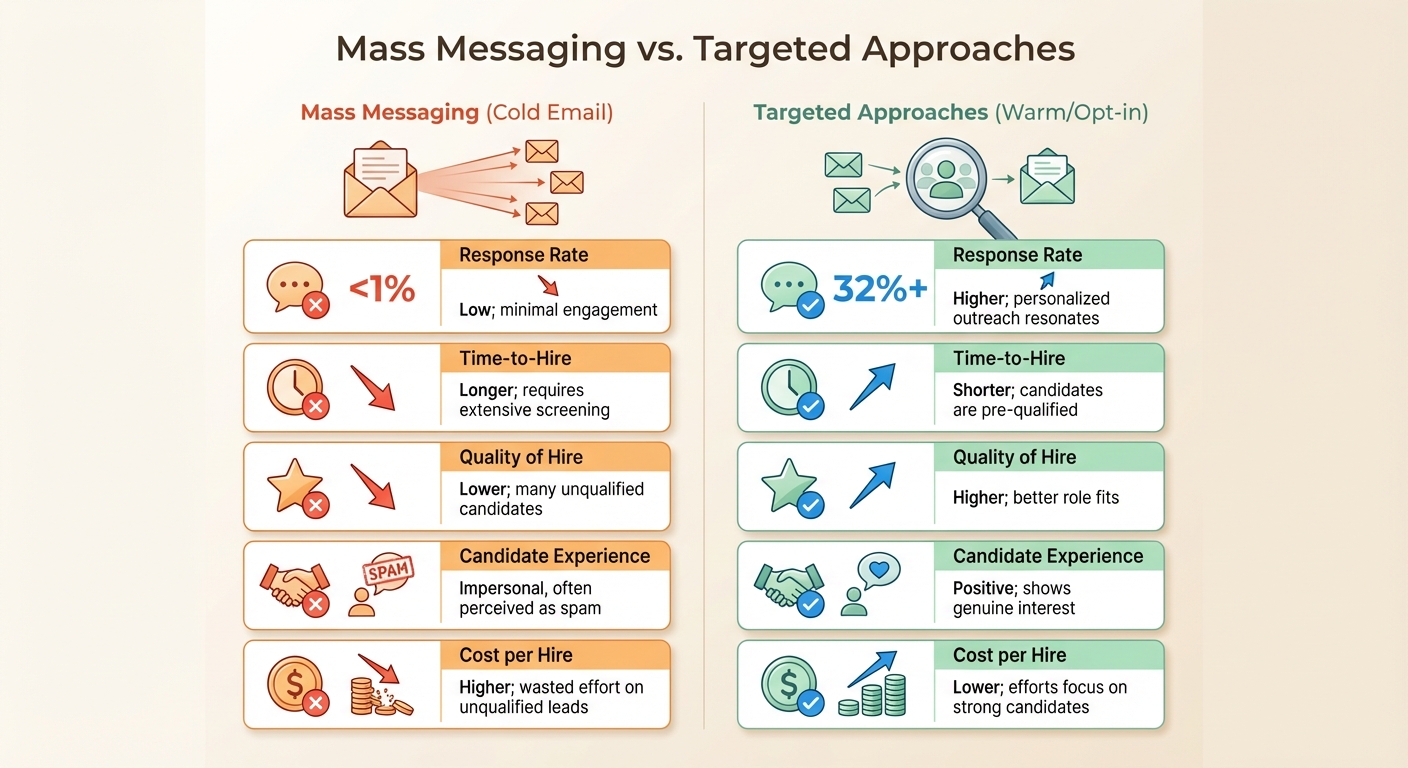 {Mass Messaging vs Targeted Hiring: Key Metrics Comparison}
Tracking the right metrics is crucial for understanding what’s working in your hiring process and what needs adjustment. Without solid data, hiring decisions can feel like guesswork. Start by focusing on metrics like response rate (how many developers respond to your outreach), time-to-hire (the days from initial contact to offer acceptance), and quality of hire (how well new hires perform in their first few months). These metrics can reveal whether a personalized, targeted approach is bringing in better candidates more efficiently than generic, broad outreach. Let’s take a closer look at these key measures.
Track Key Recruitment Metrics
The following metrics highlight the importance of precise, personalized outreach in today’s competitive hiring market:
- Response rate: High response rates suggest your messaging is resonating with candidates.
- Time-to-hire: A shorter timeline means you’re securing top talent before they move on to other opportunities.
- Quality of hire: Measure this through performance reviews and feedback on how well new hires fit the role.
Beyond these, it’s also worth tracking candidate feedback post-interview and offer acceptance rates. If you notice candidates declining offers, it could signal issues with compensation, lengthy interview processes, or unclear communication. Use this feedback to refine your strategy and remove bottlenecks.
Comparison: Mass Messaging vs. Targeted Approaches
When you compare mass messaging with targeted hiring, the benefits of a personalized approach stand out. Mass messaging relies on sending hundreds of generic emails, hoping a few will land. In contrast, targeted outreach focuses on quality by engaging with pre-qualified candidates who are genuinely interested. Here's how the two approaches stack up:
| Metric | Mass Messaging (Cold Email) | Targeted Approaches (Warm/Opt-in) |
|---|---|---|
| Response Rate | Low; minimal engagement | Higher; personalized outreach resonates |
| Time-to-Hire | Longer; requires extensive screening | Shorter; candidates are pre-qualified |
| Quality of Hire | Lower; many unqualified candidates | Higher; better role fits |
| Candidate Experience | Impersonal, often perceived as spam | Positive; shows genuine interest |
| Cost per Hire | Higher; wasted effort on unqualified leads | Lower; efforts focus on strong candidates |
Targeted hiring not only improves the quality of your candidates but also reduces time-to-hire and enhances the overall candidate experience. These benefits lead to a more efficient process with lower costs. Use these metrics to assess your current strategy and identify where a personalized approach can replace ineffective mass messaging.
Conclusion
Finding top engineering talent works best when you skip the mass emails and focus on personalized outreach. This not only shows you understand developers' needs but also respects their time. While generic cold emails often see less than 1% response rates, targeted strategies can achieve reply rates exceeding 32% .
Platforms like daily.dev Recruiter make a huge difference by connecting you with developers in the spaces they already frequent. The double opt-in method ensures you're engaging with genuinely interested candidates, cutting down on ghosting. Instead of relying on outdated resumes, you access active engineers with real-time insights .
Switching to targeted hiring builds trust and delivers better results. Developers are inundated with generic messages, so standing out means offering more than just another job posting. Thoughtful, value-driven outreach combined with developer-focused platforms creates a hiring process that respects candidates and achieves stronger outcomes.
This approach doesn’t just improve response rates - it also shortens time-to-hire and enhances candidate quality. Over time, these benefits make your recruitment process more efficient and cost-effective. By blending personalized outreach with niche sourcing, every step of your hiring process strengthens authentic connections with developers.
FAQs
How does personalized messaging help attract software engineers?
Personalized messaging is a powerful way to connect with software engineers. When you reference specific projects they've worked on, technologies they're skilled in, or achievements they've earned, it shows you've done your homework. This approach not only grabs their attention but also builds trust by demonstrating genuine interest in their unique background.
Another key factor? Transparency. Including essential details like salary ranges, the tech stack they'll be working with, and whether the role is remote, hybrid, or on-site can make your outreach far more compelling. Developers value clarity and relevance, so providing this information upfront increases the chances of a positive response.
How can niche developer platforms help you recruit top software engineers?
Niche developer platforms offer a powerful way to connect with top-tier software engineers by tapping into communities where highly skilled and often passive candidates are already active. These spaces attract developers who are deeply involved in their work - whether through contributing to projects, engaging in technical discussions, or sharing their expertise.
When recruiters genuinely participate in these coding communities, open-source platforms, or technical forums, they can build trust and establish meaningful relationships. This approach not only boosts response rates but also creates a better experience for candidates, helping you stand out in a competitive hiring landscape. These platforms enable more focused recruitment efforts, steering clear of the inefficiency of generic mass outreach.
Why is it important to define your ideal software engineer profile before reaching out?
Defining your ideal software engineer profile before reaching out is key to creating tailored and impactful communication. When you pinpoint the exact skills, interests, and experience you need, you can craft messages that genuinely connect with candidates.
This focused strategy does more than just boost response rates - it shows candidates that you're sincerely interested in them. That authenticity helps build trust and lays the foundation for positive interactions. By taking the time to outline your ideal profile, you ensure your outreach is directed at the right people with the right message, steering clear of the generic, impersonal messages that often come across as spam.
.png)