Passive candidates - those not actively job hunting but open to opportunities - make up 70% of the talent pool. They often prefer roles offering technical challenges, growth, or better team dynamics. Cold emails, however, aren't effective for engaging these candidates, who often ignore job postings and generic outreach, with response rates as low as 3–5%. Instead, focus on strategies that build trust and respect their time, such as:
- Developer Communities: Engage candidates on platforms like daily.dev where they already spend time.
- Double Opt-In Introductions: Use systems where candidates signal interest before connecting.
- Employee Referrals: Leverage team networks for warm introductions, leading to 25–40% response rates.
- Content Sharing: Share technical blogs, insights, and updates regularly to stay on their radar.
- Niche Platforms: Use GitHub and Stack Overflow to identify skilled developers based on their activity.
These methods not only improve response rates (up to 30–45%) but also help build lasting relationships, leading to better retention and quality hires. Modern recruitment is about creating meaningful connections, not spamming inboxes.
::: @figure 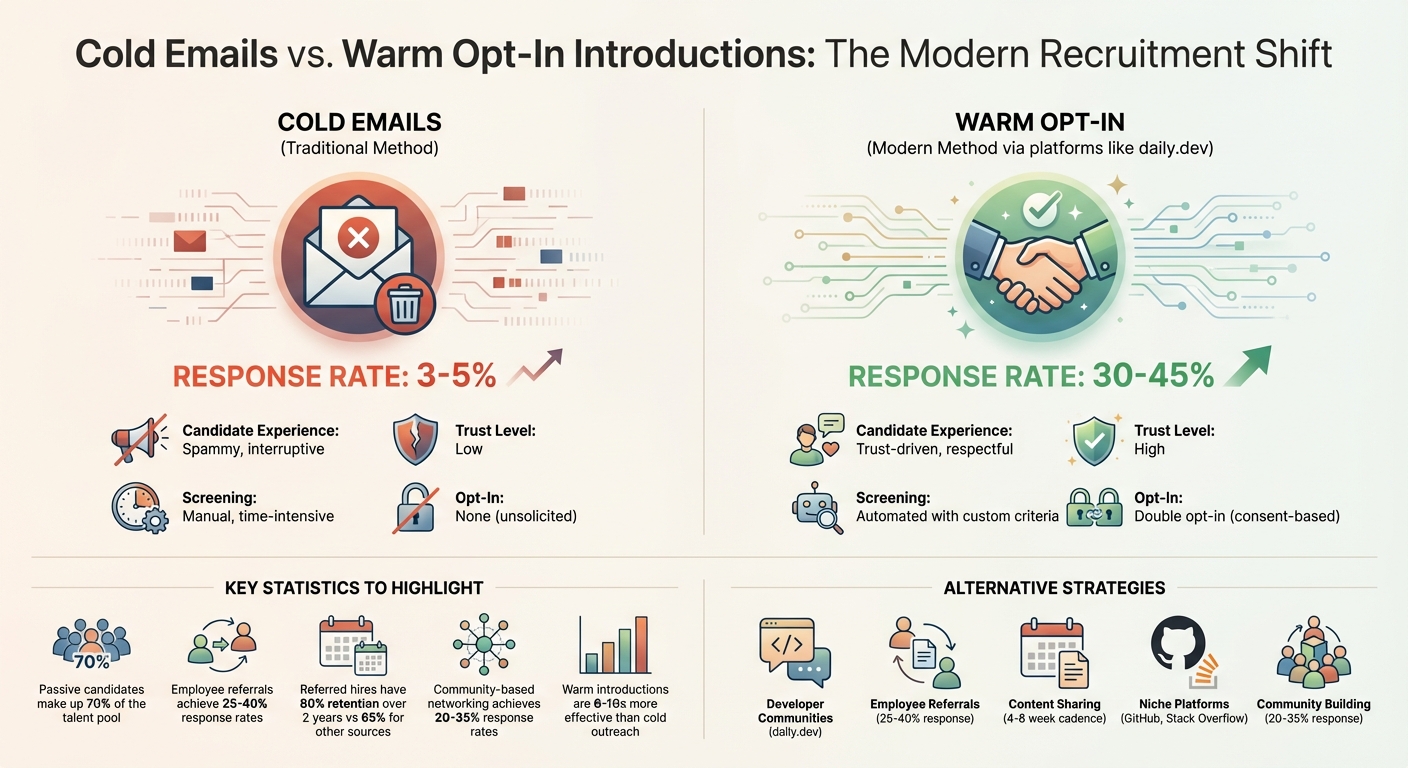 {Cold Emails vs Warm Opt-In Recruitment: Response Rates and Effectiveness Comparison}
Connect Through Developer Communities Like daily.dev
Connecting with developers through trusted communities like daily.dev offers a smarter way to engage potential candidates compared to traditional cold emails. Instead of interrupting their day with unsolicited messages, you meet developers where they naturally spend their time - reading technical articles, exploring new tools, and staying updated on industry trends. This approach integrates job opportunities into their routine in a way that feels organic, not intrusive.
The game-changer here is consent. Every interaction begins with a mutual interest. In fact, response rates for this method can be six to ten times higher than cold outreach. Why? Because developers aren’t against new opportunities - they’re against wasting time on irrelevant or poorly presented ones.
By engaging in these communities, you can connect with developers based on their actual interests and activities. This precision ensures you’re reaching the right people who are more likely to align with your hiring needs. Next, we’ll look at how leveraging employee networks can further boost your ability to connect with engaged developers.
Use Double Opt-In to Build Trust
Double opt-in systems are a powerful way to build trust and avoid the spammy tactics that can harm your employer brand. Platforms like daily.dev use this approach, requiring developers to explicitly show interest in your role before you can contact them. When a developer opts in, they’re signaling genuine curiosity - not just passively accepting a random connection request. This creates a recruitment process based on respect and mutual interest, rather than interruption.
Developers who might ignore recruiters on professional networks are more likely to engage on platforms they already trust for their career growth. Plus, this warm introduction approach saves time. Since you’re only speaking with candidates who are pre-qualified and genuinely interested, there’s less need for lengthy screening calls.
Target Candidates by Skills and Role Requirements
Consent-based engagement is just the start; precise targeting takes it to the next level. To reach the right candidates, you need to define exactly what skills and experience matter for your role. Focus on the technologies and tools developers use regularly - not just trendy buzzwords. On daily.dev, you can use advanced filters similar to Boolean searches, allowing you to target candidates based on their engagement with specific technical content.
But targeting alone isn’t enough. Add value to the community first. Participate in AMAs, share insights, or offer previews of open roles. By contributing to the community, you build credibility and trust. When you finally reach out about opportunities, developers will already recognize your company as a genuine part of the ecosystem - not just another recruiter looking to fill a position.
Hiring engineers?
Connect with developers where they actually hang out. No cold outreach, just real conversations.
Use Referrals and Employee Networks
Once you've tapped into trusted developer communities, the next step is to leverage your employees' networks for warm, genuine introductions. These referrals can complement other outreach strategies and significantly improve your hiring success.
Your team likely knows skilled developers who might be open to new opportunities. By making the referral process simple, you can unlock these connections. Referrals are effective because they come with built-in trust. When a developer hears about a role from someone they know - like a former colleague or peer - they're much more likely to respond. In fact, response rates for referrals range from 25% to 40%, compared to just 3% to 5% for cold outreach.
To keep things moving smoothly, simplify the process. Ask employees for basic details, like a name and contact information, and let your recruiting team handle the rest. Avoid long forms that might discourage participation. Internally, highlight specific developer roles that are hard to fill and explain why these positions are important to the company's goals. When employees see the bigger picture, they’re more inclined to recommend strong candidates. Streamlining how referrals are processed also encourages employees to stay engaged.
Timing is critical. Reach out to referred candidates within a few days; delays can harm both your company’s reputation and the credibility of the referring employee. Automate parts of the process with tools like Zapier to capture candidate details and notify your recruiting team in Slack. Applicant tracking systems (ATS) like Lever or Greenhouse can tag referred candidates and keep track of their interactions, ensuring you have a strong pipeline for future opportunities - even if the timing isn’t perfect right now.
Make sure your team is trained to spot candidates who align with your technical needs and company culture. To encourage referrals, consider offering non-monetary rewards like public recognition, charitable donations in the referrer’s name, or even unique perks like travel opportunities. Additionally, provide employees with LinkedIn templates to share their work experiences. These posts give potential candidates a behind-the-scenes look at your company, which can naturally attract passive talent. Referred hires often stay longer, too - retention rates for referrals hover around 80% over two years, compared to 65% for other hiring sources.
Build Talent Pipelines with Content Sharing
Once you've tapped into employee networks, the next step is to establish lasting connections through strong talent pipelines.
Most passive developers won’t respond to random outreach. Instead, focus on consistent content sharing alongside your community and referral efforts. By sharing useful and engaging content regularly, you can nurture relationships and stay on their radar over time.
Consistency is the secret sauce here. Share technical blogs, industry updates, or career advice every 4–8 weeks. This keeps your company visible without overwhelming potential candidates. Over time, this steady engagement builds trust and positions your company as a go-to resource. When a job opportunity arises, developers will already be familiar with your brand and values, making them more likely to engage.
Share Content That Developers Actually Want
Developers are quick to tune out anything that feels overly promotional. What grabs their attention? Content that helps them solve problems or grow their expertise.
For example, technical blogs explaining how your team tackled real-world challenges - like scaling a microservices architecture or fine-tuning distributed systems - can showcase your team's skills while providing value. Highlighting open-source contributions or offering behind-the-scenes looks at your team’s workflow can also resonate.
To amplify the impact, create shareable content kits with visuals, videos, and social media posts. When your engineering team shares this content, it feels more authentic and less like a pitch from HR.
Newsletters are another great way to engage developers over the long term. Include industry trends, original research, or tips for mastering new technologies. The goal is to provide something they’ll look forward to reading.
Track Passive Candidates with Your ATS
Content sharing is just one piece of the puzzle. To make the most of these efforts, you need to track engagement and stay ready to act when the time is right.
Your applicant tracking system (ATS) should go beyond managing active candidates. Use it to log interactions, monitor technical interests, and track updates like promotions or completed projects. These insights make it easier to reconnect when a developer’s situation changes.
Pair your ATS with CRM strategies to revisit talent pools, such as former applicants or even alumni of your company. This ensures you don’t lose track of promising candidates over time. By maintaining this organized approach, you’ll be ready to act quickly when the right opportunity arises.
Find Developers on Niche Platforms
Platforms like GitHub and Stack Overflow offer a unique window into what developers actually do, rather than what they claim on a resume. By reviewing code quality, problem-solving approaches, and technical interests in real time, you can identify skilled candidates - especially those who might not be actively applying for jobs.
Instead of sticking to basic keyword searches, focus on developers who are actively contributing. Look for recent activity, meaningful projects, and engagement patterns that highlight genuine expertise. This method helps you zero in on developers who are not just skilled but also actively honing their craft.
Use Boolean Searches for Skills-Based Targeting
Boolean searches are a powerful way to find developers with the exact skills you’re after. Start with operators like site:github.com combined with specific programming languages or role-related keywords. To avoid clutter from job postings, include exclusion terms like -job -jobs -hiring in your search.
For GitHub, you can refine your search further using qualifiers like pushed:>YYYY-MM-DD to locate developers with recent activity. You can also target file types by including terms like inurl:resume or inurl:CV to uncover digital portfolios.
Pay attention to metrics that signal top-tier talent. For example:
- 500+ stars on key repositories reflect industry recognition.
- 50+ pull requests in the past year show consistent contributions.
- 1,000+ followers indicate influence within the developer community.
- 100+ forks suggest practical utility of their projects.
- A polished and professional README highlights strong communication skills.
Once you’ve built a refined list of candidates, you can move on to screening them for technical expertise.
Screen Candidates with daily.dev
After narrowing your search with Boolean techniques, validate your candidates using daily.dev’s screening tools. The platform’s double opt-in process ensures that candidates review your job description and confirm their interest before you reach out. This ensures you’re only connecting with developers who are genuinely interested in your role.
With daily.dev Recruiter, you can set up to three custom screening questions to evaluate candidates on specific technical skills - such as React 18 proficiency or experience with distributed systems - before any direct conversations. This saves time and ensures better matches. With access to a global community of over 1 million developers, you can target individuals based on what they’re currently learning or working on, rather than relying on outdated resume keywords.
Build Developer Communities for Long-Term Engagement
Instead of relying solely on cold emails, consider building a developer community to create lasting and meaningful connections. Hosting regular webinars with your engineering team, leading technical roundtables, or setting up Slack and Discord channels focused on specific technologies can position your company as more than just a potential employer - it becomes a trusted resource. Developers who engage in these communities gain insight into your technical challenges and company culture, fostering a deeper connection. This strategy naturally complements consistent, value-driven content.
Shift the focus from simply posting jobs to offering genuine value. Share original research, provide short training modules on emerging technologies, or organize discussion groups where developers can tackle real-world problems together. For instance, hosting a webinar about solving a complex distributed systems challenge can highlight your team’s expertise without coming across as overly promotional. This resonates particularly well with passive candidates, who make up approximately 70% of the talent pool and are often the most high-performing individuals . These candidates gravitate toward organizations that actively contribute to the broader developer ecosystem.
Extend your reach by leveraging employee advocacy. Equip your team with content kits that include short videos showcasing team activities, graphics summarizing project milestones, and customizable social media posts . When your developers authentically share their work on platforms like GitHub or in technical subreddits, they build credibility far beyond traditional recruitment methods. Offering workshops to help employees enhance their personal brand can also turn them into natural advocates for your company . By tracking and measuring these engagements, you can ensure your community evolves into a reliable talent pipeline.
To gauge the health of your community, monitor metrics like the number of qualified passive candidates in your pipeline, engagement levels at events, and the speed at which community members transition from initial interaction to application . Community-based networking consistently outperforms traditional outreach, with events and conferences often achieving a 20–35% response rate .
Think of community building as a long-term investment. Allocate 1–3 months for creating awareness, 3–6 months for fostering deeper connections through events, and over 6 months to nurture relationships until candidates are ready to align with your open roles . This patient approach builds a pipeline of developers who not only know your company but also trust its technical leadership.
Write Job Briefs That Developers Want to Read
To connect with developers effectively, your job brief needs to resonate with their skills and ambitions. It's all about creating trust and showing you understand their world.
Developers can easily spot generic job descriptions, and they’re not impressed. Instead, focus on the real impact of the role. For example, instead of saying "improve system performance", describe the challenge: "architect a real-time payment system capable of processing $100M daily" . Specifics like this grab attention and show you value their expertise.
Transparency matters, especially when it comes to compensation. Passive candidates expect clear details about salary and equity . Keep in mind, they’re often looking for a 10–20% increase to leave their current position . If you’re vague, they’ll move on.
Stick to the most relevant qualifications. Overloading job briefs with endless requirements can drive candidates away . And don’t underestimate the power of a personalized subject line. Mentioning specific projects or achievements can make a big difference in engagement .
When it comes to calls to action, keep it simple. Offer candidates something low-pressure, like a detailed technical brief or a slide deck they can review at their own pace . Timing is also key - approaching candidates during career milestones, such as leadership changes or the completion of major projects, can make your pitch far more appealing .
Cold Emails vs. Warm Opt-In Introductions
| Aspect | Cold Emails | Warm Opt-In (daily.dev) |
|---|---|---|
| Response Rate | Low | High |
| Candidate Experience | Spammy | Trust-driven |
| Screening | Manual | Custom criteria |
| Opt-In | None | Double |
This approach highlights the shift from impersonal cold emails to building trust through warm, meaningful engagement. It’s not just about finding passive developer candidates - it’s about making them want to say yes.
Conclusion
Modern recruitment is no longer about sending out cold emails and hoping for a response. Instead, it’s about building trust, fostering community, and using targeted outreach to connect with developers in a meaningful way. Cold emails often fall flat with passive developers, who are more likely to ignore generic messages. Successful recruiters focus on creating value through community engagement, referral programs, and sharing content that resonates.
Most talented developers are passive candidates . They’re not actively job hunting but are open to the right opportunity. This means your outreach needs to feel genuine and conversational, not like a sales pitch. Platforms like daily.dev make this easier by enabling warm, double opt-in introductions that respect developers’ time and preferences. To put it into perspective: while cold LinkedIn InMail boasts a 3–5% response rate, warm, double opt-in methods can achieve 30–45% .
The benefits of this approach go beyond just higher response rates. Passive candidates tend to make thoughtful career decisions, leading to better retention rates . Companies that reallocate budgets from traditional cold outreach to referral programs and community-driven efforts often see quicker hiring cycles and higher-quality candidates .
By consistently engaging with communities and sharing meaningful content, you can transform recruitment from a one-off transaction into an ongoing conversation. This approach not only draws talent to you but also creates a better experience for candidates. It’s a smarter, more sustainable way to recruit, helping you build a talent pipeline that lasts.
Recruitment is evolving. The winners in 2026 will be those who prioritize relationships over quick, impersonal reach-outs. Investing in trust and community today sets the stage for long-term success tomorrow.
FAQs
How do I start warm outreach without cold emails?
To kick off warm outreach, start by establishing trust through shared connections and active participation in developer communities. Platforms like GitHub and Stack Overflow are great places to engage, along with attending industry events or tapping into employee referrals for trusted introductions.
Make sure to clearly define the roles you're targeting, pre-qualify candidates, and focus on nurturing relationships. You can do this by sharing relevant content or technical insights that resonate with their interests. This method builds credibility and often leads to more open and productive conversations than jumping straight into cold outreach.
What should I post to attract passive developers?
To connect with passive developers, focus on sharing personalized content that showcases your company’s culture and offers immediate value. Include specifics like salary ranges and the tech stack to make your outreach more relevant. Participate actively in developer communities to build trust and establish credibility. The key is to prioritize genuine connections over one-size-fits-all outreach approaches.
How do I track passive candidate interest over time?
Tracking the interest of passive candidates involves paying close attention to their behavioral signals on platforms like GitHub and LinkedIn. For instance, monitoring their activity - such as profile updates, engagement with posts, or contributions to online communities - can provide valuable clues about their openness to new opportunities.
Using tools powered by AI can make this process more efficient. These tools can analyze metrics like interaction frequency, community participation, or even subtle response patterns. By regularly reviewing these insights, you can adjust your outreach strategy and maintain meaningful engagement with passive talent over time. This approach ensures you're ready to connect when they're most receptive.
.png)