Hiring the wrong person is expensive. A bad hire can cost up to 30% of their first-year earnings, with technical roles averaging losses of $33,251. For senior developers, the cost can skyrocket to $300,000, factoring in productivity losses and team disruptions. Beyond finances, bad hires slow team velocity by 35%, delay project timelines by 6-8 weeks, and drop client satisfaction scores by 25%.
The solution? Focus on candidate intent early in the hiring process. Intent reveals not just what a candidate can do, but what they want to do. Companies that assess intent alongside skills are 4x more likely to identify top performers. This approach reduces bad hires, improves retention, and builds teams aligned with your goals.
Key Takeaways:
- Intent vs. Qualifications: Skills show ability, but intent shows motivation and alignment.
- Practical Techniques: Use intent-focused screening questions, structured interviews, and developer assessment tools.
- Metrics to Track: Measure quality of hire, offer acceptance rates, and early turnover to refine your process.
By qualifying intent upfront, you can save time, reduce costs, and hire candidates who contribute meaningfully to your team.
::: @figure 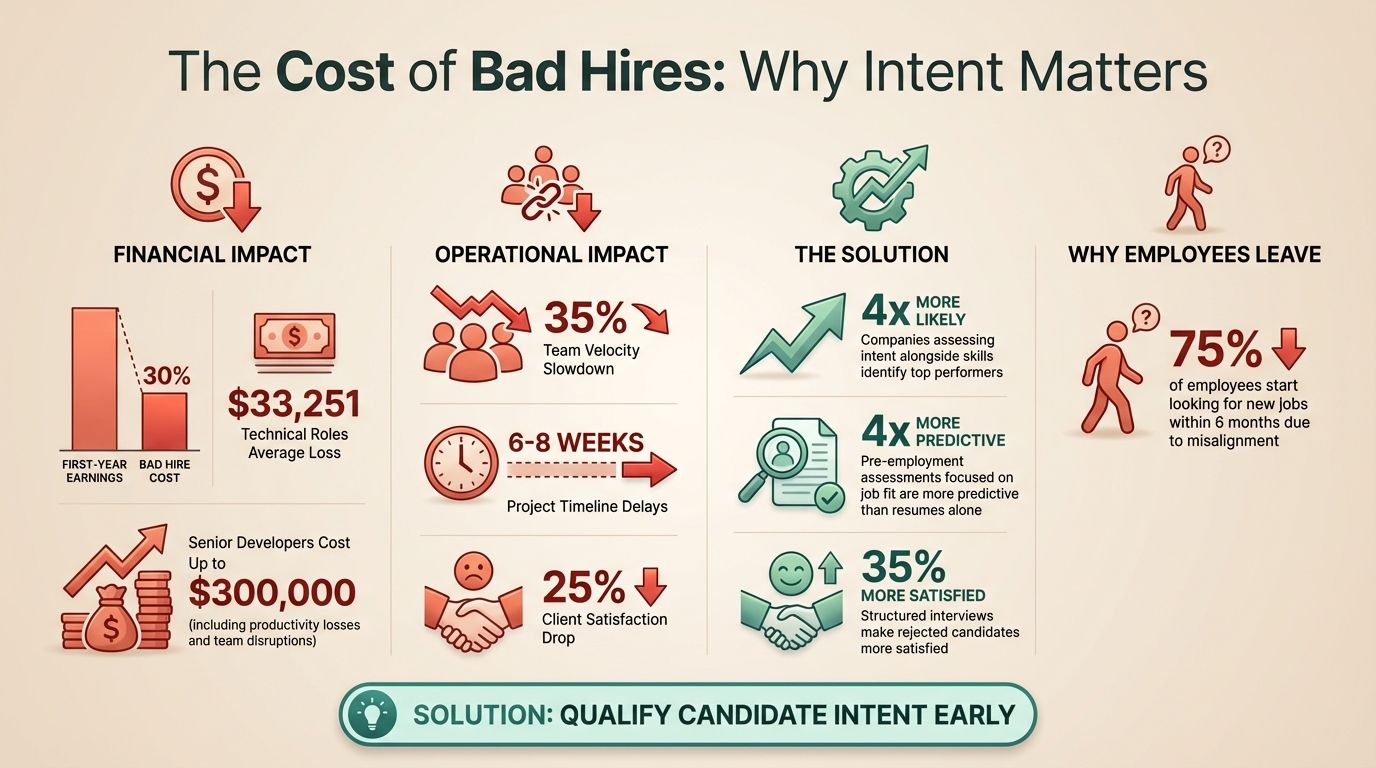 {The True Cost of Bad Hires in Tech: Key Statistics and Impact Metrics}
What Is Candidate Intent in Developer Recruitment
Candidate intent refers to a developer's genuine motivation to pursue a specific role. It separates those who are actively interested in your opportunity from those who are merely exploring options. In developer recruitment - where top talent often juggles multiple offers - understanding intent helps pinpoint candidates who are likely to thrive in your environment rather than leave shortly after joining. This understanding is key to seeing how intent complements qualifications.
Intent isn’t just about enthusiasm; it’s about intrinsic motivation - the drive to tackle the day-to-day responsibilities of the role. For instance, a candidate might connect with your company’s mission but hesitate when it comes to the routine tasks involved. This type of misalignment is a common reason why 75% of employees start looking for new jobs within six months .
Qualification vs. Intent: Understanding the Difference
Here’s a simple breakdown: Qualifications prove a candidate’s ability ("can do"), while intent reveals their desire ("wants to do") to take on the specific challenges of your role. As John Vlastelica from Recruiting Toolbox explains:
"Has done or can do is not the same as wants to do. I had to is not the same as I got to" .
Top performers usually combine strong qualifications with genuine motivation. Pay attention to how candidates describe their past experiences. Do they talk about projects as opportunities they "got to" work on, or do they frame them as tasks they "had to" complete? These subtle linguistic cues can provide insight into whether a candidate’s motivation aligns with the realities of the job.
Common Challenges When Identifying Intent
One major hurdle is separating genuine interest from surface-level enthusiasm. Developers often engage with 10–15 companies at the same time, making it tricky to discern their true priorities . During interviews, you might encounter generic answers or a focus on salary and perks, rather than a clear explanation of why they’re drawn to your role.
Another challenge is dealing with passive interest. These candidates apply broadly without fully understanding your company’s products, team dynamics, or technical stack. They might not mention specific departments, recent product updates, or shared values during early conversations. On the other hand, candidates with strong intent tend to ask thoughtful questions about how they can succeed and grow within your organization. Spotting these subtle differences early on is critical to aligning their motivations with the role’s demands, ultimately reducing the chances of a bad hire.
Practical Techniques to Qualify Candidate Intent
Once you’ve got a handle on identifying candidate intent, the next step is integrating practical techniques into your screening process. These methods help you distinguish between genuinely motivated candidates and those who are just exploring options.
Ask Intent-Focused Screening Questions
Some questions can uncover a candidate’s motivation in ways a résumé never could. To avoid overwhelming candidates, limit your initial screening to three key questions . Start with deal-breakers like work authorization, willingness to relocate, or availability timelines .
From there, shift focus to motivation and alignment. For example, ask: “What attracted you to our company and this role specifically?” This reveals whether they’ve done their homework. Another great question is: “Where do you see your career in five years, and how does this role fit?” to gauge long-term alignment . For technical roles, try: “What technical decision are you most proud of, and why?” to uncover their thought process and pride in their work .
Avoid asking for details already visible on their profile, such as years of experience or language skills. Instead, ask for context that résumés rarely provide. For instance, instead of “Do you have experience with distributed systems?” go with “Describe a recent technical challenge you solved using distributed systems.” This approach allows candidates to showcase their expertise more meaningfully .
A real-world example: In 2025, Livestorm introduced pre-screening tools with tailored questions at the very first step of their hiring process. This move cut their average time-to-hire from 60 days to just 25 .
To make comparisons between candidates easier and reduce bias, use a 1–5 scoring rubric to evaluate answers . The OARS method - Open-ended questions, Affirmations, Reflective listening, and Summarizing - can also help candidates open up about their motivations and ethics . These focused questions pave the way for deeper behavioral assessments later on.
Recognize Behavioral Signs of Strong Intent
Pay attention to how candidates talk about their past projects. Those with high intrinsic motivation often frame their experiences as opportunities (e.g., “I got to rebuild our authentication system”) rather than obligations (e.g., “I had to fix the login flow”) .
Another key indicator is the nature of their questions. Candidates who ask about challenging or repetitive aspects of the job show a deeper understanding of the role, rather than just focusing on the high-level mission or perks . Transparency is another clue - ask where your role ranks among their current opportunities. If it’s not high on their list, they might lack clarity about their priorities . On the flip side, candidates who are genuinely interested will often share their timeline and explain why your role stands out. Once these behavioral signals are identified, structured interviews can further solidify your evaluation.
Use Structured Interviews to Assess Intent
Structured interviews create consistency, making it easier to assess intent. Dr. Melissa Harrell from Google People Analytics emphasizes their value:
"Structured interviews are one of the best tools we have to identify the strongest job candidates (i.e., predictive validity). Not only that, they avoid the pitfalls of some of the other common methods."
Research shows that structured interviews are twice as effective as unstructured ones at predicting job performance, saving about 40 minutes per interview .
Start by determining the core competencies you’re hiring for - such as problem-solving, adaptability, or teamwork - and then draft questions that align with these needs . Combine behavioral questions (focused on past actions) with hypothetical ones (focused on future responses) to get a full picture . Train interviewers to listen for STAR-based behavioral questions and answers - Situation, Task, Action, and Result - for objective evaluation .
Use a standardized 1–5 scoring system to rate answers, and hold calibration sessions where multiple interviewers score the same candidate to ensure consistency and reduce individual bias . Detailed feedback is essential, as it helps hiring committees make decisions based on data rather than intuition . Interestingly, rejected candidates who undergo structured interviews report being 35% more satisfied with their experience compared to those who don’t .
Tools and Processes for Intent Qualification
Modern tools and workflows make it easier to identify genuine interest early in the hiring process, saving time and effort before committing to lengthy interviews.
How Assessment Platforms Screen for Intent
Coding test platforms that assess candidates through project-based tasks provide a clear picture of both their skills and their commitment to the role. This approach moves beyond relying on résumés or gut feelings. For instance, Qualified.io replicates real-world job tasks, offering a strong signal of a candidate’s abilities and dedication. Companies like Apple, GE, and Andela trust this method, which has been honed by the participation of 1.2 million developers in the Codewars community .
The trick is to collect meaningful data without overwhelming candidates. Keep initial coding tasks to about 30 minutes and limit in-depth projects to no more than 3 hours . Tools like live pair-programming sessions and code playback allow you to observe problem-solving skills and communication in real-time. Additionally, blind reviews - where identifying details are removed - ensure that evaluations are based purely on skill and effort, minimizing unconscious bias .
Another example is daily.dev Recruiter, which focuses on clear intent signals. By using double opt-in introductions, you connect only with developers who have actively shown interest in your job. This eliminates cold outreach and ensures every conversation starts with mutual engagement. The platform also provides detailed developer profiles and consent-based matching, fostering trust and making intent a core part of the initial interaction.
These tools and methods create a foundation for a transparent and efficient screening process, allowing you to refine candidate selection based on genuine intent.
Design a Clear Screening Workflow
With strong intent signals from assessment tools, you can design a workflow that encourages candidates to self-qualify. Start by using AI to generate screening questions tailored to your job description, then fine-tune them to address critical factors like work authorization, relocation preferences, or specific experience in your domain . Keep it simple - limit these questions to three maximum, and ensure candidates can answer them in just a few sentences .
Clarity is key. When candidates know exactly what to expect at each stage, they’re more likely to stay engaged. A transparent process also helps them determine early on if the role aligns with their goals, reducing drop-offs later in the hiring funnel. A streamlined and straightforward workflow ensures that only high-intent candidates progress to the final stages, cutting down on the risk of bad hires.
Measure and Improve Your Intent Qualification Strategy
Once you've implemented an intent-based screening process, the next step is to track its performance using a data-driven recruitment checklist. One of the most reliable ways to do this is by measuring Quality of Hire (QoH). You can gather this data by surveying hiring managers at 30, 60, and 90 days after a new hire's onboarding . These regular check-ins provide valuable insights into whether your process is identifying candidates who not only perform well but also stay engaged. Positive feedback from hiring managers is a strong signal that your strategy is on the right track .
To get a more complete view, pair QoH data with other key metrics like offer acceptance rates and first-year turnover rates. A high offer acceptance rate suggests that the role aligns with a candidate's motivations, while low early turnover indicates that your screening process is effectively weeding out poor fits. Additionally, compare "Time to Achieve" (TTA) - the expected time for a new hire to reach full productivity - with "Actual Time to Achieve" (ATTA) to evaluate how quickly high-intent hires are meeting productivity goals .
"The criteria you use to evaluate candidates in the interview process must be tightly linked to how you evaluate their performance once they're through the door."
- Steve O'Halloran, Talent Acquisition Lead, Embeddable
Use these insights to fine-tune your approach. For example, if certain interviewers or sourcing channels consistently lead to lower QoH scores, consider revising the assessment criteria for those sources . Similarly, if take-home assignments have low completion rates, the tasks might be too time-consuming or fail to capture candidates' interest. Aim for assignments that take 2–4 hours to complete . Standardize feedback intervals to ensure consistent data collection, and segment surveys by department to uncover role-specific trends in intent markers .
Over time, you can refine your scoring system by correlating initial intent scores with job performance data collected 6–12 months later. This will help you identify the factors that truly predict long-term success and further optimize your intent qualification strategy .
Conclusion
Identifying candidate intent early is a smart way to avoid the steep costs of a bad hire. With the average failed technical hire costing $33,251 and taking 50% longer to replace than other roles, the risks are hard to ignore . Shifting from a resume-only approach to intent-based methods - like tailored applications and structured assessments - creates a hiring process that respects both your time and the candidate’s effort.
The numbers tell the story: pre-employment assessments focused on job fit are 4x more predictive of success than resumes alone . Structured interviews not only reduce gut-instinct biases but also leave rejected candidates 35% more satisfied with their experience . These changes lead to quicker hiring, stronger retention rates, and teams that hit the ground running. All of this underscores the importance of a recruitment process built on trust and data.
Structured interviews don’t just improve predictive accuracy - they also remove bias, making your hiring process more efficient and fair.
A trust-driven recruitment process is rooted in respect. Using work samples that reflect real tasks, keeping assessments within reasonable time limits, and applying consistent evaluation criteria shows candidates you value fairness and transparency. Developers notice this - and they respond by fully engaging in the process.
FAQs
How can you evaluate a candidate's intent early in the hiring process?
Evaluating a candidate's intent early in the hiring process requires a mix of careful observation and thoughtful techniques to gauge their genuine interest and alignment with the role. Start by examining their application materials and any public work they’ve shared, like open-source projects or portfolio pieces. These can provide clues about their enthusiasm and the effort they’ve put into their craft.
During interviews, focus on asking behavioral and motivation-based questions. This helps uncover their reasons for applying and how their goals connect with your company’s mission. For instance, ask about specific projects they’ve admired or how they see themselves contributing to your team.
Using structured interviews with a consistent set of questions and clear scoring criteria can also help. This approach not only ensures fairness but makes it easier to compare candidates’ motivations without bias. Adding pre-employment assessments tailored to both behavioral traits and the specific demands of the role can further reveal a candidate’s drive and potential for long-term success.
By combining these strategies, you’ll identify candidates who bring not only the right skills but also a genuine commitment to growing with your organization.
What are the benefits of using structured interviews to evaluate a candidate's intent?
Structured interviews bring some solid benefits when it comes to evaluating a candidate's intent. By sticking to the same set of role-specific questions for every applicant, they promote fairness and consistency. This makes it easier to compare candidates side by side without letting personal biases or gut instincts cloud the decision-making process.
Another advantage is their focus on intent-driven factors such as motivation, genuine interest, and how well a candidate aligns with the role. This approach helps pinpoint individuals who aren't just qualified but are also excited about contributing to the company. The result? Better long-term hires, lower turnover rates, and employees who are more engaged in their work.
How can coding assessments help assess a candidate's genuine interest?
Coding assessments are an effective way to gauge a candidate's technical abilities and their enthusiasm for the role. Unlike resumes or standard interviews, these assessments present hands-on challenges that mirror actual job tasks, offering a glimpse into how candidates tackle problems and their overall engagement.
They also reveal a candidate's drive and effort. Delivering well-thought-out solutions or polished work samples often reflects dedication and a strong connection to the role. By weeding out candidates who may lack commitment or rely heavily on theoretical knowledge, coding assessments enable recruiters to zero in on those who are genuinely invested in the opportunity.
.png)