Hiring developers isn't just about finding technical skills - it’s about identifying intent. Intent shows a candidate’s genuine interest in your role, alignment with your mission, and commitment to growing with your company. Why is this important? Because nearly 44% of employees question their job choice within the first week, and companies face a 20% drop in attrition when they hire for intent alongside skills.
Here’s how to spot intent:
- Tailored Applications: Customized resumes and cover letters referencing your tech stack or challenges signal effort and interest.
- Public Contributions: GitHub activity, like polished projects and clear documentation, reflects dedication.
- Skills Match: Candidates with relevant expertise show they're ready to contribute immediately.
- Motivational Questions: Ask about career goals, past challenges, and alignment with your mission to gauge enthusiasm.
- Practical Assessments: Take-home projects and collaborative coding sessions reveal commitment and readiness.
Tools like daily.dev Recruiter streamline this process by connecting you with developers who actively show interest, using a double opt-in system to ensure mutual engagement. By focusing on intent, you can build a team that’s excited to tackle your challenges and stay for the long term. To optimize your workflow, consider performing a tech hiring stack audit to ensure your tools support this intent-driven approach.
Spotting Intent in Resumes and Applications
Candidate submissions go beyond simply listing past jobs - they can reveal genuine interest in your role. When applicants take the time to tailor their materials, it shows a clear commitment. Let’s explore the key signs that indicate this level of intent.
Customized Resumes and Cover Letters
A developer who tweaks their resume to highlight relevant projects and skills demonstrates they've put thought into aligning with your needs. Similarly, a cover letter that references your specific tech stack or a unique challenge your company faces shows they've done their research. Attention to detail matters too - emails with spelling and grammar errors are 26.3% less likely to get a response . This suggests that candidates who proofread and personalize their materials not only respect your time but are genuinely interested in the position.
Developer Platform Activity
A developer's public contributions can offer a window into their work ethic and passion. For example, targeted GitHub contributions, like well-maintained, high-star libraries or a portfolio that reflects steady growth, highlight problem-solving skills and dedication . One polished, widely used project often carries more weight than several incomplete ones. Clear and thorough README documentation is another strong indicator of a developer’s focus on maintainability and user experience .
Skills Matching Job Requirements
When a candidate’s technical expertise aligns closely with your job description, it’s a strong indicator of intent. Passive candidates - who make up 70% of the global workforce - are 17% less likely to require significant upskilling . Developers who already possess the necessary skills and choose to apply are signaling they’re ready to contribute right away. Additionally, metrics like a candidate’s Stack Overflow reputation can serve as a peer-validated measure of their technical knowledge and community involvement . Beyond resumes, these signals can be further explored during interviews to confirm their intent and readiness. You can also assess technical skills during interviews without relying solely on rigid coding tests.
Interview Questions That Reveal Motivation
Deep-dive interviews go beyond surface-level qualifications to uncover what truly drives a candidate. While technical skills are undeniably important, motivation often separates a good developer from a great one. In fact, 90% of hiring managers report difficulty finding candidates who balance technical expertise with soft skills like genuine enthusiasm . By asking the right questions, you can discover if a candidate’s passion aligns with your company’s goals, bridging the gap between what’s on their resume and their real-world potential.
Questions About Past Projects
Exploring a candidate's past projects offers a window into both their technical skills and their motivation. For example, asking why they selected a particular framework or architectural approach can reveal whether they’re driven by solving user problems and improving experiences - or if they simply followed instructions . Luis Minvielle from WeAreDevelopers explains:
"Traditional dev interviews focus on code and past projects. But that's just part of the story. It's their drive – their motivation – that sets a dev apart."
Discussing challenges they faced and how they overcame them is equally revealing. How do they handle tight deadlines or frustrating obstacles? Do they own their mistakes and demonstrate a commitment to learning from them? Great developers reflect on their missteps and look for ways to improve, showing they care about more than just completing tasks - they care about growth and delivering meaningful results . Another key insight is whether they understand the broader business impact of their work, indicating they’re invested in the company’s success, not just the technical aspects .
Beyond past experiences, understanding a candidate’s future goals can give you an even clearer picture of their motivation.
Career Goals and Company Alignment
Asking about a candidate’s five-year goals can help determine if they see your role as a meaningful step in their career journey. Questions like, “How do your aspirations align with our company’s mission?” can reveal whether they’ve done their homework and envision a long-term future with your organization . Similarly, asking which company values resonate with them can show if their personal ethics align with your corporate culture .
A particularly insightful question is the “gap analysis” - asking what they’re looking for in your role that was missing in their previous one. This helps you uncover their current motivators, whether it’s a desire for growth, a passion for innovation, or the need for stability . Software engineer Ofure Okoronkwo from RBC Royal Bank highlights the importance of showing initiative and results orientation during interviews:
"Let the hiring manager know that you have a history of bringing issues to your manager's attention quickly and push for things to get done. You should also let them know that you will do everything in your power to ensure the project progresses. Show that you're a results-oriented advocate."
Reasons for Changing Jobs
Understanding why a candidate is leaving their current role can provide valuable insight into their priorities. Are they motivated by higher salaries, new technical challenges, or a better work-life balance? Patterns in their answers can help you assess whether their goals align with what your company offers.
Using techniques like the OARS Method - Open-ended questions, Affirmations, Reflective listening, and Summarizing - can encourage candidates to share more candidly . For instance, if someone says, “I wanted new challenges,” you could respond with reflective listening: “So you felt limited by the legacy codebase and wanted to work with modern frameworks?” This approach not only builds rapport but also uncovers the underlying reasons behind their career decisions, helping you evaluate if they’re the right fit for your team.
Assessments That Show Commitment
After interviews give you a glimpse into a candidate's motivation, practical assessments can confirm their dedication. These assessments aren't just about testing technical skills - they reveal how ready candidates are to contribute in meaningful ways. Recent data highlights the importance of distinguishing between those casually exploring opportunities and those genuinely eager to join your team, often by utilizing coding-focused candidate sourcing tools.
Take-Home Projects
Practical assignments provide a reliable way to measure a candidate's commitment beyond verbal assurances. A well-designed take-home project should reflect actual challenges they might face in the role. Keep the tasks manageable - around 2–4 hours - and provide a starter repository to set clear expectations. Candidates who go above and beyond often showcase initiative, thoroughness, and attention to detail in their documentation.
Before assigning the project, have your in-house engineers complete it to ensure the time estimate is realistic. Ask candidates to include a README file that outlines their trade-offs and assumptions. This not only verifies the workload but also gives you a window into their decision-making process and their ability to communicate effectively .
Collaborative Coding Sessions
Live coding sessions are another powerful way to evaluate a candidate's intent and skills in action. Pair programming, for instance, allows you to observe how they communicate and adapt under pressure. Use a "driver" and "navigator" setup - one writes the code while the other reviews it - and switch roles frequently to assess flexibility. These sessions should last about 60–90 minutes and focus on practical scenarios, such as reviewing a pull request or adding a feature to existing code .
To make the experience realistic, let candidates use their preferred tools. The goal here isn't to test their memory but to evaluate how they communicate and collaborate. Isabelle Fahey, Head of Growth at Cloud Devs, puts it well:
A well-designed developer skills assessment is more than just a test; it's a preview of the collaborative and problem-solving environment a candidate can expect if they join your team. It should feel less like an interrogation and more like the first day on the job .
Use a standardized rubric to evaluate problem-solving approaches, communication clarity, and how candidates respond to feedback. Those who adapt quickly to suggestions and clearly explain their decisions demonstrate both technical expertise and a genuine interest in teamwork .
Video Responses
Video responses are a great way to gauge a candidate's enthusiasm and communication style. Ask them to explain past projects or how they would approach specific challenges. This format helps you assess their alignment with your team’s values and their ability to articulate a clear technical vision.
Frame your questions around motivation and team fit. For example, ask candidates to describe a work environment where they’ve thrived or what excites them most about your company’s mission. Together, these assessments form a well-rounded view of a candidate’s commitment and readiness to contribute .
Hiring engineers?
Connect with developers where they actually hang out. No cold outreach, just real conversations.
Using daily.dev Recruiter for Intent-Based Hiring

daily.dev Recruiter takes a fresh approach to recruitment by focusing on intent signals, connecting you with developers who are actively engaged and interested. Unlike traditional methods that rely on cold outreach and outdated candidate data, this platform puts you in touch with developers who are already signaling interest. Instead of wasting time on inactive profiles, you’ll be engaging with developers who are actively learning and growing in their professional journey.
Double Opt-In Connections
One standout feature is the double opt-in system, which ensures that both you and the developer agree to connect before any conversation begins. This eliminates the inefficiencies of cold outreach and improves response rates and guarantees that the interest is mutual. When a developer opts in, they’re actively expressing interest in your role, not just passively browsing. This upfront agreement saves time and allows you to focus on candidates who are genuinely engaged, setting the stage for more meaningful conversations.
Pre-Qualified Developer Network
Forget outdated databases and guesswork. With daily.dev Recruiter, you gain access to a network of developers who are actively interacting with the latest tech content. The platform tracks what developers are learning in real time, including their engagement with tutorials, articles, and open-source projects. For instance, if you’re hiring a React developer, you can identify candidates currently exploring React-related content - showing both their skills and their interest in that technology. This alignment between activity and intent ensures you’re connecting with candidates who are not only qualified but also enthusiastic about the role.
Custom Screening Filters
To make the hiring process even more targeted, the platform lets you define specific criteria through custom screening questions. Beyond the usual job requirements, you can set up to three key questions that candidates answer upfront. These questions help you identify must-have qualifications that might not appear on a resume, such as experience with a particular framework version, familiarity with your tech stack, or compatibility with your team’s workflow. Plus, it integrates seamlessly with your ATS, keeping your pipeline organized and free of duplicate entries.
Adding Intent Signals to Your Hiring Process
::: @figure 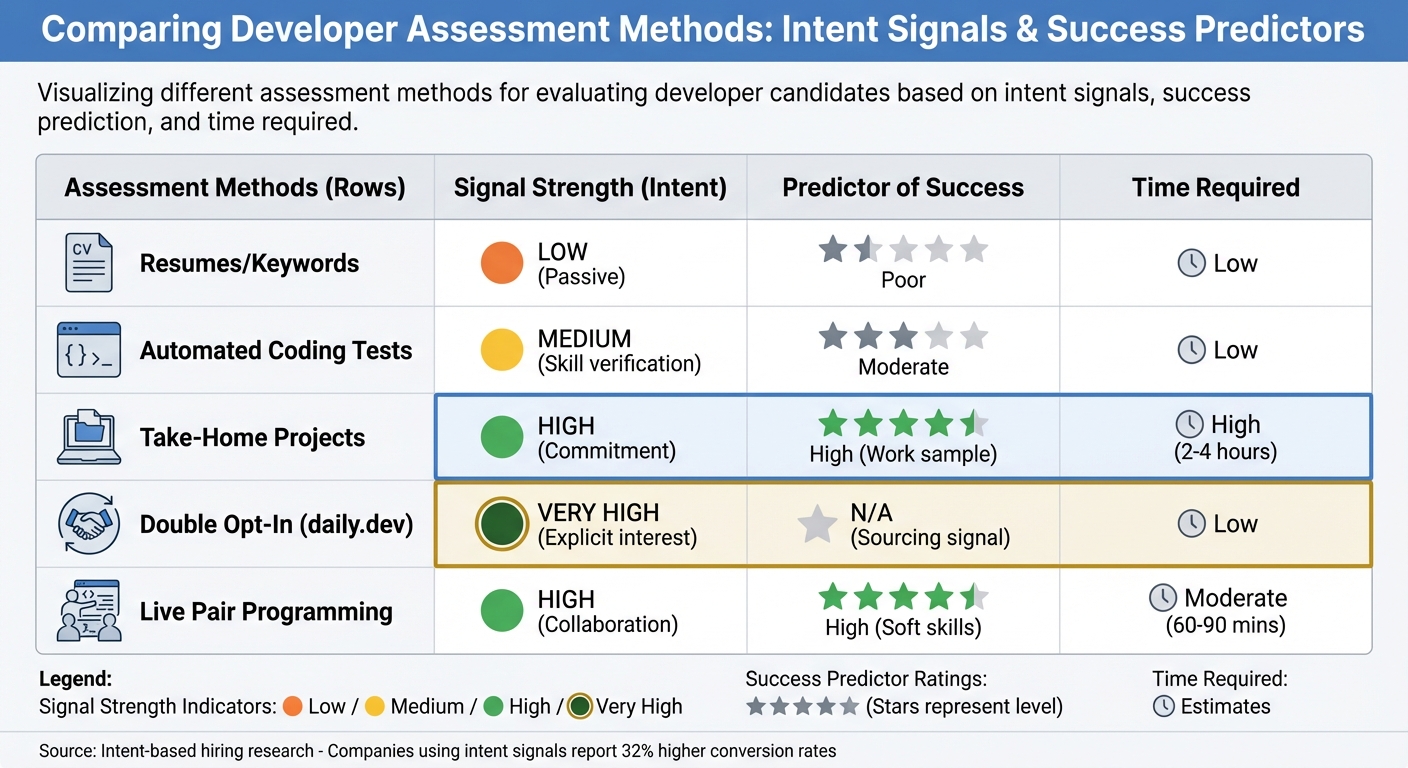 {Developer Hiring Assessment Methods Comparison: Signal Strength and Success Prediction}
Incorporating measurable intent into your hiring strategy brings a sharper focus to trust-driven, intent-based recruiting. Once you grasp the concept of intent, the next step is to create a structured system that evaluates it alongside technical skills.
Building an Intent Scoring System
Start by distinguishing between essential and optional competencies before designing your scoring framework. For example, technical requirements for backend roles will differ from skills that enhance the role but aren't mandatory . This ensures your scoring system effectively captures intent signals.
Use a 1–5 scale to evaluate areas like Code Correctness, Quality, Testing, and Problem-Solving Approach . For junior positions, place more weight on correctness, while for senior roles, emphasize architectural thinking and testing practices .
Calibration sessions are key - have multiple team members score the same candidate submission to align everyone's understanding of what each score represents, such as the difference between a "3" and a "5" . Over time, refine your rubric by correlating assessment scores with job performance after six to twelve months .
This systematic process lays a solid foundation for comparing various assessment methods and sourcing channels.
Comparing Assessment Methods
When evaluating practical assessments, consider how well each method signals intent. Resumes and keyword scans often fall short - they're passive and can quickly become outdated. On the other hand, take-home projects, which typically require two to four hours of a candidate's time, demonstrate a candidate's commitment while providing a reliable work sample . Platforms like daily.dev Recruiter, which use double opt-in connections where candidates explicitly express interest before any interaction, offer one of the strongest intent signals during the sourcing stage.
| Assessment Method | Signal Strength | Predictor of Success | Time Required |
|---|---|---|---|
| Resumes/Keywords | Low (Passive) | Poor | Low |
| Automated Coding Tests | Medium (Skill verification) | Moderate | Low |
| Take-Home Projects | High (Commitment) | High (Work sample) | High (2–4 hours) |
| Double Opt-In (daily.dev) | Very High (Explicit interest) | N/A (Sourcing signal) | Low |
| Live Pair Programming | High (Collaboration) | High (Soft skills) | Moderate (60–90 mins) |
Keep an eye on your test completion rates to ensure your assessments are balanced. If many candidates start but don't finish, the test might be too difficult or not relevant enough . A good practice is to have around 20 internal team members take the assessment first to fine-tune its difficulty and timing .
Adjusting Evaluation Criteria
Once you've compared assessment methods, refine your evaluation criteria based on how candidates engage. For instance, a candidate visiting your pricing page or salary benchmark tool shows stronger intent than someone browsing a general blog post. Focus on three key factors - recency, depth, and decision-weighting - as reliable indicators of intent.
Set clear thresholds for action. For example, fast-track candidates scoring between 80 and 100 on intent. Those scoring between 60 and 79 might be ready for targeted follow-ups, while scores from 40 to 59 suggest the need for further observation . Document these processes to ensure your team interprets intent signals consistently.
Intent signals add an extra layer to candidate evaluation. While an engaged candidate may show strong intent, they still need to meet your technical standards to be the right fit. By combining intent data with your Ideal Candidate Profile, you can prioritize candidates who are both qualified and actively seeking opportunities. Companies that use intent-based data report conversion rates up to 32% higher because they focus on prospects already motivated to take the next step .
Conclusion
Shifting the focus in hiring developer candidates from mere resume reviews to understanding intent transforms the process into a trust-centered, meaningful matchmaking experience. By prioritizing signals like personalized applications and double opt-in connections, you're not just filling a vacancy - you’re assembling a team of developers who are genuinely excited to contribute to your projects and workplace culture.
Organizations that embrace skills-based hiring report a 20% drop in employee attrition, and 75% of hiring managers have successfully brought on exceptional candidates who didn’t have traditional credentials . Plus, using real-world work sample tests - widely regarded as the best predictor of on-the-job performance - combined with intent signals allows you to identify developers who are both skilled and genuinely invested. This investment is often reflected in their soft skills, which are essential for long-term team cohesion.
"Identifying great developer talent requires a deep understanding of how developers work and live, which leads to a mutual respect between companies and developers." - Qualified
Platforms like daily.dev Recruiter make this intent-driven approach practical by connecting you with developers who have already expressed interest. Through warm double opt-ins, you interact with pre-qualified candidates who are actively open to the right opportunity, removing much of the guesswork and fostering trust from the very first conversation.
The benefits of intent-based hiring go beyond just finding the right talent. It’s about respecting developers’ time, reducing unconscious bias, and creating a hiring process that mirrors your engineering values. When developers feel respected and appreciated throughout the hiring journey, you’re more likely to attract top-tier talent who stick around and deliver outstanding results.
FAQs
How do personalized applications reflect a developer's genuine interest?
When developers craft personalized applications, it’s a clear signal that they’ve done their homework on both the role and your company. Mentioning specific projects, connecting their skills to the job’s technical needs, or outlining how the position aligns with their career aspirations shows a thoughtful and intentional approach.
This level of effort suggests that the candidate isn’t just sending out generic applications but is genuinely interested in the opportunity. It also hints at their likelihood to actively engage and contribute meaningfully throughout the hiring process.
How can public contributions help evaluate a developer’s commitment?
Public contributions - such as creating repositories, submitting pull requests, reviewing code, and participating in discussions - offer a clear window into a developer's dedication to their work. Platforms like GitHub make these activities visible, showcasing not only what a developer has worked on but also how often they engage with the community. Consistent and varied contributions demonstrate persistence, teamwork, and problem-solving abilities that go far beyond what a traditional résumé can convey.
For recruiters, this kind of activity provides tangible proof of a candidate's commitment to their craft. Tools like daily.dev Recruiter make it easier by collecting and organizing public contribution data, giving hiring teams a straightforward way to assess a developer's ongoing involvement and passion - without relying on outdated profiles or cold outreach.
Why is it important to use a double opt-in system when recruiting developers?
A double opt-in system ensures candidates actively confirm their willingness to be contacted, making the recruitment process more considerate and efficient. This method allows recruiters to focus their efforts on developers who are genuinely interested in new opportunities, cutting down on unnecessary outreach and fostering trust.
By narrowing their attention to candidates who have explicitly opted in, recruiters can save valuable time and have more productive conversations with individuals who are likely to align with the role's requirements.
.png)