When hiring developers, should you focus on job boards or passive sourcing? Here's the key takeaway: Job boards work for fast, high-volume hiring, while passive sourcing delivers better results for senior or specialized roles.
- Job Boards: Great for entry- to mid-level roles with tight deadlines. They generate more applications but often result in lower-quality candidates. Expect to sift through unqualified resumes and face higher ghosting rates.
- Passive Sourcing: Targets employed professionals who aren’t actively looking but are open to offers. It’s a slower process but yields higher-quality hires, better retention, and less competition for top talent.
Quick Comparison
| Metric | Job Boards | Passive Sourcing |
|---|---|---|
| Applications per Hire | 74 | 15–20 |
| Time-to-Hire | 5–7 weeks | 8–12 weeks |
| Retention (18 months) | 70% | >90% |
| Candidate Drop-off Rate | 40–50% | 60–70% |
Bottom Line: Use job boards for speed and volume. Use passive sourcing when quality and long-term fit matter most.
::: @figure 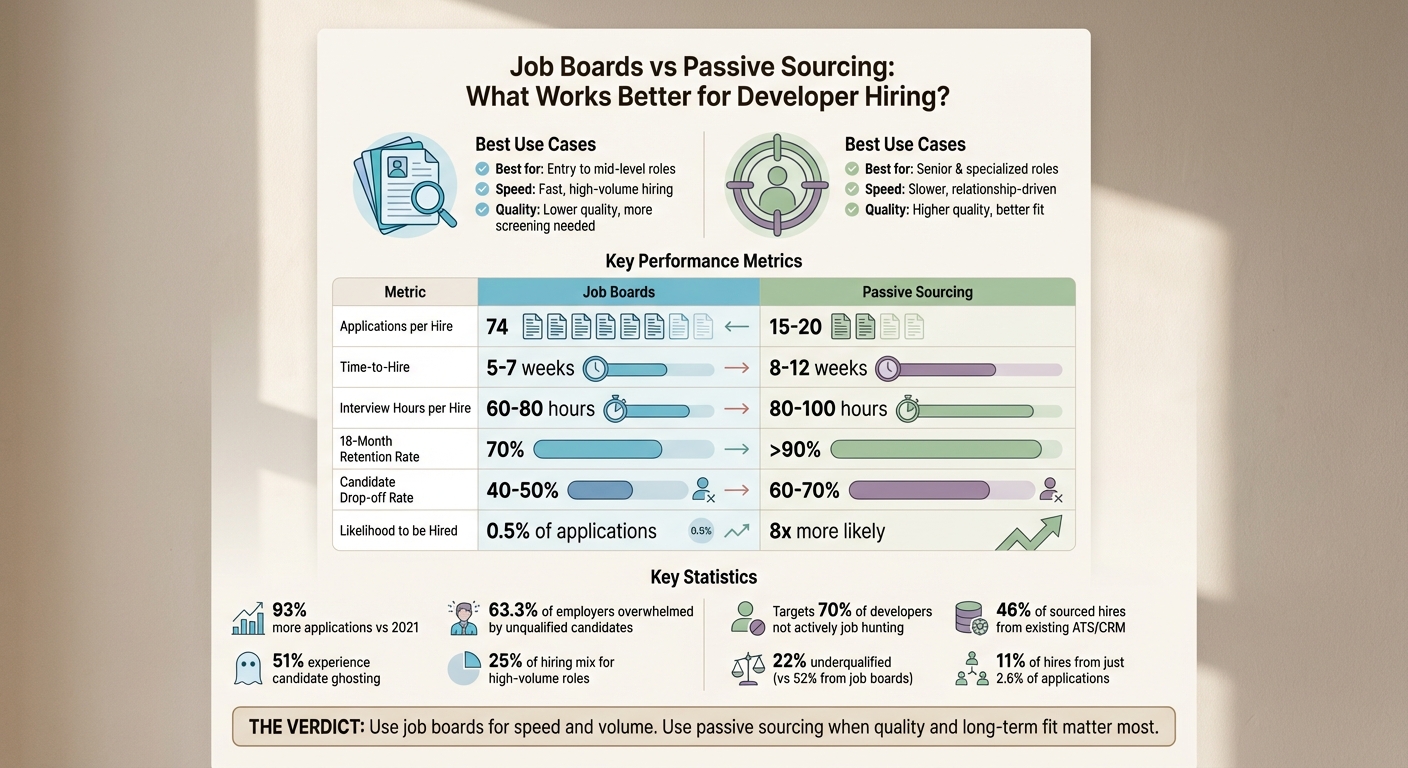 {Job Boards vs Passive Sourcing: Key Metrics Comparison for Developer Hiring}
Job Boards: Benefits, Drawbacks, and Best Uses
Benefits of Job Boards
Job boards are perfect for generating a large pool of candidates quickly, making them a go-to option when you need to fill multiple roles under tight deadlines. They’re straightforward to use - just post a job, set a budget, and watch the applications roll in. For entry-level and mid-level developer roles, job boards connect you with an audience actively searching for opportunities.
The cost structure is another advantage, especially for organizations with limited resources. Small businesses, in particular, lean on job boards because they often lack the budget or manpower for extensive sourcing efforts . With predictable fees and access to candidates ready to engage, job boards eliminate the time-consuming process of courting passive talent. However, while the quantity of applicants is a plus, it often comes at the expense of quality.
Drawbacks of Job Boards
Despite their speed and ease, job boards come with some challenges. One major issue is the quality of applicants. A staggering 63.3% of employers report being overwhelmed by unqualified candidates when using job boards . As highlighted in the Gem Benchmarks Report 2026:
job boards drive volume, but referrals, internal mobility, and direct sourcing consistently deliver more hires
Another common frustration is ghosting. Over 51% of employers say candidates simply stop responding during the hiring process . Rising platform costs are another sore spot, with 44% of employers expressing dissatisfaction . On top of that, job boards are highly competitive. Every company is vying for attention, making it harder to stand out - especially when top-tier talent often has multiple offers to consider.
When to Use Job Boards
Job boards shine in situations where urgency takes precedence over perfection. They’re ideal for urgent hiring needs, such as staffing up quickly for product launches or during periods of rapid growth. Active candidates from job boards are ready to start immediately, which can be a lifesaver when time is of the essence.
They’re also best suited for entry-level and mid-level roles, where the talent pool is naturally larger and candidates are actively seeking opportunities. For high-volume hiring - like filling multiple similar positions - job boards can be highly effective. To get the most out of them, include key details like specific salary ranges (e.g., $120,000–$150,000), outline your tech stack, and use automated screening questions to filter out unqualified applicants early on. This approach helps you sift through the noise and focus on candidates who meet your needs.
Passive Sourcing: Benefits, Drawbacks, and Best Uses
Benefits of Passive Sourcing
Unlike job boards, passive sourcing focuses on quality over quantity. It targets the 70% of developers who aren't actively job hunting but are open to the right opportunity . These candidates tend to be more qualified - only 22% are considered underqualified, compared to 52% of job board applicants . In fact, sourced candidates are 8x more likely to be hired than those from job boards, highlighting the efficiency of this approach .
A major benefit is reduced competition. Passive candidates aren't typically juggling multiple offers, giving you more room to negotiate and a better chance of closing the deal. Plus, longer engagement periods allow for a more thorough evaluation of both technical skills and alignment with your team dynamics. This method works particularly well for senior and specialized roles, where top-tier talent often avoids traditional job boards. Additionally, 51% of employers report that referrals and recommendations - key strategies in passive sourcing - consistently lead to better hires .
These advantages make passive sourcing an excellent choice when finding the right fit matters more than filling a role quickly.
Drawbacks of Passive Sourcing
The biggest downside? Time. Passive sourcing is a relationship-driven process that requires significant upfront effort. To stand out, you'll need to dig into each candidate's GitHub contributions, technical blogs, or open-source projects to craft outreach messages that feel personal and relevant. Even then, response rates can be low - developers who aren't actively searching often ignore unsolicited messages.
Another hurdle is the growing trust gap. Many developers are skeptical of automated outreach or vague job descriptions, leading them to tune out traditional recruiting attempts. While passive sourcing has a higher success rate per candidate, it’s still a slow process - on average, only 1 in 72 sourced candidates gets hired, compared to 1 in 16 for employee referrals . For roles that need to be filled quickly, this timeline can be a dealbreaker.
Despite these challenges, passive sourcing is indispensable when precision and long-term fit take precedence over speed.
When to Use Passive Sourcing
Passive sourcing shines when quality outweighs urgency. It’s especially effective for specialized technical roles - like machine learning engineers or security architects - where the talent pool is limited and the right hire can significantly impact a project’s success. Senior positions, such as engineering managers or principal engineers, also benefit from this approach since these professionals are rarely browsing job boards.
This method is also ideal for avoiding the flood of unqualified applicants that job boards often attract. To improve your chances, make your outreach highly personalized. Reference specific projects or contributions, and include transparent details about your tech stack, salary range (e.g., $180,000–$220,000), and the role’s potential impact in your initial message. Don’t overlook database rediscovery - 46% of sourced hires now come from candidates already in your ATS or CRM . Starting with these existing contacts can save time and effort before reaching out to new prospects.
Job Boards vs Passive Sourcing: Performance Metrics
Side-by-Side Comparison
Job boards have seen a surge in activity, generating 93% more applications compared to 2021. However, only 0.5% of those applications result in actual hires . On the other hand, passive sourcing stands out, with sourced candidates being 8 times more likely to be hired than those who apply through inbound channels .
According to IQTalent, it typically takes 74 applications to make one hire using job boards, which translates to significant time spent on screening and rejecting candidates .
Here’s a quick breakdown of how these two approaches compare across key hiring metrics:
| Metric | Job Boards | Passive Sourcing |
|---|---|---|
| Applications per Hire | 74 | 15–20 |
| Time-to-Hire | 5–7 weeks | 8–12 weeks |
| Interview Hours per Hire | 60–80 hours | 80–100 hours |
| 18-Month Retention Rate | 70% | >90% |
| Candidate Drop-off Rate | 40–50% | 60–70% |
While passive sourcing may take longer and require more interview hours, its higher retention rates help offset replacement costs in the long run. These numbers highlight the strengths and weaknesses of each method depending on the hiring scenario.
Performance by Hiring Scenario
The choice between job boards and passive sourcing often depends on the type of role being filled. For high-volume or entry-level positions, job boards can still play a valuable role. They account for roughly 25% of the hiring mix when companies need to quickly fill multiple junior roles . A single job posting can attract over 250 applicants , though many candidates may only meet about half of the job requirements.
For specialized or senior positions, passive sourcing is the better option. It delivers 11% of hires from just 2.6% of applications - a success rate four times higher than job boards . Technical roles, for example, often demand an average of 35–36 interviews and 26 interviewer hours per hire . In these cases, the time invested in cultivating high-quality candidates (80–100 hours ) pays off by avoiding the inefficiencies of sifting through unqualified applications.
Another effective approach is leveraging your existing talent pool. Nearly 46% of sourced hires now come from candidates already in your ATS or CRM . Before turning to job boards, it’s worth revisiting your database for "silver medalists" - those strong candidates from past hiring cycles who are already familiar with your company. This strategy not only saves time but also taps into candidates who may already have a positive impression of your organization.
Hiring engineers?
Connect with developers where they actually hang out. No cold outreach, just real conversations.
Using daily.dev Recruiter for Passive Sourcing
What daily.dev Recruiter Offers
When it comes to passive sourcing, daily.dev Recruiter takes things to the next level by meeting developers where they naturally spend their time - exploring tech content, honing their skills, and connecting with peers.
daily.dev Recruiter is built on a thriving developer community. Instead of relying on cold outreach, it directly connects you with developers who are already engaged and active. The platform operates on a double opt-in model, meaning developers express interest in your role before introductions are made. This ensures that every conversation starts with mutual intent, not an unsolicited pitch.
With job briefs highlighting your tech stack, engineering challenges, and team culture, daily.dev Recruiter helps you attract candidates who are genuinely excited about the work. Plus, its advanced targeting and custom screening features allow you to zero in on the specific skills and experience you need, eliminating the time spent sifting through irrelevant applications.
How daily.dev Recruiter Enhances Passive Sourcing
Traditional passive sourcing methods often struggle with low response rates - less than 20% - and high drop-off rates of 60–70% . Many developers simply ignore cold messages because they feel impersonal or spammy. daily.dev Recruiter eliminates these challenges by fostering trust and removing cold outreach vs. warm intros altogether. Developers opt in voluntarily, ensuring you're only engaging with candidates who are already interested.
Consider this: job boards typically require around 74 applications to secure a single hire . In contrast, passive sourcing through an engaged network like daily.dev drastically improves this ratio. Instead of wading through unqualified candidates, you can focus on meaningful, high-context conversations with developers who have already shown interest.
As Nimrod Kramer, CEO of daily.dev, explains:
Trust is the only edge that lasts
What truly sets daily.dev Recruiter apart is its ability to tap into the 70% of developers who are not actively job hunting . These passive candidates often have stronger track records and stay longer - 46% remain for at least a year, compared to just 33% for hires from job boards . By engaging developers in their preferred environments, you can connect with talent that might never even glance at a job posting - all while avoiding the noise and rejection that come with traditional outreach.
Choosing Between Job Boards and Passive Sourcing
Your recruiting strategy should align with your hiring goals, timelines, and the type of talent you're targeting. Job boards work well when you need to fill entry-level or mid-level roles quickly and can manage the influx of applications. But when you're searching for senior developers or niche specialists, passive sourcing often delivers superior results.
Here’s why: passive candidates have an 18-month retention rate of over 90%, compared to just 70% for active job seekers . Plus, around 70%–75% of the talent pool consists of passive candidates . These professionals typically have stronger career histories and are more likely to stay with your company longer - but they may never come across your job posting.
This shift in candidate quality is reshaping recruitment strategies. As Jeremy Golan, HR Manager at Virtual HR Hub, explains:
"Job boards had their time in the sun, but sadly they need to be sent off to pasture. With the advent of one‑click apply... people are spamming their generic resumes everywhere and hoping that something sticks."
Given these dynamics, your recruitment approach should match your resources and goals. For developer hiring, passive sourcing through platforms like daily.dev Recruiter can be a game-changer when quality and retention matter most. Its double opt-in model ensures you're connecting with developers who are genuinely interested, cutting through the noise that often comes with traditional outreach.
While job boards can still complement your strategy for high-volume or junior-level hiring, sourcing the top 70% of talent - those who aren’t actively job hunting - requires a more focused and efficient approach. If your recruiting team is stretched thin, prioritizing passive sourcing can lead to better candidate matches, quicker onboarding, and longer employee tenure.
FAQs
What’s the difference between job boards and passive sourcing for finding top developer talent?
Job boards tend to draw a large number of applicants, primarily entry- to mid-level developers who are actively searching for jobs. While this can be useful for filling certain roles, it often leads to stiff competition and makes it harder to find the ideal candidate for specialized or senior positions.
In contrast, passive sourcing is about reaching out to highly skilled developers who aren’t actively job hunting but are open to the right opportunity. Tools like daily.dev Recruiter make it easier to connect with pre-qualified engineers in a way that's meaningful and non-intrusive. This method often delivers higher-caliber candidates with more experience, ultimately leading to better hiring results. In fact, studies reveal that sourced candidates are up to eight times more likely to be hired compared to those who apply through job boards, making passive sourcing a smarter choice for finding exceptional talent.
When should you choose passive sourcing instead of job boards?
Passive sourcing works best when you’re aiming to connect with developers who aren’t actively searching for new opportunities. This method is particularly effective for filling senior-level or highly specialized roles since these professionals often steer clear of job boards and respond better to personalized, relationship-focused outreach.
It’s also an excellent way to build a long-term talent pool. While passive sourcing requires more time and effort, it helps establish meaningful connections with seasoned developers who are less likely to be inundated with competing offers. If your hiring needs involve hard-to-find skills, leadership roles, or you want to bypass the flood of generic applications, passive sourcing provides a more focused and tailored approach.
What challenges do employers face when using job boards to hire developers?
Job boards are a popular tool for hiring developers, but they come with their fair share of challenges. One major issue is the sheer volume of applications. While it might seem like a good problem to have, many of these applicants lack the qualifications needed for the role. This means employers spend a significant amount of time sifting through resumes to pinpoint the best candidates. In fact, research shows that candidates sourced directly are much more likely to be hired compared to those who come through job boards, underscoring the inefficiency of this method.
Another hurdle is the intense competition for active job seekers. Developers who apply via job boards often receive multiple offers in a short span of time, leaving employers scrambling to grab their attention. On top of that, many developers are increasingly disengaged from traditional recruitment methods like job board postings. This shift leads to lower response rates and missed chances to connect with exceptional talent.
All these factors combined make job boards a time-consuming and less effective way to find highly skilled developers.
.png)