Open source contributions are transforming how developers are hired. Instead of relying on resumes or keyword-heavy applications, hiring managers can use coding-focused candidate sourcing tools to evaluate real work: code commits, pull requests, and community interactions. This approach provides a clear, verifiable record of skills, collaboration, and problem-solving.
Key takeaways:
- 70%-90% of software relies on open source, yet 89% of hiring managers struggle to find candidates with strong open source skills.
- Open source platforms like GitHub serve as dynamic portfolios, showcasing technical ability and teamwork.
- Companies like Block use open source projects to attract top talent by highlighting their engineering culture.
Why it matters: Open source contributions reveal a developer's expertise and growth over time, offering transparency that resumes and interviews often lack. By focusing on these contributions, companies can identify skilled candidates faster and build stronger teams.
::: @figure 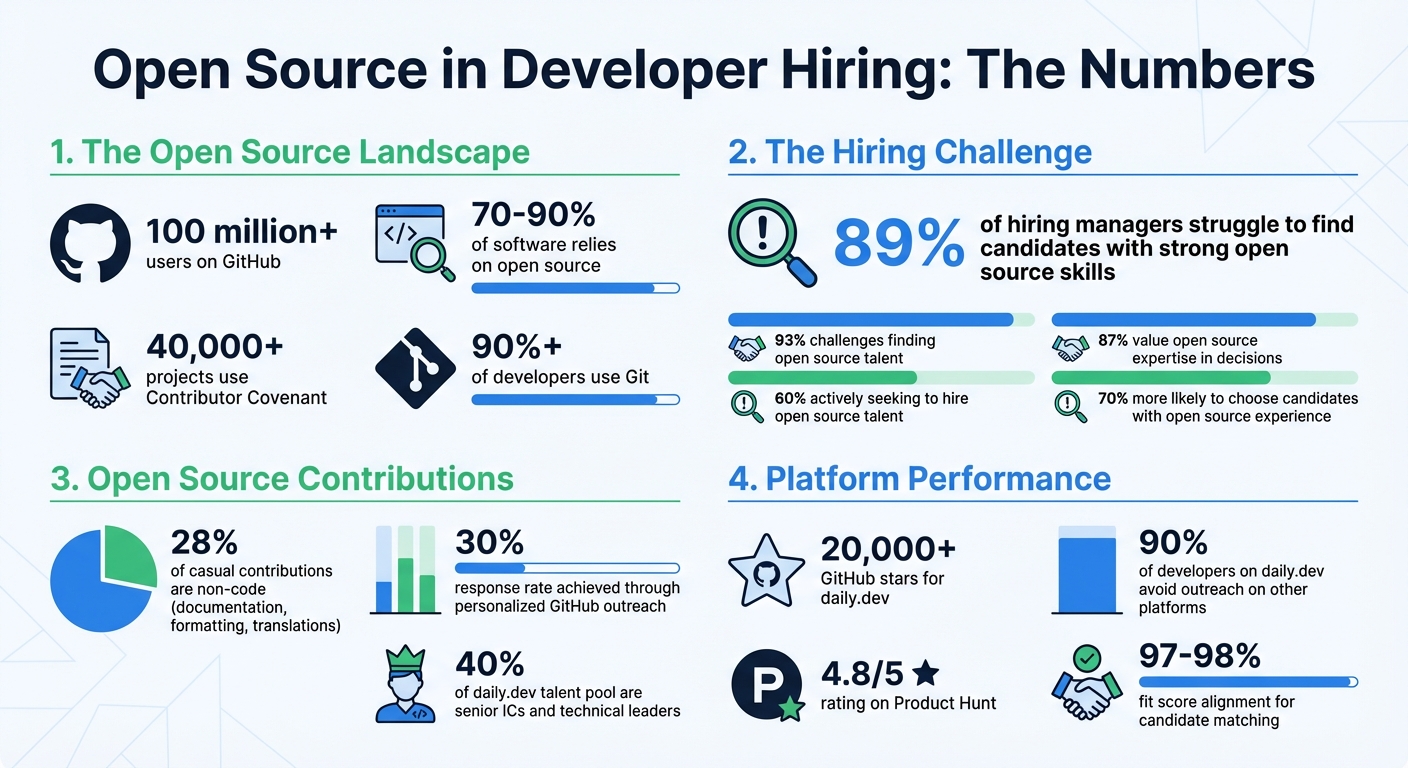 {Open Source Hiring Statistics: Skills Gap and Recruitment Challenges}
Problems with Traditional Developer Hiring
The usual approach to hiring developers - posting job ads on multiple platforms, scouring LinkedIn, and collecting a mountain of resumes - often leads to an overwhelming number of unqualified candidates. Philip Walton, an engineer at Google, calls this the "fire hose strategy", where the focus is on sheer volume rather than quality. As Walton puts it:
"The obvious problem with this fire hose strategy is that it doesn't improve the quality of your applicants, it's simply playing the numbers. More résumés just ends up meaning more time spent considering people you'll never ultimately hire."
The numbers back this up. A whopping 89% of hiring managers report difficulty finding developers with strong open-source skills, leading to unfilled roles and costly mismatches in recruiting . The flaws in traditional hiring methods become even more apparent when you look at resumes and the interview process.
Why Resumes Fall Short in Evaluating Skills
Resumes can be misleading. Many candidates pad them with keywords lifted directly from job descriptions - a practice Brad Collette, CTO of Ondsel, calls "inflated resume content" . This often allows underqualified applicants to bypass automated filters, only to stumble during technical assessments.
Even recruiters can get caught up in surface-level metrics. For instance, contribution graphs on platforms like GitHub are often mistaken as indicators of skill. But as Collette points out:
"If you're a hiring manager and you're judging an applicant's skills and experience by how many green squares they have... this is the most superficial way to look at it, and it won't tell you anything about whether this person makes valuable contributions."
These graphs can be easily manipulated with automated tools or minor, inconsequential updates. Resumes also fail to highlight critical traits like adaptability to feedback, teamwork, or the ability to maintain and improve existing codebases.
Why Developers Are Frustrated with Hiring Processes
The hiring process itself often alienates developers. Generic outreach messages feel impersonal, reducing skilled engineers to mere commodities rather than recognizing them as professionals with unique expertise. Jeff Osier-Mixon, Open Source Community Manager at Intel, emphasizes that developers value "purpose", "respect", and "recognition" .
Additionally, traditional interviews frequently rely on brain-teasers or abstract coding challenges that have little connection to the actual work developers do. These methods overlook one of the most crucial skills for team success: the ability to read and improve existing code . On top of that, recruiters, overwhelmed by fragmented data, often default to low-effort indicators like activity counts instead of assessing the actual quality of a developer's work .
This flawed system wastes everyone's time. Recruiters spend hours reviewing candidates who aren't a good fit, while developers endure repetitive and irrelevant interviews that fail to respect their time or showcase their real abilities. A better alternative lies in transparent open-source evaluations, which provide concrete evidence of how developers work and remove the impersonal nature of traditional hiring.
How Open Source Reveals Developer Skills
Resumes can list skills, but open source contributions show them in action. Platforms like GitHub and GitLab serve as public archives, documenting every commit, code review, and contribution a developer makes . This level of transparency gives recruiters something far more valuable than a resume: real-world evidence of how a developer works, collaborates, and solves problems.
Open Source as a Living Portfolio
Think of open source contributions as a developer's dynamic portfolio. Unlike resumes, which often only highlight job titles and technologies, repositories showcase actual code, problem-solving approaches, and how well someone integrates their work into existing systems. For recruiters, this is a goldmine - they can see if a developer is already working with tools or frameworks their company uses, whether it's React, Django, or Kubernetes .
Even contributions outside of coding matter. A 2021 study found that 28% of casual open source contributions involve tasks like improving documentation, fixing formatting, or adding translations . These efforts may seem minor, but they highlight a developer's initiative and attention to detail.
Open source also shines a light on collaboration skills that traditional interviews often overlook. Ryan McKinley, VP of Applications at Grafana Labs, underscores this point:
"Seeing open source activity is so important... mainly because you genuinely see not just work product, but how people participate in a community."
Through open source, recruiters can observe how developers respond to feedback on pull requests, assist others in discussion forums, and handle technical disagreements. Many open source projects - over 40,000, in fact - have adopted the Contributor Covenant to set standards for professional conduct, making it easier to gauge whether someone respects community norms .
Uncovering Skills Through Code History and Reviews
Open source contributions not only showcase a developer's current abilities but also reveal their growth over time. A developer's commit history and the reviews they've received tell a story that a resume simply can't. They highlight the problems a developer has tackled, how they respond to constructive criticism, and whether they've consistently improved their skills . Brad Collette, CTO of Ondsel, emphasizes this feedback loop:
"A candidate who participates in OSS will have a history of code review, discussion, and engaging with feedback. Do they take suggestions on board, do they offer feedback and coaching to others?"
One of the most valuable skills open source reveals is the ability to work with existing code. Research has shown that developers who contribute to others’ projects - enhancing and refining them - often make better team players than those who only focus on building their own projects from scratch . Companies often need "studio musicians" who can seamlessly join an established codebase and make it better, rather than "solo artists" who only excel in creating new projects.
Recruiters can dig deeper by reviewing issue trackers. These reveal how developers handle bug reports, whether they can break down complex problems into smaller tasks, and how well they explain their technical decisions . For example, a developer who consistently solves medium-complexity issues across various modules demonstrates a deeper skill set than someone who sticks to simple, one-file fixes . These detailed, verifiable records build trust and align perfectly with transparent, developer-focused hiring practices.
How Open Source Builds Trust in Hiring
Open source has reshaped the hiring process by offering a level of transparency that technical hiring best practices often lack. Instead of relying on polished resumes or rehearsed interviews, it provides a public record of real-world skills. Developers can demonstrate their abilities through actual contributions, while recruiters gain a clear view of their expertise. This mutual transparency fosters trust, creating a hiring process grounded in proven merit rather than corporate credentials.
How Developers Earn Credibility in Open Source
In the open source world, credibility isn’t handed out based on titles or formal qualifications - it’s earned. Developers build their reputation by consistently contributing high-quality work and engaging with the community. Guy Martin, Director of Open at Autodesk, sums it up well:
"The only way to gain leadership is to earn the role within the community. And the only way to do that is to gain credibility and make contributions."
This merit-based system provides trust signals that traditional hiring methods often can’t match. For instance, when a developer is granted commit access to a major project, it’s a testament to their code quality, reliability, and communication skills. These traits have been vetted by peers over time. It’s no wonder that 87% of hiring managers value open source expertise when making hiring decisions, and they are 70% more likely to choose candidates with open source experience .
Open source also offers a unique lens into how developers handle challenges. Contributions show how someone responds to feedback, collaborates with others, and sticks with long-term projects. Research even indicates that contributions from developers with higher perceived trust are more likely to be merged into projects . These interactions reveal much more than a resume ever could.
Companies That Hire from Open Source
Proven competence in open source communities doesn’t just earn respect - it also attracts the attention of companies looking for skilled talent. Many businesses now use open source as a direct hiring pipeline. A great example is Grafana Labs, which hired Ryan McKinley as VP of Applications in 2021. McKinley stood out as the leading community contributor to their project, and his reputation as an early contributor to Apache Lucene reportedly earned him multiple job offers daily .
This approach to hiring - based on influence and proven contributions - offers clear benefits. It reduces the risks associated with hiring and speeds up onboarding. Developers who are already active contributors arrive with a deep understanding of the codebase, community norms, and project goals. Western Digital even took this concept a step further by acquiring a company with a strong track record in open source projects and forming an internal open source working group .
However, the demand for open source talent far outweighs the supply. A staggering 93% of recruiting managers report challenges in finding candidates with open source skills, and 60% are actively seeking to hire such talent . By tapping into open source communities, companies can access a pool of candidates who have already proven their abilities in a public, transparent setting.
As Karl Fogel writes in Producing Open Source Software:
"Influence in an upstream project is usually not transferable to some other employee. Position and influence travel with the person, not with the employer."
When companies hire a leader from the open source world, they’re not just gaining technical expertise - they’re also acquiring the social capital and influence that can help shape the very technologies their business relies on.
Hiring engineers?
Connect with developers where they actually hang out. No cold outreach, just real conversations.
Using daily.dev Recruiter for Trust-Based Hiring
Building on the idea that open source fosters trust, daily.dev Recruiter takes this concept further by creating a developer-first platform. It thrives on a dynamic network fueled by real developer activity, steering away from the impersonal methods of traditional outreach. Instead, it focuses on connecting recruiters with active vs passive developer talent through approved introductions that respect both the time and preferences of developers.
Nimrod Kramer, CEO & Co-Founder of daily.dev, puts it succinctly:
"We built a place where engineers can turn off the noise. To enter this space, you don't need a hack - you need trust."
This approach has resonated deeply with the developer community. The platform has earned over 20,000 GitHub stars and boasts an impressive 4.8/5 rating on Product Hunt. Even more telling, 90% of developers on the platform avoid responding to outreach on other platforms.
How daily.dev Recruiter Connects with Open Source Developers
Instead of relying on static resumes, daily.dev Recruiter uses live signals to find the right candidates. These signals include real-time data like article views and community participation, offering a snapshot of a developer's current interests and expertise. Recruiters can access verified insights that combine a developer's reading habits with their engagement in the community, making it easier to pinpoint candidates who are actively exploring relevant fields.
For instance, if a company is looking for someone with expertise in Generative AI (GenAI), the platform identifies developers currently engaging with that topic. It even calculates fit scores - often hitting 97% to 98% alignment - to ensure a strong match. Before introductions are made, candidates answer a few screening questions, ensuring a clear and mutual fit.
Sam Hayes, Talent Acquisition Lead at CodeRabbit, shared their experience:
"Within one week of onboarding, we started interviewing qualified candidates interested to join CodeRabbit in San Francisco."
This precise and targeted approach creates a hiring process that feels both efficient and respectful.
Why Trust-Based Recruitment Outperforms Traditional Methods
Unlike traditional outreach, which often feels impersonal, trust-based recruitment treats developers as professionals with autonomy. Job opportunities are seamlessly integrated into a developer’s daily content flow, making them feel like natural career advancements. The double opt-in process ensures that recruiters connect only with candidates who have actively expressed interest, staying true to the transparency values of open source.
With 40% of the platform’s talent pool made up of senior individual contributors and technical leaders, companies gain access to seasoned developers who have proven their skills through open source contributions. The platform’s performance-based pricing model further aligns incentives, as companies pay only for successful matches.
And while 89% of hiring managers report challenges in finding candidates with the right open source skills, daily.dev Recruiter bridges this gap by connecting recruiters with developers who showcase their abilities through verified, real-time activity. This blend of transparency, precision, and trust creates a hiring experience that benefits both developers and recruiters alike.
How to Recruit Open Source Developers
Finding Active Contributors
When recruiting open source developers, start by identifying the open source libraries your company relies on - like React, Django, or Node.js - and focus on contributors to those projects. This ensures you're targeting candidates with directly relevant skills. With over 100 million users on GitHub, narrowing your search to your specific tech stack makes the process much more manageable.
GitHub's "Insights" tab is an excellent tool for this. By clicking on "Contributors", you can view a ranked list of developers based on the amount and frequency of their contributions. Aaron Decker, CTO at LeadTruffle, highlights this method as a way to identify high-quality candidates. For instance, being the top contributor to a repository with 38,000 stars is a strong indicator of expertise. Generally, repositories with over 500 stars are seen as reputable within the developer community, and hitting 1,000 stars often gives a developer a kind of "programmer fame".
The type of contributions a developer makes is just as important as their activity level. Developers who excel at improving existing codebases are often a better fit for established teams than those who primarily create from scratch. This shows they can work with and enhance someone else’s code - an invaluable skill in most workplaces. Additionally, non-code contributions like writing documentation, triaging issues, or organizing events demonstrate initiative and strong communication skills, which are just as critical as technical ability.
Be cautious of developers who use automated updates or rewrite Git history to inflate their activity. To verify authenticity, cross-check their contributions against major, well-regarded projects. Codility's technical recruiting team, for example, achieved a 30% response rate in 2023 by crafting personalized outreach messages based on actual GitHub activity. This approach helped them fill two engineering roles within a year.
Checking Teamwork and Communication Skills
Beyond technical skills, a developer’s ability to collaborate and communicate effectively is essential.
A developer’s code tells only part of the story. Their interactions in GitHub issues, pull requests, and community discussions reveal how well they work with others. Look for constructive and patient communication instead of defensive or dismissive behavior. These interactions can help you assess if they’ll fit well within your team.
Brad Collette, CTO at Ondsel, underscores this:
"A candidate who participates in OSS will have a history of code review, discussion, and engaging with feedback. Do they take suggestions on board, do they offer feedback and coaching to others?"
Pay attention to how often a candidate reviews other people’s code. Frequent peer reviews suggest a collaborative mindset and potential for mentoring others. Developers who use "draft" or "WIP" pull requests demonstrate a willingness to collaborate and refine their work. Interestingly, about 28% of open source contributions involve documentation tasks like fixing typos or improving formatting, which reflects a focus on enhancing the team’s overall experience.
However, keep an eye out for red flags. Karl Fogel, author of Producing Open Source Software, advises:
"Someone who consistently causes negative reactions from others in the project may have social problems as a collaborator, which is important to know independently of their technical ability."
To get a clearer picture, review threaded discussions or mailing list responses to see how the community reacts to their posts. This can reveal whether they are viewed as helpful or disruptive. Since over 90% of developers use Git, these public records provide invaluable insights into how a candidate might integrate into your team.
Conclusion
Open source contributions are reshaping how developers are hired, shifting the focus from self-reported resumes to tangible proof of skills like technical expertise, collaboration, and problem-solving. Companies that embrace this approach gain a clear edge in attracting top talent.
Viewing open source as a reliable measure of ability represents a major shift in assessing developer skills. As Jim Zemlin, Executive Director of The Linux Foundation, aptly states:
"The phrase we use is 'code is the new resume.'"
Public contribution histories take much of the guesswork out of hiring by showcasing how developers handle feedback, collaborate across different time zones, and tackle complex challenges. This transparency provides a clearer picture of a candidate's capabilities and work ethic.
Platforms like daily.dev Recruiter make it easier to connect with developers who are actively engaged in learning, coding, and contributing to their communities. With every introduction being warm and double opt-in, the process ensures that conversations are meaningful and mutually beneficial, replacing impersonal cold outreach with authentic, high-value interactions.
The most successful companies are those that foster genuine relationships with developers through openness and respect. By prioritizing open source contributions and leveraging tools designed for developer-focused engagement, you're not just filling positions - you’re building teams that excel in collaboration and technical performance. This approach creates a foundation for smarter, more effective hiring.
If you want to recruit developers who’ve already proven their skills in public, open source is the key. By using these contributions as evidence and focusing on trust-based connections, you’re not just hiring talent - you’re assembling cohesive, high-performing teams. The proof is out there; you just need to know where to find it.
FAQs
How does contributing to open source help build trust in developer hiring?
Open source contributions act as a transparent and practical showcase of a developer’s abilities and teamwork. By examining public commits, pull requests, and discussions on platforms like GitHub, recruiters can get a clear sense of a candidate’s code quality, problem-solving skills, and collaborative approach. This kind of visibility offers insights that go far beyond what a traditional résumé can provide.
For developers, contributing to open source projects is also a way to build a solid reputation in the community. It reflects traits like dedication, dependability, and familiarity with current engineering practices. daily.dev Recruiter makes it easier for employers to identify these contributors, connecting them with developers whose public work already proves their capability to write excellent code and thrive in team settings.
What challenges do companies face when hiring developers with open-source experience?
Hiring developers with open-source expertise comes with its own set of challenges. For starters, finding qualified talent isn't as straightforward as it might seem. Skilled open-source contributors are relatively rare, and simply posting a job listing or sending cold outreach messages often falls short in attracting the right candidates.
Another hurdle is evaluating the quality of a candidate’s open-source work. It’s easy to get misled by metrics like contribution graphs, which don’t always paint a full picture of meaningful contributions. On top of that, many talented developers might not have a visible public profile because they’ve worked on private projects or taken on leadership roles that don’t involve direct contributions.
Lastly, assessing both technical expertise and collaboration skills adds another layer of complexity. Beyond just reviewing the quality of their code, recruiters need to dig deeper into how candidates interact with others - like their approach to code reviews, their ability to resolve conflicts constructively, and their professionalism in discussions. These subtleties make the hiring process for open-source talent challenging but incredibly rewarding when done right.
How can companies evaluate open-source contributions when hiring developers?
To evaluate a candidate’s open-source contributions effectively, it’s essential to look beyond just the number of commits or contributions. Instead, focus on the quality and impact of their work. Dive into their code to assess clarity, proper documentation, test coverage, and how well they follow the project's standards. Equally important is observing how they interact with the community - do they offer constructive feedback, respond professionally to comments, and actively engage in discussions?
To make this process more efficient, ask candidates to share their primary repository usernames and highlight their most noteworthy contributions. During interviews, discuss specific examples, like pull requests or issue threads, to get a sense of their problem-solving abilities and decision-making process. Tools like daily.dev Recruiter can simplify this by providing a unified view of a developer’s public activity, making it easier to gauge both their technical skills and collaboration style. This method ensures hiring decisions are based on real contributions and genuine interactions.
.png)