Want to hire top developers? Look at their open source work. Resumes show claims, but contributions on platforms like GitHub reveal what developers have actually built, how they collaborate, and their problem-solving skills.
Here’s why this matters:
- 83% of hiring managers trust GitHub profiles more than resumes.
- Open source activity increases interview chances by 78%.
- Teams hiring active contributors see 68% higher retention rates.
To find talent:
- Use GitHub’s advanced search (
language:python location:"San Francisco" pushed:>2025-01-01). - Explore contributors to popular repositories or companies’ open source projects.
- Focus on quality: pull request details, commit messages, and collaboration style.
When reaching out, personalize your message by referencing specific work. Avoid generic pitches - show genuine interest in their contributions. Platforms like daily.dev Recruiter can also streamline this process by connecting you with engaged developers.
Open source contributions offer a transparent way to evaluate skills, making them a powerful tool in modern recruiting.
::: @figure 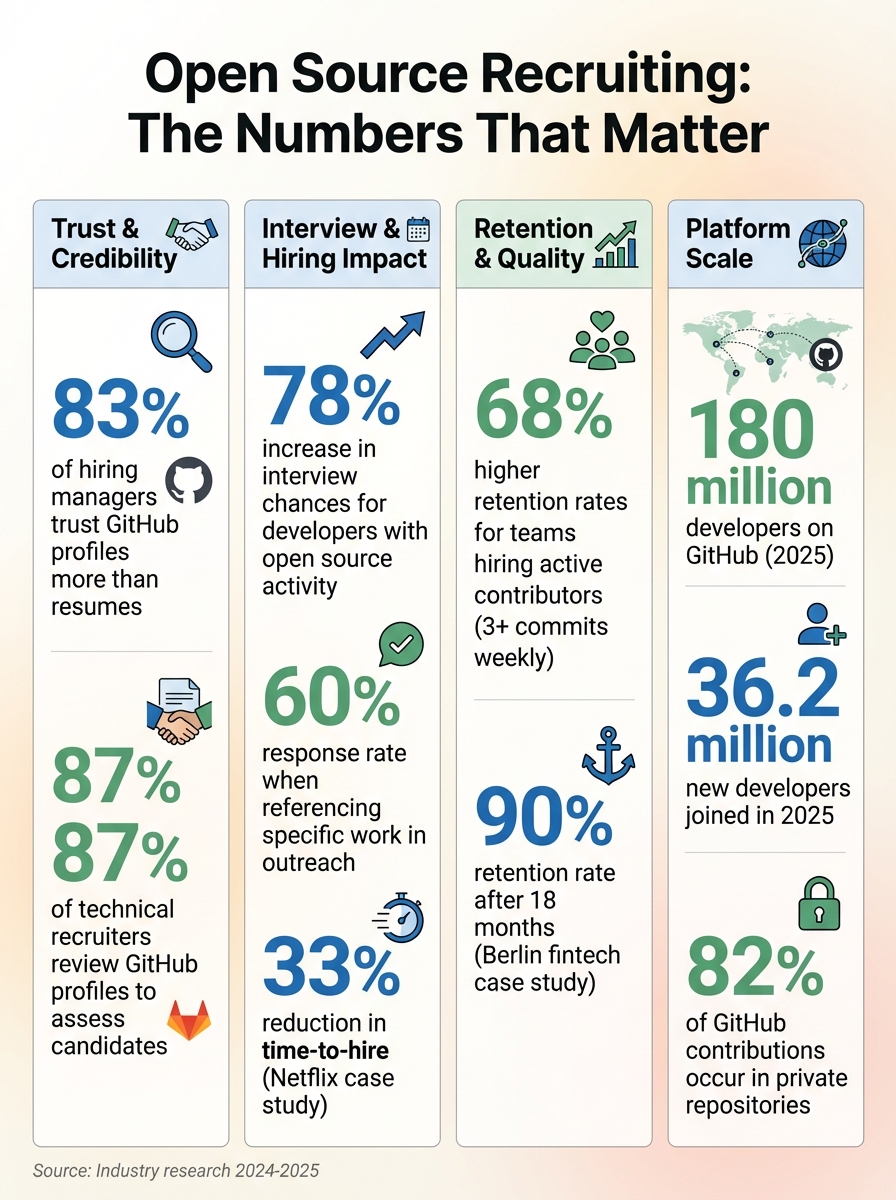 {Open Source Recruiting Statistics: Impact on Hiring Success}
Where to Find Developers Through Open Source Platforms
GitHub is home to over 180 million developers, according to the 2025 Octoverse report, with 36.2 million new developers joining in 2025 alone . That’s an enormous pool of talent, but knowing how to search effectively is key. GitHub stands out by showcasing actual code and commit histories, providing a clear picture of a developer’s skills .
GitLab, while smaller, offers a highly valuable community, especially for developers who favor its integrated DevOps lifecycle tools. Both platforms allow you to directly examine a developer’s work, but success depends on understanding their search features and recognizing the right signals.
"LinkedIn shows you what developers claim they can do. GitHub shows you what they've actually built." – GitHunt
How to Use GitHub to Identify Active Contributors
GitHub’s search bar has powerful operators that let you filter results by programming language, location, follower count, and recent activity. For instance, using language:typescript location:"New York" followers:50..500 pushed:>2025-01-01 helps you zero in on developers who meet specific criteria . The pushed: operator is especially handy for finding developers actively coding right now, rather than those maintaining older projects.
For deeper searches, advanced Google queries can be useful. By using site:github.com, you can uncover profiles and README files that GitHub’s native search might miss . After running your search, check the "Users" tab and sort by "Most recently joined" to discover talented developers who may not yet be overwhelmed with offers .
Another effective approach is repository-first sourcing. Instead of searching for individual users, explore popular repositories in specific technologies like React or Kubernetes. Check the "Contributors" tab to identify experts with proven skills . You can also visit GitHub organization pages for companies like Airbnb or Netflix to see their top languages and public contributors .
Here’s an example from early 2025: Netflix’s talent team used org:netflix language:go followers:>100 to find high-profile contributors. This method cut their time-to-hire by 33%, enabling them to recruit 15 senior engineers in just two months .
When evaluating profiles, prioritize the following:
- The "green" contribution calendar for coding consistency.
- Pinned repositories to review their best work.
- README documentation for communication skills.
Be cautious of "forked" repositories, as these are merely copies. Focus on actual "commits" or "merged pull requests" to confirm the developer wrote the code . Keep in mind that 82% of GitHub contributions occur in private repositories, so public profiles only show part of a developer’s work .
While GitHub focuses on repository-first sourcing, GitLab offers unique insights through its CI/CD pipelines. Both platforms reveal different aspects of a developer’s activity, making them complementary tools.
How to Search for Talent on GitLab and Other Platforms
GitLab is ideal for finding developers who excel in its DevOps environment. Look at merge requests (GitLab’s version of pull requests), issues participation, and project activity graphs to identify standout contributors . Issue trackers highlight communication skills, while merge request discussions reveal collaboration and feedback responsiveness.
Searching across multiple platforms can help you identify developers with diverse experience. Someone active on both GitHub and GitLab likely has exposure to a variety of workflows, tools, and team dynamics. Key areas to evaluate include:
- Commit Messages: These reveal attention to detail and documentation habits.
- Merge Requests: Look for evidence of teamwork and responsiveness to feedback.
- Issue Tracker: Shows communication skills and engagement with the community.
- Repository Structure: Reflects systematic thinking and organizational skills.
- README Files: Demonstrates technical communication and project clarity.
| Feature | Recruitment Insight |
|---|---|
| Commit Messages | Documentation habits and attention to detail |
| Merge Requests | Collaboration, teamwork, and feedback response |
| Issue Tracker | Communication skills and community engagement |
| Repository Structure | Systematic thinking and organization skills |
| README Files | Technical communication and project clarity |
Here’s a real-world example: Between June and August 2024, a Berlin-based fintech startup used the query language:rust stars:>20 pushed:>2024-06-01 to find contributors to popular Rust projects. This strategy allowed them to build their core engineering team in just 8 weeks, achieving a 90% retention rate 18 months later .
Next, we’ll dive into how to evaluate these contributions to identify the best candidates.
Hiring engineers?
Connect with developers where they actually hang out. No cold outreach, just real conversations.
How to Evaluate Developer Skills Through Open Source Contributions
Once you've identified potential talent through open source platforms, the next step is evaluating their contributions to truly understand their capabilities. Open source work provides a transparent view of a developer's coding skills, problem-solving abilities, and teamwork. It's no wonder that 87% of technical recruiters review GitHub profiles to assess candidates' technical expertise .
But remember, it's not just about surface-level metrics like stars or followers. To get a clearer picture, focus on the quality of their code, how they solve problems, and their collaboration style. For example, examining pull request descriptions, commit messages, and how they handle feedback often reveals more than follower counts ever could.
"GitHub profiles have become the new technical resume. We evaluate repositories more carefully than credentials because they show us what candidates can actually build, how they think, and how they've grown as developers." – Jason Chen, Director of Engineering, Datadog
Key Metrics for Evaluating Contributions
When reviewing a developer's open source work, look for specific indicators of skill and professionalism:
- Pull Request Quality: Top-tier developers provide detailed descriptions for changes. They explain the reasoning behind their approach, how it was tested, and often include regression tests with bug fixes to address root causes rather than just patching issues.
- Commit Frequency and Consistency: Regular, meaningful contributions over time are more telling than sheer volume. A steady stream of 50+ thoughtful pull requests in a year demonstrates commitment and engagement.
- Local CI Scripts: Developers who run linting or type-checking scripts before submitting code show respect for maintainers' time and a disciplined approach to their work.
- Branch Naming: Clear, descriptive branch names like
fix/validate-schemareflect systematic thinking, while vague names likeupdatesuggest inexperience. - Code Reviews: Participation in code reviews highlights collaboration skills. Developers who provide constructive feedback or mentor others demonstrate leadership potential.
As Brad Collette, CTO of Ondsel, points out:
"A candidate who participates in OSS will have a history of code review, discussion, and engaging with feedback. Do they take suggestions on board, do they offer feedback and coaching to others?"
To gauge a developer's experience, look for contributions such as solving 6 to 10 issues (with at least one marked "medium" or "hard") and pull requests that focus on a single, well-defined change. This level of detail reflects professionalism and helps reduce the workload for reviewers.
| Metric | Strong Indicator | Weaker Indicator |
|---|---|---|
| PR Description | Explains reasoning and testing steps | Brief "fixed bug" or status update |
| Diff Size | Small, focused, easy to review | Large, multi-issue refactors |
| Feedback Loop | Incorporates suggestions thoughtfully | Defensive or force-pushes without context |
| Testing | Includes unit/regression tests | Relies on maintainers for testing |
| Branch Naming | Clear and specific | Vague or generic (e.g., update) |
Non-code contributions, like improving documentation or submitting detailed bug reports, also highlight initiative - an important trait for senior roles.
How to Assess Long-Term Engagement and Maintenance Roles
After confirming the quality of contributions, consider the developer's long-term involvement. Maintainer roles, for example, indicate trust, leadership, and reliability. Maintainers handle tasks like reviewing pull requests, managing releases, and triaging issues, which require both technical and organizational skills.
Look for patterns of consistent activity rather than sporadic bursts. Recent, high-density contributions suggest ongoing engagement, while long periods of inactivity (e.g., more than three months) could indicate disengagement. Be cautious about relying too heavily on GitHub's contribution graph - green squares can be inflated by minor edits or automated scripts.
Another useful indicator is the fork-to-star ratio on repositories. A ratio of about 1:10 suggests active usage and validation by the community. Repositories with 500+ stars and 100+ forks often indicate practical utility .
Finally, pay attention to how developers handle feedback. Thoughtful, non-defensive responses in public threads show coachability - a key trait employers value. In fact, 78% of hiring managers say open source activity positively influences their decision to interview a candidate, largely due to the interpersonal skills it demonstrates .
Review README files as well. A well-written README should clearly outline the project's problem, technical approach, implementation details, and any challenges overcome. This not only reflects coding ability but also showcases strategic thinking and the ability to communicate complex ideas effectively .
How to Engage Developers: Building Trust Through Personalized Outreach
Once you've identified promising talent, the next step is crafting outreach that stands out. Developers often receive a flood of generic messages, and most of those go straight to the trash. What makes the difference? Showing them you've taken the time to understand their work.
Start by referencing something specific they've done - maybe a pull request they authored, a technical choice they made, or a project they maintain. This signals that you're reaching out with genuine interest, not just sending another cookie-cutter pitch.
Avoid jumping straight into job offers. Instead, focus on starting a conversation. Compliment their work, ask about their technical decisions, or share a resource they might find useful. When the time comes to discuss opportunities, they'll recognize your name and see you as someone who values their expertise, not just another recruiter. These small but meaningful gestures lay the groundwork for deeper engagement.
How to Craft Outreach Messages That Resonate
Once you've personalized your outreach, it's time to fine-tune your message to make a lasting impression. The key? Focus entirely on referencing real contributions, not your open position. Mention a repository or issue you reviewed, explain what impressed you, and ask a thoughtful question about their work. For instance, you could say: "I saw your work on the authentication module in [project name]. Your approach to handling edge cases in PR #247 was brilliant - what inspired that solution?"
Add value to the interaction by sharing a relevant article, introducing them to someone in their field, or publicly recognizing their skills.
Keep your messages concise and personal. Skip overused buzzwords like "rockstar developer" or "amazing opportunity." Instead, be specific about what caught your attention and highlight the unique technical challenges your team is tackling. Developers appreciate sincerity and technical depth far more than a flashy sales pitch disguised as an opportunity.
How to Use daily.dev Recruiter to Find Open Source Talent
Finding developers through their open-source contributions is one thing, but getting their attention without being ignored? That’s the real challenge. This is where daily.dev Recruiter changes the game. Instead of relying on cold emails or warm intros separately, it connects you with developers who are already engaged, using a warm, double opt-in system.
Here’s the process: daily.dev Recruiter tracks real-time developer activity within its community. It helps you identify talent based on their current tech stack, seniority, and time zone - often before they’ve even updated their resumes. This ensures you’re reaching pre-qualified candidates who align with your needs .
The double opt-in system is key. Both you and the developer must agree to connect before any conversation starts. This eliminates the frustration of ghosting and builds trust. Unlike cold emails or LinkedIn messages, which often feel impersonal and have low response rates, every introduction here is mutual and intentional, giving it a 100% trust score .
Another perk? daily.dev Recruiter integrates directly with your ATS (Applicant Tracking System). Forget about manual data entry or clunky browser extensions. Using semantic AI, the platform matches candidates by intent, ensuring you only connect with developers interested in the challenges your team is tackling.
Set your criteria - whether it’s tech stack, location, or seniority - and let daily.dev Recruiter do the heavy lifting. When you reach out, you won’t feel like just another recruiter. Instead, you’ll come through a trusted network, which makes a huge difference when competing for top open-source talent. This targeted, trust-driven approach simplifies the process of building your talent pipeline.
How to Build and Manage an Open Source Talent Pipeline
Creating a strong talent pipeline from open source contributors requires consistent tracking, thorough documentation, and regular engagement to ensure you're ready when hiring needs arise. This process isn't a one-time effort but an ongoing strategy to keep potential candidates on your radar.
Start by documenting contributors systematically. Use a tracking spreadsheet or an applicant tracking system (ATS) to log key details, such as profile URLs and metrics like stars (500+), forks (100+), and pull request (PR) frequency (50+ per year). This eliminates the need for manual data collection and ensures your team stays organized . Keep tabs on interaction statuses - whether you've reached out, received a response, or scheduled follow-ups - to avoid duplicate outreach and maintain alignment across your team.
Revisiting past candidates can also be a smart move. Regularly comb through your ATS for "silver medalists" - those who might not have been hired initially but have grown since. Schedule quarterly reviews of past applicants and monitor their GitHub activity for signs of progress. This approach ensures you don’t miss out on promising talent that’s matured over time.
To streamline the process, integrate open source insights into your ATS. AI tools can pull data from GitHub commits, pull requests, and project contributions, transforming raw information into clear, skills-based profiles. For example, instead of vague data, you can generate actionable metrics like "Reduced latency by 20% in React core" or "Refactored authentication module for a project with 10k+ stars." This makes it easier for non-technical recruiters to evaluate candidates and speeds up hiring decisions.
Netflix's approach highlights the value of clean data and well-defined criteria. Their targeted methods show how having organized information allows teams to act quickly when the ideal contributor emerges . By adopting these strategies, you can ensure that open source contributions directly inform and improve your hiring decisions.
Conclusion: Transforming Recruitment Through Open Source Insights
Open source sourcing changes the game for recruitment by replacing guesswork with clear, verifiable data. It provides a time-stamped record of real contributions, like commits and pull requests, that showcase a developer's ability to produce quality code . This level of transparency builds trust from the very first interaction. Referencing specific work in your outreach can even increase response rates, with some reports showing a boost to 60% .
The impact of this approach is backed by impressive industry stats. Leading companies have found that leveraging GitHub profiles and open source activity results in higher interview rates and improved retention . For instance, teams hiring active contributors - those making 3+ commits weekly - report a 68% higher retention rate compared to traditional hires . Netflix’s strategy of targeted sourcing strategies not only reduced their time-to-hire by 33% but also helped them secure senior talent faster .
FAQs
How do I verify someone’s real impact in a repo?
When assessing someone's impact in a repository, it's essential to look beyond just the number of commits. Focus on the quality of their contributions. Check their merged pull requests, the complexity of the issues they've tackled, and how actively they've participated in discussions. Pay attention to consistent involvement, meaningful contributions to major projects, and their engagement in code reviews. It's better to prioritize the substance of their work over surface-level metrics like stars or follower counts to get a clearer picture of their influence and skills.
What signals matter most beyond stars and followers?
When evaluating a developer's open source contributions, it's essential to look past metrics like stars and follower counts. Instead, prioritize quality, relevance, and impact. Key indicators include their code commits, pull requests, and involvement in projects that demonstrate technical expertise, problem-solving abilities, and collaboration.
Consistency is another critical factor. Regular contributions, active participation in community discussions, and a track record of addressing complex challenges offer a much deeper understanding of their skills and team-oriented mindset than relying on surface-level statistics.
How can I reach out without sounding like spam?
When reaching out to open-source developers, it's important to avoid coming across as spammy. Personalize your approach and show a real interest in their work. Start by reviewing their profiles to get a sense of their skills, values, and past contributions. Then craft messages that acknowledge their specific achievements and explain how your opportunity connects to what they’ve already done.
To build trust, engage genuinely with their projects - this could mean contributing to their work, leaving thoughtful feedback, or referencing specific contributions that impressed you. This approach not only shows respect for their expertise but also helps create meaningful connections.
.png)