Passive developers - those not actively searching for jobs - make up 70% of qualified talent, but reaching them is harder than ever. LinkedIn, flooded with recruiters, now sees 3–5% response rates on InMails, while platforms like GitHub and Stack Overflow offer better alternatives. By focusing on where developers spend their time coding, learning, and collaborating, you can boost response rates to 30–40% with personalized outreach.
Here’s a quick breakdown of the 12 best platforms for sourcing passive developers in 2026:
- daily.dev Recruiter: Access over 1M developers with real-time engagement data and warm introductions.
- GitHub: Spot active coders through contributions, with response rates up to 60% for personalized messages.
- Stack Overflow: Evaluate expertise through Q&A participation; filter by tags and skills.
- Twitter/X: Engage with developers discussing frameworks and trends using hashtags like #rustlang.
- Discord: Join niche technical servers for direct interaction with skilled contributors.
- Reddit: Explore subreddits like r/programming to identify active, knowledgeable developers.
- Tech Conferences: Build trust with face-to-face networking, achieving 20–35% response rates.
- Dev.to: Connect with developers sharing tutorials and insights; personalize outreach for better results.
- Hacker News: Target senior developers through technical discussions and project showcases.
- Kaggle: Find machine learning experts competing in challenges with ranked profiles.
- GitLab: Assess skills through merge requests, issue discussions, and open-source contributions.
- Technical Subreddits: Engage in verified communities like r/experienceddevs for specialized talent.
Quick Tip: Start with 2–3 platforms that align with your hiring goals. For backend engineers, GitHub and Stack Overflow are ideal. For machine learning experts, Kaggle excels. Personalization is key - reference specific contributions, posts, or projects to stand out.
A multi-channel strategy with tailored outreach can save time, improve hire quality, and reduce your average time-to-hire to 32 days. Dive into the full guide to learn how to optimize your sourcing efforts.
1. daily.dev Recruiter
daily.dev Recruiter taps into a network of over 1 million developers who regularly engage with curated tech feeds and discussions. This platform connects you with the goldmine of passive talent by reaching developers where they naturally spend their time staying up-to-date.
Developer Engagement and Activity
With 500,000+ monthly comments and shares, the platform tracks engagement metrics to highlight active developers. It provides weekly activity scores, enabling you to identify talent based on real participation rather than outdated profiles. These real-time insights make spotting top talent more efficient.
Simplified Passive Talent Identification
The platform’s advanced filters (e.g., skills:"machine learning" activity:>10/week location:"US") allow you to pinpoint developers based on their ongoing learning and project involvement. This approach reduces the time spent on searches by 5–10x compared to traditional methods. Developers’ profiles include real-time reading habits, pinned projects, and verified tech stacks, offering a depth of context that static profiles lack.
Outreach Effectiveness
By leveraging detailed engagement data, outreach becomes more targeted and effective. The double opt-in TinDev model ensures that both you and the developer express mutual interest before any conversation begins, eliminating ghosting and guaranteeing 100% warm introductions. When outreach references recent activity - like a thoughtful comment on a Rust optimization thread - response rates jump to 25–40%. For example, one software company sent 200 targeted messages, achieving a 22.5% response rate, leading to 18 interviews and an 11% conversion rate.
Sourcing Volume Potential
These tools not only improve outreach but also help scale talent pipelines. With access to over 1 million verified developers, searches yield 500–2,000 targeted profiles. One recruiter managed 300 weekly contacts, achieving an 18% response rate and a 20% hire rate. Additionally, the platform supports 10,000+ monthly impressions through sponsored content, helping you build pipelines of over 1,000 developers. Newsletters and tech stack analyses see 40–50% open rates. Recruiter’s analytics dashboard tracks key metrics like response rates (25–35%), interview rates (15–25%), and an average 32-day time-to-hire.
Hiring engineers?
Connect with developers where they actually hang out. No cold outreach, just real conversations.
2. GitHub
As platforms like LinkedIn become crowded, GitHub offers a refreshing, activity-driven way to find passive developer candidates. With access to over 100 million developers, GitHub allows you to verify skills through real code, observe problem-solving in real-time, and connect with talent that often goes unnoticed on traditional platforms. Interestingly, about 30% of software engineers don’t maintain a presence on conventional job boards, making GitHub a crucial tool for reaching this hidden pool of candidates.
Developer Engagement and Activity
One of the easiest ways to spot an active developer on GitHub is by checking their contribution graph. A graph filled with green squares signals consistent activity. Developers who push 50 or more pull requests annually are typically engaged and active contributors. To avoid wasting time on inactive accounts, review commit frequency and the dates of their last pushes. It’s worth noting that 68% of top-tier engineers are discovered through GitHub, according to industry surveys.
Identifying Passive Talent Made Simple
GitHub’s advanced search feature (github.com/search/advanced) is a powerful tool for finding developers. You can filter by programming language, location, followers, and even recent activity. For instance, a query like language:rust pushed:>2025-01-01 helps you locate Rust developers who are actively contributing. Focus on original repositories rather than forks to assess their unique contributions. High-performing developers often stand out with metrics like 500+ stars, 100+ forks, and 1,000+ followers - indicators of both technical impact and industry recognition. Additionally, a well-written README file can highlight strong communication skills, which are essential for teamwork.
Personalized Outreach for Better Results
Generic messages won’t cut it on GitHub. Instead, reference specific commits, pull requests, or solutions in your outreach to boost response rates to as high as 60%. Developers are more likely to engage with messages sent by hiring managers or engineers rather than generic notes from recruiters. If email addresses aren’t publicly available, check user bios, linked personal websites, or even commit metadata for contact details. This tailored approach takes advantage of GitHub’s transparency, making it easier to connect with potential candidates on a deeper level.
High-Volume Sourcing Potential
GitHub’s extensive developer community means a single search can yield hundreds of qualified profiles. By crafting outreach that references specific contributions, you can achieve interview conversion rates of over 25%. The platform’s transparency allows you to quickly build targeted lists by filtering for stars, forks, and contribution patterns, helping you identify standout developers. Combining this data-driven approach with personalized outreach makes GitHub one of the most effective platforms for sourcing passive developer talent.
3. Stack Overflow
Stack Overflow provides a unique opportunity for recruiters to go beyond the polished profiles of LinkedIn and dive straight into a developer's actual skills and problem-solving abilities. With 84% of developers using the platform in 2025 and 82% visiting multiple times per month , it’s clear that this is a hub where technical talent actively gathers. Unlike LinkedIn, where profiles might not always reflect technical depth, Stack Overflow offers a transparent view of how developers tackle real-world challenges and communicate their solutions.
Developer Engagement and Activity
One of the best ways to evaluate a developer's expertise on Stack Overflow is by reviewing their reputation and answer history. Look for contributors who provide detailed, well-thought-out responses, breaking down complex problems into understandable solutions. These insights go beyond surface-level fixes and demonstrate a deep understanding of their craft. Notably, 35% of developers now turn to Stack Overflow for help with issues stemming from AI-generated code , showcasing the platform’s reliability for human-vetted, expert advice. This focus on clarity and technical depth makes it easier to identify strong candidates using advanced search methods.
Ease of Passive Talent Identification
Stack Overflow's robust filtering tools make it simple to find candidates who match specific technical needs. By using filters for tags, reputation, location, and dates, recruiters can pinpoint developers with the right skills. For example, a search like [python] [machine-learning] location:United States can quickly narrow down a list of qualified candidates. The platform’s transparency - where years of contributions are visible - provides an immediate and clear picture of a developer's technical expertise. As CEO Prashanth Chandrasekar explains:
By providing a trusted human intelligence layer in the age of AI, we believe the tech enthusiasts of today can play a larger role in adding value to build the AI technologies and products of tomorrow.
Additionally, with 51% of developers using Stack Overflow as a primary resource for coding knowledge , the platform remains a go-to destination for learning and sharing expertise.
Outreach Effectiveness
Generic messages won’t cut it on Stack Overflow. To engage developers effectively, reference specific answers or discussions they’ve contributed to. This personalized approach shows respect for their expertise and fosters genuine conversations . By tailoring outreach to highlight their unique contributions, you’re more likely to capture their attention and build meaningful connections.
Sourcing Volume Potential
Stack Overflow isn’t just about finding developers - it’s about finding the right developers. The platform’s active community offers immense potential for technical recruiting, but success hinges on identifying candidates who align with your tech needs and crafting outreach that resonates. Focus on those who are active in your relevant tech stack, consistently contribute high-quality content, and demonstrate strong communication skills. Thanks to its structured format, Stack Overflow allows you to build targeted lists more efficiently than casual social platforms, though the bar for outreach quality is significantly higher.
4. Twitter/X
Twitter/X gives you a real-time look into what developers are thinking, building, and passionate about. Unlike the polished resumes and profiles you find on LinkedIn, this platform shows developers in their element - debating frameworks, sharing snippets of code, and discussing the latest trends. While data-driven sourcing strategies have become the dominant approach, with social sourcing declining by 52 percentage points as agencies lean more on databases and qualification processes , Twitter/X still holds value. It just requires a smarter, more strategic approach.
Developer Engagement and Activity
The secret to sourcing developers on Twitter/X in 2026 lies in analyzing their digital footprint rather than just scanning for keywords . Look for developers who are actively contributing to technical discussions, sharing insights on the newest technologies, or engaging with leaders in their field. Hashtags like #rustlang, #webdev, or #MachineLearning are great starting points for finding these conversations. Developers who break down complex topics in threads, contribute to open-source projects, or share their learning experiences are often the ones worth reaching out to.
Ease of Passive Talent Identification
Twitter/X’s advanced search tools make it easier to pinpoint passive talent. You can filter tweets by location, date, and specific keywords. For instance, a search like "React developer" location:"San Francisco" min_faves:10 can help you find developers sharing valuable insights about React. While this process takes more effort than sourcing on structured platforms, it often reveals developers who aren’t actively job hunting but are deeply engaged in their work. This targeted approach allows for more meaningful connections.
Outreach Effectiveness
When it comes to outreach, being specific and genuine is key. Interact with a developer’s content before reaching out - comment on their threads or reference something they’ve shared. For example, saying, "I really liked your take on the #rustlang performance update" is far more effective than sending a generic message. This kind of engagement not only shows you’ve done your homework but also highlights their technical expertise and communication skills. If they don’t respond, a single follow-up after 5–7 days is fine, but avoid over-messaging - it can do more harm than good. Tailoring your outreach like this ensures it resonates on a personal level.
Sourcing Volume Potential
Twitter/X isn’t about high-volume sourcing - it’s about quality. The platform is ideal for targeted outreach to developers active in niche technical communities. Instead of blasting messages to hundreds of people, focus on building a list of 20–30 highly relevant candidates. Apply the 80/20 rule to your own activity: share industry news and technical insights 80% of the time, and job opportunities only 20%. This balance positions you as a thoughtful connection rather than just another recruiter trying to fill a role. By prioritizing quality over quantity, you’ll get better results.
5. Discord

Discord has become a go-to platform for developer communities, boasting around 6.7 million servers and 100 million monthly active users . What sets it apart is its focus on niche technical communities. Many servers are dedicated to specialized technologies and frameworks that are hard to find on mainstream platforms. Developers here are more focused on solving problems and sharing code than showcasing curated profiles for recruiters. This makes Discord an excellent place to connect with passive talent by engaging with them in areas where they naturally demonstrate their expertise.
Developer Engagement and Activity
Discord is a treasure trove for spotting developers who actively contribute to discussions and provide clear, well-thought-out solutions. These contributors, often not actively job hunting, showcase their skills by participating in meaningful technical conversations. To tap into these communities, use tools to discover servers tailored to specific programming languages or technical interests . Once inside, spend time in channels like #help, #show-and-tell, or other language-specific spaces. These areas are where standout developers often shine through their contributions.
Ease of Passive Talent Identification
Since many Discord users operate under pseudonyms, identifying their real-world profiles requires some detective work. Start by checking their "About Me" sections for links to GitHub, LinkedIn, or personal websites . Tools like the AmazingHiring Chrome extension can be invaluable for connecting the dots once you've uncovered their real identity through interactions on the platform . While this process takes extra effort, it’s particularly effective for finding specialists in rare or emerging technologies that traditional platforms might overlook.
Outreach Effectiveness
Cold DMs on Discord are generally a bad idea. Instead, focus on engaging publicly in the community and adding value before reaching out directly . Build rapport by commenting on helpful posts, asking thoughtful follow-up questions, or sharing relevant resources. Many servers also have dedicated #jobs or #hiring channels, so be sure to review the server’s #rules or #guidelines before making any recruitment attempts. Recruitment in general discussion areas is often discouraged. If your engineering team is already active in these communities, encourage them to share opportunities in developer-only channels, as recruiters may have restricted access. Done right, outreach on Discord can achieve response rates of 15–25%, compared to the 3–5% typical for cold LinkedIn InMails .
Sourcing Volume Potential
Discord is particularly effective for building long-term relationships with experts in niche technologies . It’s not about quick wins but about genuinely engaging and contributing to the community. By participating authentically, you can uncover sourcing opportunities that traditional platforms simply can’t offer. Over time, this approach can yield a steady pipeline of highly skilled talent.
6. Reddit
As LinkedIn becomes increasingly crowded, Reddit emerges as a unique space for deep technical discussions and a lasting archive of developer expertise. With over 13.9 million members spread across its top 15 developer communities, Reddit is one of the largest hubs for technical conversations . Unlike fleeting chat platforms, Reddit's threaded discussions and searchable history allow you to observe a developer's expertise over months or even years. Subreddits such as r/programming (6.8 million members), r/webdev (3.1 million members), and r/ExperiencedDevs (321,000 members focused on senior-level system design) cater to varying levels of technical depth . The platform's real strength lies in showcasing how developers approach challenges, explain concepts, and contribute to their communities.
Developer Engagement and Activity
Developers on Reddit value detailed and precise technical conversations. A user's Karma score can help you gauge how much their contributions are valued by the community - higher scores often reflect consistent, helpful participation . Focus on subreddits like r/MachineLearning, r/rust, and r/reactjs, where technical expertise is frequently on display. For career-focused developers, check out r/cscareerquestions, or explore r/SideProject and r/RoastMyStartup to find entrepreneurial talent. Reddit rewards substance over self-promotion, so those providing thoughtful, in-depth answers are often highly skilled. The key is learning how to efficiently identify these engaged contributors.
Ease of Passive Talent Identification
Because most Reddit users operate under pseudonyms, you'll need to dig a little deeper to connect the dots. Check user bios for links to personal blogs, GitHub profiles, or portfolios that can help you verify their identity on LinkedIn or other platforms . Use Google X-Ray searches like site:reddit.com/user "javascript" "For Hire" Chicago to find developers who have explicitly mentioned availability . Alternatively, search Reddit directly using strings like Javascript AND HTML "For Hire" Chicago to locate relevant "For Hire" threads. When reaching out, avoid Reddit's direct messaging system; instead, connect via email, GitHub, or LinkedIn for a more professional approach .
Outreach Effectiveness
Reddit communities are known to be wary of recruiters, so generic pitches won't get you far. Instead, focus on building trust with value-driven engagement. A good rule of thumb is the 90/10 approach: dedicate 90% of your activity to providing value - like answering questions or sharing resources - and only 10% to recruitment efforts. The 3-2-1 strategy can also help: for every promotional post, make three helpful comments and two non-promotional posts to establish credibility. Use an account with a solid history of meaningful contributions rather than a new corporate profile. When posting job opportunities, include the "Big Three" details developers care about most: tech stack, salary range, and work model (remote, hybrid, or on-site). This transparency builds trust and attracts genuinely interested candidates.
Sourcing Volume Potential
Reddit isn't designed for high-volume sourcing; instead, it's a platform for building long-term relationships. Developers can quickly spot transactional behavior, and communities won’t hesitate to ban accounts that violate posting guidelines. However, the connections you make on Reddit are often higher quality than those from more transactional platforms. By consistently engaging and adding value to discussions, you’ll earn trust and uncover passive candidates who are more likely to respond positively to your outreach. While the volume may be lower, the quality of talent you can find on Reddit makes it a worthwhile investment for long-term recruitment efforts.
7. Tech Conferences and Events
Even in a world dominated by digital interactions, tech conferences remain a powerful way to connect with developers who may not be actively seeking opportunities. Networking at these events boasts a response rate of 20–35%, which far outpaces the 3–5% response rate of cold LinkedIn InMails. This advantage stems from face-to-face trust and meaningful conversations.
Developer Engagement and Activity
Developers attend these events to expand their knowledge, make connections, and stay informed about the latest trends. They’re particularly engaged during hands-on workshops, casual hallway chats, and while exploring sponsored booths where they can try out new tools. For example, regional gatherings like the Norfolk Developers Conference 2026 provide affordable sponsorship and ticket options, making them ideal for teams on a budget. Having your engineering managers or other technical leaders speak at these events can position your team as industry experts, naturally drawing in passive talent. This kind of direct interaction not only helps identify potential candidates but also builds a foundation for smoother recruitment down the line.
Ease of Passive Talent Identification
Conferences make it easier to identify talented developers. Attendee badges, speaker rosters, and event apps offer quick insights into a developer’s role and skill set. Developers who ask thoughtful questions during Q&A sessions or actively participate in panel discussions are often the most engaged and promising passive candidates. Virtual events add another layer of convenience, providing chat logs and participant lists for follow-up, making it easier to track and engage with attendees.
Outreach Effectiveness
The trust built during in-person interactions at conferences significantly boosts the effectiveness of follow-up outreach. Whether it’s bonding over a shared session or discussing a technical challenge at a booth, these shared experiences create a natural entry point for personalized follow-ups. Mentioning specific details from your conversation builds recruiter credibility and shows genuine interest, strengthening the relationship. By focusing on building connections rather than rushing to fill roles, you can cultivate a pipeline of high-quality talent for future opportunities.
Sourcing Volume Potential
While conferences aren’t the best for mass sourcing, they shine when it comes to fostering meaningful connections. These relationships often lead to referrals, insider tips about upcoming opportunities, and candidates who will remember your team when they’re ready for a career move. The emphasis here is on quality over quantity, making conferences a strategic choice for long-term talent acquisition.
8. Dev.to
Dev.to is a blogging platform where developers share technical articles, project insights, and discuss topics like software engineering and AI advancements. With over a million users and thousands of weekly posts, it’s a treasure trove for recruiters looking to connect with passive talent. Developers on Dev.to often demonstrate their expertise through consistent, high-quality writing rather than actively seeking jobs, giving recruiters a unique way to overcome passive sourcing challenges by assessing skills and knowledge .
Developer Engagement and Activity
On Dev.to, developers don’t just write - they build their reputation. Many contribute tutorials, share project updates, and dive deep into topics like Kubernetes optimization or React best practices. The platform’s open access encourages authentic knowledge-sharing, making it more than just a transactional space. Posts that attract hundreds of reactions or followers reflect real-world expertise and thought leadership . This active engagement offers recruiters a deeper understanding of a developer’s skills compared to traditional job boards. To further validate these findings, many teams integrate developer assessment tools into their workflow.
Ease of Passive Talent Identification
Finding talented developers on Dev.to is straightforward. Recruiters can use keywords like "React developer" or "machine learning tutorials" and refine results with filters for tags, reactions, or publication dates . User profiles provide a wealth of information, including writing history, follower counts, and GitHub links, making it easy to evaluate technical skills without complex searches. For example, searching "senior engineer remote" might uncover authors with hundreds of followers and relevant recent posts, yielding dozens of strong candidates each month .
Outreach Effectiveness
Personalized outreach on Dev.to often leads to strong results, with response rates ranging from 20–30% when recruiters mention specific articles in their initial messages . Building rapport is key - leaving thoughtful comments on posts before reaching out can make a big difference. For instance, a message like, "I enjoyed your article on Kubernetes optimization - it’s a challenge we’re tackling too", can open the door to meaningful conversations. In one case, a company reported a 45% interview rate from engaging bloggers on Dev.to, including a hire made after reaching out to a React tutorial author . Using multiple follow-up channels can further improve conversion rates by up to 40% .
Sourcing Volume Potential
Dev.to’s growing community of active developers makes it a scalable resource for sourcing talent. Recruiters can target 100–200 developers weekly, tapping into a consistent influx of new users . One tech company, for example, achieved an 18% response rate and a 22% hire rate by sourcing through similar platforms, with candidates scoring an average of 4.2 out of 5 in quality assessments . Tracking top authors on Dev.to also proved effective, with a 15% interview conversion rate from a pool of 50 candidates .
9. Hacker News
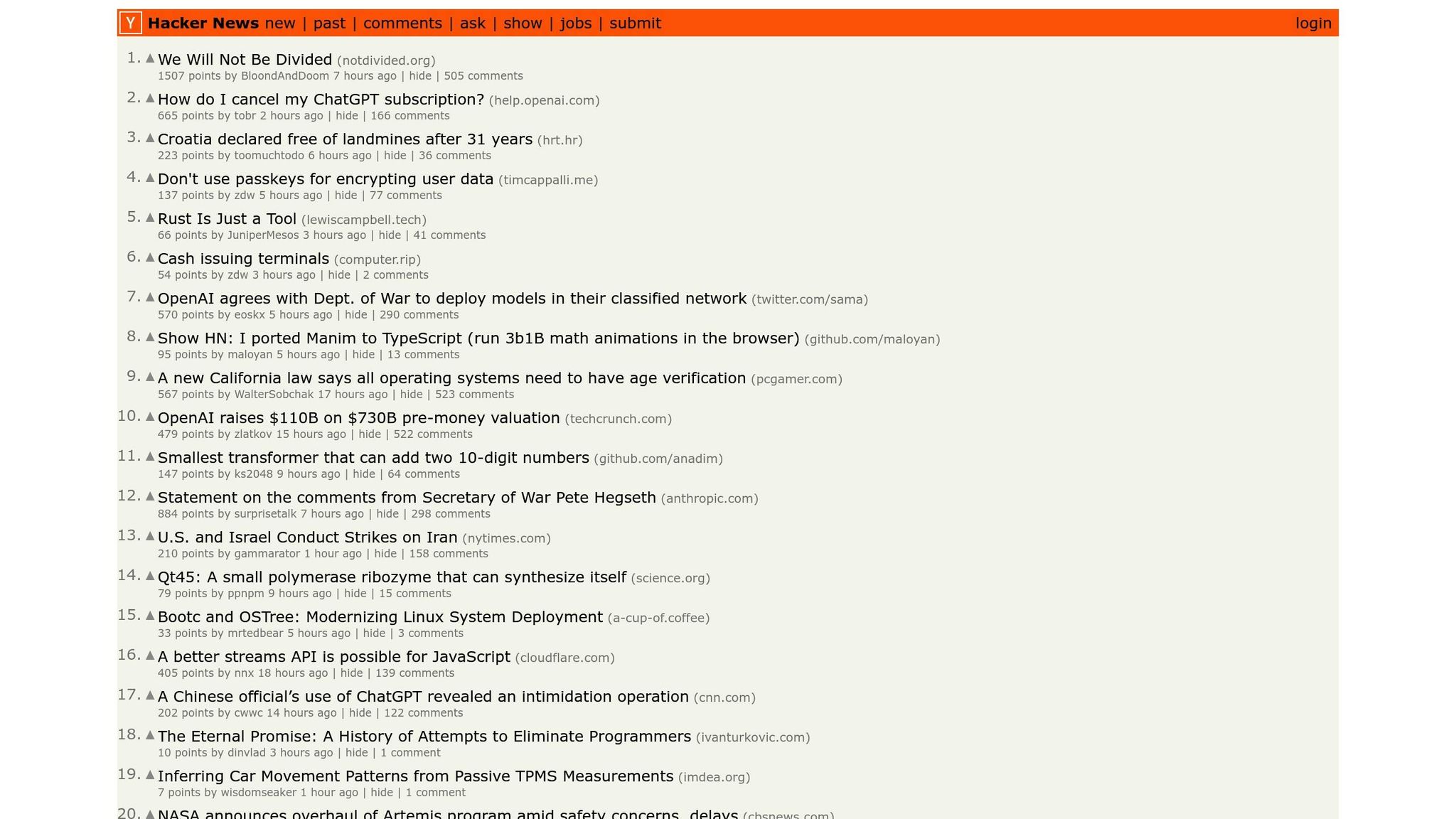
When it comes to sourcing top-tier developer talent, Hacker News is a platform you don’t want to overlook. It’s a hub where developers come together to discuss technical topics, showcase their projects, and dive deep into emerging tech trends. This makes it a natural space to discover passive talent through their contributions and interactions.
Hacker News is more than just a discussion board - it’s where developers solve complex problems, build innovative tools, and engage in meaningful technical conversations. Topics range from AI inference engines to system security vulnerabilities, offering a glimpse into the expertise and interests of its active participants.
Developer Engagement and Activity
One of the standout features of Hacker News is its "Show HN" threads. These are spaces where developers present their original projects, like Go-based reimplementations of tools or open-source engines . Recent threads that have drawn significant attention include discussions on multi-agent orchestrators, LLM inference engines with fast cold-start times, and interpretable language models . Additionally, technical debates - such as the analysis of the XZ backdoor - highlight the platform's ability to attract senior-level talent with deep technical knowledge . These interactions make it easier to identify skilled developers whose expertise shines through their contributions.
Identifying Passive Talent
Hacker News offers a variety of conversation formats that help recruiters uncover unique developer profiles. For example:
- Show HN threads often feature creators, open-source contributors, and engineers working on cutting-edge tools.
- Technical debates attract senior contributors, architects, and specialists in areas like AI and security.
- Ask HN threads reveal problem-solvers and mentors who generously share their expertise.
By reviewing comment histories, recruiters can assess a developer’s technical skills, communication abilities, and areas of expertise - all without needing a traditional resume.
Sourcing High-Quality Talent
Hacker News is a powerful tool for targeting senior developers in niche areas. Its forums allow recruiters to connect with highly skilled professionals, especially in specialized fields like AI/LLM development, Rust or Go systems programming, and security engineering . While the platform may not provide high-volume sourcing, it excels in quality-focused recruitment. By concentrating on specific expertise areas, recruiters can make meaningful connections with developers who are often hard to find elsewhere.
10. Kaggle

Kaggle is a platform tailored for data scientists and machine learning engineers to showcase their expertise through competitions. For instance, Red Hat once hosted a competition on Kaggle to develop a customer classification algorithm, offering a US$50,000 prize . In the crowded recruiting world, Kaggle stands out as a place to find skilled developers by highlighting their real-world problem-solving abilities. With challenges often featuring substantial rewards, sometimes up to US$50,000 , Kaggle provides a unique way to identify talent actively engaged in solving complex technical problems.
Developer Engagement and Activity
Kaggle profiles offer a detailed look at a candidate's technical skills and community involvement. Each profile is divided into three main sections:
- Competitions: Participants solve business problems by creating algorithms, showcasing their problem-solving abilities.
- Kernels: These sections display code samples and documentation quality, offering insight into coding proficiency.
- Discussions: This area highlights communication skills and how well users engage with the community.
Profiles also include an activity heat map, current job title, and geographic location. One of Kaggle's standout features is its ranking system, which identifies top performers. The "Top 100" users list is especially helpful for spotting elite talent. As AmazingHiring notes:
Kaggle has a Top 100 users, and if a person is on this list, it is a very good indicator .
Ease of Passive Talent Identification
Kaggle simplifies the process of finding qualified candidates by validating skills through tangible results. Reviewing Kernels provides a clear picture of coding ability and documentation standards. The Discussions section reveals how well candidates can explain technical concepts, offering clues about their seniority and leadership potential. Many profiles also include contact information or links to other professional platforms, making it easier to connect with candidates.
To refine your search by location or specific skills, you can use Google's X-ray search with queries like:site:kaggle.com "Top 100" location
Sourcing Volume Potential
While Kaggle isn't designed for high-volume recruiting, it excels at pinpointing top-tier talent for specialized roles. Like other niche platforms, it offers a curated pool of experts, helping recruiters avoid the noise of broader job boards. Kaggle is particularly valuable for finding specialists in machine learning. Focus on candidates whose competition history aligns with your company's technical needs, such as expertise in image classification, natural language processing, or customer behavior analysis.
11. GitLab
GitLab serves as both a code repository and a collaboration hub, where developers contribute to projects, review code, and engage in technical discussions. Unlike traditional professional networks, GitLab attracts developers who showcase their skills through their work rather than resumes. This makes it an excellent platform for evaluating real-world contributions.
Developer Engagement and Activity
GitLab offers a window into a developer’s technical abilities through merge requests, code reviews, and issue discussions. When assessing candidates, pay attention to their merge requests and the quality of their comments. Developers who provide thoughtful code reviews, suggest meaningful improvements, or troubleshoot issues demonstrate not only technical expertise but also strong collaboration skills. Their activity history reveals their ability to solve real problems effectively.
Identifying Passive Talent
GitLab profiles highlight contributions across various projects, making it easier to identify developers who excel in areas relevant to your tech stack. Look for consistent contributions, well-documented code, and active participation in technical discussions. Since 80% of high-impact, passive talent is found outside traditional job boards and LinkedIn , GitLab offers access to developers who prioritize technical contributions over maintaining conventional profiles. This platform gives you clear, actionable insights into their skills, enabling precise and targeted outreach.
Best Use for Sourcing
GitLab is ideal for targeted sourcing rather than high-volume recruiting. Its community consists of technical specialists, providing high-quality signals for specific roles. To make the most of GitLab’s focused community, try these strategies: monitor technical keywords and discussions relevant to your roles, and establish credibility by participating in community discussions before reaching out. As Stuart Gentle, Publisher at Onrec, explains:
The effective approach is authentic engagement: providing useful answers, contributing to conversations, and sharing relevant information .
12. Technical Subreddits
As recruiters look for alternatives to LinkedIn, technical subreddits stand out as a valuable resource. Reddit hosts some of the most active developer communities, offering a direct line to millions of professionals.
Developer Engagement and Activity
Technical subreddits are buzzing with discussions about real-world challenges, career advice, and industry trends. Popular communities like r/programming and r/learnprogramming boast millions of members actively sharing insights. For career-specific topics, r/cscareerquestions is a go-to space with over 1.5 million members, focusing on salary negotiations, job searches, and career growth .
For more specialized needs, subreddits like r/experienceddevs provide a higher signal-to-noise ratio by requiring users to verify their professional experience. This makes it an excellent space for sourcing senior talent . Similarly, r/webdev features threads where developers showcase personal projects, while niche communities like r/devops, r/datascience, and r/MachineLearning cater to specific technical expertise .
Ease of Passive Talent Identification
Reddit offers a unique window into developers' work and thought processes. Threads often reveal the challenges they face and their honest opinions about tools and workflows . By following these conversations, recruiters can identify strong candidates and gain insights into their problem-solving abilities and communication styles. The platform’s anonymous nature encourages candid discussions, making it easier to evaluate potential talent in a natural setting.
Outreach Effectiveness
When done right, outreach in these communities can yield response rates between 15% and 25% . The key is to engage authentically - join discussions, offer constructive feedback on projects, and build trust before initiating direct contact. Understanding why passive developers ignore recruiters can help you refine this initial approach. However, it’s important to note that extreme opinions in some threads can occasionally skew perceptions of candidates' interpersonal skills . These engagement strategies work best when integrated into a broader developer sourcing strategy aimed at connecting with developers where they are most active.
Channel Comparison Table
::: @figure 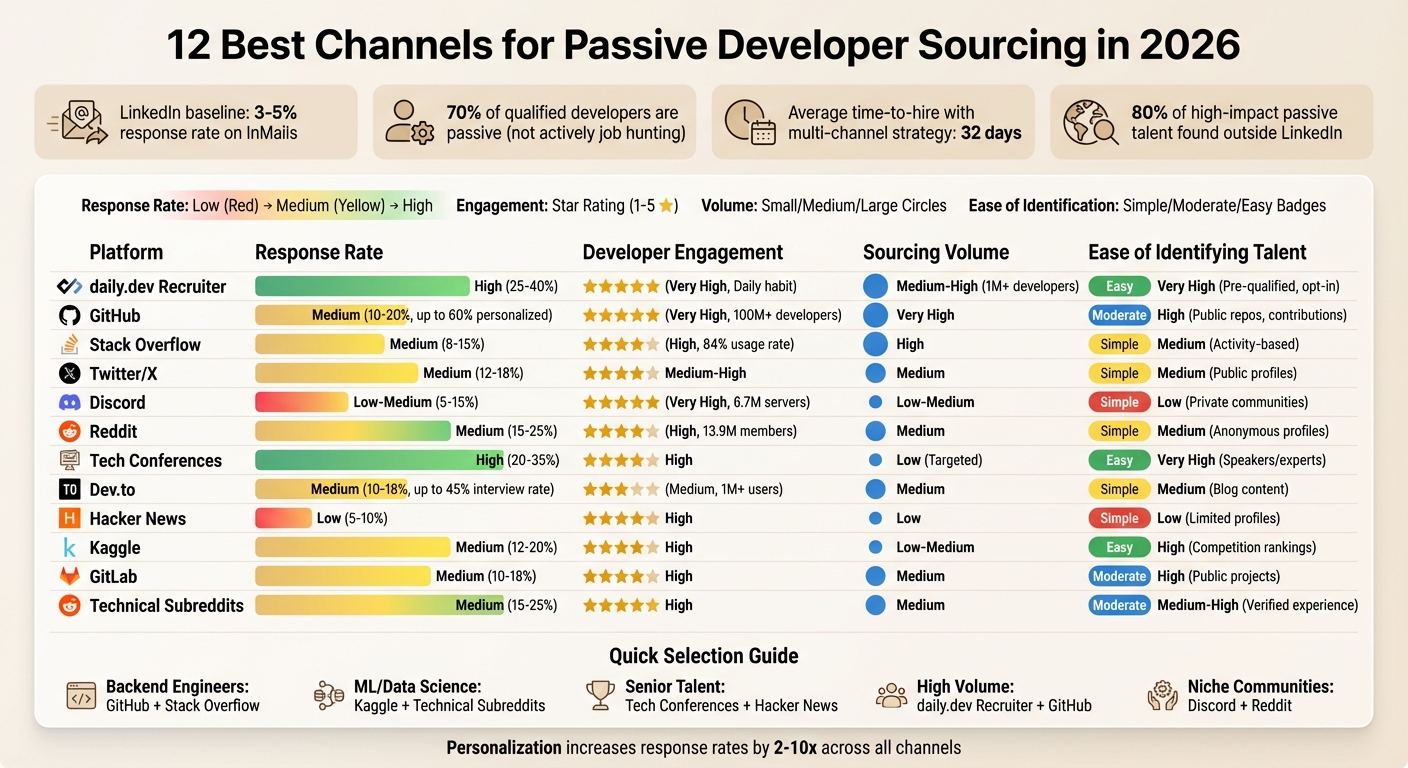 {12 Best Passive Developer Sourcing Channels: Response Rates and Engagement Comparison 2026}
This table summarizes the key metrics discussed earlier for each platform, offering a quick glance at how they compare in terms of response rates, developer engagement, sourcing volume, and ease of identifying passive talent. Each channel has its strengths, depending on its audience and how developers interact with it.
Response rates vary significantly based on the platform's culture and how often developers use it. Some channels, like tech conferences, can exceed a 20% response rate, while others, such as Discord or Hacker News, tend to be lower.
Developer engagement reflects how actively developers participate. Platforms like daily.dev Recruiter, GitHub, and Stack Overflow stand out due to their frequent activity, whether it's daily visits, code contributions, or technical discussions. Discord fosters real-time engagement, while Hacker News attracts active readers but lacks detailed profiles for sourcing.
Sourcing volume depends on the platform's user base and accessibility. GitHub offers access to millions of developers with public repositories, making it ideal for large-scale sourcing. On the other hand, niche platforms like Kaggle or technical subreddits provide smaller but highly targeted audiences, perfect for specialized roles. Tech conferences, while low in volume, are excellent for connecting with senior talent and industry leaders.
Here's how the platforms stack up:
| Channel | Response Rate | Developer Engagement | Sourcing Volume | Ease of Identifying Passive Talent |
|---|---|---|---|---|
| daily.dev Recruiter | High | Very High (Daily habit) | Medium-High | Very High (Pre-qualified, opt-in) |
| GitHub | Medium (10–20%) | Very High | Very High | High (Public repos, contributions) |
| Stack Overflow | Medium (8–15%) | High | High | Medium (Activity-based) |
| Twitter/X | Medium (12–18%) | Medium-High | Medium | Medium (Public profiles) |
| Discord | Low-Medium (5–15%) | Very High | Low-Medium | Low (Private communities) |
| Medium (15–25%) | High | Medium | Medium (Anonymous profiles) | |
| Tech Conferences | High (20–35%) | High | Low (Targeted) | Very High (Speakers/experts) |
| Dev.to | Medium (10–18%) | Medium | Medium | Medium (Blog content) |
| Hacker News | Low (5–10%) | High | Low | Low (Limited profiles) |
| Kaggle | Medium (12–20%) | High | Low-Medium | High (Competition rankings) |
| GitLab | Medium (10–18%) | High | Medium | High (Public projects) |
| Technical Subreddits | Medium (15–25%) | High | Medium | Medium-High (Verified experience) |
To maximize your hiring efforts, mix and match channels based on your goals. For senior-level roles demanding technical expertise, focus on GitHub, tech conferences, and specialized communities. For large-scale hiring, platforms like daily.dev Recruiter provide broad reach and consistent engagement. If you're looking for niche talent in areas like machine learning or data science, Kaggle and technical subreddits are excellent choices.
Conclusion
70% of qualified developers aren’t actively looking for jobs. This means traditional job boards won’t help you reach this hidden talent pool. And with LinkedIn flooded by recruiter messages, standing out becomes nearly impossible. The 12 channels outlined in this guide - from daily.dev Recruiter and GitHub to Discord communities and tech conferences - are where these passive developers hone their skills, share insights, and immerse themselves in their craft.
Start small by focusing on 2–3 channels where your target developers are most active. For backend engineers, GitHub is ideal for tracking code contributions, while Stack Overflow highlights their technical expertise. For developers who stay updated with industry trends, daily.dev Recruiter provides warm, double opt-in introductions, saving you from ineffective cold outreach vs. warm intros. Track metrics like response rates, interview success, hire quality, and overall hiring efficiency for each channel. Companies using a multi-channel strategy consistently see better results across these key metrics.
Of course, finding the right channels is just the beginning - your outreach matters just as much. Personalization is critical. Tailor your messages to fit each platform’s vibe: mention specific GitHub projects, highlight expertise from Stack Overflow, and engage authentically in Discord and Reddit communities before bringing up job opportunities. Generic, template-style messages won’t cut it - 90% of developers ignore recruiter spam.
It’s also time to move beyond outdated keyword-based sourcing. Modern AI tools that analyze full professional profiles - like code contributions, technical discussions, and competition rankings - are far more effective than basic Boolean searches. Focus on actual skills and accomplishments rather than traditional credentials, adapting your approach for each platform’s unique format.
Finally, shift your mindset from short-term hiring to building long-term talent pipelines. Foster ongoing engagement through email newsletters, Discord groups, or technical content. To keep your strategy sharp, review your channel performance monthly. Invest more in what works and drop what doesn’t. This data-driven, multi-channel strategy turns passive developer sourcing into a powerful, strategic advantage.
FAQs
How do I pick the best 2–3 channels to source passive developers?
To find the top 2–3 channels for reaching passive developers, focus on platforms where engagement is high, trust is established, and skills can be assessed. GitHub and Stack Overflow are excellent for evaluating coding abilities and problem-solving expertise. Meanwhile, communities like Reddit, Discord, and daily.dev provide spaces for meaningful conversations and connections. Choose platforms that promote active participation and deliver better response rates to make your outreach more effective.
What should I personalize in outreach to boost developer response rates?
To get better responses from developers, make your outreach personal and relevant. Mention their specific skills, projects, or interests to show you've done your homework. Platforms like GitHub are great for understanding their goals and work - use this insight to craft a tailored message. Always lead with value by sharing something useful, being upfront about compensation, and acknowledging their contributions or involvement in the community. This thoughtful approach helps build trust and makes your message stand out.
What metrics should I track to show passive sourcing is effective?
Key metrics to track include time-to-hire, response rates, candidate engagement, the quality of candidates (such as their performance in skills assessments or code contributions), and cost per hire. These metrics provide insight into how effective your passive sourcing efforts are and highlight areas where adjustments may be needed.
.png)