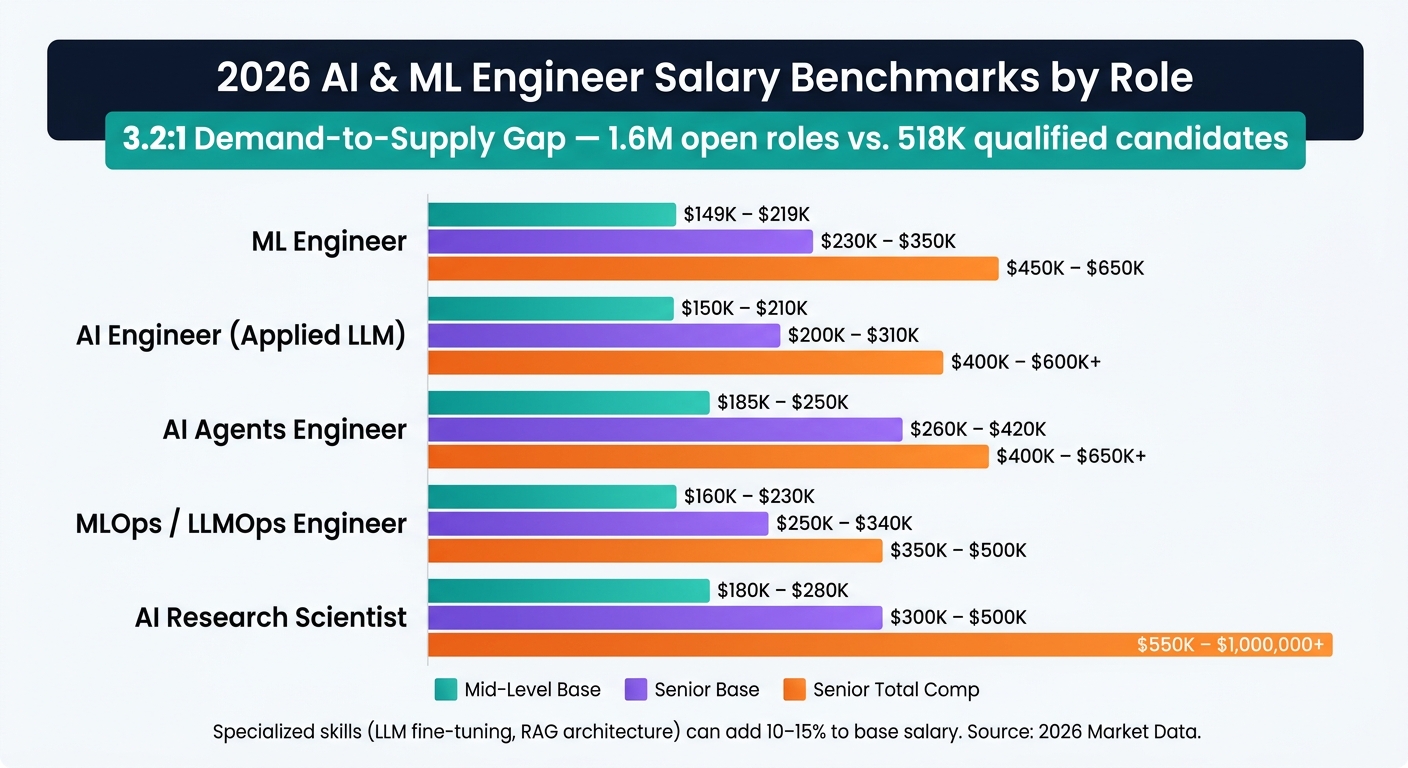
Recruiting AI and ML engineers in 2026 is more challenging than ever due to a 3.2:1 demand-to-supply gap - with 1.6 million open roles but only 518,000 qualified candidates. The competition is fierce, salaries are high, and the hiring process must be fast and precise to secure top talent.
Key takeaways:
- Demand is growing faster than supply: AI job postings increased by 163% from 2024 to 2025, while qualified professionals grew by only 24%.
- Salaries are steep: Senior AI engineers earn $230,000–$500,000 in base pay, with total compensation often exceeding $600,000.
- Speed matters: Top candidates accept offers in 2–3 weeks; slow hiring processes lose out.
- Role clarity is critical: Misaligned job descriptions waste time and resources. Define roles based on specific business needs, such as AI Engineers for integrating features or MLOps Engineers for maintaining systems.
To succeed:
- Clearly define the role and its responsibilities.
- Source talent via platforms like GitHub, Kaggle, and Hugging Face.
- Streamline your interview process with practical assessments like paid take-home tasks.
- Offer competitive compensation aligned with market benchmarks.
Hiring the right AI talent requires precision, speed, and a deep understanding of the current market dynamics.
The AI and ML Talent Market in 2026
Demand, Supply, and the Competition for Talent
Hiring AI professionals remains a challenge for 72% of global employers, making it the toughest area to recruit in tech . This isn't just about rising demand - it's about a structural gap. The number of professionals with AI expertise increased from 1 million in 2023 to 7 million in 2025, but that's still not enough to meet the growing need .
The reality is, top-tier candidates - those skilled in building production-grade systems - are rarely job hunting. They’re busy at leading companies or well-funded startups, often fielding multiple offers without ever browsing platforms for hiring software developers. If your hiring strategy depends on applications rolling in, you're already behind—ensure you have a developer hiring checklist to stay ahead.
"Speed wins. Period. Top AI candidates receive multiple offers within days of starting to look." - Devin Hornick
2026 Salary Benchmarks for AI and ML Roles
With demand outstripping supply, salaries for AI roles reflect the premium placed on experience and expertise. Here’s what competitive compensation looks like in 2026:
| Role | Mid-Level (3–5 yrs) Base | Senior (5–8+ yrs) Base | Total Comp (Senior) |
|---|---|---|---|
| ML Engineer | $149,000 – $219,000 | $230,000 – $350,000 | $450,000 – $650,000 |
| AI Engineer (Applied LLM) | $150,000 – $210,000 | $200,000 – $310,000 | $400,000 – $600,000+ |
| AI Agents Engineer | $185,000 – $250,000 | $260,000 – $420,000 | $400,000 – $650,000+ |
| MLOps / LLMOps Engineer | $160,000 – $230,000 | $250,000 – $340,000 | $350,000 – $500,000 |
| AI Research Scientist | $180,000 – $280,000 | $300,000 – $500,000 | $550,000 – $1,000,000+ |
Specialized skills can boost salaries even further. Expertise in areas like LLM fine-tuning (LoRA/RLHF) or RAG architecture can add 10–15%. MLOps and deployment capabilities often come with an extra $15,000–$30,000 . However, don’t overlook the full cost of hiring. A senior AI engineer can cost between $430,000 and $630,000 annually when you factor in recruiter fees, GPU budgets, and benefits .
Understanding these benchmarks is critical before defining the exact role your project requires.
How to Decide Which AI or ML Role You Need
In such a competitive market, misaligning roles can lead to wasted resources. Before drafting a job description, identify the specific problem you need solved. A common misstep is confusing an "AI Engineer" with an "ML Engineer" - their roles are fundamentally different.
"The model is 20% of the work. The infrastructure to deploy, monitor, retrain, and maintain it is the other 80%." - KORE1
Here’s a quick guide to help align your needs with the right role:
| If your goal is… | Hire this role | Key skills to test |
|---|---|---|
| Add AI features to an existing product | AI Engineer | RAG, API integration, prompt engineering, evals |
| Train or fine-tune proprietary models | ML Engineer | PyTorch, LoRA/QLoRA, GPU optimization, distributed training |
| Build autonomous multi-step workflows | AI Agents Engineer | LangGraph, CrewAI, multi-agent orchestration |
| Keep production models reliable and cost-efficient | MLOps / LLMOps Engineer | CI/CD for ML, drift detection, observability, Kubernetes |
| Conduct original model research | AI Research Scientist | Math, publications, experimental design |
Clearly defining the problem is key. For instance, tackling hallucinations in support documentation requires a specific role, not a vague “hire an AI person” approach . If you’re early-stage or launching a new AI initiative, consider starting with a contract-to-hire arrangement for 6–12 months. This can help validate the role's scope before committing to a full-time hire with a $400,000+ price tag .
Defining AI and ML Roles Clearly
What Each AI and ML Role Actually Does
Once you've confirmed the need to hire, the next step is to clearly define the role. Each title in the AI and ML space carries distinct responsibilities.
An AI Engineer is essentially a systems integrator. They focus on building applications by leveraging existing foundation models like those from OpenAI, Anthropic, or Gemini. Their work involves APIs, retrieval-augmented generation pipelines, and prompt engineering. Instead of creating models from scratch, they integrate AI functionalities into products.
An ML Engineer, on the other hand, operates deeper in the development stack. They handle tasks like managing model weights, creating training pipelines, optimizing GPU infrastructure, and fine-tuning models. If your organization needs a custom model tailored to your proprietary data, this is the role you need.
A Data Scientist is more research-oriented, focusing on statistical analysis, experimentation, and prototyping - often using tools like Jupyter notebooks. They are not typically involved in production engineering. Meanwhile, an MLOps Engineer ensures the operational side of machine learning runs smoothly. Their responsibilities include model serving, monitoring, detecting drift, and maintaining reliability in production systems. Lastly, the LLM Engineer is a newer specialization, concentrating on building applications specifically for large language models using frameworks like LangChain or LangGraph.
"The generic title 'AI engineer' is becoming less useful. What drives compensation now is the specific type of work someone does." - KORE1
By defining these roles clearly, you can align technical expertise with your business needs more effectively.
Connecting Role Responsibilities to Business Goals
Once you've clarified the differences between roles, the next step is to match these responsibilities to your specific business challenges. Start by identifying the problem you want to solve. Then, think about what the hire will need to deliver.
For instance, if your goal is to integrate a chat assistant into your support product, you'll need an AI Engineer who can manage retrieval quality and ensure seamless integration with your existing systems. If you're tackling fraud detection with proprietary transaction data, an ML Engineer skilled in training pipelines and GPU optimization is the better choice. And if your current models are live but experiencing reliability issues, that’s where an MLOps Engineer comes in.
"Hire against business outcomes, not tool lists." - TekRecruiter
Writing job descriptions focused on what the candidate will own and deliver - rather than just listing technical tools - helps attract the right talent and sets clear expectations from the start.
Common Mistakes When Defining AI and ML Roles
Getting the role definition right is crucial to avoid mis-hires, which can be both costly and time-consuming. One common mistake is the "unicorn hunt" - creating job descriptions that combine expertise in PyTorch, LangChain, Kubernetes, and advanced research into one role. This approach often leads to confusion and mismatched expectations.
"The AI engineer job description is currently the most mis-calibrated posting in tech hiring... it lists every AI framework anyone on the team has ever touched and ends up describing four different jobs in one." - Tom Kenaley, KORE1
Other frequent errors include requiring a PhD for roles focused on production systems - where hands-on production experience is far more valuable - and overlooking the importance of MLOps. Hiring talented model builders without planning for reliable deployment and monitoring can result in impressive prototypes that never make it to production, missing out on revenue opportunities.
"AI engineer describes at least four distinct roles with different stacks, outputs, and salary bands; conflating them is how you end up with a six-figure mis-hire and a stalled roadmap." - Tamyris Cuppari Kohler
Where and How to Find AI and ML Talent in 2026
The Best Places to Source AI and ML Engineers
Finding AI and ML engineers requires more than just posting on generic job boards. These professionals are in high demand and typically aren't waiting around for opportunities to come to them . To connect with them, you need to focus on where they spend their time and showcase their skills.
Some of the best platforms to source software developers include GitHub, Kaggle, Hugging Face, and arXiv. Here's what to look for on each:
| Platform | Key Indicators of Talent |
|---|---|
| GitHub | Look for maintained repositories, meaningful pull requests, and deployment artifacts that demonstrate practical experience . |
| Kaggle | Pay attention to robust feature engineering, reproducibility of work, and sensible validation techniques . |
| Hugging Face | Check for detailed model cards, thoughtful demos, and a history of valuable contributions . |
| arXiv | Focus on authorship in niche areas like Retrieval-Augmented Generation (RAG) or Agentic workflows . |
These platforms not only highlight technical skills but also provide a starting point for engaging with candidates in meaningful ways.
Beyond these platforms, niche communities are excellent hubs for finding serious practitioners. Spaces like the latent.space Discord, Maven cohort alumni networks (from courses by experts like Hamel Husain), and the r/LocalLLaMA subreddit are becoming go-to places for discovering engineers skilled in shipping production systems . For senior-level talent, Slack groups for former employees of organizations like OpenAI, Anthropic, Google DeepMind, and Meta FAIR are invaluable, as they often house some of the most experienced professionals in the field .
While LinkedIn remains a useful tool, its strength lies in retrieving contact details rather than assessing technical expertise .
Using daily.dev Recruiter for AI and ML Hiring
Modern AI recruitment has shifted toward platforms where developers are already active, making it easier to connect with them without relying on cold outreach.
One such platform is daily.dev Recruiter, which taps into a network of developers who regularly engage with technical content and track AI and ML trends. This platform helps you reach passive candidates who are already signaling interest in the field. Plus, its double opt-in system ensures that developers only engage when genuinely interested, making the process more efficient. This aligns perfectly with the earlier insights about targeting production-focused talent.
Once you've identified potential candidates, the next step is crafting effective outreach.
How to Write Outreach That AI and ML Engineers Will Actually Read
One of the most common mistakes in AI recruiting is sending outreach messages that feel generic or overly promotional. Engineers can spot this type of messaging instantly, and it often turns them away.
"Great ML engineers read job descriptions like code reviews. Vague copy signals a vague team." - CalTek Staffing
The key to successful outreach is specificity. Reference their actual work - whether it's a GitHub repository, a paper they've authored, or a Kaggle competition result - and tie it directly to a real-world production challenge your team is tackling. Be upfront about what they'll own, the type of data they'll work with, and the compute resources available. And don't forget to include clear details about compensation - burying this information can be a dealbreaker.
A strong outreach message typically includes these four elements:
- A reference to their specific work or achievements.
- A description of a real production issue your team is solving.
- A clear outline of the role's responsibilities and scope.
- A concise, low-pressure request for an initial conversation .
This approach mirrors the importance of role clarity - vague outreach, much like unclear job descriptions, can drive away top talent. By respecting their time and demonstrating focus, you signal that your team values precision and results-oriented thinking.
"The winning company paid less and got him anyway because they removed three frictions he had lived with for two years: compute access, technical leadership, and the ability to publish." - CalTek Staffing
Finally, speed is critical. The average time-to-fill for AI roles has dropped to just 25 days, with top candidates often accepting offers within 2–3 weeks . A slow hiring process not only risks losing great talent but also reflects poorly on your organization's efficiency and pace.
Building an Interview Process for AI and ML Roles
When it comes to identifying top-tier AI and ML engineers, an effective interview process is essential. It's not just about finding candidates who can write code but those who can deliver solutions that work in real-world production environments.
Picking the Right Assessment Format
Traditional coding challenges often fall short when evaluating an engineer's ability to create production-ready ML systems. By 2026, the best assessments are those that mimic actual production challenges. One standout method is a paid take-home task, which typically compensates candidates $300–$500 for 4–6 hours of work. This task might involve building a small Retrieval-Augmented Generation (RAG) system with an evaluation harness. It’s a highly effective way to gauge how candidates approach implementation decisions, respect their time, and filter out those who bluff their way through interviews .
While take-home tasks are powerful, other assessment formats can also play a role. Here's a comparison to help you decide which one fits your needs:
| Assessment Format | Best For | Potential Pitfalls |
|---|---|---|
| Paid Take-Home | RAG design, eval pipelines | Requires 4–6 hours of candidate time |
| Live Debugging | Problem-solving instincts | Needs a skilled internal interviewer |
| Past Work Review | Verifying production experience | Confident bluffers can fake it |
| System Design | Architecture and cost thinking | Can become too theoretical without proper probing |
To get the best results, use a structured rubric alongside these assessments. Combine this with tests of independent reasoning to improve retention and long-term success .
A structured system design interview is another critical step in understanding a candidate's practical skills and ability to execute.
How to Run an ML System Design Interview
The purpose of an ML system design interview is to evaluate how a candidate handles the entire model lifecycle under realistic constraints - not to test how well they’ve memorized concepts. A 90-minute interview loop works well :
| Interview Phase | Duration | What You're Evaluating |
|---|---|---|
| Past Work Walkthrough | 15 min | Dataset size, evaluation methods, production challenges |
| System Design | 30 min | Chunking strategy, vector database choice, cost projections |
| Practical Coding | 30 min | Coding skills and data handling expertise |
| Candidate Questions | 15 min | Interest in evaluation infrastructure, model pinning, on-call responsibilities |
During the system design segment, focus on tradeoffs. For instance, if a candidate mentions using Ray Serve, ask them to explain the tradeoffs involved. Strong candidates will narrow the problem, state their assumptions, and highlight possible alternatives . Also, assess their cost awareness - senior engineers should be able to estimate per-query costs and discuss when to use a more affordable model tier versus a more capable one .
"The model is 20% of the work. The infrastructure to deploy, monitor, retrain, and maintain it is the other 80%." - KORE1
A clever screening trick for 2026: mention a fictional model like "Claude Sonnet 5." If a candidate claims experience with it, they’re likely bluffing. Engineers who are truly up-to-date rely on primary documentation rather than social media summaries .
Assessing Research Depth and Team Collaboration
Technical skills are only part of the equation. It’s just as important to evaluate how well a candidate communicates and collaborates. Can they explain a complex model decision to a non-technical product manager? Can they push back diplomatically when a business requirement conflicts with what the data shows?
One way to evaluate this is by asking about a production bug they’ve resolved. Strong answers will include specific examples, such as latency spikes, model degradation, or prompt injection issues - not vague mentions of "hallucination problems" . This kind of "war story" test helps distinguish candidates who have hands-on experience from those who’ve only read about it.
"Eval literacy - knowing how to design, run, and reason about model evaluations - is the single biggest signal of 'this person actually built with LLMs' vs watching YouTube videos." - The AI Career Lab
Finally, pay close attention to the questions candidates ask you. Senior engineers often inquire about your evaluation infrastructure, model-version-pinning approach, and cost management strategies . These questions reflect a deeper understanding of the role and a cross-functional mindset - qualities that are essential for success in production-grade ML engineering.
Conclusion: What to Take Away from This Guide
This guide emphasizes the importance of precision in defining roles, streamlining processes, and targeting the right talent pools when recruiting AI and ML engineers in 2026. With a demand-to-supply ratio of 3.2:1 - 1.6 million open roles and only 518,000 qualified candidates available - success hinges on refining every step of your hiring strategy.
Clear role definitions are essential. Avoid generic job descriptions that fail to distinguish between AI and ML engineering roles. Instead, provide specific details about the tech stack, production environment, and key objectives for the first six months. This clarity saves time and ensures you're attracting the right talent.
Speed is equally critical. The best candidates often juggle multiple offers, sometimes within days. A hiring process that drags beyond three weeks risks losing them to competitors. To stay competitive, aim for a 90-minute interview loop, compensate take-home tasks at $300–$500, and make decisions quickly.
When it comes to sourcing, focus on active engagement. Platforms like daily.dev Recruiter connect you with engineers who are already immersed in AI and ML discussions, such as those exploring RAG architecture threads. These candidates are far more likely to be receptive than those with outdated résumés sitting in databases.
Finally, align your compensation packages with 2026 market standards. Senior AI and ML engineers command base salaries between $220,000 and $300,000+, with total compensation often reaching $350,000–$600,000+ . Falling short on budget could mean losing top candidates at the offer stage, wasting valuable time and effort, or hiring AI engineers without high agency fees.
For further guidance on AI recruiting strategies and best practices, check out our additional resources.
FAQs
Which AI/ML role should I hire first for my project?
By 2026, companies looking to leverage AI should focus on hiring an applied LLM engineer as their first step. This role is all about creating production-ready applications using pre-existing foundation models, bypassing the need to train models from the ground up.
For SaaS products that require quick AI features - like chat functionality or text summarization - an integrator is the ideal hire. However, if your company is building AI-first products or managing multiple LLM surfaces, a platform engineer should take precedence. These experts are skilled in tasks like retrieval-augmented generation (RAG), agent management, evaluation processes, and monitoring costs effectively.
How can I verify an AI engineer has real production experience?
To gauge real-world production experience, ask candidates to describe a production feature they delivered in the past year. Pay attention to specifics, such as how they evaluated its success, handled failure scenarios, and resolved issues. Strong candidates will share clear examples of responding to incidents and using metrics to track performance. Additionally, review their GitHub or other public repositories to assess the quality of their documentation and their approach to edge cases. If they struggle to discuss a production failure or explain their evaluation process, it may indicate limited hands-on experience.
What can smaller companies offer besides higher pay to win AI talent?
To stand out against major tech giants, emphasize what smaller companies excel at: meaningful contributions and autonomy. Showcase opportunities where employees can tackle real-world, high-impact challenges using proprietary data. Sweeten the deal with perks like dedicated time for research, flexible GPU budgets, and the ability to publish findings or attend industry conferences. Most importantly, stress that their work will have a direct impact on production systems, free from the layers of bureaucracy that often slow down larger organizations.
.png)