In 2026, hiring DevOps engineers requires a clear strategy due to the evolving nature of the role and high demand. These professionals now manage cloud infrastructure, write production-ready code, and integrate security into pipelines. With a 19.7% annual growth rate, the global DevOps market highlights the increasing demand, but 37% of IT leaders still report critical skill gaps.
Key Takeaways:
- DevOps vs. SRE vs. Platform Engineer: Understand the differences. DevOps focuses on delivery speed, SRE ensures system reliability, and Platform Engineers reduce developer friction. Mislabeling roles leads to hiring mismatches.
- What to Look For: Depth in tools like Kubernetes, Terraform, CI/CD, and observability. Prioritize candidates with experience solving incidents and building scalable systems.
- Sourcing Talent: Use platforms like GitHub, Slack communities, and tools like daily.dev Recruiter to connect with skilled, passive candidates.
- Job Descriptions: Focus on outcomes (e.g., reducing deployment time) instead of overwhelming tool checklists. Transparency about on-call duties and compensation is essential.
- Interviews: Evaluate candidates with practical exercises (e.g., Terraform module reviews, CI/CD scenarios) and behavioral questions about incident management.
Quick Comparison:
| Role | Focus | Metrics | Tools | On-Call Responsibility |
|---|---|---|---|---|
| DevOps Engineer | Delivery speed | CI/CD lead time, deployments | Terraform, GitHub Actions | Shared with developers |
| SRE | System reliability | SLOs, MTTR, error budgets | Prometheus, PagerDuty | Heavy/primary |
| Platform Engineer | Developer productivity | Platform adoption, time-to-deploy | Backstage, ArgoCD | Minimal (tool uptime) |
To attract top talent, move quickly - hiring processes longer than three weeks risk losing candidates. Offer competitive salaries (e.g., $145,000–$220,000 for senior roles in the U.S.) and emphasize perks like tooling autonomy and learning budgets. A transparent, well-structured approach not only attracts skilled candidates but also reflects your company’s infrastructure maturity.
DevOps, SRE, and Platform Engineering: What Each Role Actually Means
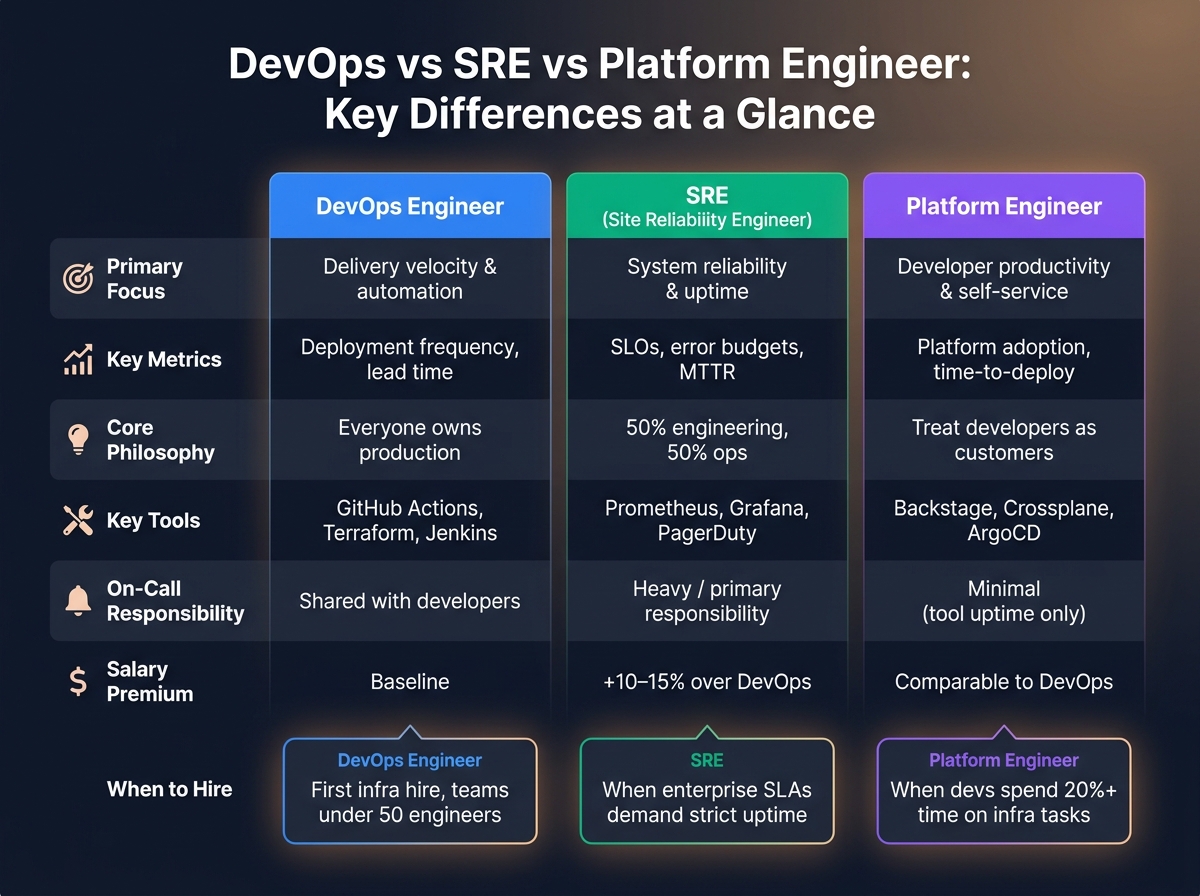
It's a mistake to treat DevOps, SRE (Site Reliability Engineering), and Platform Engineering as if they were interchangeable. Each role has a distinct purpose, and hiring the wrong fit can lead to immediate friction within a team. Below, we break down how these roles differ and why understanding their unique functions is critical.
What DevOps Engineers Do Today
In today’s tech landscape, DevOps engineers are essentially software engineers who specialize in managing the delivery pipeline. Their responsibilities include creating and maintaining CI/CD pipelines, managing cloud infrastructure through tools like Terraform and Pulumi , and overseeing observability across services. Proficiency in Kubernetes is a baseline expectation - senior engineers are often tasked with handling cluster networking, RBAC (Role-Based Access Control), and overall operations, not just simple deployments .
Additionally, DevOps engineers are now expected to integrate security into pipelines, optimize cloud costs, and even manage GPU resources for AI workloads .
"Modern DevOps engineers are software engineers first. They write production code (automation frameworks, internal tools, operators), not just bash scripts."
If the role you’re offering is primarily reactive - focused on triaging alerts, managing tickets, or simply keeping systems running - you’ll struggle to attract top-tier talent. The best DevOps engineers want to build systems, not just maintain them.
DevOps vs. SRE vs. Platform Engineer: A Side-by-Side Comparison
The easiest way to understand these roles is by asking: What problem are they solving? DevOps engineers focus on delivery speed. SREs tackle system reliability. Platform engineers aim to reduce developer friction.
Here’s a practical tip for recruiters: if your job description mentions terms like "self-service", "internal portals", or "Backstage", you’re likely describing a Platform Engineering role - not DevOps . Mislabeling these roles can attract the wrong candidates while discouraging the right ones.
The table below highlights the key differences between these roles:
| DevOps Engineer | Site Reliability Engineer | Platform Engineer | |
|---|---|---|---|
| Primary Focus | Delivery velocity & automation | System reliability & uptime | Developer productivity & self-service |
| Key Metrics | Deployment frequency, lead time | SLOs, error budgets, MTTR | Platform adoption, time-to-deploy |
| Core Philosophy | "Everyone owns production" | "50% engineering, 50% ops" | "Treat developers as customers" |
| Typical Work | CI/CD, IaC, cloud setup | Incident response, chaos engineering | Internal portals (Backstage), IDPs |
| Key Tools | GitHub Actions, Terraform, Jenkins | Prometheus, Grafana, PagerDuty | Backstage, Crossplane, ArgoCD |
| On-Call | Shared with developers | Heavy/primary responsibility | Minimal (focus on tool uptime) |
Clearly defining these roles helps prevent hiring mismatches and ensures candidates’ expectations align with your team’s needs. These distinctions can also shape job descriptions and hiring strategies as your organization grows.
One key consideration is on-call responsibilities. SRE roles typically come with a 10–15% salary premium compared to DevOps roles due to the heavier on-call workload . Be upfront about rotation schedules and compensation during initial conversations - senior candidates in 2026 will expect this level of transparency , requiring recruiters to adopt new candidate sourcing tactics .
When deciding which role to hire, consider the following:
- DevOps Engineer: Often the first infrastructure hire for teams with fewer than 50 engineers.
- SRE: Necessary when enterprise customers demand strict uptime SLAs.
- Platform Engineer: Ideal when developers are spending more than 20% of their time on infrastructure tasks instead of shipping features .
"SRE and Platform titles attract candidates who want to work on policy abstractions, not ship a Helm chart on a Tuesday." - Ayush Singh, Growth & Talent Partner, Cadence
Core Skills to Look for in DevOps Engineer Candidates
When evaluating DevOps engineer candidates, focus on the depth of their skills rather than creating a long checklist of tools. A common pitfall is disqualifying candidates simply because they don’t check every box on a tool-specific list.
Technical Skills: Tools and Hands-On Capabilities
Here are the key technical areas to assess:
Infrastructure as Code (IaC): Tools like Terraform remain widely used, though Pulumi is gaining popularity. Instead of focusing solely on tool familiarity, ask candidates to describe a module they’ve shipped. Pay attention to their understanding of module design, remote state management, and drift detection. These details reveal how they approach real-world challenges.
CI/CD Architecture: As GitHub Actions continues to surpass Jenkins in popularity, and GitLab CI remains a strong contender, examine how candidates design pipelines. Look for their ability to handle monorepos and securely manage secrets injection. These are critical to ensuring efficient and secure deployment practices.
Kubernetes Fluency: For senior roles, operational expertise in Kubernetes is a must. Evaluate their decision-making around configurations and their use of GitOps tools like ArgoCD or Flux. These skills indicate a mature approach to Kubernetes management.
Observability: Strong candidates don’t just list tools - they explain how they’ve used them to solve problems. Ask them to share how they’ve set SLOs, managed error budgets, or used tools like Prometheus and Grafana to prevent or resolve incidents.
DevSecOps: Security can’t be an afterthought. Assess their experience with automated scanning, secrets management tools like HashiCorp Vault, and adherence to least-privilege IAM principles. Engineers who see security as someone else’s responsibility can create vulnerabilities for the entire organization.
"A DevOps engineer who does not treat security as part of their daily work is a DevOps engineer who will eventually hand you an incident report." - Acquaint Softtech
Technical skills are just one side of the coin. Collaboration and communication are equally critical for success in DevOps.
Collaboration and Communication Skills
DevOps engineers thrive when they work effectively with cross-functional teams. The best candidates treat developers as stakeholders, focusing on creating self-service tools and "golden paths" that simplify workflows. Beware of candidates who insist on managing every deployment themselves - they can quickly become bottlenecks.
Written Communication: Clear documentation is a hallmark of great DevOps work. Ask for examples of runbooks or post-mortems they’ve written. Strong candidates can also translate technical risks into terms that non-technical stakeholders understand, which is vital for securing buy-in for infrastructure improvements.
"The engineers who create the most damage aren't the ones with weak technical skills. They're the ones who can't work with other humans." - Devin Hornick, KORE1
Red Flags and Green Flags in DevOps Candidates
Here’s a quick guide to help you assess candidates after interviews:
| Green Flag | Red Flag | |
|---|---|---|
| IaC | Can walk through a real module and explain state management and modularity. | Relies on monolithic scripts with hardcoded values. |
| Incidents | Describes a production incident they owned, including timelines and post-mortem actions. | Claims they’ve "never had a production incident." |
| Tooling | Explains why a tool was chosen and the tradeoffs involved. | Lists tools without linking them to business outcomes. |
| Collaboration | Builds self-service platforms to reduce developer friction. | Blames failures on other teams or dismisses developers. |
| Interviews | Clearly narrates their thought process during troubleshooting exercises. | Goes silent or provides solutions without explanation. |
"Candidates who've never caused an outage aren't trusted at the senior level. Candidates who can't explain the post-mortem aren't trusted either." - Gregg Flecke, Senior Talent Acquisition Partner, KORE1
One final thing to watch for: candidates who jump straight into coding without asking clarifying questions. In a real-world DevOps environment, this behavior can lead to costly mistakes. Strong candidates take the time to fully understand the constraints before diving into solutions - a habit that speaks volumes about their approach to production challenges.
How and Where to Source DevOps, SRE, and Platform Engineering Talent
Finding top-tier DevOps talent can be tricky. These professionals are rarely on the hunt for a new job - they’re usually content where they are. As Devin Hornick from KORE1 explains:
"The person you want is already working somewhere, probably already happy there, and isn't going to move unless something really compelling comes along."
So, if you want to attract these experts, you need to meet them where they spend their time.
Where DevOps Talent Spends Time
The best DevOps, SRE, and platform engineering professionals often gather in spaces dedicated to their tools and ecosystems. For example:
- Slack Communities: Channels like CNCF Slack and Kubernetes Slack are buzzing with discussions about real-world infrastructure challenges.
- Forums and Subreddits: Platforms like HashiCorp Discuss and subreddits such as r/devops, r/kubernetes, and r/aws are where engineers swap insights and share lessons learned.
- Conferences and Meetups: Events like KubeCon, DevOpsDays, and AWS re:Invent attract top practitioners. Smaller, more localized events - like HashiCorp User Groups (HUGs), AWS User Groups, and SRE meetups - offer great opportunities to connect in a more personal setting.
Another often-overlooked resource is GitHub. Engineers who contribute to Terraform providers, maintain public Helm charts, or create Kubernetes operators are essentially showcasing their skills. Searching for repositories tagged with terms like "production" or "aws-vpc" can help you pinpoint people with hands-on experience.
By understanding where these professionals gather and engage, you’ll be better equipped to connect with them.
Using daily.dev Recruiter to Find DevOps Candidates
In addition to engaging with communities, coding-focused candidate sourcing tools can expand your reach. One such tool is daily.dev Recruiter, which connects you with engineers actively exploring infrastructure and cloud topics. Since daily.dev is a go-to platform for engineers interested in DevOps and related fields, it’s a great way to reach passive candidates who are actively staying informed.
For roles in DevOps and platform engineering, this is particularly effective. Candidates currently exploring topics like ArgoCD, Pulumi, or internal developer platforms are more likely to be relevant than those who merely list these tools on their profiles without recent engagement.
How to Assess Seniority and Specialization
Once you’ve identified potential candidates, the next step is to assess their expertise. Title inflation is common in DevOps roles, so it’s important to verify whether a "Senior DevOps Engineer" is truly senior or more mid-level.
Here are some ways to gauge expertise:
- Original Work: Senior engineers often create Terraform or Pulumi modules from scratch.
- Incident Ownership: Ask candidates to describe a specific production outage they led. Details about the timeline, actions taken, and lessons learned can reveal their operational maturity.
Specialization matters, too. For example:
- SRE Candidates: They should be able to clearly explain service level objectives (SLOs) and error budgets.
- Platform Engineers: Look for candidates who can describe the "golden paths" they’ve built - self-service tools that improve developer workflows. If they can’t articulate the problem their internal developer platform solved, dig deeper.
"Platform Engineering is what DevOps evolves into at companies that are large enough to need it." - Akshay Ghalme, AWS DevOps Engineer
Finally, evaluate their cloud expertise. A deep understanding of one major platform (like AWS, Azure, or GCP) is often more valuable than surface-level knowledge of several. Strong candidates can explain the architectural decisions behind their preferred platform, which often signals a higher level of competence.
Writing DevOps Job Descriptions and Running Interviews
How to Write a DevOps Job Description That Works
Once you've identified promising DevOps candidates, the next step is crafting a job description that sets clear, outcome-driven expectations. Just as DevOps engineers evaluate companies based on their infrastructure maturity, they'll also judge your role by how well it's defined and communicated.
One common pitfall in these job postings is the overwhelming tool checklist. Listing expertise in AWS, Azure, GCP, Terraform, Pulumi, Kubernetes, Helm, ArgoCD, Datadog, and Vault as "required" is not only unrealistic but also discourages qualified candidates. It tends to attract applicants who simply keyword-match their résumés instead of those with true expertise.
Instead, narrow the technical requirements to five core skills. A typical list might include Kubernetes, Terraform, CI/CD design, proficiency in one cloud platform, and Docker. Beyond tools, focus on outcomes rather than tasks. For example, replace "manage CI/CD pipelines" with something like "reduce deployment time from 18 to 8 minutes" or "achieve a 20% reduction in cloud costs." This approach appeals to engineers who prioritize business impact. Be transparent about on-call responsibilities and compensation - vague descriptions often lead to unpleasant surprises, like unexpected 3 AM alerts. If the role is primarily reactive, consider redefining it before posting.
Lastly, outline the interview process in the job description. By 2026, top DevOps candidates often juggle multiple offers, and fast-moving hiring processes (under three weeks) tend to win out. A clear, streamlined process can make all the difference in securing the right hire .
How to Structure Technical and Behavioral Interviews
Assessing technical skills without coding tests is often more effective, as whiteboard puzzles are a poor fit for the operational judgment required in DevOps roles. In 2026, about 75% of senior DevOps interviews include live troubleshooting exercises . Your interview structure should evaluate both technical expertise and the collaborative, operational mindset essential for success in these roles.
A well-balanced technical screen, lasting about an hour, can focus on three key areas:
- Terraform module walk-through: Ask candidates to present a module they've built. Evaluate how they handle variable design, state management, and error handling - this reveals much more than just their knowledge of Terraform syntax.
- On-call war story: This gives insight into their experience with real-world issues and their ability to handle emergencies under pressure.
- CI/CD optimization scenario: Pose a challenge, such as, "The pipeline takes 35 minutes, and developers are bypassing it. How would you identify the bottleneck and what tradeoffs would you suggest?" .
For the behavioral portion, focus on production incidents the candidate has owned. Ask them to detail the timeline, what triggered the alert, and how the runbook was updated afterward. A lack of ownership in such situations often signals a gap in operational experience.
"Candidates who've never caused an outage aren't trusted at the senior level. The hiring manager is checking whether your self-awareness matches your seniority claim." - Gregg Flecke, KORE1
During live troubleshooting exercises, pay close attention to how candidates explain their thought process. Silence, rather than a less-than-perfect solution, is often the dealbreaker.
"What gets candidates eliminated in this round is silence. Not inability. Silence." - Gregg Flecke, Senior Talent Acquisition Partner, KORE1
DevOps Compensation Benchmarks and What Else Candidates Care About
After setting clear expectations through the job description and interviews, aligning compensation and benefits is critical to closing the deal.
In 2026, U.S. base salaries for DevOps engineers vary widely based on experience and specialization:
| Level | Experience | Base Salary Range |
|---|---|---|
| Entry-Level | 0–3 years | $85,000 – $120,000 |
| Mid-Level | 4–6 years | $120,000 – $165,000 |
| Senior | 7+ years | $145,000 – $220,000+ |
| Staff / Principal | 8+ years | $200,000 – $340,000+ |
Site Reliability Engineering (SRE) roles generally command a 10–15% premium over standard DevOps roles due to the additional on-call responsibilities and advanced reliability engineering expertise required .
But salary alone won't seal the deal. Top candidates also value perks like tooling autonomy, annual learning budgets of $3,000 or more, and a well-defined on-call culture with clear escalation paths and comprehensive runbooks. Including details like blameless post-mortems in your job description signals a mature and supportive work environment - something that doesn't go unnoticed by experienced engineers.
Building Your DevOps Hiring Strategy for 2026
The DevOps talent market in 2026 is highly competitive. While the field is expanding quickly, 37% of IT leaders still identify DevOps and DevSecOps skills as a major talent gap . This gap persists because the skill set required combines infrastructure expertise, security knowledge, and a collaborative mindset - qualities that traditional computer science programs often don’t fully address .
One critical factor that’s often overlooked? Speed. You need to move from initial contact to a signed offer in less than three weeks. Streamline your process to three or four interview stages at most, cutting out any steps that don’t directly impact your final decision . Moving quickly doesn’t just help you secure top talent - it sends a strong signal to candidates.
"The company that moves fastest wins. Even when they're not the highest bidder. Speed signals confidence. Delays signal dysfunction."
Once you’ve optimized for speed, the next step is role clarity before posting the job. Be clear about whether you need someone focused on deployment automation (DevOps), system reliability and error budgets (SRE), or internal developer tooling (Platform Engineering). This clarity shapes your interview process and ensures candidates know exactly what’s expected. Misaligned expectations are a major reason for early attrition, and savvy candidates can spot confusion from a mile away. If you’re a startup with fewer than 10 engineers and cloud costs under $20,000 per month, consider whether hiring a full-time $200,000+ DevOps professional is necessary - or if a managed service provider might be a better fit .
Lastly, consider your infrastructure maturity as part of your recruiting strategy. Top DevOps candidates will scrutinize your infrastructure just as much as you evaluate their skills. A job description that hints at a broken CI/CD pipeline, unclear on-call policies, or an overwhelming list of required tools can send candidates running to organizations with a more polished setup. A transparent, well-structured hiring process not only attracts strong candidates but also reflects the strength of your technical foundation. Tools like daily.dev Recruiter can help you connect with engineers who are already immersed in topics like infrastructure, cloud, and platform engineering, ensuring your outreach resonates with the right audience.
FAQs
Should I hire a DevOps engineer, an SRE, or a platform engineer?
The right decision hinges on factors like team size, the maturity of your infrastructure, and the specific hurdles you're facing.
- DevOps engineers are a great fit for smaller teams (fewer than 30 engineers) that require help with CI/CD pipelines, automation, and handling on-call responsibilities.
- SREs excel in maintaining uptime, managing SLOs, and handling incident responses, making them a solid choice for enterprise-level organizations.
- Platform engineers are ideal for larger teams (50+ engineers) as they focus on creating internal developer platforms, which simplify self-service infrastructure and improve efficiency.
What skills show a DevOps candidate is truly senior?
A senior DevOps engineer stands out through expertise in system design, operational responsibility, and driving measurable business results. They have the ability to build production-ready Terraform modules from the ground up, ensuring systems are robust and maintainable. Security is a top priority, demonstrated through the use of dynamic secrets management to protect sensitive data.
On the Kubernetes front, they tackle complex challenges, such as safely draining nodes or troubleshooting intricate service issues, ensuring system stability. Their experience often includes managing production incidents with a focus on detailed, blameless post-mortems. This approach highlights their commitment to accountability and fostering continuous improvement in processes and systems.
How can I interview DevOps engineers without whiteboard puzzles?
Whiteboard puzzles might look impressive, but they rarely showcase a candidate's actual job performance. Instead, prioritize hands-on, scenario-based evaluations that mirror the challenges they'll face on the job.
For example, ask candidates to troubleshoot realistic problems like a failing CI/CD pipeline or a degraded Kubernetes cluster. These tasks provide insights into their technical expertise and approach to problem-solving.
Another effective strategy is to discuss real-world production issues they've encountered in the past. Ask about outages they've managed and the steps they took to resolve them. Dive deeper into the lasting improvements they implemented to prevent similar issues.
You can also assess their problem-solving skills by introducing ambiguous scenarios during architecture discussions. For instance, explore how they would handle repeated late-night alerts. This can reveal their ability to think critically and design resilient systems under uncertain conditions.
.png)